SUBSCRIBE TO OUR FREE NEWSLETTER
Daily news & progressive opinion—funded by the people, not the corporations—delivered straight to your inbox.
5
#000000
#FFFFFF
To donate by check, phone, or other method, see our More Ways to Give page.


Daily news & progressive opinion—funded by the people, not the corporations—delivered straight to your inbox.
One policy expert warned the move was likely meant to signal to Republican election officials that if they take actions to steal future elections, "they'll be pardoned."
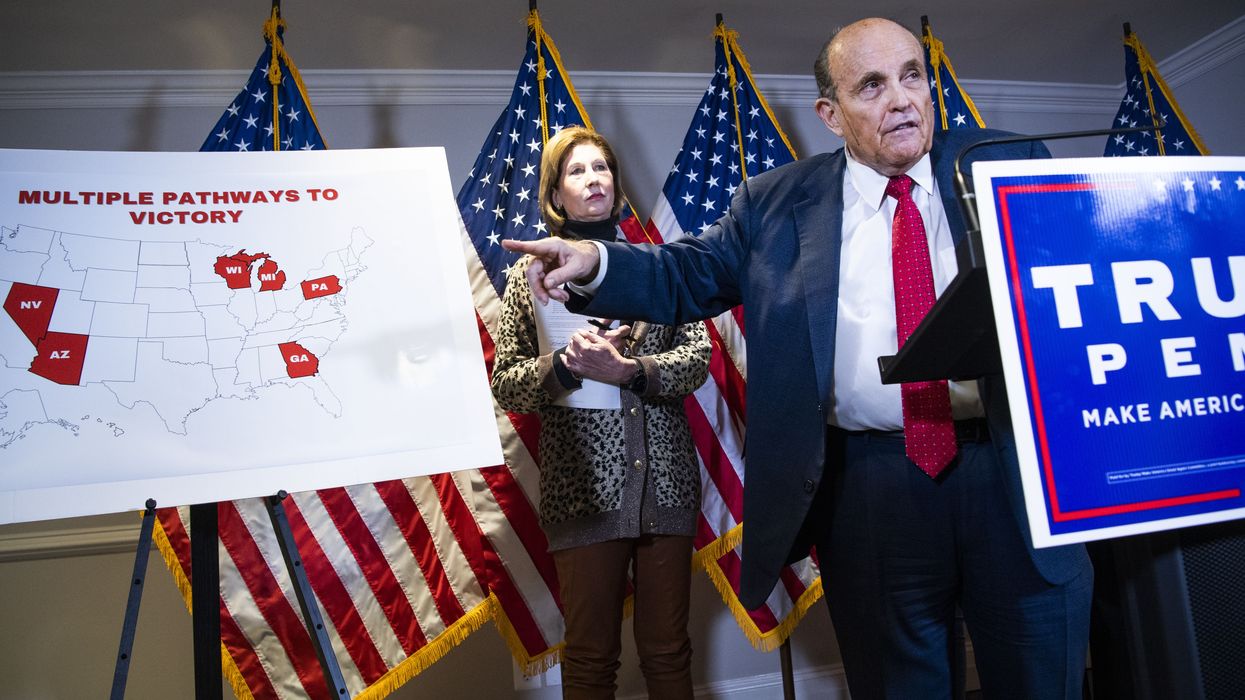
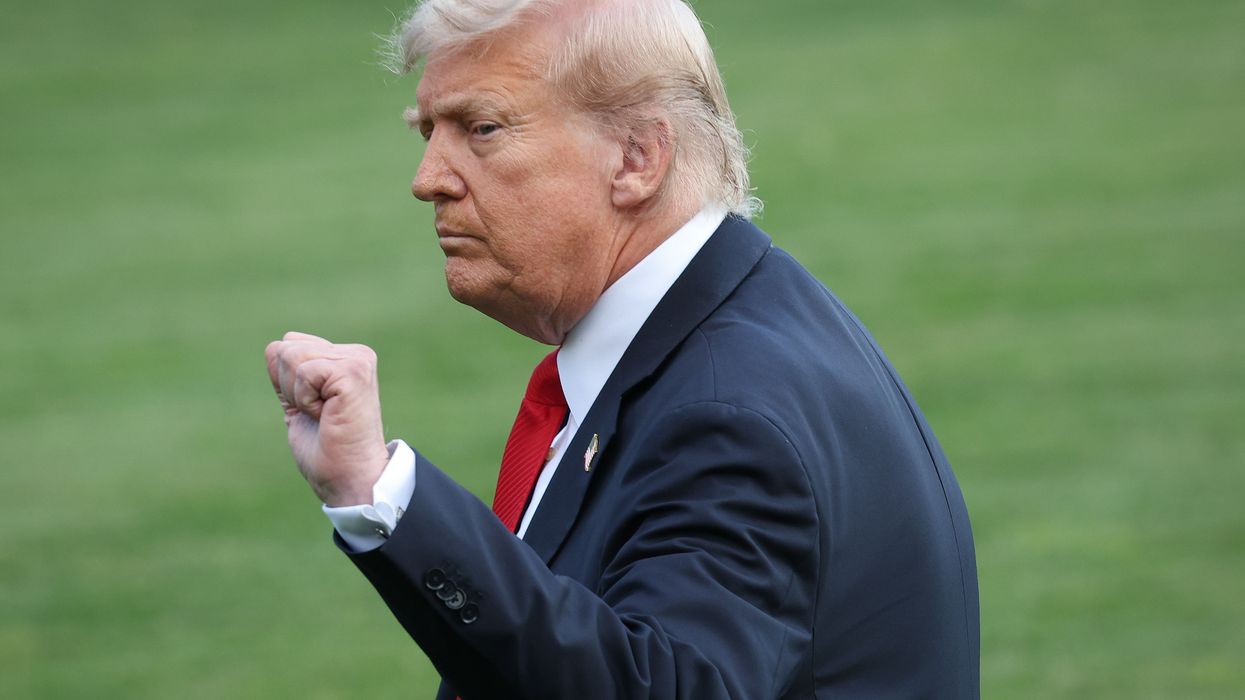
President Donald Trump has given a "full, complete, and unconditional” pardon to a long list of allies who conspired to help him overturn his loss in the 2020 election.
Late Sunday night, Justice Department attorney Ed Martin posted a list of over 70 people who would receive pardons. Many of the figures included were named as unindicted co-conspirators or charged at the state level for their roles in the plot to knowingly spread false claims of widespread voter fraud in an attempt to push states to reject former President Joe Biden's victories in key swing states and pressure Vice President Mike Pence into stopping the certification of the election.
Among those pardoned are Trump lawyers Rudy Giuliani and Sidney Powell, who publicly promoted baseless claims of a vast conspiracy against the president to the public, claiming that the election was stolen by a cabal of foreign infiltrators and scheming election officials. They later faced defamation lawsuits for these claims, and in legal proceedings, Giuliani conceded he made false statements about election workers, while Powell's lawyers argued that "no reasonable person" would conclude her public claims were statements of fact.
Trump also pardoned former chief of staff Mark Meadows, who acted as a facilitator between the president and state officials he attempted to bully into saying he won the election. Aside from the president himself, Meadows was the highest-ranking White House staffer on the phone call in which Trump asked Georgia's Republican Secretary of State Brad Raffensperger to "find" him enough votes to be declared the winner of the election.
Also receiving pardons were attorneys John Eastman and Kenneth Chesebro. They were part of what Pence called Trump's "gaggle of crackpot lawyers," who concocted the tortured legal theory that the vice president could declare Biden's victory in swing states illegitimate and anoint Trump as the winner. Eastman privately admitted to Trump that the scheme was illegal but pressed ahead with it anyway, culminating in the January 6, 2021, insurrection at the US Capitol, during which Trump supporters chanted, "Hang Mike Pence," and tried to stop the election results from being certified.
Also pardoned were several of the right-wing activists who signed documents falsely claiming to be electors from states that had certified the election for Biden.
Crucially, the individuals listed never faced federal criminal indictments for their election subversion attempts. However, dozens of those on the list were charged with crimes in swing states—including Georgia, Arizona, Wisconsin, and Nevada—related to the effort. The pardons mean these officials cannot be indicted at the federal level for these crimes.
Though the pardon list is broad, giving clemency to "all United States citizens for conduct relating to the advice, creation, organization, execution, submission, support, voting activities, participation in or advocacy for or of any slate or proposed slate of presidential electors… as well for any conduct relating to their efforts to expose voting fraud and vulnerabilities in the 2020 presidential election," it explicitly states that it "does not apply" to Trump himself, indicating that his legal team is not yet ready to test the theory that the president can pardon himself.
Still, the language Martin used in the announcement—"No MAGA left behind"—signaled the goal of creating a two-tiered justice system where those who display loyalty to Trump are immune from the law.
"The stated goal of the pardon attorney is to reward the president's political supporters," wrote Matt Gertz, a senior fellow for Media Matters for America on social media.
It coincides with Trump's broader efforts to give get-out-of-jail-free cards to anyone who gives him political support. Immediately after returning to office, he gave blanket pardons to more than 1,500 people who participated in the violent effort to overturn the election on his behalf on January 6. Since then, his Justice Department has moved to fire or suspend those who brought cases against them, even for unrelated crimes.
Simply being a public Trump supporter has often been enough for people to be let off the hook for petty crimes. Florida healthcare executive Paul Walczak, who was convicted of federal tax evasion, reportedly got a pardon after his mother made a substantial donation to Trump's Super PAC. He later gave pardons to reality stars Todd and Julie Chrisley, a pair of vocal supporters, who were convicted of bank and tax fraud. He also pardoned Virginia Sheriff Scott Jenkins, another prominent supporter, who was convicted in a bribery scandal for accepting "cash for badges."
"Pardon attorney Ed Martin explicitly linked the pardons to his 'No MAGA left behind' mantra—tweeting the news in reply to a post that said exactly that," noted senior Lawfare editor Anna Bower. "Ironically, Martin also leads the Weaponization Working Group, which probes alleged 'politicization' of the Justice Department."
Tyson Slocum, an energy policy expert at Public Citizen, warned that these pardons send a clear message to those hoping to help Trump subvert future elections.
"Trump's pardons of Republicans who have committed crimes," he said, "is a setup to encourage state-level Republican election officials to take actions to illegally steal the election, knowing that if they succeed, they'll be pardoned."
"It's a federal strategy to control elections and rig our democracy," said a spokesperson for Fair Fight Action.
Voting rights advocates are raising fears that the Trump administration may attempt to "hijack" the 2026 election after a new report revealed that a top election integrity official suggested invoking a "national emergency" to justify a federal takeover of state-run election processes.
The New York Times reported on Wednesday that during a call in March with right-wing activists, the woman who has since been appointed to President Donald Trump's newly created "election integrity" position within the Department of Homeland Security (DHS) had suggested that the president could declare a "national emergency" to give his government new authority to dictate election rules typically decided by state and local governments.
Heather Honey, formerly a Pennsylvania-based private investigator who came to prominence as a leading proponent of Trump's efforts to overturn his 2020 loss to former President Joe Biden, said this authority would come from "an actual investigation" of the loss, which she has baselessly argued was marred by widespread fraud.
In the US, elections are administered by states, with the president having no legal authority over how they are carried out. But Honey suggested that the Trump administration has "some additional powers that don't exist right now," and that by using the investigation as a pretext, "we can take these other steps without Congress and we can mandate that states do things and so on."
Seeming to recognize the extreme step she was proposing, Honey added: "I don't know if that's really feasible and if the people around the president would let him test that theory."
The 2020 election was subject to numerous state-level recounts and audits and over 60 failed court challenges in state and federal jurisdictions—many of which were dismissed by Republican and Trump-appointed judges for lack of merit and credible evidence.
An investigation by the Associated Press last year found that across the six battleground states Trump claimed were beset by widespread fraud, only 475 individual ballots out of millions of votes cast were flagged by election officials as "potentially" affected by fraud. Even if every single one of the ballots had been proven fraudulent, it would not have been nearly enough to swing the election result in Trump's favor.
Meanwhile, several aides and officials who served Trump during the waning days of his first administration testified before the January 6 commission that the president was well aware he'd lost the election, but continued to push false claims of fraud in an effort to cling to power.
Matt Crane, a former Republican election official who served until earlier this year as a consultant for the Cybersecurity and Infrastructure Security Agency (CISA)—which Trump recently purged of election experts—told the Times that officials who have roposed relitigating the 2020 election "are not coming with an objective frame of mind to say, 'Let's look at the facts and see where that takes us.'"
"They have their destination in mind and cherry-pick facts to help stand up their crazy theories, so there's nothing objective about it," he said.
Last week, the Wall Street Journal reported that the administration had begun this effort to reboot the election fraud narrative, with Trump tapping former campaign lawyer and "Stop the Steal" proponent Kurt Olsen as a "special government employee" tasked with reinvestigating 2020. Olsen has reportedly already begun asking intelligence agencies for information about the 2020 election and has also suggested he wants to purge government employees who are disloyal to Trump.
Trump has also sought to implement many of the proposals from the "US Citizens Elections Bill of Rights," proposed by the Election Integrity Network (EIN), a group of pro-Trump election deniers, of which Honey is a member. The group has become deeply influential during Trump's second term, receiving a briefing from the DHS in June on how a database run by the department can be used to verify the citizenship status of registered voters, according to a report from Democracy Docket.
The group has called for new restrictions on mail-in ballots, early voting, and to make it easier for voter rolls to be scrubbed and for election results to be challenged. Many of these proposals have made it in some form or another into Trump's executive order on elections and the SAVE Act, which Republicans passed through the House earlier this year, that would require all voters to show passports or birth certificates in order to register to vote, which voting rights groups have denounced as a "modern-day poll tax."
As Max Flugrath, the communications director for the voting rights group Fair Fight Action, noted, "Judges have blocked Trump's March executive order on elections—a move courts called an overreach that belongs to the states, not the White House."
"Despite the rulings, Trump allies are pressing ahead," Flugrath said. "The DOJ is collecting massive voter roll data, DHS is pressuring states to upload files, and Honey is spreading false claims and framing the directives as 'best practices.' It's election disinformation rebranded as policy." Those actions, he said, are being urged on by the EIN, which has promoted Trump "pushing the limits of executive power."
Honey is just one of many EIN members with a direct line of communication to Trump.
Trump has also elevated a leading EIN operative, Marcy McCarthy—who also pushed debunked theories of widespread illegal voting in Georgia—to be CISA's director of public affairs.
EIN's founder, Cleta Mitchell, was notably one of the lawyers present on Trump's phone call in January 2021 in which he attempted to pressure Georgia election officials to "find" him enough votes to be declared the winner of the state, which resulted in him being indicted three years later.
On a podcast with a Christian nationalist influencer last month, Mitchell likewise pushed the idea that Trump could use emergency powers to assert control over the election.
"The president's authority is limited in his role with regard to elections except where there is a threat to the national sovereignty of the United States—as I think that we can establish with the porous system that we have," she said.
She seemed to suggest Trump was on board with the idea, saying, "I think maybe the president is thinking that he will exercise some emergency powers to protect the federal elections going forward."
Flugrath said these statements, and those reported by the Times, "should be a five-alarm fire," as they suggest Trump will use past false claims of voter fraud as "a cover to hijack elections" in the future.
He noted that in April, Trump himself seemed to echo EIN's theories of sweeping authority, saying during a speech that "we're gonna get good elections pretty soon" because "the states are just an agent of the federal government."
"Trump is embedding EIN operatives into the government to push his election takeover agenda, all built on lies about his 2020 loss," Flugrath said. "EIN seems to be using a playbook to decimate the independence and fairness of elections: Sow doubt in elections, install loyalists in government, use doubt sowed to push an 'emergency,' and change election rules."
"It's a federal strategy to control elections and rig our democracy," he continued. "Independent elections are the foundation of freedom. If Trump can control our elections, he can dismantle other checks on power. Protecting free, state-run elections is the firewall between democracy and authoritarianism."
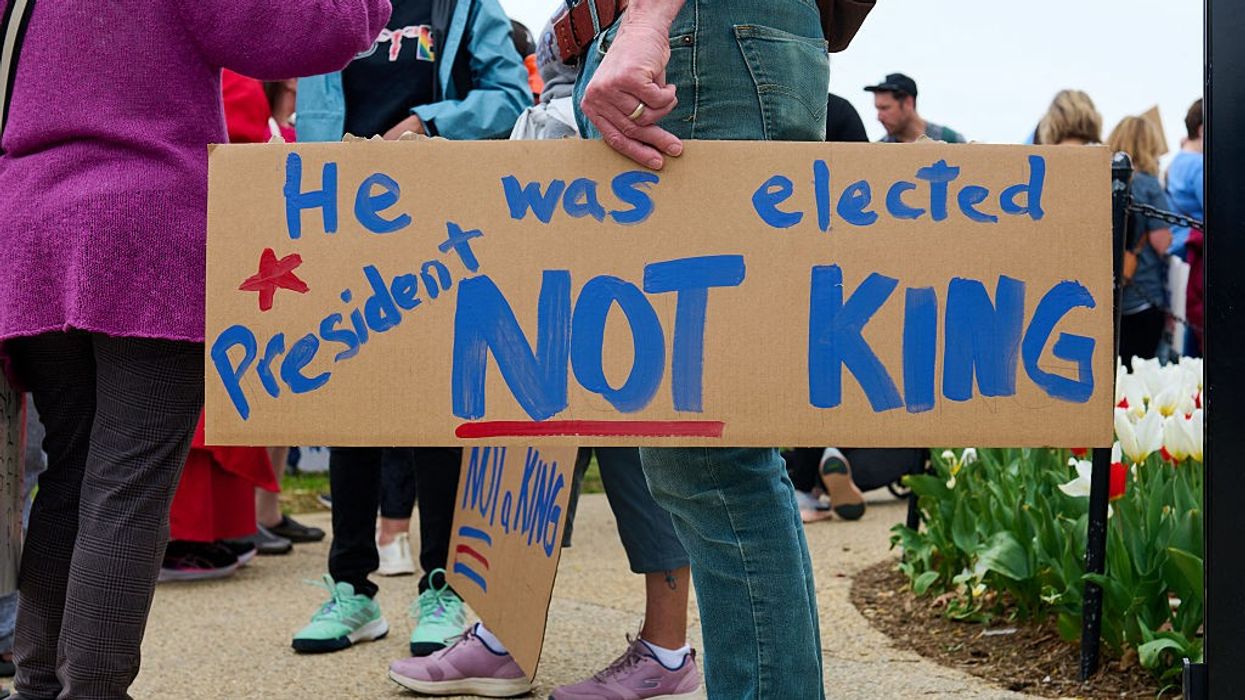
And yet, as he was elected by the people, we need no revolution to overthrow him. What we must do is reclaim democracy for the common good and put back together what the MAGA movement has smashed.
Donald Trump seems to think he is a king.
On June 14, I joined with citizens across the country to loudly declare “No Kings!
At the same time, Trump is not a king. For while he inherited great wealth, he did not inherit the political power he now wields with such cruelty and contempt for the law.
Trump, alas, is the elected President of the United States.
Well over 77 million citizens voted for him, after experiencing his Covid response, his two impeachments, his civil and criminal convictions, and his failed administration. After all that, those millions of our fellow citizens elected him to the highest office in the country for a second time.
As we celebrate this July 4, it is important to emphasize the ways that Trump’s presidency stands as an affront and a danger to those core values of the Declaration that have long animated democratic struggles...
Trump is indeed much more dangerous than any monarch, precisely because he was elected after a multi-year campaign (kings do not campaign) that consisted of angry rhetoric and violent incitement and very clear promises to do exactly what he is now doing, a campaign that generated substantial popular support and even enthusiasm. There is something paradoxical about this: claiming to represent “We the People,” Trump is laying waste to the foundations of the very constitutional democracy that authorizes his power—much like dictators of the past, including Mussolini and Hitler, did a century ago, and Viktor Orban and Recep Tayyip Erdoğan do today.
The U.S. was not a constitutional democracy in 1776. But it became one, over time, because of the struggles of social movements that regarded the Declaration of Independence as “a charter of liberty” and sought to make real its promise—to secure human rights for all, and a government legitimated by popular consent. A nation, as Lincoln famously put it, “dedicated to the proposition that all men are created equal,” and challenged to sustain “government of the people, by the people, and for the people.”
As we celebrate this July 4, it is important to emphasize the ways that Trump’s presidency stands as an affront and a danger to those core values of the Declaration that have long animated democratic struggles—which makes it all the more galling that he continues to insist that he, along with his recently reinstated “1776 Commission,” is its chief defender.
The rhetoric of popular revolt or revolution is misleading precisely because Trump is a democratically elected president and is neither a king nor a dictator—at least not yet.
On June 14, I nodded approvingly as I heard fellow demonstrators rightly invoke the liberatory rhetoric of the Declaration’s Preamble. But I blanched when this line was loudly repeated as a call to action: “whenever any Form of Government becomes destructive of these Ends, it is the Right of the People to alter or to abolish it, and to institute new Government, laying its Foundation on such Principles, and organizing its Powers in such Form, as to them shall seem most likely to effect their Safety and Happiness.”
I bow to no one in my opposition to Trump, and I truly want to see him gone as soon as possible. Given his administration’s rapid-fire assaults on liberal democracy, I fully appreciate the mobilizational power of those “No Kings” appeals to the rhetoric of popular revolt. And it must be stated: those who embrace this rhetoric do so only rhetorically; it is not anywhere accompanied by incitements to violence or calls to insurrection.
At the same time, the rhetoric of popular revolt or revolution is misleading precisely because Trump is a democratically elected president and is neither a king nor a dictator—at least not yet. Trump is what historians call a “conservative revolutionary.” Seeking to destroy the progressive achievements of past decades, and to restore a mythic lost “greatness,” it is he who seeks to alter or abolish the current political system, and it is we who must prevent him from succeeding, by defending constitutional democracy, whatever its deficiencies.
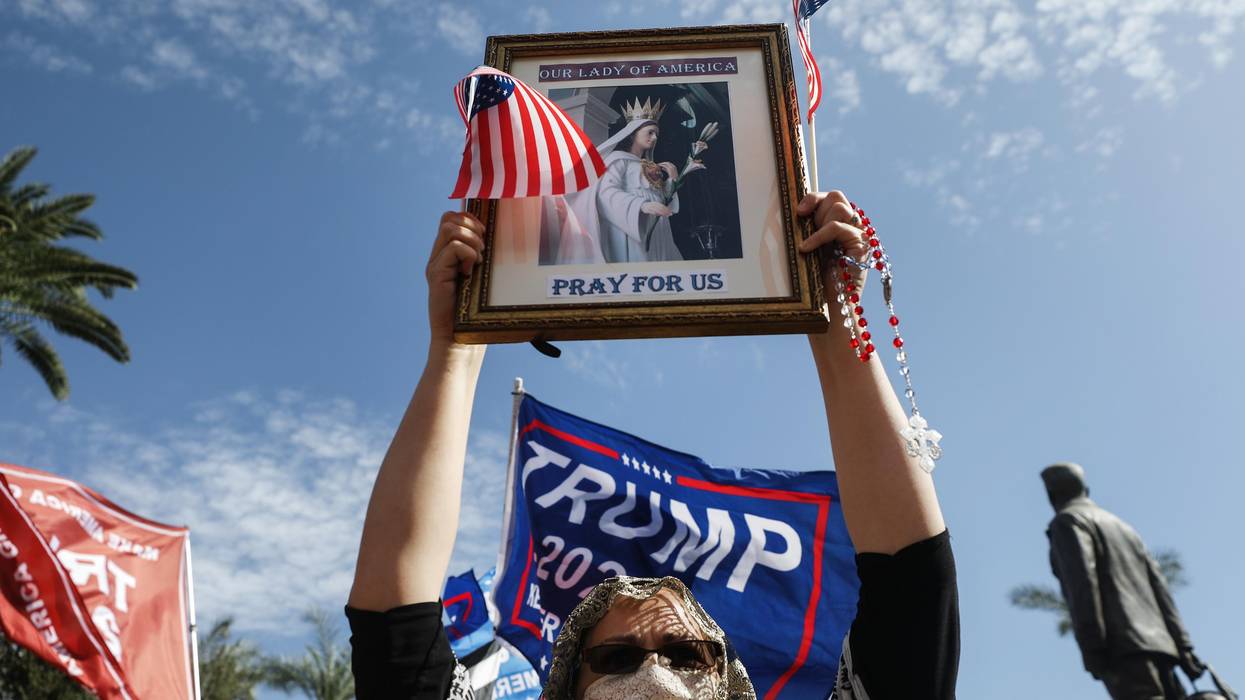
Recall that the January 6, 2021 insurrection was justified as a second American Revolution. On that morning, MAGA Congresswoman Lauren Boebert ttweeted “Today is 1776.” Congressman Jody Hice followed a few hours later, tweeting “this is our 1776 moment.” The rallying cry was heard. And, led by Proud Boys and Three Percenters cosplaying the Minutemen of Lexington and Concord, the “patriotic” mob descended upon the Capitol, doing their part to prevent “Biden the Usurper” from becoming president. Days later, the Philadelphia Inquirer profiled Jim Sinclair, a 38-year-old home restoration contractor from Bensalem, Pennsylvania, who traveled to Washington to participate in the “Stop the Steal” march. “Freedom!!!!!!!” Sinclair posted on Facebook. “It’s 1776, the American people have ears and eyes,” he declared. “We will not accept this fraudulent election.” Politico reported that online social media traffic among extremists in the lead-up to the insurrection frequently alluded to the precedent of 1776.
This is the rhetoric of civil war. And it attacks the fundamental premise of our constitutional democracy—the legitimacy of political contestation.
Also recall that the highbrow conservative luminaries from Hillsdale College and the Claremont Institute who comprised Trump’s “1776 Commission” and revere “The Founding Fathers” either directly supported this insurrection or gave it intellectual cover. The “Stop the Steal” movement that powered Trump’s 2024 victory frequently invoked the “spirit of ’76.” Claiming to represent a “resistance” to the supposedly “totalitarian Biden regime,” MAGA ideologues were quite amenable to extra-legal action in the service of “regime change,” in the event that “the Democrat Party” succeeded in 2024. If you doubt this, take a look at Claremont Institute Fellow Kevin Slack’s 2023 book War on the American Republic: How Liberalism Became Despotism, which floats the idea of a new—and very much armed—American Revolution. Discussing the book in The American Mind, a MAGA journal, Claremont fellow Glenn Ellmers dispassionately discusses “Revolutionary Necessity,” quoting Jefferson on “prudence” and gently urging caution because “the regime” would love to crush a revolution, and “one should embark on a revolution only when there is a reasonable expectation, and plan for, a better arrangement.” In other words, you need to really be sure you can succeed before you try to overthrow the “despotism” of liberal democracy.
This is the rhetoric of civil war. And it attacks the fundamental premise of our constitutional democracy—the legitimacy of political contestation. Trump won the 2024 election. And so, instead of taking to the streets—as they might have done had Trump lost—MAGA ideologues, armed with their own revolutionary manifesto, Project 2025, have taken control of the Executive Branch of the federal government. And they are using it to wage war on legal institutions, universities, immigrants both documented and undocumented, sexual minorities, and political critics of all kinds.
This July Fourth, we ought to recall heroes and heroines of the past—Elizabeth Cady Stanton, Frederick Douglass, Eugene V. Debs, Martin Luther King, Jr., and others—who led the fight to realize a robustly democratic vision of the Declaration. And then, using the hard-won civil and political liberties still at our disposal, we ought to rededicate ourselves to winning back political power democratically, so that, in the words of Lincoln, “government of, by, and for the people shall not perish from the earth.” For if the MAGA agenda succeeds, we can say goodbye to civil rights, civil liberties, and democracy itself. It would be a cruel irony indeed if future July 4 celebrations were to become celebrations of the MAGA illiberalism that warms Donald Trump’s shriveled heart.