SUBSCRIBE TO OUR FREE NEWSLETTER
Daily news & progressive opinion—funded by the people, not the corporations—delivered straight to your inbox.
5
#000000
#FFFFFF
To donate by check, phone, or other method, see our More Ways to Give page.
Daily news & progressive opinion—funded by the people, not the corporations—delivered straight to your inbox.
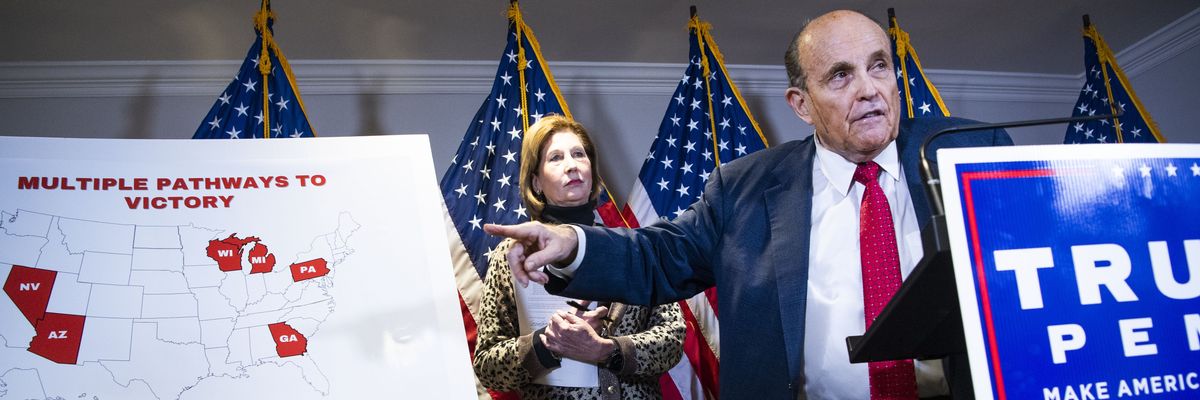
Rudolph Giuliani, attorney for President Donald Trump, conducts a news conference at the Republican National Committee on lawsuits regarding the outcome of the 2020 presidential election on November 19, 2020.
One policy expert warned the move was likely meant to signal to Republican election officials that if they take actions to steal future elections, "they'll be pardoned."
President Donald Trump has given a "full, complete, and unconditional” pardon to a long list of allies who conspired to help him overturn his loss in the 2020 election.
Late Sunday night, Justice Department attorney Ed Martin posted a list of over 70 people who would receive pardons. Many of the figures included were named as unindicted co-conspirators or charged at the state level for their roles in the plot to knowingly spread false claims of widespread voter fraud in an attempt to push states to reject former President Joe Biden's victories in key swing states and pressure Vice President Mike Pence into stopping the certification of the election.
Among those pardoned are Trump lawyers Rudy Giuliani and Sidney Powell, who publicly promoted baseless claims of a vast conspiracy against the president to the public, claiming that the election was stolen by a cabal of foreign infiltrators and scheming election officials. They later faced defamation lawsuits for these claims, and in legal proceedings, Giuliani conceded he made false statements about election workers, while Powell's lawyers argued that "no reasonable person" would conclude her public claims were statements of fact.
Trump also pardoned former chief of staff Mark Meadows, who acted as a facilitator between the president and state officials he attempted to bully into saying he won the election. Aside from the president himself, Meadows was the highest-ranking White House staffer on the phone call in which Trump asked Georgia's Republican Secretary of State Brad Raffensperger to "find" him enough votes to be declared the winner of the election.
Also receiving pardons were attorneys John Eastman and Kenneth Chesebro. They were part of what Pence called Trump's "gaggle of crackpot lawyers," who concocted the tortured legal theory that the vice president could declare Biden's victory in swing states illegitimate and anoint Trump as the winner. Eastman privately admitted to Trump that the scheme was illegal but pressed ahead with it anyway, culminating in the January 6, 2021, insurrection at the US Capitol, during which Trump supporters chanted, "Hang Mike Pence," and tried to stop the election results from being certified.
Also pardoned were several of the right-wing activists who signed documents falsely claiming to be electors from states that had certified the election for Biden.
Crucially, the individuals listed never faced federal criminal indictments for their election subversion attempts. However, dozens of those on the list were charged with crimes in swing states—including Georgia, Arizona, Wisconsin, and Nevada—related to the effort. The pardons mean these officials cannot be indicted at the federal level for these crimes.
Though the pardon list is broad, giving clemency to "all United States citizens for conduct relating to the advice, creation, organization, execution, submission, support, voting activities, participation in or advocacy for or of any slate or proposed slate of presidential electors… as well for any conduct relating to their efforts to expose voting fraud and vulnerabilities in the 2020 presidential election," it explicitly states that it "does not apply" to Trump himself, indicating that his legal team is not yet ready to test the theory that the president can pardon himself.
Still, the language Martin used in the announcement—"No MAGA left behind"—signaled the goal of creating a two-tiered justice system where those who display loyalty to Trump are immune from the law.
"The stated goal of the pardon attorney is to reward the president's political supporters," wrote Matt Gertz, a senior fellow for Media Matters for America on social media.
It coincides with Trump's broader efforts to give get-out-of-jail-free cards to anyone who gives him political support. Immediately after returning to office, he gave blanket pardons to more than 1,500 people who participated in the violent effort to overturn the election on his behalf on January 6. Since then, his Justice Department has moved to fire or suspend those who brought cases against them, even for unrelated crimes.
Simply being a public Trump supporter has often been enough for people to be let off the hook for petty crimes. Florida healthcare executive Paul Walczak, who was convicted of federal tax evasion, reportedly got a pardon after his mother made a substantial donation to Trump's Super PAC. He later gave pardons to reality stars Todd and Julie Chrisley, a pair of vocal supporters, who were convicted of bank and tax fraud. He also pardoned Virginia Sheriff Scott Jenkins, another prominent supporter, who was convicted in a bribery scandal for accepting "cash for badges."
"Pardon attorney Ed Martin explicitly linked the pardons to his 'No MAGA left behind' mantra—tweeting the news in reply to a post that said exactly that," noted senior Lawfare editor Anna Bower. "Ironically, Martin also leads the Weaponization Working Group, which probes alleged 'politicization' of the Justice Department."
Tyson Slocum, an energy policy expert at Public Citizen, warned that these pardons send a clear message to those hoping to help Trump subvert future elections.
"Trump's pardons of Republicans who have committed crimes," he said, "is a setup to encourage state-level Republican election officials to take actions to illegally steal the election, knowing that if they succeed, they'll be pardoned."
Dear Common Dreams reader, It’s been nearly 30 years since I co-founded Common Dreams with my late wife, Lina Newhouser. We had the radical notion that journalism should serve the public good, not corporate profits. It was clear to us from the outset what it would take to build such a project. No paid advertisements. No corporate sponsors. No millionaire publisher telling us what to think or do. Many people said we wouldn't last a year, but we proved those doubters wrong. Together with a tremendous team of journalists and dedicated staff, we built an independent media outlet free from the constraints of profits and corporate control. Our mission has always been simple: To inform. To inspire. To ignite change for the common good. Building Common Dreams was not easy. Our survival was never guaranteed. When you take on the most powerful forces—Wall Street greed, fossil fuel industry destruction, Big Tech lobbyists, and uber-rich oligarchs who have spent billions upon billions rigging the economy and democracy in their favor—the only bulwark you have is supporters who believe in your work. But here’s the urgent message from me today. It's never been this bad out there. And it's never been this hard to keep us going. At the very moment Common Dreams is most needed, the threats we face are intensifying. We need your support now more than ever. We don't accept corporate advertising and never will. We don't have a paywall because we don't think people should be blocked from critical news based on their ability to pay. Everything we do is funded by the donations of readers like you. When everyone does the little they can afford, we are strong. But if that support retreats or dries up, so do we. Will you donate now to make sure Common Dreams not only survives but thrives? —Craig Brown, Co-founder |
President Donald Trump has given a "full, complete, and unconditional” pardon to a long list of allies who conspired to help him overturn his loss in the 2020 election.
Late Sunday night, Justice Department attorney Ed Martin posted a list of over 70 people who would receive pardons. Many of the figures included were named as unindicted co-conspirators or charged at the state level for their roles in the plot to knowingly spread false claims of widespread voter fraud in an attempt to push states to reject former President Joe Biden's victories in key swing states and pressure Vice President Mike Pence into stopping the certification of the election.
Among those pardoned are Trump lawyers Rudy Giuliani and Sidney Powell, who publicly promoted baseless claims of a vast conspiracy against the president to the public, claiming that the election was stolen by a cabal of foreign infiltrators and scheming election officials. They later faced defamation lawsuits for these claims, and in legal proceedings, Giuliani conceded he made false statements about election workers, while Powell's lawyers argued that "no reasonable person" would conclude her public claims were statements of fact.
Trump also pardoned former chief of staff Mark Meadows, who acted as a facilitator between the president and state officials he attempted to bully into saying he won the election. Aside from the president himself, Meadows was the highest-ranking White House staffer on the phone call in which Trump asked Georgia's Republican Secretary of State Brad Raffensperger to "find" him enough votes to be declared the winner of the election.
Also receiving pardons were attorneys John Eastman and Kenneth Chesebro. They were part of what Pence called Trump's "gaggle of crackpot lawyers," who concocted the tortured legal theory that the vice president could declare Biden's victory in swing states illegitimate and anoint Trump as the winner. Eastman privately admitted to Trump that the scheme was illegal but pressed ahead with it anyway, culminating in the January 6, 2021, insurrection at the US Capitol, during which Trump supporters chanted, "Hang Mike Pence," and tried to stop the election results from being certified.
Also pardoned were several of the right-wing activists who signed documents falsely claiming to be electors from states that had certified the election for Biden.
Crucially, the individuals listed never faced federal criminal indictments for their election subversion attempts. However, dozens of those on the list were charged with crimes in swing states—including Georgia, Arizona, Wisconsin, and Nevada—related to the effort. The pardons mean these officials cannot be indicted at the federal level for these crimes.
Though the pardon list is broad, giving clemency to "all United States citizens for conduct relating to the advice, creation, organization, execution, submission, support, voting activities, participation in or advocacy for or of any slate or proposed slate of presidential electors… as well for any conduct relating to their efforts to expose voting fraud and vulnerabilities in the 2020 presidential election," it explicitly states that it "does not apply" to Trump himself, indicating that his legal team is not yet ready to test the theory that the president can pardon himself.
Still, the language Martin used in the announcement—"No MAGA left behind"—signaled the goal of creating a two-tiered justice system where those who display loyalty to Trump are immune from the law.
"The stated goal of the pardon attorney is to reward the president's political supporters," wrote Matt Gertz, a senior fellow for Media Matters for America on social media.
It coincides with Trump's broader efforts to give get-out-of-jail-free cards to anyone who gives him political support. Immediately after returning to office, he gave blanket pardons to more than 1,500 people who participated in the violent effort to overturn the election on his behalf on January 6. Since then, his Justice Department has moved to fire or suspend those who brought cases against them, even for unrelated crimes.
Simply being a public Trump supporter has often been enough for people to be let off the hook for petty crimes. Florida healthcare executive Paul Walczak, who was convicted of federal tax evasion, reportedly got a pardon after his mother made a substantial donation to Trump's Super PAC. He later gave pardons to reality stars Todd and Julie Chrisley, a pair of vocal supporters, who were convicted of bank and tax fraud. He also pardoned Virginia Sheriff Scott Jenkins, another prominent supporter, who was convicted in a bribery scandal for accepting "cash for badges."
"Pardon attorney Ed Martin explicitly linked the pardons to his 'No MAGA left behind' mantra—tweeting the news in reply to a post that said exactly that," noted senior Lawfare editor Anna Bower. "Ironically, Martin also leads the Weaponization Working Group, which probes alleged 'politicization' of the Justice Department."
Tyson Slocum, an energy policy expert at Public Citizen, warned that these pardons send a clear message to those hoping to help Trump subvert future elections.
"Trump's pardons of Republicans who have committed crimes," he said, "is a setup to encourage state-level Republican election officials to take actions to illegally steal the election, knowing that if they succeed, they'll be pardoned."
President Donald Trump has given a "full, complete, and unconditional” pardon to a long list of allies who conspired to help him overturn his loss in the 2020 election.
Late Sunday night, Justice Department attorney Ed Martin posted a list of over 70 people who would receive pardons. Many of the figures included were named as unindicted co-conspirators or charged at the state level for their roles in the plot to knowingly spread false claims of widespread voter fraud in an attempt to push states to reject former President Joe Biden's victories in key swing states and pressure Vice President Mike Pence into stopping the certification of the election.
Among those pardoned are Trump lawyers Rudy Giuliani and Sidney Powell, who publicly promoted baseless claims of a vast conspiracy against the president to the public, claiming that the election was stolen by a cabal of foreign infiltrators and scheming election officials. They later faced defamation lawsuits for these claims, and in legal proceedings, Giuliani conceded he made false statements about election workers, while Powell's lawyers argued that "no reasonable person" would conclude her public claims were statements of fact.
Trump also pardoned former chief of staff Mark Meadows, who acted as a facilitator between the president and state officials he attempted to bully into saying he won the election. Aside from the president himself, Meadows was the highest-ranking White House staffer on the phone call in which Trump asked Georgia's Republican Secretary of State Brad Raffensperger to "find" him enough votes to be declared the winner of the election.
Also receiving pardons were attorneys John Eastman and Kenneth Chesebro. They were part of what Pence called Trump's "gaggle of crackpot lawyers," who concocted the tortured legal theory that the vice president could declare Biden's victory in swing states illegitimate and anoint Trump as the winner. Eastman privately admitted to Trump that the scheme was illegal but pressed ahead with it anyway, culminating in the January 6, 2021, insurrection at the US Capitol, during which Trump supporters chanted, "Hang Mike Pence," and tried to stop the election results from being certified.
Also pardoned were several of the right-wing activists who signed documents falsely claiming to be electors from states that had certified the election for Biden.
Crucially, the individuals listed never faced federal criminal indictments for their election subversion attempts. However, dozens of those on the list were charged with crimes in swing states—including Georgia, Arizona, Wisconsin, and Nevada—related to the effort. The pardons mean these officials cannot be indicted at the federal level for these crimes.
Though the pardon list is broad, giving clemency to "all United States citizens for conduct relating to the advice, creation, organization, execution, submission, support, voting activities, participation in or advocacy for or of any slate or proposed slate of presidential electors… as well for any conduct relating to their efforts to expose voting fraud and vulnerabilities in the 2020 presidential election," it explicitly states that it "does not apply" to Trump himself, indicating that his legal team is not yet ready to test the theory that the president can pardon himself.
Still, the language Martin used in the announcement—"No MAGA left behind"—signaled the goal of creating a two-tiered justice system where those who display loyalty to Trump are immune from the law.
"The stated goal of the pardon attorney is to reward the president's political supporters," wrote Matt Gertz, a senior fellow for Media Matters for America on social media.
It coincides with Trump's broader efforts to give get-out-of-jail-free cards to anyone who gives him political support. Immediately after returning to office, he gave blanket pardons to more than 1,500 people who participated in the violent effort to overturn the election on his behalf on January 6. Since then, his Justice Department has moved to fire or suspend those who brought cases against them, even for unrelated crimes.
Simply being a public Trump supporter has often been enough for people to be let off the hook for petty crimes. Florida healthcare executive Paul Walczak, who was convicted of federal tax evasion, reportedly got a pardon after his mother made a substantial donation to Trump's Super PAC. He later gave pardons to reality stars Todd and Julie Chrisley, a pair of vocal supporters, who were convicted of bank and tax fraud. He also pardoned Virginia Sheriff Scott Jenkins, another prominent supporter, who was convicted in a bribery scandal for accepting "cash for badges."
"Pardon attorney Ed Martin explicitly linked the pardons to his 'No MAGA left behind' mantra—tweeting the news in reply to a post that said exactly that," noted senior Lawfare editor Anna Bower. "Ironically, Martin also leads the Weaponization Working Group, which probes alleged 'politicization' of the Justice Department."
Tyson Slocum, an energy policy expert at Public Citizen, warned that these pardons send a clear message to those hoping to help Trump subvert future elections.
"Trump's pardons of Republicans who have committed crimes," he said, "is a setup to encourage state-level Republican election officials to take actions to illegally steal the election, knowing that if they succeed, they'll be pardoned."