

SUBSCRIBE TO OUR FREE NEWSLETTER
Daily news & progressive opinion—funded by the people, not the corporations—delivered straight to your inbox.
5
#000000
#FFFFFF
To donate by check, phone, or other method, see our More Ways to Give page.
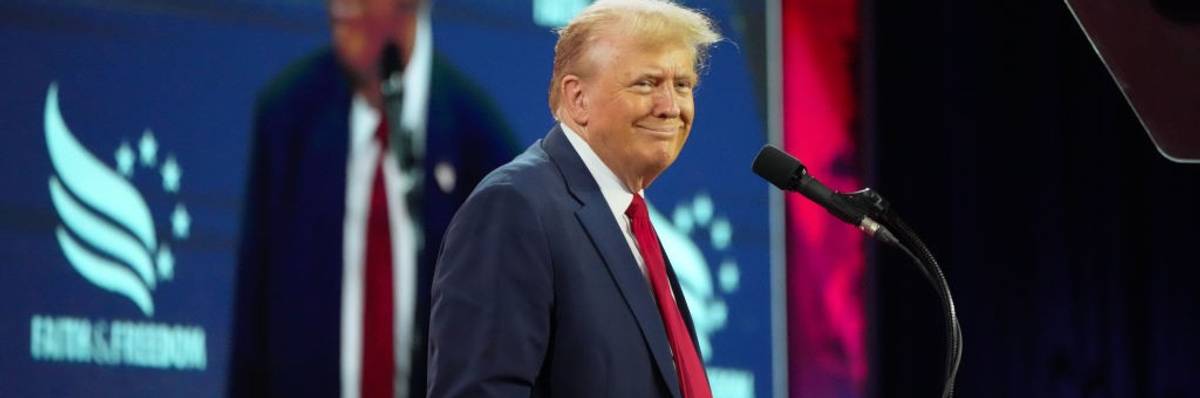
Presumptive Republican nominee Donald Trump on Saturday endorsed the display of the Ten Commandments in schools while speaking at a conference of religious conservatives, raising concerns among progressives of a rising tide of Christian nationalism.
Trump made the comments as keynote speaker at a Faith and Freedom Coalition conference in Washington, D.C., after Louisiana adopted a law this week that requires the display of the Ten Commandments in all public classrooms.
"Has anyone read the 'Thou shalt not steal'?" he said. "They think it's such a bad thing. I mean, has anybody read this incredible stuff? It’s just incredible," Trump said. “They don’t want it to go up. It’s a crazy world."
Louisiana Gov. Jeff Landry, a Republican, signed the bill into law on Wednesday—the first state to enact such a law in recent memory.
The law requires primary, secondary, and postsecondary classrooms to display the commandments in "large, easily readable font" by the start of 2025. The display must also state that the commandments "were a prominent part of American public education for almost three centuries"—a debatable contention.
Rights groups immediately condemned the law, calling it "blatantly unconstitutional" and announcing a planned lawsuit. The U.S. Supreme Court, which could end up with the case, struck down a similar law from Kentucky in 1980, but is now under a conservative super majority.
Supreme Court Justice Samuel Alito was recently called a "crusader for Christian nationalism" by a critic following a series of controversies, including a leaked audio tape in which he said that the country needs to return to being "a place of godliness" and that there were fundamental issues on which no compromise with "the left" could be brooked.
Trump's endorsement of the Ten Commandments law comes as he seeks to sure up evangelical support even though he declined to support a national abortion ban—the next step on the anti-choice agenda. During his speech, he did say, in an apparent effort to placate his audience, that there was "a vital role for the federal government in protecting unborn life." He also implored attendees, "Go and vote, Christians, please!"
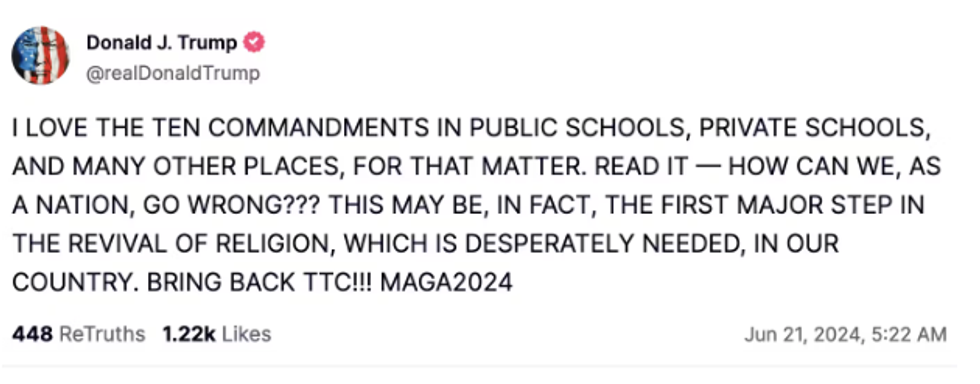
Trump's speech followed a social media post on Friday in which he'd expressed support for the display of the commandments, not just in public schools but other private schools and "many other places."
"This may be, in fact, the first major step in the revival of religion, which is desperately needed in our country," he wrote on Truth Social, which is owned by Trump Media. "Bring back [the Ten Commandments]!!!"
Neither his position on the national abortion ban nor revelations from his personal life have had a noticeable impact on Trump's popularity with evangelicals.
"Somehow, despite his philandering, lying, business fraud, and numerous other violations of the Ten Commandments, he continues to be thought of as a person of faith by 64 percent of Republicans," The New Republic's Hafiz Rashid wrote.
Louisiana's Ten Commandments law is a prime example of Christian nationalism in action, Sarah Jones wrote in New York.
"Christian nationalists are looking to score points against their foes—and win an ideological war in the process," she wrote. "If America is a Christian nation, nobody else truly belongs. Not atheists, not Muslims, not Jews, not even other Christians who disagree with their interpretation of the Bible. That's a lesson Louisiana Republicans hope to impart to Americans as children."
With Trump's success in the Republican primaries and relatively high polling numbers, progressive thinkers have this year ramped up their warnings about the threat that Christian nationalism poses to democracy.
"A society where one set of religious views is imposed on a large number of citizens who disagree with them is not a democracy," Robert Reich wrote in a Common Dreams op-ed in February. "It's a theocracy."
Presumptive Republican nominee Donald Trump on Saturday endorsed the display of the Ten Commandments in schools while speaking at a conference of religious conservatives, raising concerns among progressives of a rising tide of Christian nationalism.
Trump made the comments as keynote speaker at a Faith and Freedom Coalition conference in Washington, D.C., after Louisiana adopted a law this week that requires the display of the Ten Commandments in all public classrooms.
"Has anyone read the 'Thou shalt not steal'?" he said. "They think it's such a bad thing. I mean, has anybody read this incredible stuff? It’s just incredible," Trump said. “They don’t want it to go up. It’s a crazy world."
Louisiana Gov. Jeff Landry, a Republican, signed the bill into law on Wednesday—the first state to enact such a law in recent memory.
The law requires primary, secondary, and postsecondary classrooms to display the commandments in "large, easily readable font" by the start of 2025. The display must also state that the commandments "were a prominent part of American public education for almost three centuries"—a debatable contention.
Rights groups immediately condemned the law, calling it "blatantly unconstitutional" and announcing a planned lawsuit. The U.S. Supreme Court, which could end up with the case, struck down a similar law from Kentucky in 1980, but is now under a conservative super majority.
Supreme Court Justice Samuel Alito was recently called a "crusader for Christian nationalism" by a critic following a series of controversies, including a leaked audio tape in which he said that the country needs to return to being "a place of godliness" and that there were fundamental issues on which no compromise with "the left" could be brooked.
Trump's endorsement of the Ten Commandments law comes as he seeks to sure up evangelical support even though he declined to support a national abortion ban—the next step on the anti-choice agenda. During his speech, he did say, in an apparent effort to placate his audience, that there was "a vital role for the federal government in protecting unborn life." He also implored attendees, "Go and vote, Christians, please!"
Trump's speech followed a social media post on Friday in which he'd expressed support for the display of the commandments, not just in public schools but other private schools and "many other places."
"This may be, in fact, the first major step in the revival of religion, which is desperately needed in our country," he wrote on Truth Social, which is owned by Trump Media. "Bring back [the Ten Commandments]!!!"
Neither his position on the national abortion ban nor revelations from his personal life have had a noticeable impact on Trump's popularity with evangelicals.
"Somehow, despite his philandering, lying, business fraud, and numerous other violations of the Ten Commandments, he continues to be thought of as a person of faith by 64 percent of Republicans," The New Republic's Hafiz Rashid wrote.
Louisiana's Ten Commandments law is a prime example of Christian nationalism in action, Sarah Jones wrote in New York.
"Christian nationalists are looking to score points against their foes—and win an ideological war in the process," she wrote. "If America is a Christian nation, nobody else truly belongs. Not atheists, not Muslims, not Jews, not even other Christians who disagree with their interpretation of the Bible. That's a lesson Louisiana Republicans hope to impart to Americans as children."
With Trump's success in the Republican primaries and relatively high polling numbers, progressive thinkers have this year ramped up their warnings about the threat that Christian nationalism poses to democracy.
"A society where one set of religious views is imposed on a large number of citizens who disagree with them is not a democracy," Robert Reich wrote in a Common Dreams op-ed in February. "It's a theocracy."
Presumptive Republican nominee Donald Trump on Saturday endorsed the display of the Ten Commandments in schools while speaking at a conference of religious conservatives, raising concerns among progressives of a rising tide of Christian nationalism.
Trump made the comments as keynote speaker at a Faith and Freedom Coalition conference in Washington, D.C., after Louisiana adopted a law this week that requires the display of the Ten Commandments in all public classrooms.
"Has anyone read the 'Thou shalt not steal'?" he said. "They think it's such a bad thing. I mean, has anybody read this incredible stuff? It’s just incredible," Trump said. “They don’t want it to go up. It’s a crazy world."
Louisiana Gov. Jeff Landry, a Republican, signed the bill into law on Wednesday—the first state to enact such a law in recent memory.
The law requires primary, secondary, and postsecondary classrooms to display the commandments in "large, easily readable font" by the start of 2025. The display must also state that the commandments "were a prominent part of American public education for almost three centuries"—a debatable contention.
Rights groups immediately condemned the law, calling it "blatantly unconstitutional" and announcing a planned lawsuit. The U.S. Supreme Court, which could end up with the case, struck down a similar law from Kentucky in 1980, but is now under a conservative super majority.
Supreme Court Justice Samuel Alito was recently called a "crusader for Christian nationalism" by a critic following a series of controversies, including a leaked audio tape in which he said that the country needs to return to being "a place of godliness" and that there were fundamental issues on which no compromise with "the left" could be brooked.
Trump's endorsement of the Ten Commandments law comes as he seeks to sure up evangelical support even though he declined to support a national abortion ban—the next step on the anti-choice agenda. During his speech, he did say, in an apparent effort to placate his audience, that there was "a vital role for the federal government in protecting unborn life." He also implored attendees, "Go and vote, Christians, please!"
Trump's speech followed a social media post on Friday in which he'd expressed support for the display of the commandments, not just in public schools but other private schools and "many other places."
"This may be, in fact, the first major step in the revival of religion, which is desperately needed in our country," he wrote on Truth Social, which is owned by Trump Media. "Bring back [the Ten Commandments]!!!"
Neither his position on the national abortion ban nor revelations from his personal life have had a noticeable impact on Trump's popularity with evangelicals.
"Somehow, despite his philandering, lying, business fraud, and numerous other violations of the Ten Commandments, he continues to be thought of as a person of faith by 64 percent of Republicans," The New Republic's Hafiz Rashid wrote.
Louisiana's Ten Commandments law is a prime example of Christian nationalism in action, Sarah Jones wrote in New York.
"Christian nationalists are looking to score points against their foes—and win an ideological war in the process," she wrote. "If America is a Christian nation, nobody else truly belongs. Not atheists, not Muslims, not Jews, not even other Christians who disagree with their interpretation of the Bible. That's a lesson Louisiana Republicans hope to impart to Americans as children."
With Trump's success in the Republican primaries and relatively high polling numbers, progressive thinkers have this year ramped up their warnings about the threat that Christian nationalism poses to democracy.
"A society where one set of religious views is imposed on a large number of citizens who disagree with them is not a democracy," Robert Reich wrote in a Common Dreams op-ed in February. "It's a theocracy."

