
SUBSCRIBE TO OUR FREE NEWSLETTER
Daily news & progressive opinion—funded by the people, not the corporations—delivered straight to your inbox.
5
#000000
#FFFFFF
To donate by check, phone, or other method, see our More Ways to Give page.


Daily news & progressive opinion—funded by the people, not the corporations—delivered straight to your inbox.
The BBC has long been accused of centering Israel and dismissing the humanity of Palestinians in its coverage of Gaza.
British journalist Owen Jones on Thursday celebrated a UK High Court judge's ruling in his favor in a libel lawsuit that a BBC editor brought against him—and said that should the editor choose to move forward with his case despite the decision, he was looking forward "to defending my article in court."
The High Court ruled that Jones was expressing an opinion when he wrote an article for Drop Site News in December 2024 titled "The BBC's Civil War Over Gaza," in which he spoke to BBC staffers about Middle East online editor Raffi Berg's influence over the news outlet's coverage of Israel and Palestine.
The court also said Jones had expressed his opinion and that of his sources based on concrete examples of Berg's editorial role and journalism.
Jones' article described staffers' allegations that "internal complaints about how the BBC covers Gaza have been repeatedly brushed aside" as Berg "sets the tone" for the outlet's online coverage of Israel's onslaught in the exclave, where more than 75,000 Palestinians have been killed since October 2023 in what's been called a genocide by top Holocaust scholars and human rights groups.
It noted that the BBC failed to report on Amnesty International's finding that Israel was committing genocide in Gaza and displayed an on-screen chyron reading, "Israel rejects 'fabricated' claims of genocide.'"
"Journalists expressed concerns over bias in the shaping of the Middle East index of the BBC news website," wrote Jones. "Several allege that Berg 'micromanages' this section, ensuring that it fails to uphold impartiality."
The BBC has long been criticized for centering Israel and "dehumanizing" Palestinians, as more than 1,000 artists said in a letter last year when they condemned the network for refusing to air a documentary about the impact of Israel's attacks on children in Gaza, on the grounds that it featured the child of the exclave's deputy minister of agriculture—suggesting "that Palestinians holding administrative roles are inherently complicit in violence."
The article also pointed to Berg's own history of pro-Israel coverage, including a 2002 story "that presented young [Israel Defense Forces] soldiers as courageous defenders of their country while failing to mention the occupation and settlement of Palestinian land or the widespread allegations of crimes" documented by human rights groups and the US government.
Berg also presented Israeli settlers in the West Bank as "victims seeking 'a better quality of life' and did not mention the fact that the settlements have been repeatedly deemed illegal," and wrote about the Mossad "in glowing terms" in a book he wrote with extensive cooperation from the Israeli intelligence agency.
He also posted a photo on social media showing Prime Minister Benjamin Netanyahu with a copy of Berg's book on his bookshelf, Jones reported.
Berg's lawyer said last year that Jones' reporting attacked Berg's "professional reputation as a journalist and editor," and led to death threats.
In order for his case against Jones to proceed, Berg would now need to prove in court that "Jones did not genuinely hold the opinion he expressed in his reporting, or demonstrate that the opinion is not one an honest person could hold on the basis of any fact that existed at the time of its publication," Middle East Eye reported.
"I am proud to stand by my journalism," said Jones Thursday.
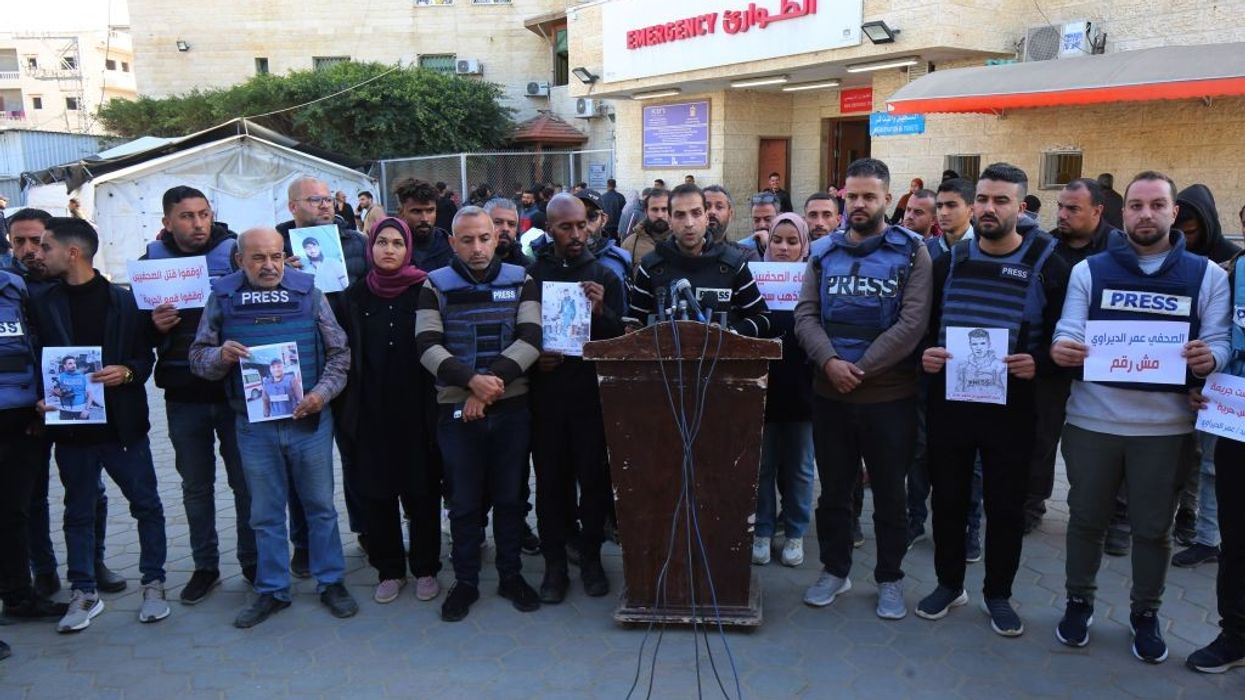
"We have been let down by the international community, particularly the international media organizations," said Abubaker Abed, sharing a message from Palestinian journalists.
Palestinian journalists gathered outside al-Aqsa Martyrs Hospital in Deir al-Balah this week to call attention to Israeli forces' genocidal assault on the Gaza Strip, their slaughter of those reporting on the ground, and the global community's failure to hold Israel accountable for the bloodshed.
On Thursday, the day after the event, Abubaker Abed, a Palestinian sports journalist now covering Israel's war on Gaza, shared on social media a short video of his remarks in English, which he said were delivered on behalf of all the reporters in blue vests who surrounded him and the podium.
Since the Hamas-led October 7, 2023 attack on Israel, Palestinian reporters across Gaza have covered what Abed called "the most well-documented and first livestreamed genocide in history," as Israel—armed by the United States—has launched airstrikes and ground raids, and stopped humanitarian aid and international media from entering the coastal enclave.
Abed said that "we've been reporting tirelessly, extensively, and thoroughly on this genocide. It's indeed a genocide against us, which we've been documenting in makeshift tented camps and workplaces... You've seen us shedding tears over our loved ones, colleagues, friends, and family members. You've seen us killed in every possible way. We've been immolated, incinerated, dismembered, and disemboweled—and recently, we've been freezing to death."
"What more ways should you be seeing us killed, then, so that you can move and act and stop the hell inflicted upon us? There are no words to describe what we've been going through, because you've seen our bodies, how they've become fragile, skinny, and fatigued, but we never stopped," he continued, highlighting how Palestinian journalists have worked "to help the population that has seen every sort of torture and tasted every type of death," while the world has refused to "stop Israel's impunity against us."
"Our message is very clear: We are journalists, and we are Palestinian journalists. We have been let down by the international community, particularly the international media organizations," Abed declared. "We haven't seen any sort of support—a single word of support. Even the press vests we're wearing right now mark us as a target. They do not protect us at all, because we are Palestinians. Maybe if we were Ukrainians or of any other citizenship, with blond hair and blue eyes, the world would rage and rant for us. But because we are Palestinians, we have only one right, which is to die and be maimed."
"We are just documenting a genocide against us," he concluded. "After almost a year and a half, we want you to stand foot-by-foot with us, because we are like any other journalists, reporters, and media workers all across the globe—no matter the origin, the color, or the race. Journalism is not a crime. We are not a target."
Some journalists around the world reposted Abed's video and called out their colleagues for ignoring Israel's decimation of Gaza or reporting on it in ways favorable to the far-right Israeli government and its supporters, including the United States.
"The past 15+ months have been one of the most shameful periods in the history of Western journalism,"
said Jeremy Scahill, co-founder of Drop Site News, which has published Abed's reporting from Gaza. "The refusal of so many journalists to speak out in defense of our Palestinian colleagues in Gaza as they and their families have been hunted down and killed is a bloody stain."
The New Yorker editor Erin Overbey similarly said that "the staggering silence of Western journalists this past year as their Palestinian colleagues have been targeted, intimidated, and killed by Israeli forces during the genocide in Gaza will go down as one of the most shameful periods in media/journalism and human rights history."
British writer Owen Jones
said: "How to describe the refusal of Western journalists to speak out about the biggest slaughter of journalists in the history of human civilization? Damning. Racist. Nauseating. You will never be forgiven. History will damn those who stayed silent—every last fucking one."
Hamza Yusuf, a London-based British Palestinian writer, said that "we will never forget that whilst Palestinian journalists in Gaza were being systematically slaughtered by Israel, their industry peers at best looked on with indifference and at worst used their positions and their coverage to whitewash Israel's crimes. Blood on their hands."
As of Thursday, health officials in Gaza put the death toll from Israel's 15-month assault at 46,006, with at least 109,378 other Palestinians wounded, the vast majority of the enclave's population displaced, and civilian infrastructure in ruins. Israel faces global accusations of genocide, including in a case at the International Court of Justice.
Figures for press deaths have varied. The International Federation of Journalists—which works with its affiliate, the Palestinian Journalists' Syndicate, to verify information—has documented the killings of 148 Palestinian media workers while the Committee to Protect Journalists has a list of 152 confirmed fatalities, at least 13 of which the group classifies as murders by Israeli forces.
At the end of last year, Al Jazeera published a long-form article titled "Know Their Names" and reported that "from October 7, 2023, to December 25, 2024, at least 217 journalists and media workers had been killed in Gaza. Five more were killed on December 26 when an Israeli airstrike targeted a news van near al-Awda Hospital."
"Eighty percent of the journalists and media workers killed were between the ages of 20 and 40, a stark statistic that captures the young age of those who risk their lives to document the conflict," according to
Al Jazeera. "They were reporters and writers, photographers and video directors, analysts and editors, sound engineers and voiceover artists, and even founders of media outlets. Their stories remind us of the heavy price paid by those who strive to document humanity's darkest moments."
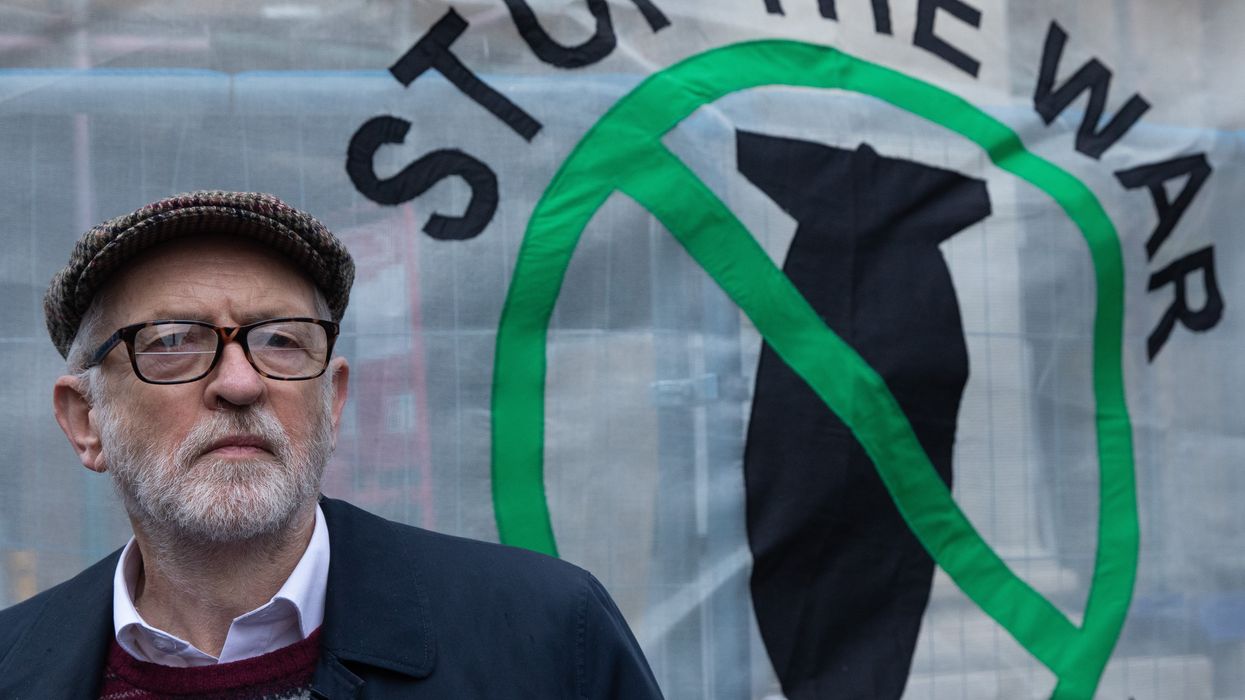
"Blocking Jeremy Corbyn from standing as a Labour candidate is an affront to decency and a declaration of civil war within a party about to metamorphose from a broad church to a toxic sect," said Yanis Varoufakis.
Former U.K. Labour Leader Jeremy Corbyn is expected to seek reelection as an independent next year after current Leader Keir Starmer and his establishment allies on Tuesday made good on their pledge to formally block the leftist member of Parliament from running under the party's banner.
After Starmer publicly declared last month that "Jeremy Corbyn will not stand as a Labour candidate at the next general election," the party's National Executive Committee (NEC) voted 22-12 on Starmer's motion to not endorse Corbyn's candidacy.
The Times reported that Corbyn's allies say the MP has already decided to run as an independent, with one source telling the London newspaper: "It's become personal. There will be an announcement by the end of the week."
Our message is clear: We are not going anywhere. Neither is our determination to stand up for a better world.
Corbyn has represented the Greater London constituency Islington North for four decades and served as an independent MP since he was suspended from Labour in 2020 due to a battle over allegations of antisemitism in the party.
After news broke of Starmer's motion on Monday, Corbyn charged that the party leader "has broken his commitment to respect the rights of Labour members and denigrated the democratic foundation of the party."
Noting that Islington North voters have elected him as a Labour MP 10 consecutive times since 1983, Corbyn said that "I am proud to represent a community that supports vulnerable people, joins workers on the picket line, and fights for transformative change."
Also calling out the ruling Conservative Party, Corbyn continued:
This latest move represents a leadership increasingly unwilling to offer solutions that meet the scale of the crises facing us all. As the government plunges millions into poverty and demonizes refugees, Keir Starmer has focused his opposition on those demanding a more progressive and humane alternative.
I joined the Labour Party when I was 16 years old because, like millions of others, I believed in a redistribution of wealth and power. Our message is clear: We are not going anywhere. Neither is our determination to stand up for a better world.
Some other MPs, constituents, journalists, and leftists from around the world have, since Monday, blasted Starmer's "disgraceful" move and expressed solidarity with Corbyn.
Greek leftist MP Yanis Varoufakis warned that "Starmer's Labour Party is close to the point of no return. Blocking Jeremy Corbyn from standing as a Labour candidate is an affront to decency and a declaration of civil war within a party about to metamorphose from a broad church to a toxic sect."
Critics have highlighted that in February 2020, Starmer said: "The selections for Labour candidates needs to be more democratic and we should end NEC impositions of candidates. Local party members should select their candidates for every election."
In a joint statement Tuesday, officers from the Islington North Constituency Labour Party (CLP) denounced the move by Starmer and the NEC.
"We believe in the democratic right of all constituency parties to choose their prospective parliamentary candidate," the CLP leaders from Corbyn's area said. "Therefore, we reject the NEC's undue interference in Islington North, which undermines our goal of defeating the Conservatives and working with our communities for social justice."
Noting the CLP's statement in a series of tweets Tuesday, Guardian columnist Owen Jones, who identifies as a socialist and a longtime Labour voter, also took aim at Starmer:
While Starmer was seeking his leadership role, "I think he said a lot of things he didn't believe at all, because he thought that if he didn't, then he wouldn't be elected leader of the Labour Party. And he was absolutely right in that calculation," Jones asserted.
"A lot of Starmer's cheerleaders see themselves as upstanding liberals who believe in decency, honesty, and integrity in politics. They don't," he said. "They disregard the colossal deceit of Starmer because they hate the left, and they believe anything done to crush the left is a good thing."
"Anyway, I don't think it will end well for a Labour leadership which is founded on a load of lies, essentially believes in nothing, and is ahead in the polls solely because of Tory self-destruction," Jones added. "They'll win the election by default, then political reality will intrude."
The grassroots group Momentum, which has supported Corbyn since his successful 2015 campaign to lead the Labour Party, called Tuesday "a dark day for democracy."
While there was previously no appeals process for anyone blocked by the NEC, Sky News revealed Tuesday as the party faces "accusations of fixing parliamentary selections for candidates who are preferred by the leadership," those "who wish to stand for Labour at the next election will be given the right to appeal if the party rejects their bid to become an MP."
According to the outlet, "Candidates will be provided with written feedback as to why they 'fell below the standards expected of a Westminster parliamentary candidate,' while an appeals panel will be convened to hear the claim."
Welcoming the development on Twitter, Momentum said that "socialists and trade unionists have been wrongly excluded in favor of those favored by a narrow London clique. The result has been a cohort of prospective MPs dominated by the professional political classes, making Labour less representative of the communities we seek to serve."
"This new process should mark an end to the Labour right's factional abuses of selections process," the group added. "In Islington North as everywhere else—let local members decide."
"So now the Tories are going to slash your already shredded local services because they crashed the economy because they want to cut the taxes of the top 1%."
"What was intended as mere bribery has turned out to be a gigantic financial bomb."
That's how socialist Guardian columnist Owen Jones on Wednesday summarized the recent revelations about U.K. Prime Minister Liz Truss and other Conservative leaders' fiscal policies.
Following reports that U.K. Chief Secretary to the Treasury Chris Philp will send letters asking government departments to identify potential "savings," the Tory confirmed on television Wednesday that they are being asked to "look for efficiencies wherever they can find them."
The push to cut public spending came as The Guardian revealed Wednesday the National Health Service (NHS)--the U.K.'s publicly funded healthcare system--has admitted that "dangerous roofs that could collapse at any time at hospitals across England will not be fixed until 2035."
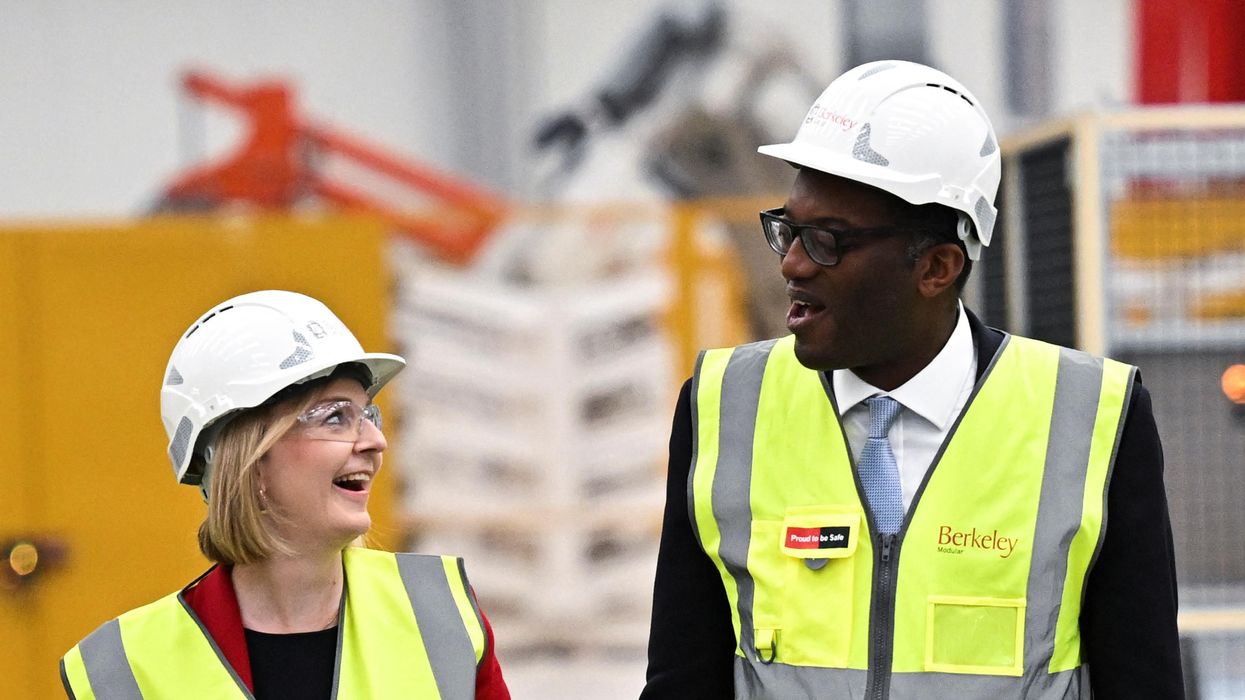
That admission came in response to a request from Liberal Democrats, whose health spokesperson and deputy leader, Daisy Cooper, took aim at Chancellor of the Exchequer Kwasi Kwarteng's "mini-budget," which was unveiled last Friday and includes major tax cuts for the rich, funded by extra borrowing.
"Kwasi Kwarteng's first budget prioritized slashing taxes on the big banks over fixing crumbling hospitals. There was a deafening silence from government on how it intends to deal with dangerous ambulance wait times or lack of local NHS dentists, let alone buildings at risk of collapse," Cooper told the newspaper. "This is a disaster waiting to happen and Conservative ministers just don't seem to care."
The tax plan--which caused the pound to fall to its lowest level against the U.S. dollar in nearly four decades and ultimately led to emergency action by the Bank of England to calm the markets--has been criticized across the British political spectrum and around the world, including by the credit agency Moody's.
Even Tory members of Parliament are voicing concerns. BBC reports:
Few Conservative MPs are commenting publicly about Chancellor Kwasi Kwarteng's handling of the economic turmoil sparked by his mini-budget--but they are not mincing their words in off-the-record conversations.
Inept, humiliating, naive, and reckless are just some of the words that have cropped up.
Perhaps most notably, the International Monetary Fund (IMF), known worldwide as "a bastion of free market economics and fiscal austerity," on Tuesday delivered a rare critique of the policy--which Guardian economics editor Larry Elliott called "a global embarrassment for Truss and Kwarteng."
The mini-budget "will likely increase inequality," the IMF warned, adding that the next full budget announcement--which Kwarteng is expected to outline in November--gives the U.K. government "an early opportunity... to consider ways to provide support that is more targeted and re-evaluate the tax measures, especially those that benefit high-income earners."
Nick Dearden, director of the U.K.-based group Global Justice Now, tweeted Tuesday, "When the IMF tells you, 'hang on guys, this is going to be so bad for inequality it needs a rethink,' you've got a serious problem."
Economist and former Greek Finance Minister Yanis Varoufakis said the IMF and the U.S. Federal Reserve are concerned the United Kingdom "may trigger a financial crisis" by doing to the United States and other wealthy nations what "Greece did to the Eurozone."
"The particular focus of the concern... is the impact that the destabilization of the markets in Britain will have on the U.S. treasuries, in other words on the public debt of the United States," he said. "Because that kind of domino effect would have quite severe repercussions for the whole world."
Keir Starmer, the Labour leader, said during a BBC radio interview Wednesday that Truss must urgently review the budget following "very serious" criticism from the IMF, noting concerns that November would be too late.
According to Starmer, Truss needs to explain: "How are you going to fix the problems that you caused ...on Friday? The government caused this on the theory, the ideology that the way we fix our country is to make the rich richer."
Other critics also delivered broader rebukes of Truss-aligned ideology, with some going as far back as former Conservative U.K. Prime Minister Margaret Thatcher.
"September 2022 will forever be remembered as the month in which the febrile fantasies of neoliberalism ran full-tilt into reality," said Guardian columnist and author George Monbiot.
Referencing a London road that's home to various think tanks, one Twitter user dubbed this September "the month of the Tufton Street Massacre." Monbiot concurred.
"This catastrophe isn't all on Truss and Kwarteng," Jones stressed Wednesday.
"This is the logical end point of a 43-year-long Thatcherite experiment--brought to us by Tory MPs, right-wing newspapers, and think tanks--which has brought nothing but stagnation, economic turmoil, and mass insecurity," he continued.
Summarizing the chaos since last week, Guardian columnist and and senior economics commentator Aditya Chakrabortty wrote Wednesday:
What was intended as mere bribery has turned out to be a gigantic financial bomb. The pound dived so far that it won a new name: shitcoin. (One wag mused on Reddit: "Apparently britbongs use it to purchase crumpets and tea, but other than that doesn't have any usage.") Lending rates in the markets soared, so Halifax and other big mortgage firms had to pull some of their products. The Bank of England essentially lost control over interest rates, while pension funds and other investors began scrabbling around for cash. Finally, today, the bank started buying government bonds in a bid to quell panic.
A week is a long time in financial wreckage. Thanks to Kwarteng and Truss, you have just got a lot poorer. If you're a homeowner on a standard variable mortgage or looking to renew, your bills have spiraled. If you have a money-purchase pension or a nest-egg ISA, you probably don't want to check your balance. Prices for pretty much anything from overseas--from food to T-shirts to cars--have just gone up.
Institutionally, the Treasury's credibility has been ruined and the Bank of England's monetary policy destroyed.
"This is their crisis, not ours," Chakrabortty concluded of the Conservatives. "You didn't benefit from these big tax cuts, the Tory donors did. Truss can reverse her stupid, cynical budget, resign, and force a general election--and Labour should demand she does so."
Meanwhile, Tory leadership is showing no sign of reconsidering its path, with Financial Secretary to the Treasury Andrew Griffith claiming Wednesday that the proposals were the "right plans" for the U.K.'s economy--despite the mounting evidence to the contrary.
As U.K. Conservatives doubled down on their controversial policies, a coalition of civil society groups launched the End Austerity campaign and warned that next year, 85% of the global population is set to live under "deadly" measures, from cuts to social programs to privatization of public services.
"This austerity recipe has been tried and failed many times," the campaign's website says, "and only inflicted hardship and pain on populations all over the world, supercharging the inequality crisis."
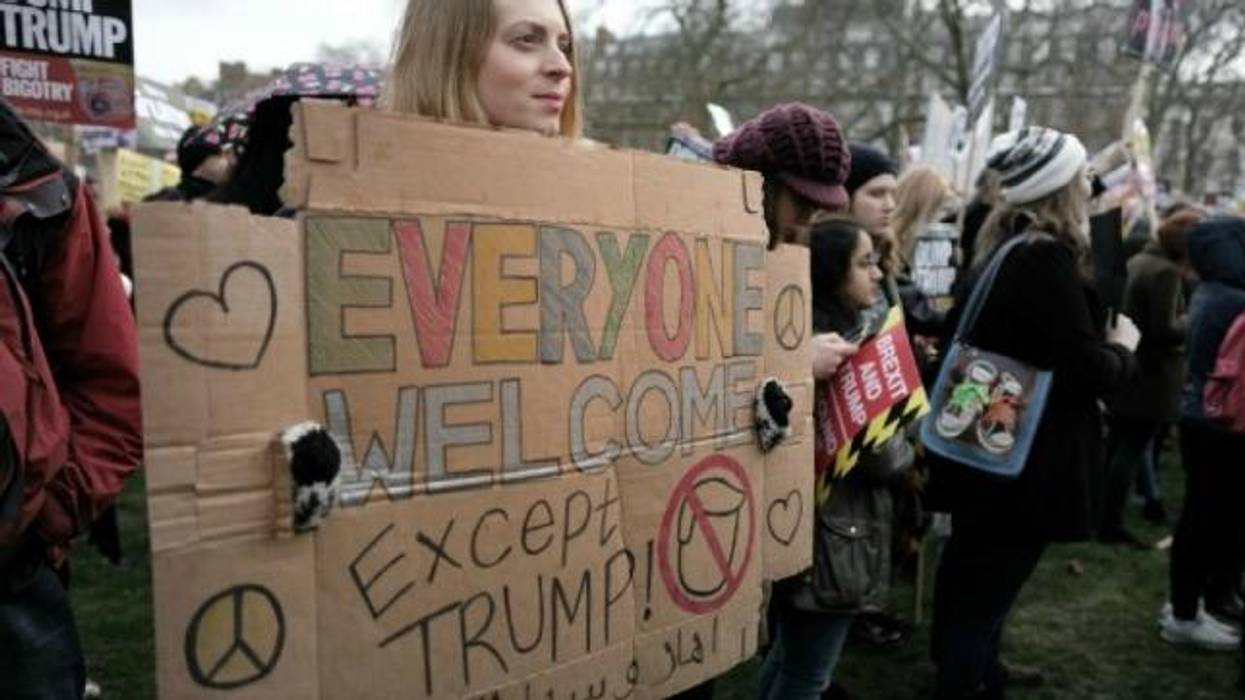
Amid reports that President Donald Trump may make an unscheduled visit to Downing Street in the coming weeks, protesters in the U.K. are saying--that "whenever and however" the U.S. president arrives--they will be ready to take to the streets.
The president is set to visit Poland Thursday, ahead of the G20 summit in Hamburg, Germany, this weekend. He will also visit France for Bastille Day on July 14. U.K. government sources confirmed they had been warned the president could also visit Turnberry, his golf resort in Scotland.
"There is a window of opportunity for the president to visit Britain when he is in Europe later this month," a government source told the U.K.'s Sunday Times. "It is likely it will be hastily arranged and it is possible no official confirmation of his visit will be given until at least 24 hours before to stop any large-scale protests against his visit from being mobilised."
But time constraints aren't deterring anti-Trump organizing efforts in London and across the United Kingdom.
Guardian columnist and Stop Trump coalition co-founder Owen Jones urged his Twitter followers to "commit to protesting this bigot at short notice," adding "any visit by Donald Trump on British soil will be met by nationwide mass protests."
"This month's visit, if it happens, is a way of him sneaking in the backdoor in the hope that he can save face for himself and May. But we'll oppose him whenever and however he comes to the U.K.," said Nick Dearden, director of Global Justice Now, a Stop Trump coalition member. "We won't allow Trump's presidency to be normalised, and we'll make sure Theresa May pays a political cost for supporting Trump and his politics of hate."
A spokesman for Prime Minister Theresa May said Monday the U.K. government was not aware of any plans for Trump's potential visit, and declined to comment on whether May would meet with Trump if he makes a surprise stop in London.
"We expect him to go to his golf course. We are aware he might want to see the Prime Minister," a government source told the U.K.'s Daily Express. "The Americans haven't requested that he comes and we haven't invited him, but we aware it might happen."
May invited Trump to the U.K. when, in January, she became the first foreign leader to visit the White House during this administration. The U.K.'s Sun reported in February that Trump and May had agreed to delay his visit to avoid large-scale demonstrations, with a U.K. government source telling the paper, "Trump still really wants to come this year, but he wants the heat to die down a bit first."
Last month, just after the U.K. general election, an official state visit was postponed because fears of mass protests persisted, which Dearden called "an incredible victory." Trump had told May in a phone-call that he would hold off on an official visit until he had the support of the British people, according to the Guardian.
Before the June visit was postponed, some Brits had planned to greet the president by mooning him, and circulated the #ShowYourRumpToTrump social media campaign.
The White House has denied today's reports of an unofficial visit, with White House press secretary Sean Spicer telling the Financial Times, "While he looks forward to visiting the U.K., it will not be in the next two weeks."
Speaking with the Guardian's Owen Jones in London on Monday night, Canadian author and activist Naomi Klein continued to broadcast the message of her new book, This Changes Everything, by arguing that the anti-fracking movement that has taken hold in the United Kingdom is a prime example of people rising up against the fossil fuel industry in ways that were once unheard of. Though these fights are always grounded in the particulars of local politics and dynamics, Klein says, they also share common bonds that are turning otherwise singular battles into a unified global movement.
"The movement against fracking has been heroic," Klein said. "People get involved in fighting fracking not because of climate change but because they're worried about their water. Water is what unites so many of these movements, whether it's against tar sands, pipelines or fracking, coal mining, it's water and love of place."
Klein said the power of the global climate justice movement is not only the number of people involved, but about the movement's inherent and growing diversity. Asked about the recent People's Climate March in New York City, which drew more than 400,000 people to the streets ahead of the UN Climate Summit in September, she said: "To me, it was not just the size of it, this march had a quality to it that I'd never seen at a mass environmental demonstration."
To the applause of the crowd, Klein continued, "I think we need to be very clear about this - the only way you can win against forces with a huge amount to lose is to build a movement of people, many more people, with a huge amount to gain."
From saving our local natural resources to fighting back against what she called the "brutal logic of austerity," Klein said the crisis of climate change is offering new ways to organize against the existing neoliberal order that is ravaging our economies and democracies, our ecological systems, and the places where people live.
"Climate is the big tent we've been waiting for, and why wouldn't it be," she said. "The atmosphere is the biggest tent of all, we're all under it and we need to start acting like it."