

SUBSCRIBE TO OUR FREE NEWSLETTER
Daily news & progressive opinion—funded by the people, not the corporations—delivered straight to your inbox.
5
#000000
#FFFFFF
To donate by check, phone, or other method, see our More Ways to Give page.
Daily news & progressive opinion—funded by the people, not the corporations—delivered straight to your inbox.
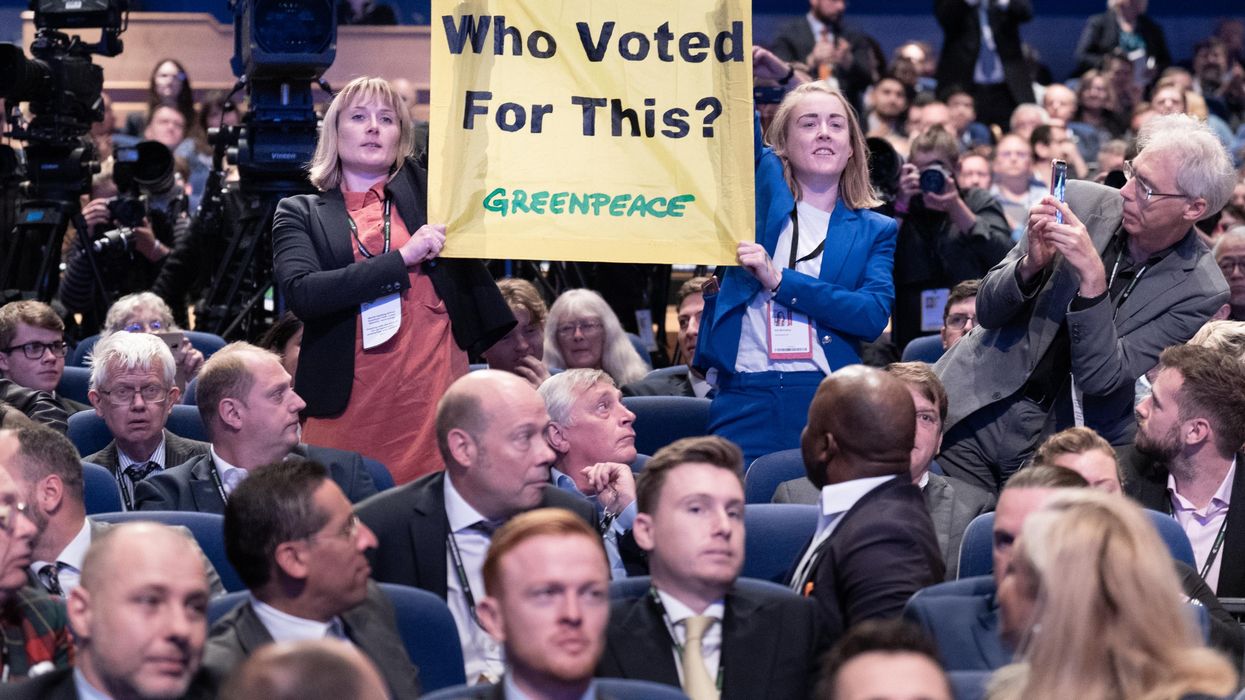
Demanding to know "who voted for" new U.K. Prime Minister Liz Truss' reversal on fracking, Greenpeace campaigners on Wednesday prominently displayed a banner as the Conservative leader spoke at her party's annual conference in Birmingham before being forcibly removed from the meeting.
"Who voted for this?" read the sign displayed by Rebecca Newsom, Greenpeace U.K.'s head of public affairs, and Ami McCarthy, the group's policy officer.
After Truss called for the protesters to be "removed" from the conference hall, the banner was ripped from their hands by security guards, but Newsom and McCarthy quickly produced another sign.
The protest came two weeks after Truss announced the Conservative government will reverse the fracking ban imposed by the party in 2019, following tremors near the country's only fracking site in Lancashire.
Last week, Truss told BBC Radio that the government "will only press ahead with fracking in areas where there is local community support for that" but did not provide details on how local consent would be secured, and did not respond when an interviewer noted that members of Parliament who represent the area don't support fracking.
The Greenpeace campaigners on Wednesday said Truss' plan to return to fracking represents just part of her party's "U-turn" on policy since she took office.
"Nobody voted for fracking, nobody voted to cut benefits, nobody voted to trash nature, nobody voted to scrap workers' rights," Newsom told reporters after the pair were forced to leave the conference hall. "There's a whole host of things that the Conservative government were elected to do in 2019 that they're simply not doing."
The protest followed nationwide outcry over the "mini-budget" the Conservative government released last month, including a tax cut for the wealthy which Chancellor Kwasi Kwarteng announced this week would no longer be included in the plan.
"The chancellor said the government is now listening," said Newsom. "If so, they may want to pay attention to the widening chorus of leading businesses, energy experts, former Conservative ministers, and even the U.S. president telling them to go in the opposite direction."
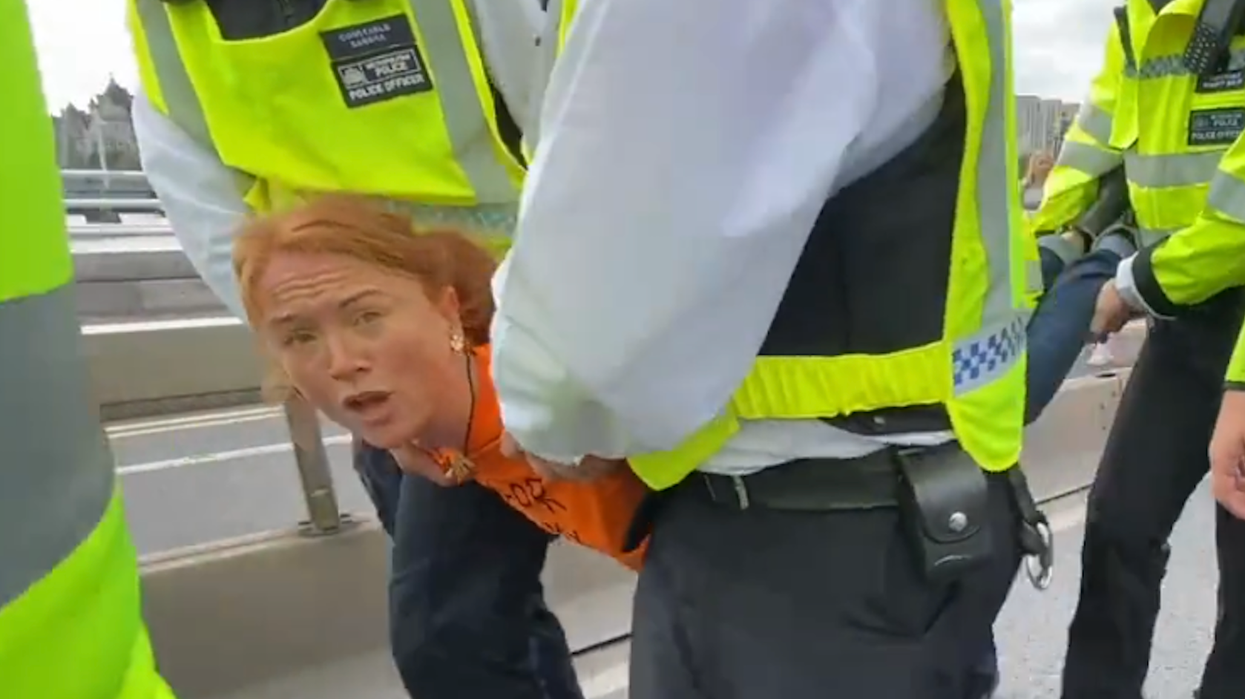
Climate campaigners on Monday hailed video footage of a British mother giving an interview while being hauled off by London police, with one prominent activist calling the clip "climate communication at its best."
"The United Nations has said we should have no new oil."
Hundreds of Just Stop Oil demonstrators marched through central London Sunday, where activists blocked traffic on Waterloo Bride to demand that Britain's new right-wing government address the cost-of-living and climate crises by stopping new fossil fuel projects.
Video journalist Zoe Broughton was on the scene as Metropolitan Police officers began arresting protesters on the bridge.
"I'm doing this for my son," said one woman who was arrested on the bridge as multiple officers carried her handcuffed and in a prone position. "The government's inaction on climate change is a death sentence to us all."
Noting that "the United Nations has said we should have no new oil," the activist lamented that new Conservative U.K. Prime Minister Liz Truss "wants to open 130 new oil licenses."
"That's a death sentence to this planet," she said.
Numerous other activists were also arrested. As they were led or carried off by police, a musician sang a version of the civil disobedience anthem "Have You Been to Jail for Justice?" written by the late Anne Feeney and most famously recorded by Peter, Paul, and Mary:
Have you been to jail for justice? I want to shake your hand
Sitting in and lying down are ways to take a stand
Have you sung a song for freedom, or marched a picket line?
Have you been to jail for justice? Oh, you're a friend of mine
Was it Cesar Chavez? Maybe it was Dorothy Day
Some will say Dr. King or Gandhi set them on their way
No matter who your mentors are it's pretty plain to see
That if you've been to jail for justice, you're in good company.
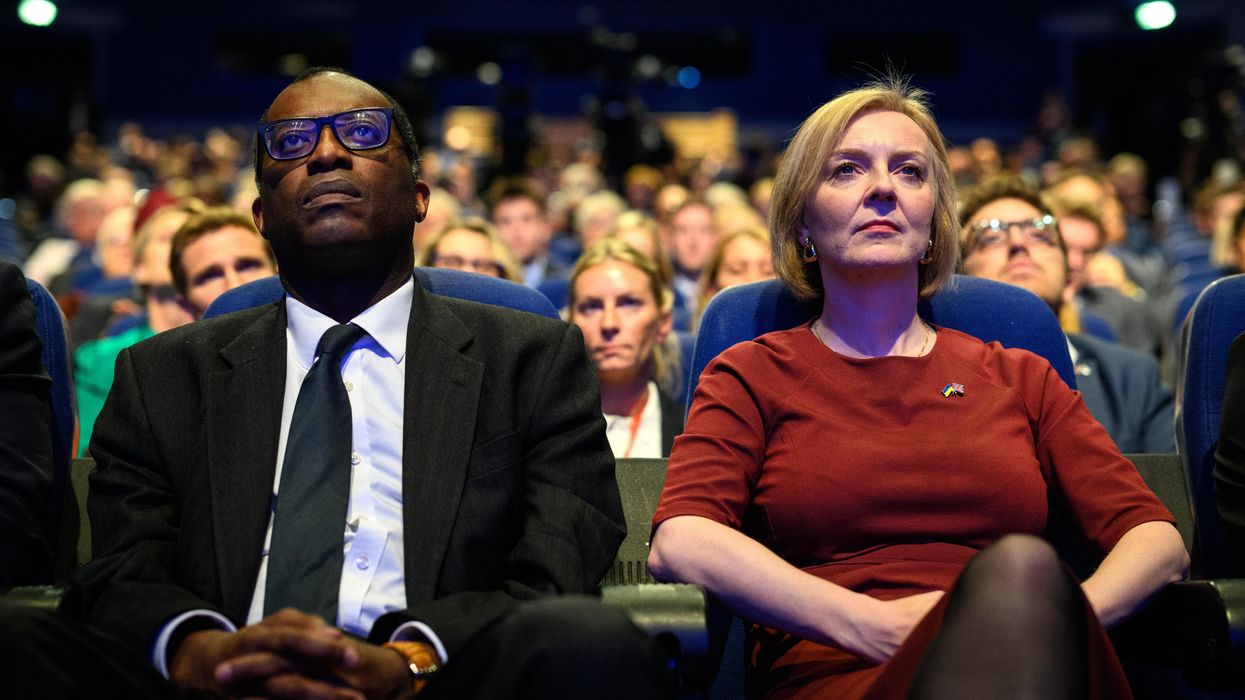
Progressives welcomed right-wing British Prime Minister Liz Truss' Monday decision to scrap a widely condemned tax break for wealthy individuals but warned of looming public spending cuts tied to planned corporate giveaways and called for a reversal of the decadeslong neoliberal model that has brought the United Kingdom to the brink of an economic calamity.
"They need to reverse their whole economic, discredited trickle-down strategy."
The proposed elimination of the U.K's top income tax rate of 45% was a small part of the regressive fiscal and deregulatory framework unveiled by Truss, who was picked by the ruling right-wing Tory Party less than a month ago to become the nation's fourth prime minister in the last six years.
Her entire "mini-budget"--an assemblage of PS45 billion ($50.7 billion) in unfunded tax cuts announced September 23 by British Chancellor of the Exchequer Kwasi Kwarteng--triggered chaos in financial markets and pushback from across the political spectrum, with the left-wing Enough is Enough campaign organizing massive anti-austerity protests this past weekend.
Even some Tory lawmakers expressed resistance to parts of Truss' package, especially the now jettisoned plan to nix the 45% tax rate--an additional levy paid by Britain's richest 1%, or roughly 600,000 citizens with annual incomes above PS150,000 ($168,390). Beneficiaries of the tax break would have gained an estimated PS10,000 ($11,275) per year, on average, while the nation's top 0.1% would have gained at least PS22,000 ($24,805) per year.
Ben Houchen, the Tory mayor of Tees Valley in northeast England, said Sunday at the party's annual conference in Birmingham that pursuing a move that so nakedly favors the rich amid a cost-of-living crisis is "very naive," while an unnamed Tory MP described it as "deranged," and former Tory cabinet minister Michael Gove called it wrong to implement when "people are suffering."
During an emergency meeting convened by Truss and Kwarteng after several Tory MPs indicated publicly that they would vote against the measure, one senior cabinet minister reportedly said that "the politics of this were just awful and I am amazed the idea has lasted as long as it did."
Less than 24 hours after Truss tried to defend the contentious policy one last time on Sunday, Kwarteng issued a statement Monday declaring that "we get it, and we have listened."
"We are not proceeding with the abolition of the 45% tax rate," said Kwarteng, who called it "a distraction from our overriding mission to tackle the challenges facing our country."
While welcoming "the U-turn," left-wing Labour Party MP Jeremy Corbyn wrote on social media that "if you really wanted to 'listen,' you'd also raise benefits, reverse cuts to [the] corporation tax, and reinstate the cap on bankers' bonuses."
"Twelve years of failed Tory economics have plunged millions into poverty," Corbyn added. "Do you 'get it' now?"
Zarah Sultana, another left-wing Labour Party MP and co-founder of Enough is Enough, told Kwarteng in no uncertain terms that he doesn't "get it" and urged him to "ditch this Tory class war."
Truss' abandoned attempt to axe the U.K.'s top income tax rate would have cost between PS2 to PS3 billion ($2.3 to $3.4 billion), representing just a portion of the PS45 billion ($50.7 billion) in unfunded tax cuts proposed by her administration.
As the Financial Times reported:
Having retreated on the 45% tax rate plan, Kwarteng and Truss could now come under pressure to reverse other proposed unfunded tax cuts that have blown a hole in the public finances.
They include a PS13 billion ($14.7 billion) reduction in national insurance, which gives the biggest benefit to better-off voters, and a PS17 billion ($19.2 billion) plan to reverse a corporation tax rise--a policy that business leaders have said is not a priority.
Just minutes after announcing the preservation of the 45% tax rate, Kwarteng confirmed that up to PS18 billion ($20.3 billion) in annual public service spending remains on the chopping block even though economists have warned that this would have devastating impacts on the nation's public healthcare and education systems.
The level of impending public service cuts is nearly identical to the PS18.7 ($21.1 billion) billion corporate tax cut still being pushed by Truss.
The Tories' plan for a simultaneous corporate tax cut and reduction in public services is "a direct trade-off," Enough is Enough tweeted Monday. "Our pain for their profits."
At one of the dozens of Enough is Enough rallies held Saturday, Eddie Dempsey of the National Union of Rail, Maritime, and Transport Workers characterized Truss' austerity budget as a "diabolical disaster."
After having crashed the British pound, he warned, Tories are "going to massively cut expenditure on public services."
"We've got to have a change in direction," said Dempsey. "We need an economy for the people with public ownership, outside of the chaos of the market, so we can have a decent standard of living rather than making this country one big trough for the corporate privateers to stick their noses in and cream off all of our wealth."
That message was echoed by Labour Party MP Rachel Reeves, who said Monday in a statement responding to Truss and Kwarteng's about-face on slashing taxes for Britain's richest households that "they need to reverse their whole economic, discredited trickle-down strategy."
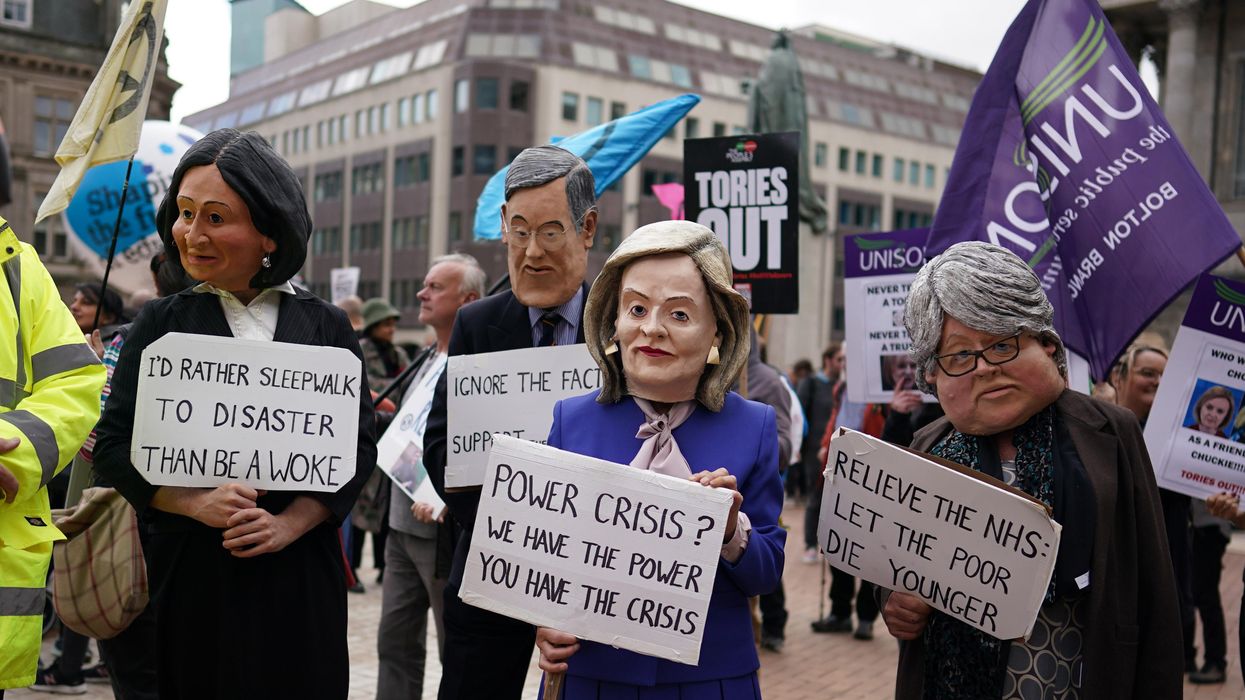
"The Queen's final act of service to the nation was to selflessly buy the economy one last fortnight," said one tweet when all four wheels finally came off the British economy.
The Queen's death and funeral took up the first twelve days of Liz Truss's tenure, so the new prime minister's work of destruction could not get properly underway until last Friday. Then, however, Truss and her faithful sidekick Kwasi Kwarteng, the new Chancellor of the Exchequer (finance minister), got to work with amazing speed.
Kwarteng's 'mini-Budget' on Friday was a suicide note that virtually guarantees defeat for the Conservative Party at the next election, two years from now. There is growing doubt that Truss's government can even survive that long.
She is the fourth Conservative prime minister in the past six years, and at each turn of the wheel the party she currently leads has grown more mutinous. Moreover, it did not choose her as its leader.
That choice was made not by her fellow Conservative members of parliament but by the party's 160,000 paid-up members, who tend to be old, white, non-urban and very ideological.
What drew them to her was her fanatical devotion to the cause of lower taxes and a smaller state, as exemplified in a book she and Kwarteng co-authored ten years ago called 'Britannia Unchained'.
So as soon as the Queen's obsequies were safely past, she and Kwarteng gave them what they longed for: a Budget that is the political equivalent of asset-stripping. It contains unfunded tax cuts, mostly to the benefit of the rich, of around $50 billion a year.
Where will the money come from to make up the lost tax income, plus an extra PS65 billion to help voters cover horrendously high energy costs this winter due to the Russian invasion of Ukraine?
Why, they'll just borrow it all. All that extra spending will allegedly boost the growth rate of the British economy from an average of 1.5% a year to 2.5%, and the extra tax revenue will easily cover that.
At least that's what Liz Truss believes, in the firm belief that she is walking in the footsteps of her heroine, sainted former prime minister Margaret Thatcher. She is not.
The Blessed Margaret cut taxes, but she also cut government spending. The Truss-Kwarteng partnership is spending like a drunken sailor on shore leave. It's not 'Britannia Unchained'; it's 'Britannia Unhinged'.
Nobody believes this will work except a few right-wing think tanks that try to justify low taxes for the rich by touting the old 'trickle-down' model, also known as the 'horse and sparrow' theory: feed the horses enough oats, and eventually there will be lots of horse-poop for the sparrows to eat.
The sad news for Truss and Kwarteng is that the 'free market' they so revere isn't stupid. The value of the British pound is already collapsing. Former US Treasury secretary Larry Summers says: "My guess is that the pound will find its way below parity with both the dollar and the euro."
Meanwhile, investors look at Truss and Kwarteng's business model, do the math, and flee. In the words of Paul Donovan, chief economist at UBS Global Wealth Management, they now see the Conservative Party as a 'doomsday cult'.
And as interest rates soar to fight runaway inflation, millions of Britons find they cannot afford to pay their mortgages. The poor cannot even afford to feed their children. The strikes and protests proliferate.
It's probably around this time - midwinter, say - that the next rebellion occurs in the Conservatives' parliamentary party. However, changing horses would make little difference unless the policy changes. It wouldn't.
The next prime minister would be chosen by the same tiny band of Conservative Party members, no matter who the MPs want - and the members' mindset favors the ideological purist over the pragmatic realist. As one MP said: "You can have as many leadership elections as you like. You are only going to end up with the nutter winning."
The International Monetary Fund (IMF) has already issued its first warning to the United Kingdom to get its house in order. Larry Summers accuses the British government of "behaving like an emerging market turning itself into a submerging market," but Truss is not shifting.
It's a bit like the slow-motion car crash that brought the Sri Lankan government and economy down, which took more than six months from start to finish. Liz Truss's government will not last a year, and the Conservative Party may then split, leading to an early election (due anyway by 2024).
The Labour party is already seventeen points ahead in the polls, and its lead may even widen. It will be a wild ride, but the next British government will be led by Labour, which will rapidly reverse everything that Truss aspires to do.
"So now the Tories are going to slash your already shredded local services because they crashed the economy because they want to cut the taxes of the top 1%."
"What was intended as mere bribery has turned out to be a gigantic financial bomb."
That's how socialist Guardian columnist Owen Jones on Wednesday summarized the recent revelations about U.K. Prime Minister Liz Truss and other Conservative leaders' fiscal policies.
Following reports that U.K. Chief Secretary to the Treasury Chris Philp will send letters asking government departments to identify potential "savings," the Tory confirmed on television Wednesday that they are being asked to "look for efficiencies wherever they can find them."
The push to cut public spending came as The Guardian revealed Wednesday the National Health Service (NHS)--the U.K.'s publicly funded healthcare system--has admitted that "dangerous roofs that could collapse at any time at hospitals across England will not be fixed until 2035."
That admission came in response to a request from Liberal Democrats, whose health spokesperson and deputy leader, Daisy Cooper, took aim at Chancellor of the Exchequer Kwasi Kwarteng's "mini-budget," which was unveiled last Friday and includes major tax cuts for the rich, funded by extra borrowing.
"Kwasi Kwarteng's first budget prioritized slashing taxes on the big banks over fixing crumbling hospitals. There was a deafening silence from government on how it intends to deal with dangerous ambulance wait times or lack of local NHS dentists, let alone buildings at risk of collapse," Cooper told the newspaper. "This is a disaster waiting to happen and Conservative ministers just don't seem to care."
The tax plan--which caused the pound to fall to its lowest level against the U.S. dollar in nearly four decades and ultimately led to emergency action by the Bank of England to calm the markets--has been criticized across the British political spectrum and around the world, including by the credit agency Moody's.
Even Tory members of Parliament are voicing concerns. BBC reports:
Few Conservative MPs are commenting publicly about Chancellor Kwasi Kwarteng's handling of the economic turmoil sparked by his mini-budget--but they are not mincing their words in off-the-record conversations.
Inept, humiliating, naive, and reckless are just some of the words that have cropped up.
Perhaps most notably, the International Monetary Fund (IMF), known worldwide as "a bastion of free market economics and fiscal austerity," on Tuesday delivered a rare critique of the policy--which Guardian economics editor Larry Elliott called "a global embarrassment for Truss and Kwarteng."
The mini-budget "will likely increase inequality," the IMF warned, adding that the next full budget announcement--which Kwarteng is expected to outline in November--gives the U.K. government "an early opportunity... to consider ways to provide support that is more targeted and re-evaluate the tax measures, especially those that benefit high-income earners."
Nick Dearden, director of the U.K.-based group Global Justice Now, tweeted Tuesday, "When the IMF tells you, 'hang on guys, this is going to be so bad for inequality it needs a rethink,' you've got a serious problem."
Economist and former Greek Finance Minister Yanis Varoufakis said the IMF and the U.S. Federal Reserve are concerned the United Kingdom "may trigger a financial crisis" by doing to the United States and other wealthy nations what "Greece did to the Eurozone."
"The particular focus of the concern... is the impact that the destabilization of the markets in Britain will have on the U.S. treasuries, in other words on the public debt of the United States," he said. "Because that kind of domino effect would have quite severe repercussions for the whole world."
Keir Starmer, the Labour leader, said during a BBC radio interview Wednesday that Truss must urgently review the budget following "very serious" criticism from the IMF, noting concerns that November would be too late.
According to Starmer, Truss needs to explain: "How are you going to fix the problems that you caused ...on Friday? The government caused this on the theory, the ideology that the way we fix our country is to make the rich richer."
Other critics also delivered broader rebukes of Truss-aligned ideology, with some going as far back as former Conservative U.K. Prime Minister Margaret Thatcher.
"September 2022 will forever be remembered as the month in which the febrile fantasies of neoliberalism ran full-tilt into reality," said Guardian columnist and author George Monbiot.
Referencing a London road that's home to various think tanks, one Twitter user dubbed this September "the month of the Tufton Street Massacre." Monbiot concurred.
"This catastrophe isn't all on Truss and Kwarteng," Jones stressed Wednesday.
"This is the logical end point of a 43-year-long Thatcherite experiment--brought to us by Tory MPs, right-wing newspapers, and think tanks--which has brought nothing but stagnation, economic turmoil, and mass insecurity," he continued.
Summarizing the chaos since last week, Guardian columnist and and senior economics commentator Aditya Chakrabortty wrote Wednesday:
What was intended as mere bribery has turned out to be a gigantic financial bomb. The pound dived so far that it won a new name: shitcoin. (One wag mused on Reddit: "Apparently britbongs use it to purchase crumpets and tea, but other than that doesn't have any usage.") Lending rates in the markets soared, so Halifax and other big mortgage firms had to pull some of their products. The Bank of England essentially lost control over interest rates, while pension funds and other investors began scrabbling around for cash. Finally, today, the bank started buying government bonds in a bid to quell panic.
A week is a long time in financial wreckage. Thanks to Kwarteng and Truss, you have just got a lot poorer. If you're a homeowner on a standard variable mortgage or looking to renew, your bills have spiraled. If you have a money-purchase pension or a nest-egg ISA, you probably don't want to check your balance. Prices for pretty much anything from overseas--from food to T-shirts to cars--have just gone up.
Institutionally, the Treasury's credibility has been ruined and the Bank of England's monetary policy destroyed.
"This is their crisis, not ours," Chakrabortty concluded of the Conservatives. "You didn't benefit from these big tax cuts, the Tory donors did. Truss can reverse her stupid, cynical budget, resign, and force a general election--and Labour should demand she does so."
Meanwhile, Tory leadership is showing no sign of reconsidering its path, with Financial Secretary to the Treasury Andrew Griffith claiming Wednesday that the proposals were the "right plans" for the U.K.'s economy--despite the mounting evidence to the contrary.
As U.K. Conservatives doubled down on their controversial policies, a coalition of civil society groups launched the End Austerity campaign and warned that next year, 85% of the global population is set to live under "deadly" measures, from cuts to social programs to privatization of public services.
"This austerity recipe has been tried and failed many times," the campaign's website says, "and only inflicted hardship and pain on populations all over the world, supercharging the inequality crisis."

Conservative U.K. Prime Minister Liz Truss' Thursday decision to lift a 2019 moratorium on hydraulic fracturing for gas was swiftly decried by climate campaigners, British politicians, and people across the United Kingdom.
"Anyone who thinks that bringing back fracking will solve the energy crisis is living in cloud-cuckoo-land."
"We will end the moratorium on extracting our huge reserves of shale, which could get gas flowing in as soon as six months, where there is local support," the new prime minister said in a speech to Parliament about her broader energy policy, unveiled amid soaring costs tied to Russia's invasion of Ukraine and fossil fuel industry war profiteering.
In response, Oil Change International senior campaigner Silje Lundberg declared that "long gone are the days of lofty COP26 speeches about climate ambition," referencing the global summit for parties to the Paris agreement held in Glasgow, Scotland last year.
"By doubling down on its fossil fuel production, the U.K. has given up any claim to be a credible climate leader," Lundberg said. "The decision to lift the fracking ban will do nothing to assuage the crisis that millions of households are facing as it would take years before any significant production would happen, without any impacts on energy prices. Local communities in fracking areas will have to pay the double price of high energy prices and local pollution."
"It will, however, make the climate crisis worse and further entrench the U.K.'s dependence on the very same fossil fuels that are at the heart of the current social and economic crisis," she continued. "There is an urgent need for sensible short-term solutions for energy efficiency in homes, reducing nonessential energy use, and accelerating the rollout of readily available alternatives to replace fossil gas and oil. More fossil fuels is not the solution to a fossil-fueled crisis."
Fracking is a process that involves injecting a mix of chemicals, sand, and water into the ground to extract gas. The practice has generated concerns about not only the global climate, but also impacts on communities where it occurs, in terms of both human health and the environment.
Friends of the Earth campaigner Danny Gross said that "fracking is a false solution to the cost-of-living crisis. The most effective way to bring down our bills and boost energy security for good is to invest in cheap, clean renewables and a nationwide home insulation and energy efficiency program."
"Anyone who thinks that bringing back fracking will solve the energy crisis is living in cloud-cuckoo-and," he argued. "Fracking is a failed industry that's unpopular and unfeasible."
Both Gross and Georgia Whitaker, an oil and gas campaigner for Greenpeace U.K., pointed out that--as she put it--all the industry achieved in the decade before the moratorium was "two holes in a muddy field, traffic, noise, earthquakes, and enormous controversy."
The fracking ban was imposed in 2019--under Conservative leadership--following a series of earthquakes in Lancashire, which has the nation's only shale gas wells.
After a series of earthquakes around Cuadrilla Resources' Preston New Road fracking operation and the Oil and Gas Authority concluded it could not rule out future seismic activity, the Department for Business, Energy, and Industrial Strategy said that "further consents for fracking will not be granted" unless the industry "can reliably predict and control tremors."
The BBC noted that "in their 2019 election manifesto, the Conservatives said they would not support it 'unless the science shows categorically that it can be done safely.'"
Gross said that "by breaking its manifesto promise on fracking, the government is showing that it's completely out of touch with communities across the country. They have already defeated fracking once and they're ready to do so again."
Whitaker similarly warned that "communities who have this nonsense inflicted on them in the name of an out-of-date ideology will be wondering who their elected representatives are really representing."
Lancashire resident Nick Moore told the BCC that he was "absolutely disgusted" by the decision to lift the ban. The 67-year-old shared that activity at the Preston New Road site caused cracks in the walls of his home--for which Cuadrilla took responsibility, fixing the damage and compensating him.
The Guardian reported that Tina Louise Rothery, a 60-year-old with the women-led group calling themselves the Nanas, returned on Thursday to the Preston New Road site--where she's been arrested seven times--in her group's signature yellow and vowed to involve others, including the protest movement Extinction Rebellion (XR), in the renewed fight against fracking.
"It won't just be frontline stuff. We will oppose this with legal challenges, planning applications. We will call on XR and the unions and the lines to blockade things. We will pull out all the stops," she explained. "And this time we won't settle for a moratorium either. We're just going to keep on hammering this until we get the proper ban on fracking."
Rothery said that she doesn't anticipate local support for fracking, adding that "it's dangling a precious, precious thing, which is a reduction in your energy bills, in a town like Blackpool that is among the most poverty-stricken places in the country--that isn't local support, that's desperation."
Nick Danby, the spokesperson for Frack Free Lancashire, told the BBC that it appears he may be "out of retirement and back campaigning." He also doesn't anticipate local support for the extraction.
Danby, who lives near another site Cuadrilla wanted to frack, added that "there is nothing to indicate fracking can be done safely" and Truss had "thrown our fate to the wind."
The Independent pointed out Thursday that when Chancellor of the Exchequer Kwasi Kwarteng was business secretary earlier this year, he commissioned a report from the British Geological Survey "into whether there were any new scientific developments that could reduce the risk and magnitude of seismic events."
In March, while serving as business secretary, Kwarteng wrote that those advocating for the return of onshore fracking "misunderstand the situation we find ourselves in," given that "even if we lifted the fracking moratorium tomorrow, it would take up to a decade to extract sufficient volumes--and it would come at a high cost for communities and our precious countryside."
"No amount of shale gas from hundreds of wells dotted across rural England would be enough to lower the European price any time soon," the Tory added in his piece for The Mail on Sunday. "And with the best will in the world, private companies are not going to sell the shale gas they produce to U.K. consumers below the market price. They are not charities, after all."
Ed Miliband, the shadow climate minister and former Labour leader, similarly told Sky News Thursday that market prices mean fracked gas extracted in the U.K. wouldn't be any cheaper. He also said lifting the moratorium was "another case of ideology trumping common sense."
"There's only one way out of being in the grip of the geopolitics of [Russian President Vladimir] Putin and others, and that is a clean energy sprint," according to Milliband. "I'm afraid the government seems to be setting its face against that."
The Independent highlighted critiques from other political figures:
Caroline Lucas, the Green MP for Brighton Pavilion, said the decision was "a massive kick in the teeth for [the] vast majority of communities who don't want fracking, a disaster for our climate, and a measure that will make absolutely zero difference to the cost of energy bills."
Leader of the Liberal Democrats Ed Davey said lifting the ban on fracking would do nothing to change the sky-high price of energy.
"The government should be focusing its attention on solar and wind power, the cheapest and most popular forms of energy," he said. "Alongside insulation, investment in renewable power is the best way to bring down energy prices and protect Britain's energy supply in the long term."
While the death of Queen Elizabeth II on Thursday directed some attention away from the new energy plan, critics also called out Truss--who worked for Shell over two decades ago--for refusing to support a new windfall profits tax targeting industry giants.
"By ruling out a windfall tax, Liz Truss, in one of her first acts as prime minister, has written a blank check to the oil and gas giants making PS170 billion in excess profits, and the British people will foot the bill," said Milliband. "Every penny her government refuses to raise in windfall taxes is money that they will be loading onto the British people for years to come."
Overall, "the government's energy plan is farcical in its detachment from reality," said Mike Childs, head of science, policy, and research at Friends of the Earth. "It does nothing to tackle the root cause of the energy crisis--our reliance on costly, polluting fossil fuels--and only lines the pockets of the oil and gas companies driving the cost-of-living and climate emergencies."