

SUBSCRIBE TO OUR FREE NEWSLETTER
Daily news & progressive opinion—funded by the people, not the corporations—delivered straight to your inbox.
5
#000000
#FFFFFF
To donate by check, phone, or other method, see our More Ways to Give page.
Daily news & progressive opinion—funded by the people, not the corporations—delivered straight to your inbox.
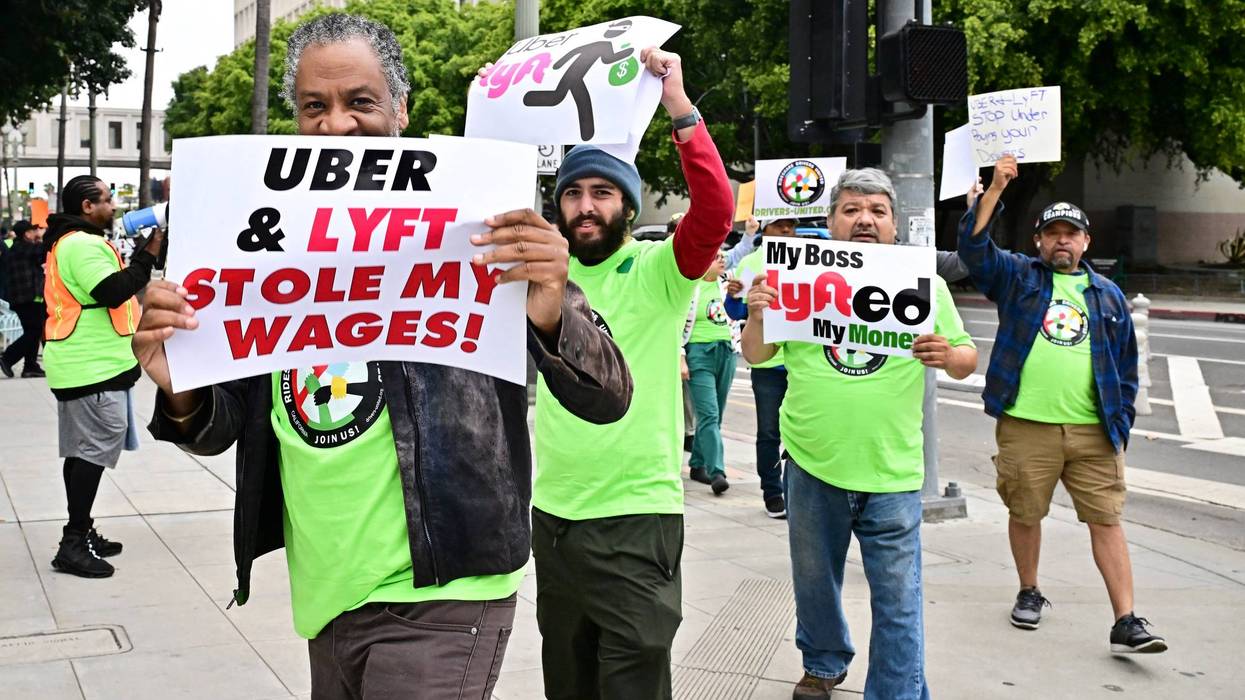
President Donald Trump's "barrage of attacks on workers" continued on Thursday with announcements about two key labor rules.
The US Department of Labor (DOL) proposed an independent contractor rule that the National Employment Law Project (NELP) called "yet another example of the administration siding with major corporations and stacking the deck against working people" by "effectively allowing employers to strip workers of federal minimum wage and overtime protections."
The DOL's Wage and Hour Division proposal would replace the Biden administration's widely celebrated 2024 policy for when employers can treat workers as independent contractors under the Fair Labor Standards Act with business-friendly guidance that resembles a rule adopted just before the end of Trump's first term.
"This rule will have profound real-world consequences for working people," warned NELP. "Misclassification is common in many labor-intensive, poorly paid jobs—jobs like home healthcare, janitorial work, landscaping, personal services, and increasingly, app-dispatched ride-hail and delivery—where people of color and immigrants are overrepresented, and workers lack the bargaining power to negotiate higher wages and better working conditions."
NELP pointed to research showing that low-paid independent contractors "lag behind their employee counterparts," and some "do not even earn the federal minimum wage." The organization stressed that "this rule threatens to enshrine a two-tiered labor system where similarly situated workers receive vastly different rights and protections based on the classification chosen by the business employing them."
The new rule—which now faces a 60-day public comment period—focuses on two "core factors" to determine an employee's classification: the nature and degree of control over the work, and the worker's opportunity for profit or loss based on initiative or investment.
NELP argued that "by elevating two factors above other equally important factors, the Trump administration's test fails to account for the economic realities of many working relationships. Many workers labeled as independent contractors are not really in business for themselves because they are integrated into the operations of a larger business structure that sets most of the terms of the work."
"In app-dispatched ride-hail and delivery jobs, for example, corporations like Uber, Lyft, DoorDash, and Amazon use apps and algorithms to offer shifts or assignments to so-called independent contractors doing the core work of the business, set the wages these workers receive, surveil and assess their performance, and determine if they are offered future assignments or get 'deactivated,'" the group noted. "App-based ride-hail and delivery workers perform difficult and dangerous work without basic employment protections like the right to minimum wage and overtime, workers' compensation, and unemployment insurance."
As NELP and other critics sounded the alarm over the DOL proposal on Thursday, the National Labor Relations Board (NLRB) also revived an effort from Trump's first term, reinstating that administration's 2020 rule on joint employers.
During Trump's initial administration, the NLRB required joint employers to "possess and exercise substantial direct and immediate control" over at least one aspect of the workers' employment. In 2023, under former President Joe Biden, the board decided that two or more entities could be considered joint employers if they had an employment relationship with the workers and helped to determine their terms and conditions of employment. However, the latter was blocked by a Trump-appointed judge the next year.
Unlike the DOL proposal, the board's rule is final. The NLRB—which has two Trump appointees, one Biden appointee, and two vacancies—said in the Federal Register that "the 2023 rule was vacated by the district court, and the action the board takes today merely implements the court's decision. Our action is ministerial and therefore will have no separate economic effect."
US Sen. Patty Murray (D-Wash.), a senior member and former chair of the Senate Health, Education, Labor, and Pensions Committee, declared in a Thursday statement that "every day, little by little, the Trump administration is rigging the system to benefit giant corporations and shortchange workers—it's an outright grift and working people should be furious."
"The joint employer rule is nothing more than a return to Trump's anti-worker policies that let giant corporations skirt their basic obligations to employees—Trump is giving the biggest corporations cover to deny workers their ability to band together for better wages and working conditions and leaving millions of workers in the lurch, vulnerable to egregious violations of their rights," she said.
"At the same time, today, the Trump administration announced they're working to rescind the independent contractor rule," Murray continued. "Trump wants to let giant corporations classify workers as contractors so that they don't have to pay them minimum wage and overtime—these workers deserve fair pay."
The senator then took aim at the so-called One Big Beautiful Bill Act that congressional Republicans passed and the president signed last summer, saying that "under the Trump administration, giant corporations get giant tax breaks paid for by cutting Medicaid—the healthcare that the poorest workers are forced to rely on."
"Now, Trump wants those same corporations off the hook for every benefit, protection, and dollar they'd otherwise owe to millions of workers—it's a shakedown," she asserted. "Republicans are proving time and again, they don't care about workers—they don't want to even let workers have crumbs, but billionaires can get trillions in tax breaks that will blow up our national debt."
Murray isn't up for reelection in November's closely watched midterms, but could lead the Senate Appropriations Committee if Democrats reclaim the chamber. On Thursday, she vowed that "I am going to keep fighting for laws on the books that protect workers and build an economy that grows the middle-class, not just profit margins for the largest corporations on Earth."
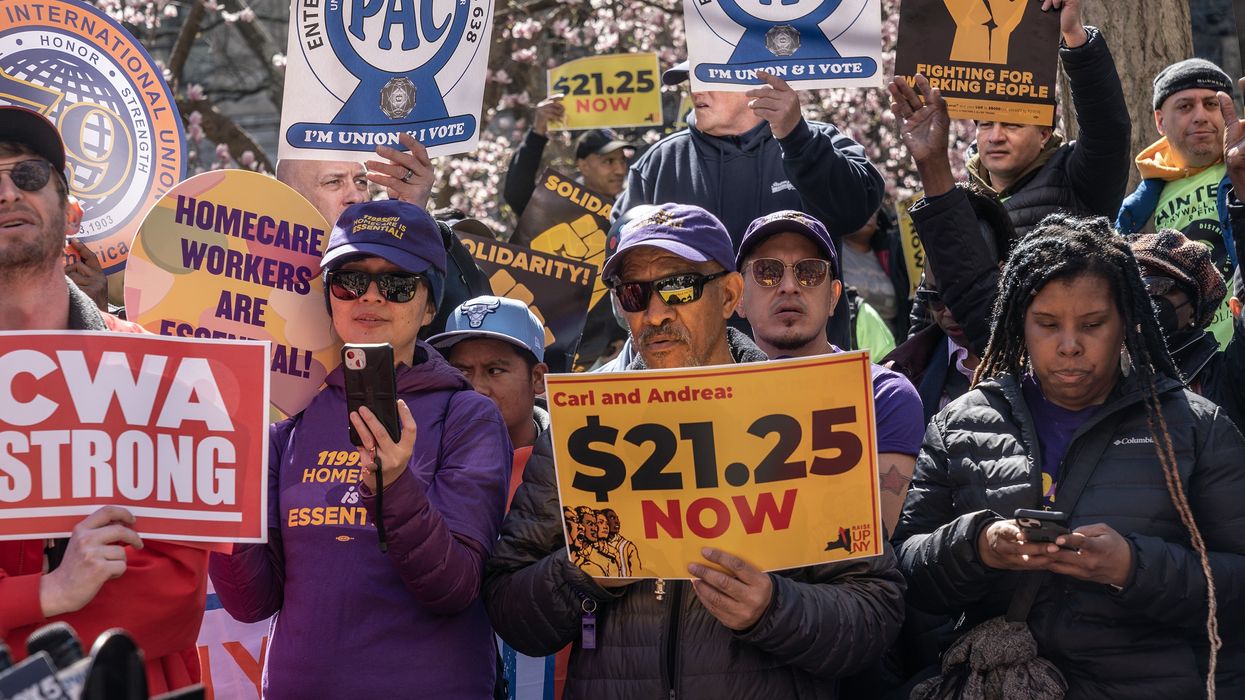
One Fair Wage noted that "tipped workers can still legally be paid as little as $2.13 an hour, a system advocates describe as a direct legacy of slavery."
Over a third of US states are set to raise their minimum hourly wage in 2026, but worker advocates including Sen. Bernie Sanders on Wednesday decried a federal minimum wage that's remained at $7.25 since 2009—and just $2.13 an hour for tipped workers for over three decades.
Minimum wage hikes are set to go into effect in 19 states on Thursday: Arizona, California, Colorado, Connecticut, Hawaii, Maine, Michigan, Minnesota, Missouri, Montana, Nebraska, New Jersey, New York, Ohio, Rhode Island, South Dakota, Vermont, Virginia, and Washington.
Increases range from 28 cents in Minnesota to $2 in Hawaii, with an average hike of 67 cents across all 19 states. More than 8.3 million workers will benefit from the increases, according to the Economic Policy Institute (EPI). The mean minimum wage in those 19 states will rise to $14.57 in 2026, up from $13.90 this year.
Three more states—Alaska, Florida, and Oregon—plus Washington, DC are scheduled to raise their minimum wages later in 2026.
In addition to the state hikes, nearly 50 counties and municipalities plan to raise their minimum wages in the coming year, according to the National Employment Law Project (NELP). These include San Diego, California—where the minimum wage for hospitality workers is set to rise to $25 an hour by 2030—and Portland, Maine, where all workers will earn at least $19 by 2028.
However, the federal minimum wage remains at $7.25, and the subminimum rate for tipped workers is $2.13, where it's been since 1991—and has lost more than half its purchasing power since then.
The federal minimum wage has stayed at $7.25 since 2009. In 2026, workers in 19 states and 49 cities and counties an increase. Alabama’s rate will stay at $7.25. 🔗 https://t.co/mrGfPAKba3 pic.twitter.com/EsokVIc6KP
— AL.com (@aldotcom) December 31, 2025
"Tipped workers can still legally be paid as little as $2.13 an hour, a system advocates describe as a direct legacy of slavery," the advocacy group One Fair Wage (OFW) said in a statement Tuesday.
Sanders (I-Vt.) said on social media on the eve of the hikes: "Congratulations to the 19 states raising the minimum wage in 2026. But let’s be clear: A $7.25 federal minimum wage is a national disgrace. No one who works full time should live in poverty. We must keep fighting to guarantee all workers a living wage—not starvation wages."
Yannet Lathrop, NELP's senior researcher and policy analyst, said earlier this month that "the upcoming minimum wage increases are incremental and won’t magically turn severely underpaid jobs into living-wage jobs, but they do offer a bit of relief at a time when every dollar matters for people."
“The bigger picture is that raising the minimum wage is just one piece of a much larger fight for a good jobs economy rooted in living wages and good benefits for every working person," Lathrop added. "That’s where we need to get to."
Numerous experts note that neither $7.25, nor even $15 an hour, is a livable wage anywhere in the United States.
"The gap between wages and real living costs is stark," OFW said. "According to the MIT Living Wage Calculator, there is no county in the United States where a worker can afford to meet basic needs on less than $25 an hour. Even in the nation’s least expensive counties, a worker with one child would need at least $33 an hour to cover essentials like rent, food, childcare, and transportation."
"Advocates argue that policies like President [Donald] Trump’s 'no tax on tips' proposal fail to address the underlying problem of poverty wages," OFW continued. "While the policy has drawn attention, they say it is a headline rather than a solution, particularly since nearly two-thirds of tipped workers do not earn enough to owe federal income taxes."
Frustrated by the long-unchanged $7.25 federal minimum wage, numerous states in recent years have let voters give themselves raises via ballot initiatives. Such measures have been successful even in some red states, including Missouri and Nebraska.
Rising minimum wages are a legacy of the union-backed #FightFor15 movement that began among striking fast-food workers in 2012. At least 20 states now have minimum wages of $15 or higher.
However, back then, "the buying power of a $15 minimum wage was substantially higher than it is today," EPI noted. "In 2025, a $15 minimum wage does not achieve economic security for working people in most of the country. This is particularly true in the highest cost-of-living cities."
In April, US senators voted down an amendment that would have raised the federal minimum wage to $17 an hour. Every Democratic and Independent upper chamber lawmaker voted in favor of the measure, while all Republicans except Sen. Josh Hawley (Mo.) rejected it.
As Trump administration and Republican policies and practices—such as passing healthcare legislation that does not include an extension of Affordable Care Act tax credits, which are set to expire on Wednesday and send premiums soaring—coupled with persistently high living costs squeeze workers, advocates say a living wage is more important than ever.
The issue is underscored by glaring income and wealth inequality in the US, as well as a roughly 285:1 CEO to worker pay gap among S&P 500 companies last year.
"Minimum wage doesn't cover the cost of living," Janae van De Kerk, an organizer with the Service Employees International Union (SEIU) Airport Workers union and Phoenix Sky Harbor International Airport employee, said in a video posted Tuesday on social media.
"Minimum wage doesn't cover the cost of living. Many of my co-workers have to choose between food on the table or health insurance" Janae, Phoenix Sky Harbor Airport service worker No one should have to make that choice.
[image or embed]
— Airport Workers United (@goodairports.bsky.social) December 30, 2025 at 10:34 AM
"Many of my co-workers have to choose between food on the table or health insurance, or the choice between having food and paying the electric bill," van De Kerk—who advocates a $25 hourly minimum wage—continued.
"We shouldn't have to worry about those things," she added. "We shouldn't have to stress about those things. We're willing to work and we wanna work, and we should be paid for our work."
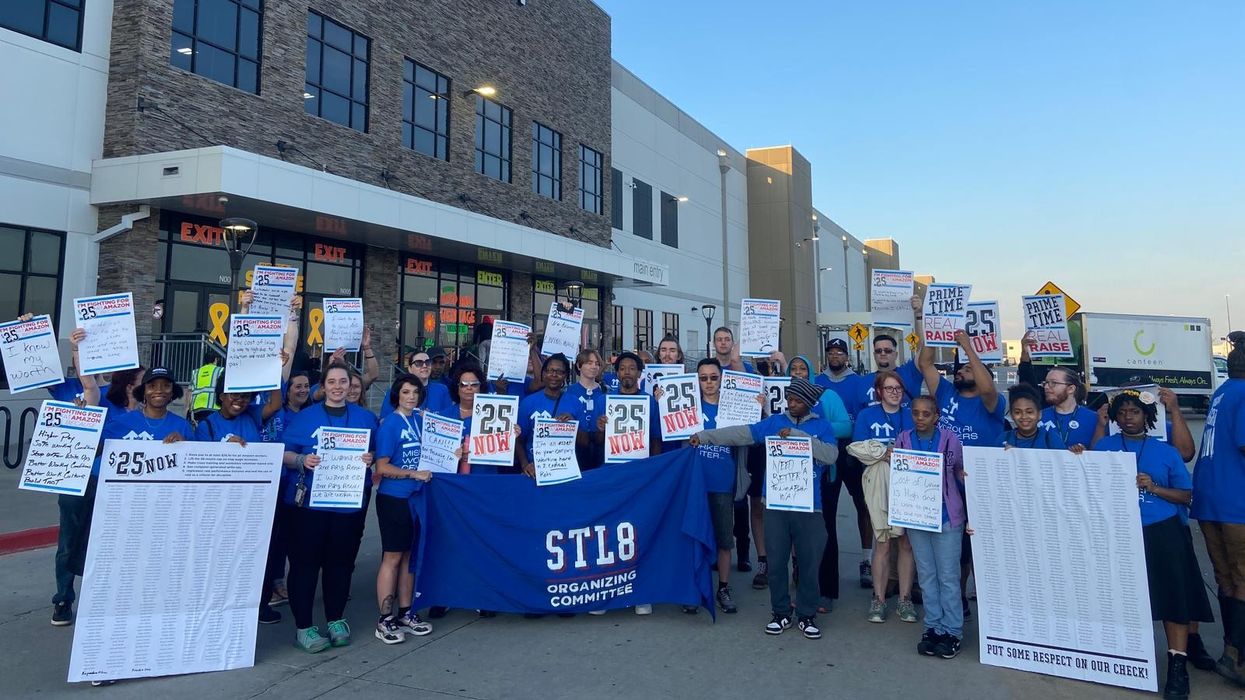
"Today shows that Amazon workers are united and stronger than ever in our demands for higher pay," said one warehouse worker and organizer.
As Amazon workers across the United States launched a campaign demanding at least $25 an hour, the e-commerce giant announced Wednesday that it is raising hourly pay for its warehouse workers and drivers.
In what Amazon vice president of worldwide operations Udit Madan called the company's "biggest-ever investment in pay and benefits," the average starting pay for U.S. fulfillment and transportation workers will rise starting this month.
"Members of our front-line team will be getting at least an additional $1.50/hour starting this month, which will bring their average base wage to more than $22/hour and average total compensation to more than $29/hour when you include the value of their elected benefits," such as healthcare, said Madan, who added that the workers will also receive free Amazon Prime subscriptions.
While the Amazon workers who launched the drive for $25 welcomed the announcement, they say they deserve more.
"I've lost out on thousands of dollars of income. I haven't gotten a paycheck since my short-term disability—which only covered 60% of my regular pay—ended in January," said Christine, a worker at Amazon's STL8 fulfillment center in Missouri and longtime member of the STL8 Organizing Committee.
"I'm awaiting approval for long-term disability, which I applied for back in January," explained Christine, who was injured on the job. "I've maxed out my credit cards and drained my 401(k). I'm on food stamps. I just got approved for Medicaid. At one point I started a GoFundMe just to make rent. I've never been in the position of having to ask for money, but the alternative was homelessness. When you're forced into that position, you do what it takes to survive."
"Today shows that Amazon workers are united and stronger than ever in our demands for higher pay," she added. "With over 800 worker signatures on our petition and new workers joining us from across the region, together we will win the $25 an hour that we all deserve."
According to the campaign:
Research suggests working families need at least $25 to make it by. In Missouri, for example, a livable wage for a family of four is at least $25; in New York, the livable wage is even higher, at $39. However, a majority of Amazon warehouse workers reported earning wages between $16 and $20—before Amazon increased starting pay to $17 in September 2023. Amazon itself reports an average pay of $20.50.
"The $1 raise that Amazon gave workers last year was shameful. After accounting for inflation, it wasn't even a raise," lamented Irene Tung, senior researcher and policy analyst at the National Employment Law Project. "Our research has shown that Amazon tends to locate its warehouses in high earnings counties around the country, but lags behind other warehouse employers in pay—even though it can afford to pay workers much more."
Advocates point to Amazon's $30.4 billion 2023 profits as proof that the company can afford to pay its workers more.
"Raising pay by 25% would bring Amazon workers much closer to a middle-income standard of earnings," Tung said. "Given Amazon's size and the enormity of its wealth, it is not far-fetched to ask why this company has thus far failed at creating middle-income jobs for the hundreds of thousands of U.S. workers that power its operations."
Beth Gutelius—the author of Handling Hardship: Data on Economic Insecurity Among Amazon Warehouse Workers—said in a statement that "if warehouse wages had kept pace with inflation, workers would be earning $25.66 an hour—so workers are simply asking Amazon to bring wages in line with the cost of living, which as we know has risen sharply."
"Doing so would help ensure that workers are able to meet their basic needs without relying on public assistance," she added.
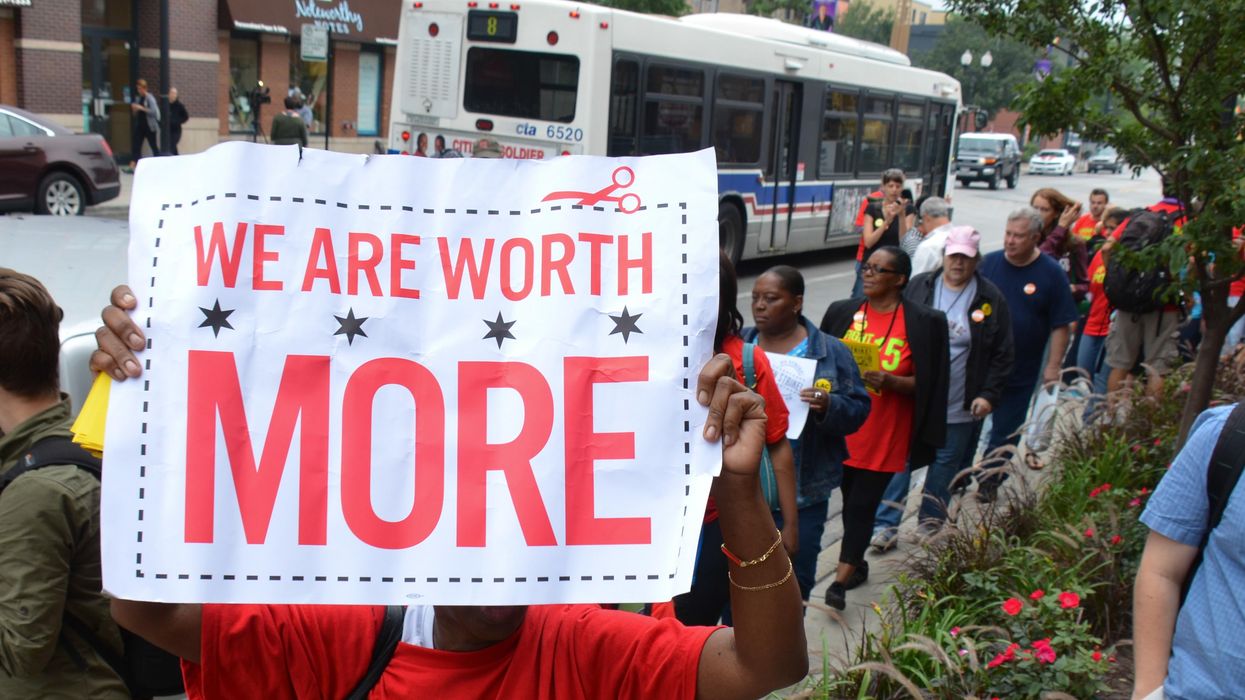
"These raises are the outcome of over a decade of workers organizing with Fight for $15," said the National Employment Law Project.
Tireless campaigning by economic justice advocates helped to secure minimum wage hikes for nearly 10 million U.S. workers starting in 2024, and one think tank noted on Wednesday that further successes at the state and local levels are expected in the coming year—but experts said the federal government must catch up with state legislators to deliver fair wages to all workers.
January 1 will see 22 states increase their minimum wages, providing affected workers with an additional $6.95 billion.
That's not counting the 38 cities and counties where minimum pay will be raised starting New Year's Day, including in Montgomery County, Maryland and in Tukwila, Washington, a city outside Seattle that will have the highest minimum wage in the country at $20.29 per hour.
A shrinking number of states still abide by the federal minimum wage of $7.25 per hour, which has not been updated in nearly 15 years.
"In the absence of federal action, states and localities continue to take the lead in advancing fairer wage floors via legislation, ballot measures, and automatic inflation adjustments," wrote Sebastian Martinez Hickey, a research assistant at the Economic Policy Institute (EPI), last week.
For the first time in 2024, Maryland, New Jersey, and New York will require workers to be paid at least $15 an hour, joining other high cost-of-living states including California, Massachusetts, and Connecticut.
At the National Employment Law Project (NELP), senior researcher and policy analyst Yannet Lathrop pointed out on Tuesday that just over a decade after the national Fight for $15 movement was launched, none of the recent ongoing minimum wage campaigns demand less than $15 per hour, and many of the recent victories and campaigns push for "significantly higher wage floors of $20 or above."
The bold demands and reforms of the past year signal "the strength of the movement and a recognition that robust wage increases are needed especially in a post-pandemic, high inflation economic environment," wrote Lathrop. "Some of these campaigns are also demanding equal wages and treatment for all workers including those earning tips, signaling the increasing importance of equitable wage policies."
NELP also noted that the adoption of the $15 minimum wage by large employers like Starbucks and Amazon is likely to positively influence the wage policies of companies across the country.
In addition to raising minimum wages, city and state policymakers have taken other actions this year to stop the exploitation of workers. An ordinance passed in Chicago will phase out the subminimum wage for tipped workers by 2028, and in Boulder County, Colorado, the minimum wage will be raised to $25 per hour by 2030.
Advocates brought to Boulder County policymakers' attention EPI's Family Budget Calculator, wrote Hickey, which showed that a two-income, two-parent, two-child household would need to earn roughly $26 per hour at both jobs to cover "a modest living standard."
The research underscored "how difficult it is for low-wage workers to find a way to live sustainably," Hickey wrote. "A $25 minimum wage might seem high, but the truth is that Boulder County is unlikely to be the highest minimum wage in the country in 2030 because of steps other localities have taken to index their minimum wages to inflation. Strong minimum wage policy can only benefit localities seeking a thriving and equitable local economy."
According to EPI, the minimum wage increases across the U.S. in the new year will disproportionately benefit Black and Hispanic workers. Black Americans make up 9% of the workforce in the states where increases will go into effect, but represent 11.1% of the affected employees. Fewer than 20% of workers in the states are Hispanic, but Hispanic workers make up 37.9% of those whose wages will be increased.
The new state and local laws will increase the purchasing power of households that include 5.6 million children, as more than a quarter of affected workers—2.5 million people—are working parents.
And nearly 20% of workers who will get a raise on January 1 have incomes below the poverty line.
"The minimum wage continues to be a powerful tool for fostering economic equity and ensuring a dignified standard of living for workers across the nation," wrote Hickey. "The proactive steps many states and localities took to index their minimum wages to inflation has helped protect the purchasing power of low-wage workers during the recent period of inflation."
NELP noted that later in 2024, additional minimum wage increases will go into effect in at least three more states and 22 more cities and counties—and advocates will continue campaigning for more victories across the country in the coming year.
Campaigners in states including Alaska, Ohio, and Oklahoma are collecting signatures for ballot initiatives that would push minimum wages to $15 or above, and in California an initiative pushing for an $18 minimum wage by 2026 has qualified for 2024 ballots.
Hickey noted that campaigners are still fighting on behalf of 17.6 million workers who employers continue to pay less than $15 per hour—almost half of whom live in one of the 20 states that use the federal minimum wage.
"Policy reforms are still necessary," wrote Hickey, "to overcome federal inaction and the persistence of unjust minimum wage carve-outs like the tipped minimum wage."
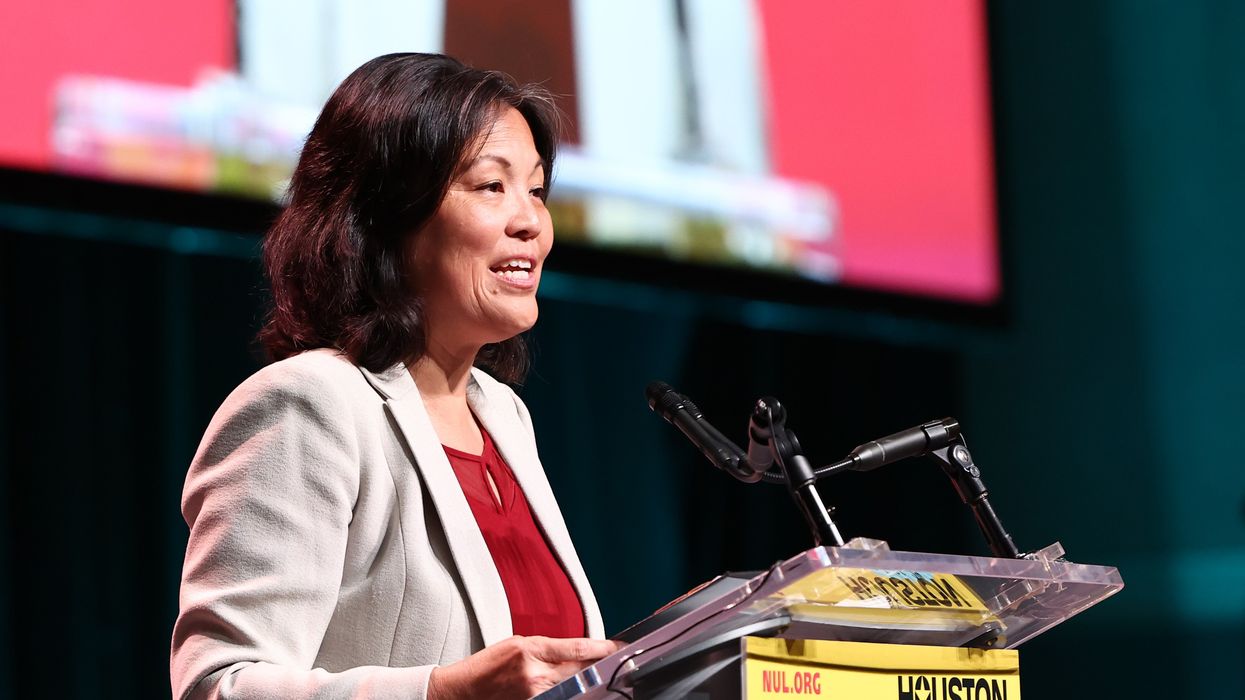
While welcoming the move, the head of the Congressional Progressive Caucus also urged the president to "not to consider the job done with this proposed rule, and pursue a relentless commitment to fair overtime pay."
Labor rights advocates within and beyond Congress celebrated on Wednesday after the Biden administration proposed a federal rule to restore and extend overtime protections to 3.6 million more salaried workers earning up to about $55,000 a year.
"For over 80 years, a cornerstone of workers' rights in this country is the right to a 40-hour workweek, the promise that you get to go home after 40 hours or you get higher pay for each extra hour that you spend laboring away from your loved ones," said Julie Su, who is acting secretary at the U.S. Department of Labor (DOL) because her nomination is stalled in the U.S. Senate.
"I've heard from workers again and again about working long hours, for no extra pay, all while earning low salaries that don't come anywhere close to compensating them for their sacrifices," she said. "Today, the Biden-Harris administration is proposing a rule that would help restore workers' economic security by giving millions more salaried workers the right to overtime protections if they earn less than $55,000 a year. Workers deserve to continue to share in the economic prosperity of Bidenomics."
Informed by 27 listening sessions, the rule would ensure most salaried workers earning less than $1,059 per week get overtime pay after 40 hours; clarify which administrative, executive, or professional employees should be overtime exempt; automatically update the salary threshold every three years in line with earnings data; and restore overtime protections for U.S. territories.
"This proposal is a crucial step in creating a stronger, fairer economy."
"Once again, the Biden administration is listening to workers' voices by taking these much-needed steps to strengthen overtime protections," declared Rebecca Dixon, president and CEO of the National Employment Law Project. "Ensuring this proposed rule is finalized and implemented as soon as possible is essential because workers don't deserve to wait any longer for the benefits this rule will provide."
Economic Policy Institute president Heidi Shierholz—a former DOL chief economist—similarly praised the proposal, saying that "EPI is encouraged to see this important regulation move forward. The overtime threshold has not been properly updated for nearly 50 years, robbing millions of workers of their basic wage and hour rights under the Fair Labor Standards Act."
"Currently, a worker making just $36,000 a year can be required to work 50- or 60-hour workweeks with no additional pay," she noted. "This proposal would ensure that employers have 'skin in the game' when they ask these workers to work long hours. As a result, these workers will either get those extra hours back or they will get higher wages when they do work long hours—whether through salary increases or by earning time-and-a-half overtime pay. This proposal is a crucial step in creating a stronger, fairer economy."
Congressional Progressive Caucus (CPC) Chair Pramila Jayapal (D-Wash.) also applauded the DOL's move to "advance this key pillar of worker justice" while stressing that "it doesn't go far enough," leaving "too many behind when a larger increase to the threshold could give millions more families breathing room in their budgets at a time when they desperately need it."
The congresswoman highlighted the CPC's "long history of advocating for bold action" under then-President Barack Obama in 2014, 2015, and 2016, as well as in the caucus' 2022 and 2023 executive action agendas under Biden, who was Obama's vice president.
"Our caucus understands this is about basic fairness: People should be paid for every hour they work," Jayapal emphasized. "It is also about economic justice: Workers should not be forced to donate their time over 40 hours per week to their employers, especially for those who work at wealthy corporations that are raking in record profits."
“The CPC called for the overtime threshold to be raised to $80,000 per year, which would cover 55% of workers at one-and-a-half times their regular pay—and grant fair pay to 26 million new workers," she added. "We urge President Biden not to consider the job done with this proposed rule, and pursue a relentless commitment to fair overtime pay, which would be a powerful demonstration of his pro-worker commitment. We cannot rest until we've exhausted every option to ease the burden on working- and middle-class people."
The current threshold of $35,568 was previously raised from $23,660 in 2019 under then-President Donald Trump—the current front-runner for the 2024 GOP presidential nomination. With only a few longshot Democratic challengers, Biden is expected to face the Republican nominee next year.
The Associated Press reported Wednesday that "the new rule could face pushback from business groups that mounted a successful legal challenge against similar regulation that Biden announced as vice president during the Obama administration, when he sought to raise the threshold to more than $47,000."
Publication of the administration's notice of proposed rulemaking kicks off a 60-day public comment period. Jessica Looman, principal deputy administrator at the DOL's Wage and Hour Division, said Wednesday that "public input is essential as we consider the needs of today's workforce and industry demands, and we encourage continued stakeholder input during the public comment period."
"We are committed to ensuring that all workers are paid fairly for their hard work," she said. "For too long, many low-paid salaried workers have been denied overtime pay, even though they often work long hours and perform much of the same work as their hourly counterparts. This proposed rule would ensure that more workers receive extra pay when they work long hours."
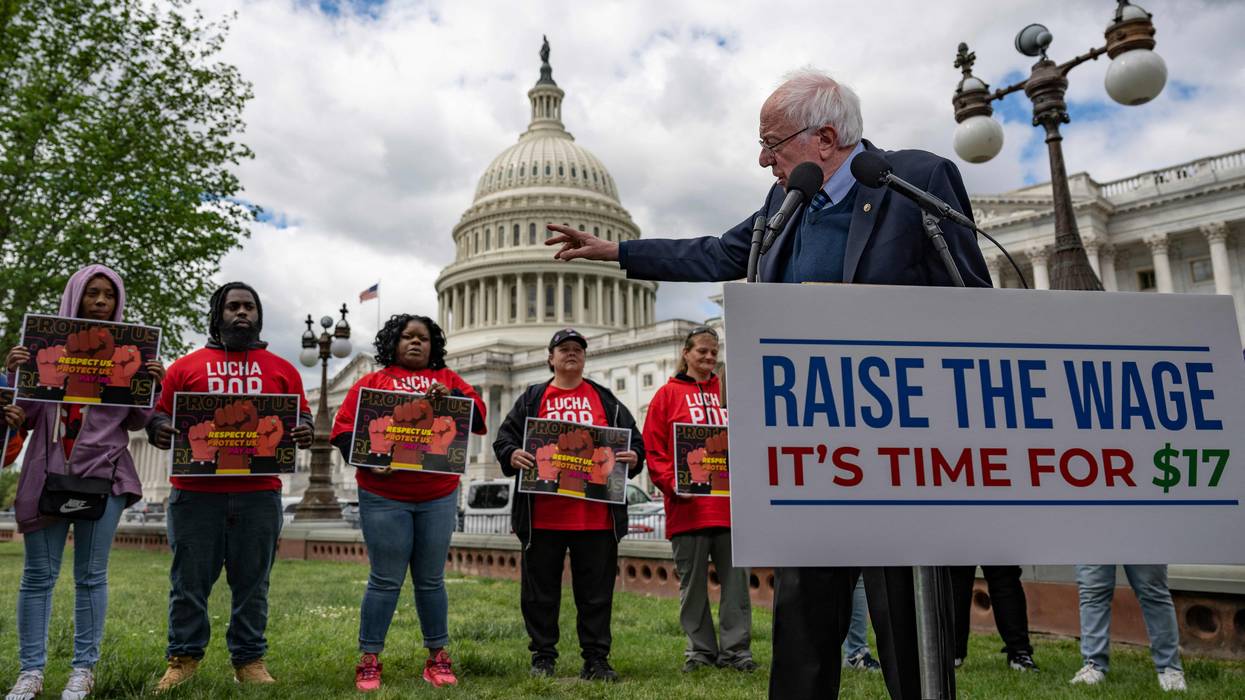
"Raising the federal wage floor is the single most efficient, effective—and wildly popular—bipartisan tool we have to deliver economic stability to working people," said one supporter of the legislation.
Economic justice advocates applauded Tuesday as U.S. Sen. Bernie Sanders and Congressman Bobby Scott formally introduced the Raise the Wage Act of 2023, which would increase the federal hourly minimum wage from $7.25 to $17 by 2028.
The legislation was first announced in May but the lawmakers finally unveiled the bill text a day after the 14th anniversary of the last time the national wage floor was lifted. In the years since 2009, the Fight for $15 movement has pressured several U.S. state and local governments to boost wages, but Republicans and some Democrats in Congress have blocked similar federal efforts.
"The $7.25 an hour federal minimum wage is a starvation wage. It must be raised to a living wage—at least $17 an hour," Sanders (I-Vt.), who chairs the Senate Committee on Health, Education, Labor, and Pensions, said in a statement. "In the year 2023, a job should lift you out of poverty, not keep you in it."
"At a time of massive income and wealth inequality and record-breaking corporate profits, we can no longer tolerate millions of workers being unable to feed their families because they are working for totally inadequate wages. Congress can no longer ignore the needs of the working class of this country. The time to act is now."
Scott (D-Va.) declared that "no person working full-time in America should be living in poverty. The Raise the Wage Act will increase the pay and standard of living for nearly 28 million workers across this country."
That works out to about a fifth of the U.S. workforce, according to the Economic Policy Institute—which also found in an analysis published Tuesday that the bill "would provide an additional $86 billion annually in wages for the country's lowest-paid workers, with the average affected worker who works year-round receiving an extra $3,100 per year."
Scott, ranking member of the House Committee on Education and the Workforce, stressed that "raising the minimum wage is good for workers, good for business, and good for the economy. When we put money in the pockets of American workers, they will spend that money in their communities."
At a Tuesday press conference to promote the bill, Scott was joined by House Minority Leader Hakeem Jeffries (D-N.Y.), Congressional Progressive Caucus Chair Pramila Jayapal (D-Wash.), Labor Caucus Co-Chair Donald Norcross (D-N.J.), Well-Paid Maids owner Aaron Seyedian, and Frances Holmes, who makes $13 an hour working a seasonal job at a baseball stadium St. Louis, Missouri.
"I've been in the Fight for $15 for a decade and I'm here to plead with Congress, the senators, people that vote, just anybody that'll hear our story," said Holmes, explaining her difficulty paying for rent, utilities, and food for her family. "Workers like me, we need your help."
Along with hiking the federal minimum wage over five years, the bill would phase out the subminimum wage for tipped workers, teens, and people with disabilities, and tie future increases to median wage growth. In addition to Sanders and Scott, the legislation is co-sponsored by 146 House members and 29 senators.
The bill is also backed by dozens of groups, including the AFL-CIO, Business for a Fair Minimum Wage, Demand Progress, Indivisible, Leadership Conference on Civil and Human Rights, National Employment Law Project, National Network to End Domestic Violence, One Fair Wage, Oxfam America, Patriotic Millionaires, Service Employees International Union, and United for Respect.
"Raising the federal wage floor is the single most efficient, effective—and wildly popular—bipartisan tool we have to deliver economic stability to working people," said Patriotic Millionaires chair Morris Pearl, a former managing director at BlackRock.
"Moreover, doing so will strengthen and expand the economic base for businesses across the country," Pearl added. "To preserve American democratic capitalism, we must raise the wage floor substantially and close its gaping holes. This piece of legislation is a step in the right direction."

"The overwhelming majority of Americans support raising the minimum wage to a living wage."
Decrying the "national disgrace" of poverty wages in the world's richest country, Sen. Bernie Sanders on Thursday introduced legislation that would raise the federal minimum wage to $17 an hour over a period of five years.
Sanders (I-Vt.), the chair of the Senate Health, Education, Labor, and Pensions (HELP) Committee, lamented that Congress hasn't raised the federal minimum wage in more than a decade, leaving tens of millions of workers with what the senator described as "starvation wages."
"Now is the time to raise the minimum wage," Sanders (I-Vt.) said at a Capitol Hill press conference alongside union leaders and service workers. "Let's be clear: This is not a radical idea. The overwhelming majority of Americans support raising the minimum wage to a living wage."
"It is not acceptable today that nearly 35 million American workers earn less than $17 an hour," the senator added.
Sanders pledged to push his legislation "as quickly and as hard" as possible in the Senate, where the bill faces long odds given likely opposition from several members of the chamber's Democratic caucus and every Republican. The Senate HELP Committee will hold a mark-up hearing for the new legislation on June 14, Sanders announced Thursday.
The full text of the bill is not yet available.
Mary Kay Henry, president of the Service Employees International Union (SEIU), said during Thursday's press conference that "we are going to be watching any congressperson—senator or in the House—that dares to say that they are not going to vote yes for Senator Sanders' bill."
"They need to be held accountable at the ballot box," said Henry.
More than a decade has passed since Congress last raised the federal minimum wage, and efforts in recent years to enact a $15-an-hour wage floor nationally have fallen short amid opposition from the GOP, corporate-friendly Democrats, and the business lobby.
While some lawmakers are sure to balk at the idea of more than doubling the federal minimum wage, a working paper released this week showed that counties that have enacted large minimum wage increases have seen higher employment, higher earnings for workers, and lower inequality.
"Nobody in this country can survive on $7.25 an hour," Sanders said Thursday. "Maybe some of my colleagues in Congress might want to live for a month on seven-and-a-quarter an hour and see what that's like."
As Congress has failed to act, many states, cities, and counties across the U.S. have raised their minimum wages substantially, with progress continuing this year. According to a recent report by the National Employment Law Project, a record 86 U.S. jurisdictions are set to raise their minimum wages in 2023.
But 15 states have their minimum wages set at the federal floor of $7.25 an hour, according to the Economic Policy Institute's Minimum Wage Tracker, and five other states have no minimum wage laws—meaning the federal minimum applies.
"As it becomes more and more expensive to get by in America, $15 is no longer an adequate goal. We need to go higher to reflect what it actually costs to live in America."
In an analysis earlier this year, EPI estimated that "a worker in one of the 20 states with a $7.25 minimum wage is 46% more likely to make less than $15 an hour than a worker in the other 30 states or District of Columbia with higher minimum wages."
"There is no part of this country where even a single adult without children can achieve an adequate standard of living with a wage of less than $15 an hour," EPI noted. "With the lack of congressional action, the federal minimum wage has lost more than a third of its value since its inflation-adjusted high point of 1968."
Sanders said Thursday that with living costs rising across the country, a $15 minimum wage would still be insufficient—a point that supporters of the new legislation echoed.
"As it becomes more and more expensive to get by in America, $15 is no longer an adequate goal," Stephen Prince, vice chair of the Patriotic Millionaires, said in a statement. "We need to go higher to reflect what it actually costs to live in America. Sanders is right to revise his minimum wage push to $17 an hour to save workers across the country from further suffocation."
"On a larger scale, raising the minimum wage would give millions of people more money to buy more products and services from businesses around the country, which is good for our bottom lines," said Prince. "From a business standpoint, 60% of the country living paycheck to paycheck is unsustainable and precarious. Sanders' $17 minimum wage will change this reality and I’m all for it."

"Workers in this country need an experienced leader and brilliant public servant at the helm of the Department of Labor, and Julie Su is exactly that," said EPI's president.
As corporate interests continue to attack Julie Su, dozens of progressive organizations on Wednesday pressured a U.S. Senate panel to swiftly advance the labor secretary nominee, who "has devoted her life to fighting for workers' rights, holding exploitative employers accountable, leveling the playing field for high-road employers, and doing pioneering work to protect the most vulnerable of workers."
Labor and advocacy groups have celebrated since President Joe Biden nominated Su in February, but industries opposed to her are spending big in states like Arizona, Montana, and West Virginia, hoping some current and former Democrats in the Senate will block her confirmation.
"Julie Su's career has been defined by solving complex problems and building a more just economy for all."
"Why are corporations spending millions to defeat Julie Su's nomination as labor secretary? They know she's a champion of the working class and will take on the forces of corporate greed, illegal union-busters, and improve working conditions. The Senate must confirm her nomination," Sen. Bernie Sanders (I-Vt.) tweeted Friday.
Sanders and Sen. Bill Cassidy (R-La.)—as chair and ranking member of the Senate Committee on Health, Education, Labor, and Pensions (HELP), respectively—received the new letter from 94 organizations ahead of the panel's Thursday hearing.
Led by the Economic Policy Institute (EPI) and National Employment Law Project (NELP), the groups wrote:
The Department of Labor's (DOL) basic mission is "to foster, promote, and develop the welfare of the wage earners, job seekers, and retirees of the United States; improve working conditions; advance opportunities for profitable employment; and assure work-related benefits and rights." Few people are as uniquely well-suited to lead the Department of Labor in executing this mission as Julie Su...
Over the past two years, Deputy Secretary Su has proven herself to be an indispensable partner to Secretary Marty Walsh. Her recent experience and proven track record as a leader at the Department of Labor will enable a smooth leadership transition for the agency and a continuation of the agenda they both charted, one that will better protect workers from exploitation, but one that also has due regard for the regulated community and employers who are playing by the rules. Indeed, that is why Deputy Secretary Su is so well respected by so many in the business community in her home state of California, because she is someone who respects all stakeholders, including high-road employers who understand that their success is built by and with their workforces.
"This is a critical time for the Department of Labor to continue supporting workers through the economic recovery from the Covid-19 pandemic," the letter stresses, pointing to the DOL's work to finalize independent contractors rules, modernize unemployment insurance, carry out new interagency initiatives, improve access to well-paying employment, and implement the Good Jobs Initiative and items from the White House Task Force on Worker Organizing and Empowerment.
The letter highlights Su's "deep experience addressing the particular needs of low-wage workers" as well as her "pioneering work for the labor and human rights of immigrant workers," and argues that her former job in California "left her well-positioned to manage the relationship between the U.S. DOL and their numerous state-level counterparts."
As NELP executive director Rebecca Dixon said Wednesday, "Even before coming to Washington—from her experience as a civil rights lawyer to her work as secretary of the California Labor and Workforce Development Agency—Julie Su's career has been defined by solving complex problems and building a more just economy for all."
"Now, having served as deputy secretary at the Department of Labor for over two years and using her decades of experience to have a profound impact at the national level, we urge a swift confirmation process so that she and the Department of Labor can continue to make progress on the key labor, workforce, and employment issues facing our country today," Dixon added.
EPI president Heidi Shierholz also advocated for urgent action by lawmakers, saying: "Workers in this country need an experienced leader and brilliant public servant at the helm of the Department of Labor, and Julie Su is exactly that. I encourage the U.S. Senate to act quickly on her nomination to ensure that the Department of Labor can continue its ongoing work to support the economic recovery and address issues important to working people."
Other groups that signed on to the letter include the AFL-CIO, AFSCME, Casa Latina, Child Labor Coalition, Coalition for Humane Immigrant Rights, Communications Workers of America, National Black Worker Center, Our Revolution, Oxfam America, Sierra Club, Service Employees International Union, United Steelworkers, and Women's Law Project.
Citing unnamed sources, Punchbowl also reported that "union officials will begin a six-figure TV ad buy" supporting Su in Washington, D.C. as well as Arizona and other states, and that more spending would follow.
Some unions have individually pressured the Senate on Su's nomination—including the International Brotherhood of Teamsters, whose general president, Sean O'Brien, argued in a letter last week that she is "uniquely qualified" and "would make an extremely effective leader" at the DOL.
United Farm Workers president Teresa Romero similarly said in a Tuesday letter to Sanders and Cassidy that "few nominees in U.S. history have been as qualified" for the role as Su, who "has shown a lifelong commitment to upholding worker's rights as well as working with employers to keep our economy strong and working for everyone."

Biden administration officials publicly signaled Friday that they have no intention of putting up a fight as the Republican governors of 25 states prematurely cut off emergency unemployment programs, yanking key lifelines from millions of jobless workers and depriving local economies of billions of dollars.
In the wake of a solid but weaker-than-expected jobs report--which showed that the U.S. added nearly 560,000 jobs in May--President Joe Biden told reporters that it "makes sense" for the $300-per-week federal unemployment boost to expire nationwide in September, even as he acknowledged that "we're going to hit some bumps along the way" to economic recovery.
"Cutting off adequate supports to these workers to try to force them to take whatever job might be available is cruel."
--David Cooper, Economic Policy Institute
White House National Economic Council Director Brian Deese echoed the president, saying it is "appropriate" for the enhanced unemployment benefits to end in September.
Press Secretary Jen Psaki, meanwhile, said during a briefing Friday that Republican governors "have every right" to prematurely cut off the federal unemployment programs that were approved under the CARES Act last year to help workers weather the pandemic-induced economic crisis.
"Shameful," progressive activist Jonathan Cohn tweeted in response to Psaki's comments, which came as the economy remains nearly eight million jobs short of pre-pandemic levels.
More than two dozen Republican governors have recently announced that, instead of waiting for the formal expiration date of September 6, they are cutting off the $300-per-week unemployment insurance boost beginning in mid-June. Twenty-one Republican-led states are also terminating emergency benefits for the long-term unemployed and gig workers.
The GOP leaders have justified their potentially devastating actions by claiming that enhanced jobless benefits are holding back hiring--a narrative that experts have rejected as baseless and simplistic, given other potential factors such as lack of child care, low wages, and coronavirus-related health concerns.
White House officials previously pushed back against the right-wing narrative; last month, Biden said there was "nothing measurable" to indicate that unemployment benefits were dissuading people from returning to the workforce. But they declined to push back again on Friday.
"I would leave it to you and your outside analysts to decide whether that is a big factor," Psaki told reporters.
Sen. Bernie Sanders (I-Vt.) and labor law experts with the National Employment Law Project have recently argued that under the terms of the CARES Act, the Biden administration is legally obligated to continue distributing the emergency unemployment benefits regardless of Republican governors' actions, which could affect more than four million workers.
But Biden administration officials never responded to Sanders' letter detailing that argument, opting instead to anonymously tell media outlets that they are powerless to stop the Republican governors.
"There is nothing we can do," one official told CNN last month.
On Friday, progressives were quick to voice outrage over the Biden administration's refusal to mount a defense of the emergency unemployment programs, which have helped millions of jobless workers cover basic expenses and bolstered the economic recovery. At present, around 15 million people across the U.S. are receiving benefits from federal unemployment programs approved in response to the coronavirus pandemic.
"You can't cut off peoples' temporary lifeline while they still need it to stay afloat," tweeted Claire Guzdar, director of campaigns and partnerships at the Groundwork Collaborative. "The struggle doesn't know you've got a September 6th deadline, y'know? Your bills don't disappear, your rent isn't paid, all the stress of a year of unemployment isn't over. You only take back the lifeline when people aren't drowning."
Rachel Deutsch, a worker justice advocate with the Center for Popular Democracy, called the Biden administration's position on the emergency jobless benefits "appalling" and said the White House is "siding with employers that want to coerce people into bad jobs."
"Some will be forced into into abject poverty because no amount of deprivation can make them work right now," Deutsch added, pointing to testimony from unemployed workers who are either unable to find a job or unable to work due to family circumstances.
One unemployed worker in Montana identified as Emily said the medical team treating her seven-year-old son--who is terminally ill and has a disability--"told me to keep him home until he can be vaccinated."
Unemployment insurance "has helped keep us going so I can choose my son's health and safety and keep both kids from getting sick."
Once the 25 Republican-led states end the emergency unemployment programs, millions of jobless workers will be left with paltry state benefits or--in the case of gig workers and the long-term unemployed--no benefits at all.
As the Economic Policy Institute's David Cooper pointed out last week, "Nearly all the states cutting UI still have significantly fewer jobs than before the pandemic."
"Those that are still relying on these programs are likely those that need them most--the people having the hardest time finding suitable work or facing significant constraints on their ability to resume working due to care responsibilities, health concerns, or other factors," Cooper noted. "Cutting off adequate supports to these workers to try to force them to take whatever job might be available--even if it is low-paying, high-risk, not suited to their skills, or incompatible with their responsibilities at home--is cruel and not in the long-term best interest of any state's workers or businesses."
To be "poor" in America isn't an identifying characteristic or a defining trait, like being forgetful or creative or tall.
Being a low-income American comes from being paid a low income.
It seems like a basic point, but it's one Andy Puzder needs to review. Puzder is CEO of CKE Restaurants, Inc., which employs more than 20,000 people and worldwide owns, operates and franchises more than 3,300 fast food restaurants, including Hardee's and Carl's Jr.
In a recent op-ed, Puzder made the specious claim that the social safety net "can lock [people] into poverty."
He argues that "these programs have the unintended consequence of discouraging work rather than encouraging independence, self-reliance and pride," and that, because of government assistance, his low-wage employees across the U.S. are refusing promotions and additional hours "for fear of losing public assistance."
What Puzder forgets to point out is that it is poverty wages--poverty wages paid by institutions like Hardee's and Carl's Jr. to many of their 20,000-plus employees-- that force families to turn to nutrition and housing assistance, and other government-supplemented work supports, just to get by.
Media Matters reports that a 2013 study by the National Employment Law Project (NELP) found that "the overwhelming majority of fast food employees (89.1 percent) make less than $9 per hour and face significant 'barriers to upward mobility' in the profession."
In a recent interview with Fox News, Puzder doubled down on his flawed thesis.
"We need a different system," he concluded.
On that point he's right.
We need a system where people like Savino, a father of two in Brooklyn and a member of the New York Communities for Change, don't have to work 72 hours a week at a local supermarket for wages that are so low they still struggle to get by.
"Sometimes things are so bad that I have to decide- should I pay rent this month, or should I eat?" said Savino.
We need a system where mothers like Ashely, a Washington, D.C. resident and a member of Working Families, don't have to sleep with a young child on the floor because jobs don't pay enough to cover rent.
"If I were paid a living wage, I could get my own place," Ashley said. "As it is, I feel stuck, and don't see a way out."
We need employers to pay enough money so that people like Darrell, who works in the auto parts industry in Ohio, can bring home more than $272 a week. Darrell hopes to move out of the two-bedroom trailer he shares with his daughter, son-in-law and 17-month-old granddaughter.
"I just want enough to survive," Darrell said, "and I think that is a reasonable expectation for someone who goes to work and works hard every day."
We need a system where parents aren't forced to choose between working more hours for low wages and paying exorbitant child care fees, or staying home with their kids and barely scraping by on government assistance.
We need a system where people are paid enough during their working years to put money away in order to retire peacefully in old age.
We need to change the current system, where people like Puzder make more in one day ($17,192) than one of his minimum wage employees would earn after working full-time for an entire year ($15,130).
This system was created by people like Puzder and political leaders who, like him, blame the very people who are just trying to make ends meet. But we have the power to change how the system works.
Not surprisingly, the road to change doesn't involve taking away supports from the people who need them most. It involves creating good jobs for the people who need them most; jobs that provide a fair wage and benefits--that give people options rather than forcing them to choose between bad and worse.