SUBSCRIBE TO OUR FREE NEWSLETTER
Daily news & progressive opinion—funded by the people, not the corporations—delivered straight to your inbox.
5
#000000
#FFFFFF
To donate by check, phone, or other method, see our More Ways to Give page.
Daily news & progressive opinion—funded by the people, not the corporations—delivered straight to your inbox.
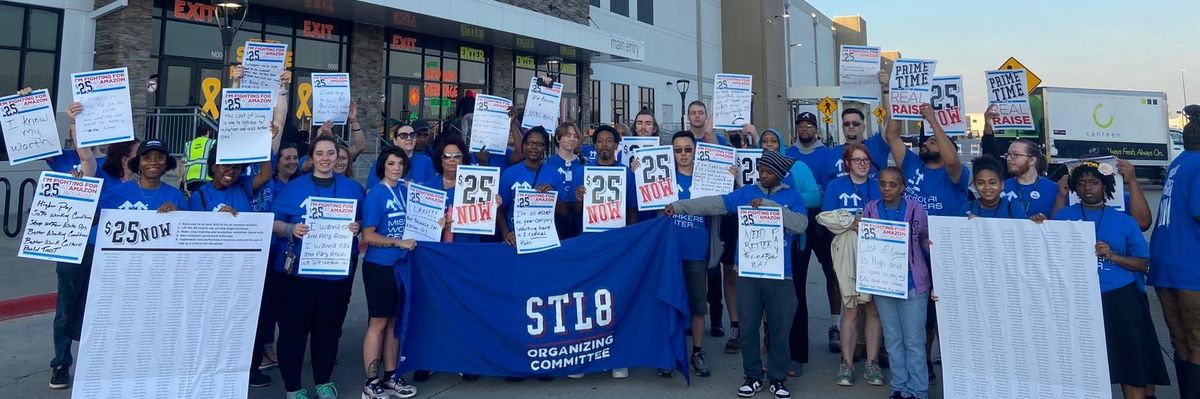
Amazon workers rally for $25 an hour in St. Louis on September 18, 2024.
"Today shows that Amazon workers are united and stronger than ever in our demands for higher pay," said one warehouse worker and organizer.
As Amazon workers across the United States launched a campaign demanding at least $25 an hour, the e-commerce giant announced Wednesday that it is raising hourly pay for its warehouse workers and drivers.
In what Amazon vice president of worldwide operations Udit Madan called the company's "biggest-ever investment in pay and benefits," the average starting pay for U.S. fulfillment and transportation workers will rise starting this month.
"Members of our front-line team will be getting at least an additional $1.50/hour starting this month, which will bring their average base wage to more than $22/hour and average total compensation to more than $29/hour when you include the value of their elected benefits," such as healthcare, said Madan, who added that the workers will also receive free Amazon Prime subscriptions.
While the Amazon workers who launched the drive for $25 welcomed the announcement, they say they deserve more.
"I've lost out on thousands of dollars of income. I haven't gotten a paycheck since my short-term disability—which only covered 60% of my regular pay—ended in January," said Christine, a worker at Amazon's STL8 fulfillment center in Missouri and longtime member of the STL8 Organizing Committee.
"I'm awaiting approval for long-term disability, which I applied for back in January," explained Christine, who was injured on the job. "I've maxed out my credit cards and drained my 401(k). I'm on food stamps. I just got approved for Medicaid. At one point I started a GoFundMe just to make rent. I've never been in the position of having to ask for money, but the alternative was homelessness. When you're forced into that position, you do what it takes to survive."
"Today shows that Amazon workers are united and stronger than ever in our demands for higher pay," she added. "With over 800 worker signatures on our petition and new workers joining us from across the region, together we will win the $25 an hour that we all deserve."
According to the campaign:
Research suggests working families need at least $25 to make it by. In Missouri, for example, a livable wage for a family of four is at least $25; in New York, the livable wage is even higher, at $39. However, a majority of Amazon warehouse workers reported earning wages between $16 and $20—before Amazon increased starting pay to $17 in September 2023. Amazon itself reports an average pay of $20.50.
"The $1 raise that Amazon gave workers last year was shameful. After accounting for inflation, it wasn't even a raise," lamented Irene Tung, senior researcher and policy analyst at the National Employment Law Project. "Our research has shown that Amazon tends to locate its warehouses in high earnings counties around the country, but lags behind other warehouse employers in pay—even though it can afford to pay workers much more."
Advocates point to Amazon's $30.4 billion 2023 profits as proof that the company can afford to pay its workers more.
"Raising pay by 25% would bring Amazon workers much closer to a middle-income standard of earnings," Tung said. "Given Amazon's size and the enormity of its wealth, it is not far-fetched to ask why this company has thus far failed at creating middle-income jobs for the hundreds of thousands of U.S. workers that power its operations."
Beth Gutelius—the author of Handling Hardship: Data on Economic Insecurity Among Amazon Warehouse Workers—said in a statement that "if warehouse wages had kept pace with inflation, workers would be earning $25.66 an hour—so workers are simply asking Amazon to bring wages in line with the cost of living, which as we know has risen sharply."
"Doing so would help ensure that workers are able to meet their basic needs without relying on public assistance," she added.
Dear Common Dreams reader, It’s been nearly 30 years since I co-founded Common Dreams with my late wife, Lina Newhouser. We had the radical notion that journalism should serve the public good, not corporate profits. It was clear to us from the outset what it would take to build such a project. No paid advertisements. No corporate sponsors. No millionaire publisher telling us what to think or do. Many people said we wouldn't last a year, but we proved those doubters wrong. Together with a tremendous team of journalists and dedicated staff, we built an independent media outlet free from the constraints of profits and corporate control. Our mission has always been simple: To inform. To inspire. To ignite change for the common good. Building Common Dreams was not easy. Our survival was never guaranteed. When you take on the most powerful forces—Wall Street greed, fossil fuel industry destruction, Big Tech lobbyists, and uber-rich oligarchs who have spent billions upon billions rigging the economy and democracy in their favor—the only bulwark you have is supporters who believe in your work. But here’s the urgent message from me today. It's never been this bad out there. And it's never been this hard to keep us going. At the very moment Common Dreams is most needed, the threats we face are intensifying. We need your support now more than ever. We don't accept corporate advertising and never will. We don't have a paywall because we don't think people should be blocked from critical news based on their ability to pay. Everything we do is funded by the donations of readers like you. When everyone does the little they can afford, we are strong. But if that support retreats or dries up, so do we. Will you donate now to make sure Common Dreams not only survives but thrives? —Craig Brown, Co-founder |
As Amazon workers across the United States launched a campaign demanding at least $25 an hour, the e-commerce giant announced Wednesday that it is raising hourly pay for its warehouse workers and drivers.
In what Amazon vice president of worldwide operations Udit Madan called the company's "biggest-ever investment in pay and benefits," the average starting pay for U.S. fulfillment and transportation workers will rise starting this month.
"Members of our front-line team will be getting at least an additional $1.50/hour starting this month, which will bring their average base wage to more than $22/hour and average total compensation to more than $29/hour when you include the value of their elected benefits," such as healthcare, said Madan, who added that the workers will also receive free Amazon Prime subscriptions.
While the Amazon workers who launched the drive for $25 welcomed the announcement, they say they deserve more.
"I've lost out on thousands of dollars of income. I haven't gotten a paycheck since my short-term disability—which only covered 60% of my regular pay—ended in January," said Christine, a worker at Amazon's STL8 fulfillment center in Missouri and longtime member of the STL8 Organizing Committee.
"I'm awaiting approval for long-term disability, which I applied for back in January," explained Christine, who was injured on the job. "I've maxed out my credit cards and drained my 401(k). I'm on food stamps. I just got approved for Medicaid. At one point I started a GoFundMe just to make rent. I've never been in the position of having to ask for money, but the alternative was homelessness. When you're forced into that position, you do what it takes to survive."
"Today shows that Amazon workers are united and stronger than ever in our demands for higher pay," she added. "With over 800 worker signatures on our petition and new workers joining us from across the region, together we will win the $25 an hour that we all deserve."
According to the campaign:
Research suggests working families need at least $25 to make it by. In Missouri, for example, a livable wage for a family of four is at least $25; in New York, the livable wage is even higher, at $39. However, a majority of Amazon warehouse workers reported earning wages between $16 and $20—before Amazon increased starting pay to $17 in September 2023. Amazon itself reports an average pay of $20.50.
"The $1 raise that Amazon gave workers last year was shameful. After accounting for inflation, it wasn't even a raise," lamented Irene Tung, senior researcher and policy analyst at the National Employment Law Project. "Our research has shown that Amazon tends to locate its warehouses in high earnings counties around the country, but lags behind other warehouse employers in pay—even though it can afford to pay workers much more."
Advocates point to Amazon's $30.4 billion 2023 profits as proof that the company can afford to pay its workers more.
"Raising pay by 25% would bring Amazon workers much closer to a middle-income standard of earnings," Tung said. "Given Amazon's size and the enormity of its wealth, it is not far-fetched to ask why this company has thus far failed at creating middle-income jobs for the hundreds of thousands of U.S. workers that power its operations."
Beth Gutelius—the author of Handling Hardship: Data on Economic Insecurity Among Amazon Warehouse Workers—said in a statement that "if warehouse wages had kept pace with inflation, workers would be earning $25.66 an hour—so workers are simply asking Amazon to bring wages in line with the cost of living, which as we know has risen sharply."
"Doing so would help ensure that workers are able to meet their basic needs without relying on public assistance," she added.
As Amazon workers across the United States launched a campaign demanding at least $25 an hour, the e-commerce giant announced Wednesday that it is raising hourly pay for its warehouse workers and drivers.
In what Amazon vice president of worldwide operations Udit Madan called the company's "biggest-ever investment in pay and benefits," the average starting pay for U.S. fulfillment and transportation workers will rise starting this month.
"Members of our front-line team will be getting at least an additional $1.50/hour starting this month, which will bring their average base wage to more than $22/hour and average total compensation to more than $29/hour when you include the value of their elected benefits," such as healthcare, said Madan, who added that the workers will also receive free Amazon Prime subscriptions.
While the Amazon workers who launched the drive for $25 welcomed the announcement, they say they deserve more.
"I've lost out on thousands of dollars of income. I haven't gotten a paycheck since my short-term disability—which only covered 60% of my regular pay—ended in January," said Christine, a worker at Amazon's STL8 fulfillment center in Missouri and longtime member of the STL8 Organizing Committee.
"I'm awaiting approval for long-term disability, which I applied for back in January," explained Christine, who was injured on the job. "I've maxed out my credit cards and drained my 401(k). I'm on food stamps. I just got approved for Medicaid. At one point I started a GoFundMe just to make rent. I've never been in the position of having to ask for money, but the alternative was homelessness. When you're forced into that position, you do what it takes to survive."
"Today shows that Amazon workers are united and stronger than ever in our demands for higher pay," she added. "With over 800 worker signatures on our petition and new workers joining us from across the region, together we will win the $25 an hour that we all deserve."
According to the campaign:
Research suggests working families need at least $25 to make it by. In Missouri, for example, a livable wage for a family of four is at least $25; in New York, the livable wage is even higher, at $39. However, a majority of Amazon warehouse workers reported earning wages between $16 and $20—before Amazon increased starting pay to $17 in September 2023. Amazon itself reports an average pay of $20.50.
"The $1 raise that Amazon gave workers last year was shameful. After accounting for inflation, it wasn't even a raise," lamented Irene Tung, senior researcher and policy analyst at the National Employment Law Project. "Our research has shown that Amazon tends to locate its warehouses in high earnings counties around the country, but lags behind other warehouse employers in pay—even though it can afford to pay workers much more."
Advocates point to Amazon's $30.4 billion 2023 profits as proof that the company can afford to pay its workers more.
"Raising pay by 25% would bring Amazon workers much closer to a middle-income standard of earnings," Tung said. "Given Amazon's size and the enormity of its wealth, it is not far-fetched to ask why this company has thus far failed at creating middle-income jobs for the hundreds of thousands of U.S. workers that power its operations."
Beth Gutelius—the author of Handling Hardship: Data on Economic Insecurity Among Amazon Warehouse Workers—said in a statement that "if warehouse wages had kept pace with inflation, workers would be earning $25.66 an hour—so workers are simply asking Amazon to bring wages in line with the cost of living, which as we know has risen sharply."
"Doing so would help ensure that workers are able to meet their basic needs without relying on public assistance," she added.