SUBSCRIBE TO OUR FREE NEWSLETTER
Daily news & progressive opinion—funded by the people, not the corporations—delivered straight to your inbox.
5
#000000
#FFFFFF
To donate by check, phone, or other method, see our More Ways to Give page.
Daily news & progressive opinion—funded by the people, not the corporations—delivered straight to your inbox.
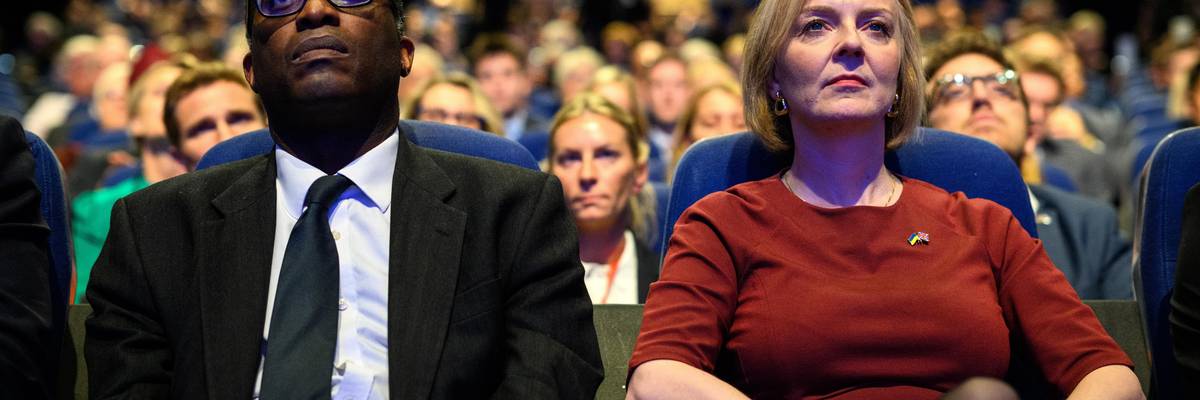
British Prime Minister Liz Truss and Chancellor of the Exchequer Kwasi Kwarteng attend the annual Conservative Party conference on October 2, 2022 in Birmingham, England. (Photo: Leon Neal/Getty Images)
Progressives welcomed right-wing British Prime Minister Liz Truss' Monday decision to scrap a widely condemned tax break for wealthy individuals but warned of looming public spending cuts tied to planned corporate giveaways and called for a reversal of the decadeslong neoliberal model that has brought the United Kingdom to the brink of an economic calamity.
"They need to reverse their whole economic, discredited trickle-down strategy."
The proposed elimination of the U.K's top income tax rate of 45% was a small part of the regressive fiscal and deregulatory framework unveiled by Truss, who was picked by the ruling right-wing Tory Party less than a month ago to become the nation's fourth prime minister in the last six years.
Her entire "mini-budget"--an assemblage of PS45 billion ($50.7 billion) in unfunded tax cuts announced September 23 by British Chancellor of the Exchequer Kwasi Kwarteng--triggered chaos in financial markets and pushback from across the political spectrum, with the left-wing Enough is Enough campaign organizing massive anti-austerity protests this past weekend.
Even some Tory lawmakers expressed resistance to parts of Truss' package, especially the now jettisoned plan to nix the 45% tax rate--an additional levy paid by Britain's richest 1%, or roughly 600,000 citizens with annual incomes above PS150,000 ($168,390). Beneficiaries of the tax break would have gained an estimated PS10,000 ($11,275) per year, on average, while the nation's top 0.1% would have gained at least PS22,000 ($24,805) per year.
Ben Houchen, the Tory mayor of Tees Valley in northeast England, said Sunday at the party's annual conference in Birmingham that pursuing a move that so nakedly favors the rich amid a cost-of-living crisis is "very naive," while an unnamed Tory MP described it as "deranged," and former Tory cabinet minister Michael Gove called it wrong to implement when "people are suffering."
During an emergency meeting convened by Truss and Kwarteng after several Tory MPs indicated publicly that they would vote against the measure, one senior cabinet minister reportedly said that "the politics of this were just awful and I am amazed the idea has lasted as long as it did."
Less than 24 hours after Truss tried to defend the contentious policy one last time on Sunday, Kwarteng issued a statement Monday declaring that "we get it, and we have listened."
"We are not proceeding with the abolition of the 45% tax rate," said Kwarteng, who called it "a distraction from our overriding mission to tackle the challenges facing our country."
While welcoming "the U-turn," left-wing Labour Party MP Jeremy Corbyn wrote on social media that "if you really wanted to 'listen,' you'd also raise benefits, reverse cuts to [the] corporation tax, and reinstate the cap on bankers' bonuses."
"Twelve years of failed Tory economics have plunged millions into poverty," Corbyn added. "Do you 'get it' now?"
Zarah Sultana, another left-wing Labour Party MP and co-founder of Enough is Enough, told Kwarteng in no uncertain terms that he doesn't "get it" and urged him to "ditch this Tory class war."
Truss' abandoned attempt to axe the U.K.'s top income tax rate would have cost between PS2 to PS3 billion ($2.3 to $3.4 billion), representing just a portion of the PS45 billion ($50.7 billion) in unfunded tax cuts proposed by her administration.
As the Financial Times reported:
Having retreated on the 45% tax rate plan, Kwarteng and Truss could now come under pressure to reverse other proposed unfunded tax cuts that have blown a hole in the public finances.
They include a PS13 billion ($14.7 billion) reduction in national insurance, which gives the biggest benefit to better-off voters, and a PS17 billion ($19.2 billion) plan to reverse a corporation tax rise--a policy that business leaders have said is not a priority.
Just minutes after announcing the preservation of the 45% tax rate, Kwarteng confirmed that up to PS18 billion ($20.3 billion) in annual public service spending remains on the chopping block even though economists have warned that this would have devastating impacts on the nation's public healthcare and education systems.
The level of impending public service cuts is nearly identical to the PS18.7 ($21.1 billion) billion corporate tax cut still being pushed by Truss.
The Tories' plan for a simultaneous corporate tax cut and reduction in public services is "a direct trade-off," Enough is Enough tweeted Monday. "Our pain for their profits."
At one of the dozens of Enough is Enough rallies held Saturday, Eddie Dempsey of the National Union of Rail, Maritime, and Transport Workers characterized Truss' austerity budget as a "diabolical disaster."
After having crashed the British pound, he warned, Tories are "going to massively cut expenditure on public services."
"We've got to have a change in direction," said Dempsey. "We need an economy for the people with public ownership, outside of the chaos of the market, so we can have a decent standard of living rather than making this country one big trough for the corporate privateers to stick their noses in and cream off all of our wealth."
That message was echoed by Labour Party MP Rachel Reeves, who said Monday in a statement responding to Truss and Kwarteng's about-face on slashing taxes for Britain's richest households that "they need to reverse their whole economic, discredited trickle-down strategy."
Dear Common Dreams reader, It’s been nearly 30 years since I co-founded Common Dreams with my late wife, Lina Newhouser. We had the radical notion that journalism should serve the public good, not corporate profits. It was clear to us from the outset what it would take to build such a project. No paid advertisements. No corporate sponsors. No millionaire publisher telling us what to think or do. Many people said we wouldn't last a year, but we proved those doubters wrong. Together with a tremendous team of journalists and dedicated staff, we built an independent media outlet free from the constraints of profits and corporate control. Our mission has always been simple: To inform. To inspire. To ignite change for the common good. Building Common Dreams was not easy. Our survival was never guaranteed. When you take on the most powerful forces—Wall Street greed, fossil fuel industry destruction, Big Tech lobbyists, and uber-rich oligarchs who have spent billions upon billions rigging the economy and democracy in their favor—the only bulwark you have is supporters who believe in your work. But here’s the urgent message from me today. It's never been this bad out there. And it's never been this hard to keep us going. At the very moment Common Dreams is most needed, the threats we face are intensifying. We need your support now more than ever. We don't accept corporate advertising and never will. We don't have a paywall because we don't think people should be blocked from critical news based on their ability to pay. Everything we do is funded by the donations of readers like you. When everyone does the little they can afford, we are strong. But if that support retreats or dries up, so do we. Will you donate now to make sure Common Dreams not only survives but thrives? —Craig Brown, Co-founder |
Progressives welcomed right-wing British Prime Minister Liz Truss' Monday decision to scrap a widely condemned tax break for wealthy individuals but warned of looming public spending cuts tied to planned corporate giveaways and called for a reversal of the decadeslong neoliberal model that has brought the United Kingdom to the brink of an economic calamity.
"They need to reverse their whole economic, discredited trickle-down strategy."
The proposed elimination of the U.K's top income tax rate of 45% was a small part of the regressive fiscal and deregulatory framework unveiled by Truss, who was picked by the ruling right-wing Tory Party less than a month ago to become the nation's fourth prime minister in the last six years.
Her entire "mini-budget"--an assemblage of PS45 billion ($50.7 billion) in unfunded tax cuts announced September 23 by British Chancellor of the Exchequer Kwasi Kwarteng--triggered chaos in financial markets and pushback from across the political spectrum, with the left-wing Enough is Enough campaign organizing massive anti-austerity protests this past weekend.
Even some Tory lawmakers expressed resistance to parts of Truss' package, especially the now jettisoned plan to nix the 45% tax rate--an additional levy paid by Britain's richest 1%, or roughly 600,000 citizens with annual incomes above PS150,000 ($168,390). Beneficiaries of the tax break would have gained an estimated PS10,000 ($11,275) per year, on average, while the nation's top 0.1% would have gained at least PS22,000 ($24,805) per year.
Ben Houchen, the Tory mayor of Tees Valley in northeast England, said Sunday at the party's annual conference in Birmingham that pursuing a move that so nakedly favors the rich amid a cost-of-living crisis is "very naive," while an unnamed Tory MP described it as "deranged," and former Tory cabinet minister Michael Gove called it wrong to implement when "people are suffering."
During an emergency meeting convened by Truss and Kwarteng after several Tory MPs indicated publicly that they would vote against the measure, one senior cabinet minister reportedly said that "the politics of this were just awful and I am amazed the idea has lasted as long as it did."
Less than 24 hours after Truss tried to defend the contentious policy one last time on Sunday, Kwarteng issued a statement Monday declaring that "we get it, and we have listened."
"We are not proceeding with the abolition of the 45% tax rate," said Kwarteng, who called it "a distraction from our overriding mission to tackle the challenges facing our country."
While welcoming "the U-turn," left-wing Labour Party MP Jeremy Corbyn wrote on social media that "if you really wanted to 'listen,' you'd also raise benefits, reverse cuts to [the] corporation tax, and reinstate the cap on bankers' bonuses."
"Twelve years of failed Tory economics have plunged millions into poverty," Corbyn added. "Do you 'get it' now?"
Zarah Sultana, another left-wing Labour Party MP and co-founder of Enough is Enough, told Kwarteng in no uncertain terms that he doesn't "get it" and urged him to "ditch this Tory class war."
Truss' abandoned attempt to axe the U.K.'s top income tax rate would have cost between PS2 to PS3 billion ($2.3 to $3.4 billion), representing just a portion of the PS45 billion ($50.7 billion) in unfunded tax cuts proposed by her administration.
As the Financial Times reported:
Having retreated on the 45% tax rate plan, Kwarteng and Truss could now come under pressure to reverse other proposed unfunded tax cuts that have blown a hole in the public finances.
They include a PS13 billion ($14.7 billion) reduction in national insurance, which gives the biggest benefit to better-off voters, and a PS17 billion ($19.2 billion) plan to reverse a corporation tax rise--a policy that business leaders have said is not a priority.
Just minutes after announcing the preservation of the 45% tax rate, Kwarteng confirmed that up to PS18 billion ($20.3 billion) in annual public service spending remains on the chopping block even though economists have warned that this would have devastating impacts on the nation's public healthcare and education systems.
The level of impending public service cuts is nearly identical to the PS18.7 ($21.1 billion) billion corporate tax cut still being pushed by Truss.
The Tories' plan for a simultaneous corporate tax cut and reduction in public services is "a direct trade-off," Enough is Enough tweeted Monday. "Our pain for their profits."
At one of the dozens of Enough is Enough rallies held Saturday, Eddie Dempsey of the National Union of Rail, Maritime, and Transport Workers characterized Truss' austerity budget as a "diabolical disaster."
After having crashed the British pound, he warned, Tories are "going to massively cut expenditure on public services."
"We've got to have a change in direction," said Dempsey. "We need an economy for the people with public ownership, outside of the chaos of the market, so we can have a decent standard of living rather than making this country one big trough for the corporate privateers to stick their noses in and cream off all of our wealth."
That message was echoed by Labour Party MP Rachel Reeves, who said Monday in a statement responding to Truss and Kwarteng's about-face on slashing taxes for Britain's richest households that "they need to reverse their whole economic, discredited trickle-down strategy."
Progressives welcomed right-wing British Prime Minister Liz Truss' Monday decision to scrap a widely condemned tax break for wealthy individuals but warned of looming public spending cuts tied to planned corporate giveaways and called for a reversal of the decadeslong neoliberal model that has brought the United Kingdom to the brink of an economic calamity.
"They need to reverse their whole economic, discredited trickle-down strategy."
The proposed elimination of the U.K's top income tax rate of 45% was a small part of the regressive fiscal and deregulatory framework unveiled by Truss, who was picked by the ruling right-wing Tory Party less than a month ago to become the nation's fourth prime minister in the last six years.
Her entire "mini-budget"--an assemblage of PS45 billion ($50.7 billion) in unfunded tax cuts announced September 23 by British Chancellor of the Exchequer Kwasi Kwarteng--triggered chaos in financial markets and pushback from across the political spectrum, with the left-wing Enough is Enough campaign organizing massive anti-austerity protests this past weekend.
Even some Tory lawmakers expressed resistance to parts of Truss' package, especially the now jettisoned plan to nix the 45% tax rate--an additional levy paid by Britain's richest 1%, or roughly 600,000 citizens with annual incomes above PS150,000 ($168,390). Beneficiaries of the tax break would have gained an estimated PS10,000 ($11,275) per year, on average, while the nation's top 0.1% would have gained at least PS22,000 ($24,805) per year.
Ben Houchen, the Tory mayor of Tees Valley in northeast England, said Sunday at the party's annual conference in Birmingham that pursuing a move that so nakedly favors the rich amid a cost-of-living crisis is "very naive," while an unnamed Tory MP described it as "deranged," and former Tory cabinet minister Michael Gove called it wrong to implement when "people are suffering."
During an emergency meeting convened by Truss and Kwarteng after several Tory MPs indicated publicly that they would vote against the measure, one senior cabinet minister reportedly said that "the politics of this were just awful and I am amazed the idea has lasted as long as it did."
Less than 24 hours after Truss tried to defend the contentious policy one last time on Sunday, Kwarteng issued a statement Monday declaring that "we get it, and we have listened."
"We are not proceeding with the abolition of the 45% tax rate," said Kwarteng, who called it "a distraction from our overriding mission to tackle the challenges facing our country."
While welcoming "the U-turn," left-wing Labour Party MP Jeremy Corbyn wrote on social media that "if you really wanted to 'listen,' you'd also raise benefits, reverse cuts to [the] corporation tax, and reinstate the cap on bankers' bonuses."
"Twelve years of failed Tory economics have plunged millions into poverty," Corbyn added. "Do you 'get it' now?"
Zarah Sultana, another left-wing Labour Party MP and co-founder of Enough is Enough, told Kwarteng in no uncertain terms that he doesn't "get it" and urged him to "ditch this Tory class war."
Truss' abandoned attempt to axe the U.K.'s top income tax rate would have cost between PS2 to PS3 billion ($2.3 to $3.4 billion), representing just a portion of the PS45 billion ($50.7 billion) in unfunded tax cuts proposed by her administration.
As the Financial Times reported:
Having retreated on the 45% tax rate plan, Kwarteng and Truss could now come under pressure to reverse other proposed unfunded tax cuts that have blown a hole in the public finances.
They include a PS13 billion ($14.7 billion) reduction in national insurance, which gives the biggest benefit to better-off voters, and a PS17 billion ($19.2 billion) plan to reverse a corporation tax rise--a policy that business leaders have said is not a priority.
Just minutes after announcing the preservation of the 45% tax rate, Kwarteng confirmed that up to PS18 billion ($20.3 billion) in annual public service spending remains on the chopping block even though economists have warned that this would have devastating impacts on the nation's public healthcare and education systems.
The level of impending public service cuts is nearly identical to the PS18.7 ($21.1 billion) billion corporate tax cut still being pushed by Truss.
The Tories' plan for a simultaneous corporate tax cut and reduction in public services is "a direct trade-off," Enough is Enough tweeted Monday. "Our pain for their profits."
At one of the dozens of Enough is Enough rallies held Saturday, Eddie Dempsey of the National Union of Rail, Maritime, and Transport Workers characterized Truss' austerity budget as a "diabolical disaster."
After having crashed the British pound, he warned, Tories are "going to massively cut expenditure on public services."
"We've got to have a change in direction," said Dempsey. "We need an economy for the people with public ownership, outside of the chaos of the market, so we can have a decent standard of living rather than making this country one big trough for the corporate privateers to stick their noses in and cream off all of our wealth."
That message was echoed by Labour Party MP Rachel Reeves, who said Monday in a statement responding to Truss and Kwarteng's about-face on slashing taxes for Britain's richest households that "they need to reverse their whole economic, discredited trickle-down strategy."