

SUBSCRIBE TO OUR FREE NEWSLETTER
Daily news & progressive opinion—funded by the people, not the corporations—delivered straight to your inbox.
5
#000000
#FFFFFF
To donate by check, phone, or other method, see our More Ways to Give page.
Daily news & progressive opinion—funded by the people, not the corporations—delivered straight to your inbox.
"U.S. military service is the strongest predictor of carrying out extremist violence," noted one expert.
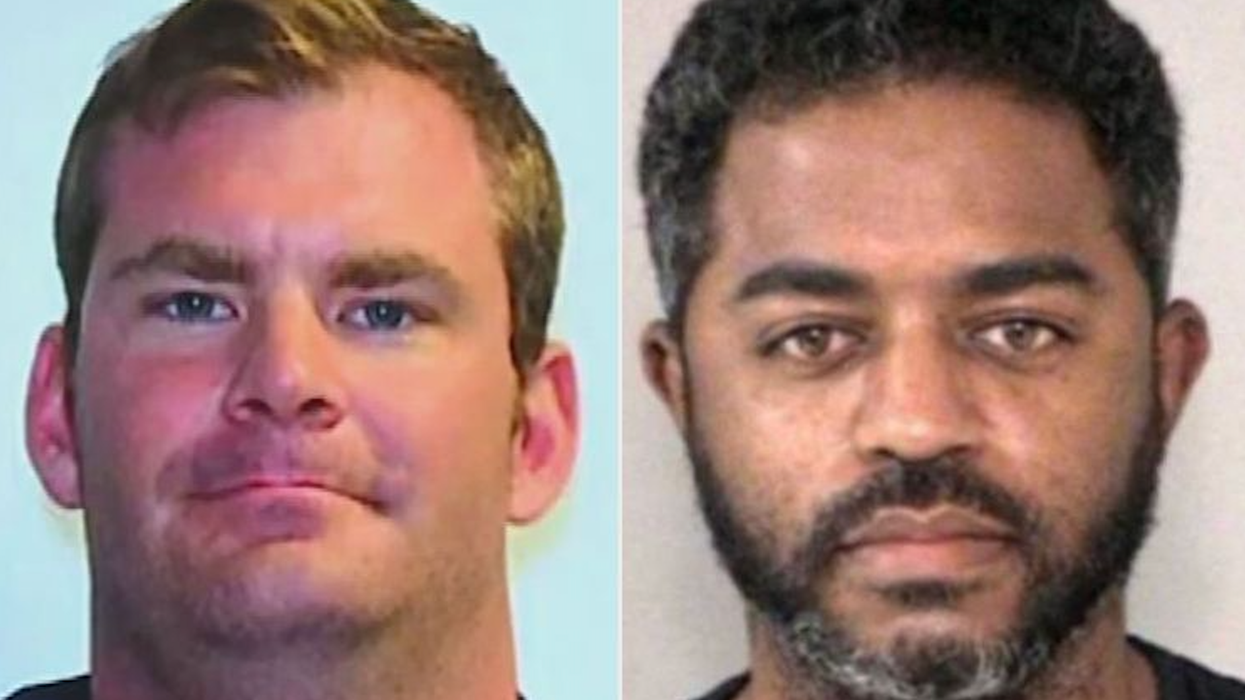
As right-wing figures blamed factors ranging from Islam to the Biden administration's nonexistent "open borders policy" for the deadly New Year's Day attacks in New Orleans and Las Vegas, progressive observers noted Thursday that the men who carried out those attacks both served in the U.S. military, which one historian called "a consistent incubator of violence that returns home."
Republican U.S. President-elect Donald Trump was among those weighing in on the New Orleans attack, in which authorities say 42-year-old Shamsud Din-Jabbar—who was killed at the scene during a shootout with police—plowed a pickup truck into a crowd of New Year's revelers on Bourbon Street, killing 15 people and wounding dozens more.
Apparently misinformed by an erroneous Fox News report, Trump falsely called Jabbar a career criminal and recent immigrant and attributed the New Orleans attack to President Joe Biden's "open border's (sic) policy."
"That Mr. Trump persists in deploying the politics of hate and bigotry is a bad sign for the U.S."
Jabbar was born and raised in Texas. He was an active-duty U.S. Army soldier from 2007-15 and a veteran of the war in Afghanistan.
"He was, in short, a patriotic American who did his part in fighting the War on Terror," Juan Cole wrote Thursday on his Informed Comment site. "He was not an immigrant or a member of a foreign criminal gang."
"That Mr. Trump persists in deploying the politics of hate and bigotry is a bad sign for the U.S.," Cole continued. "Even if Jabbar had been a immigrant, his actions would have said nothing about immigrants, who have low rates of criminality compared to the native-born population and whose productivity has been one key to American economic success."
"Nor is Jabbar's religion a reason to engage in Muslim-hatred," he asserted, decrying the New York Post for "ominously" reporting that "Jabbar referenced the Quran" and had animals including sheep, goats, and chickens in the backyard of his Houston home.
"D'oh," Cole added. "He was a Muslim. He also referenced the Quran when he was in Afghanistan as part of the U.S. Army's fight against the Taliban."
Matthew Livelsberger, the 37-year-old suspected driver of the Tesla Cybertruck blown ups outside the Trump International Las Vegas Hotel on Wednesday, was an active-duty U.S. Army soldier. The explosion of the truck, which was laden with fireworks and fuel canisters, injured seven people. Authorities said Livelsberger fatally shot himself inside the vehicle before the blast.
While given scant in-depth coverage in the U.S. corporate media, numerous observers highlighted the attackers' military backgrounds.
The Intercept's Nick Turse on Thursday published a piece asserting that "U.S. military service is the strongest predictor of carrying out extremist violence." Citing a new, unreleased report from researchers at the University of Maryland's National Consortium for the Study of Terrorism and Responses to Terrorism (START), Turse, who viewed the publication, noted that "from 1990 to 2010, about seven persons per year with U.S. military backgrounds committed extremist crimes," and that "since 2011, that number has jumped to almost 45 per year."
Turse continued:
From 1990 through 2023, 730 individuals with U.S. military backgrounds committed criminal acts that were motivated by their political, economic, social, or religious goals, according to data from the new START report. From 1990 to 2022, successful violent plots that included perpetrators with a connection to the U.S. military resulted in 314 deaths and 1,978 injuries—a significant number of which came from the 1995 bombing of the Murrah Federal Building in Oklahoma City.
"Military service is also the single strongest individual predictor of becoming a 'mass casualty offender,' far outpacing mental health issues, according to a separate study of extremist mass casualty violence by the researchers," Turse added.
Both Jabbar and Livelsberger were once stationed at Fort Liberty, formerly Fort Bragg, in North Carolina. Although their time there overlapped, there is no indication that the men knew each other. Turse called Fort Liberty "an exceptionally troubled Army base."
"Investigations found, for example, that 109 soldiers assigned there died in 2020 and 2021," he wrote. "Ninety-six percent of those deaths took place stateside. Fewer than 20 were from natural causes. The remaining soldier fatalities, including macabre or unexplained deaths, homicides, and dozens of drug overdoses, were preventable."
The issue of violence committed by soldiers and veterans gained national attention during the height of the so-called War on Terrord—which is still ongoing—amid a wave of domestic and other killings and suicides attributed to post-traumatic stress disorder. According to the U.S. Department of Veterans Affairs (VA), more than 1 in 6 veterans of the Afghanistan or Iraq wars screened positive for PTSD, compared with about 1 in 10 nondeployed vets.
The VA also reported in 2018 that 1 in 4 male and 1 in 5 female veterans deployed during the War on Terror who received care from the agency had PTSD.
There is also the issue of who the military allowed to enlist. In an effort to fill the military's ranks during the War on Terror, some service branches lowered recruiting standards and allowed neo-Nazis, gang members, and other violent criminals to serve.
"This policy, which was behind many atrocities abroad, is now coming home," author Matt Kennard said Thursday on social media.
In 2022, Democratic U.S. lawmakers led by Rep. Brad Schneider (D-Ill.) introduced an amendment to 2023 military spending bill requiring the Pentagon and federal law enforcement agencies to publish a report on countering white supremacist and neo-Nazi activity in the armed forces.
The measure passed—without a single Republican vote.
"Companies are generating record profits and we demand that workers aren't left behind and have a fair share of that success," said one Culinary Union leader.
Members of two Nevada labor unions—including the state's largest—on Tuesday overwhelmingly voted to authorize a citywide strike at 22 Las Vegas casinos, while continuing to negotiate a new contract "in good faith" with gaming companies.
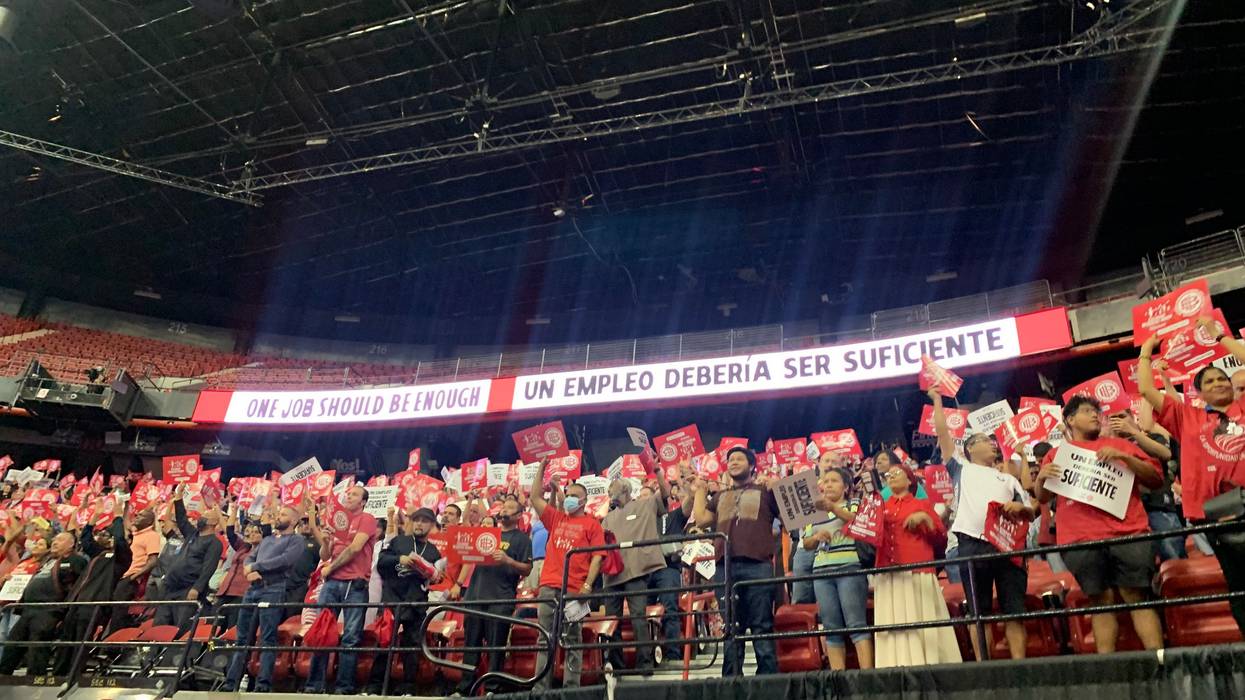
Chanting "one job should be enough," tens of thousands of cocktail and food servers, bartenders, cooks, porters, and other non-gaming hotel employees in the Culinary Union Local 226 and Bartenders Union Local 165—affiliates of the Unite Here—packed the Thomas and Mack Center at the University of Nevada, Las Vegas, where they voted by 95% during two sessions to approve a work stoppage at Las Vegas Strip properties owned by MGM Resorts, Caesars Entertainment, and Wynn/Encore Resorts.
The affiliated unions—which represent 60,000 Nevada workers, including 53,000 in Las Vegas—can now call a strike at any time. It would be the first citywide strike in the resort industry in nearly 40 years.
Since September 15, 40,000 union members have been working under an expired contract. The Culinary Union said it remains in "active negotiations" with employers over a new five-year contract.
"Today, Culinary and Bartenders union members have sent the strongest message possible to the casino industry to settle a fair contract as soon as possible," Culinary Union secretary-treasurer Ted Pappageorge said in a statement. "We have negotiations scheduled next week with MGM Resorts, Caesars Entertainment, and Wynn/Encore Resorts and it's up to the three largest employers in Las Vegas to step up and do the right thing."
"If these gaming companies don't come to an agreement, the workers have spoken and we will be ready to do whatever it takes—up to and including a strike," Pappageorge added. "Companies are generating record profits and we demand that workers aren't left behind and have a fair share of that success."
Las Vegas set an all-time record for gaming revenue for the second straight year last year, despite the Covid-19 pandemic. The city's casino resorts reported $14.8 billion in 2022 revenue, a 10.5% increase over the previous year.
The unions' objectives include:
"I voted yes to authorize a strike because I'm fighting for my family and for our future," said Maria Sanchez, a Culinary Union member who works as a guest room attendant at the Bellagio. "The workload since the pandemic has been intense and when I get home I'm so tired and I don't have energy to take my two kids to the park or play with them. I feel sad like I'm just living to work and it's not right."
"I feel sad like I'm just living to work and it's not right."
"I was thinking about getting a second job, but I'm already doing more than one job at work right now and I believe that one job should be enough," she added. "I voted yes to win the best contract ever so that I can work one job and come home to spend time with my children."
In 2018, members of the Culinary and Bartenders unions voted to authorize a strike. A new contract was negotiated shortly after the vote, averting a work stoppage.
Last year, members of the Local 54 chapter of the Unite Here union—which represents hospitality industry employees in Atlantic City, New Jersey—negotiated new contracts that included the workers' largest-ever raise.
Nevada's unpredictable electorate and "fractured Latino vote" are in the spotlight on the eve of the state's Democratic caucus, with polls showing Hillary Clinton and Bernie Sanders going into Saturday's contest neck-and-neck.
While the Silver State was supposed to be a lock for Clinton, recent endorsements (and non-endorsements) and demonstrable voter enthusiasm have signaled a Sanders surge backed up by polling.
| #americatogether Tweets |
As The New Republic explained, "Nevada offers a much different terrain" than Iowa or New Hampshire: "The state's population is 28 percent Latino, 8 percent Asian-American, and 9 percent African-American."
"Sanders needs to prove he can win over Latinos, Asian-Americans, and African-Americans--there's no other way that he can seriously compete for the nomination," wrote TNR's Jeet Heer. "Clinton, conversely, needs to prove that her 'firewall' of non-white support, which she's also counting on in the upcoming Southern primaries, will be strong enough to block Sanders."
Des Moines Register reporter Jennifer Jacobs wrote on Friday:
For Clinton to be victorious in the Nevada caucuses, she needs blacks and Latinos to turn out in numbers like in the 2008 race, and she needs to carry that Las Vegas-based segment of the electorate. She has to make sure she doesn't get swamped in rural counties like she did running against Barack Obama eight years ago. And although she doesn't need to dominate Nevada's other population base -- Reno -- she needs to post a decent showing there.
"Our state is a three-pronged approach," said Leo Murrieta, a Democratic political consultant and Latino activist in Las Vegas who supports Clinton.
Sanders, who didn't open his first office here until October, three months later than Clinton, must thwart her meticulously planned strategy in those three areas by stoking the last-minute fever of enthusiasm that left-leaning Nevadans are feeling for him, strategists said.
Indeed, "the fractured Latino vote threatens further to erode Clinton's aura as the party's nominee-in-waiting," the Guardian reported on Friday.
While Clinton "still maintains the backing of Nevada's older, democratic establishment, including a string of prominent Latino figures...look beyond the endorsements from prominent figures, such as civil rights leaders Astrid Silva and Dolores Huerta and actor Eva Longoria, and the Latino community's alliances begins to fray," the paper continued, writing:
The same is true for unions in Nevada, which also tend to be heavily Latino and, in a service-sector dominated state, have historically been kingmakers in Democratic elections.
While labor leaders back Clinton, low-wage workers and indebted students are being drawn to the message of radical economic change propagated by the 74-year-old senator from Vermont who some are calling "El Viejito" (the little old man).
Meanwhile, the Clark County Black Caucus, an organization in Nevada's largest county, endorsed Sanders late Thursday. On Friday, the Sanders campaign launched its #AmericaTogether hashtag, highlighting the Vermont senator's multicultural appeal.
To that end, the Clinton campaign has appeared to be trying to lower expectations, painting Nevada as a largely-white state.
"There's an important Hispanic element to the Democratic caucus in Nevada, but it's still a state that is 80% white voters," Brian Fallon, the Clinton campaign press secretary, said last week. "You have a caucus-style format, and he'll have the momentum coming out of New Hampshire presumably, so there's a lot of reasons he should do well."
Renowned Nevada pundit Jon Ralston scoffed at that "canard," noting that "Nevada's Hispanic population is about 27 percent" and that "nearly half of the state's population is made up of minorities."
According to Politico, Sanders' surge in Nevada has been served by his "ability to tap directly into the bloodstream of Nevada progressives."
Politico reports:
While Clinton has been making a direct appeal to Latino voters here by saying she would go further than President Barack Obama on immigration reform, Sanders' resolute message reverberated across the demographic board here, party leaders said.
"Nevada was one of the states hit hardest by the Bush recession and the foreclosure crisis," said Rebecca Lambe, a senior adviser to the Nevada Democratic party and to Sen. Harry Reid, who has not endorsed a candidate in the race. "The unemployment rate was the worst in the nation. The Sanders campaign recognized that their candidate's economic message would resonate here and they pounced."
Or, as University of Nevada-Las Vegas English instructor and restaurant server Brittany Bronson wrote in a New York Times op-ed on Friday:
Clinton's proposals are a step in the right direction. But with the economy tepid and income inequality only growing, modesty is not a good enough policy. And as anyone who has spent time in the real Las Vegas -- the struggling, striving working-class metropolis behind the neon lights -- can attest, her proposals won't make a dent in most Americans' lives.
Nevada's recent history testifies to the tragic ramifications of corporate greed and power, but also to the benefits of worker-centered policies. Mr. Sanders speaks directly to those themes, and to voters' growing concerns. Nevada, more than any other early contest, will show how well he is getting through to them.
"With its relatively few delegates, Nevada isn't a do-or-die state--but its diversity does make it a bellwether state," Heer wrote at TNR. "If Sanders can pull off a win on Saturday, or even if he comes close, it'll be clear that his revolution has real legs."
Now that casino magnate and billionaire rightwinger Sheldon Adelson has been outed as the mystery buyer of an influential Nevada newspaper; a watchdog group is demanding that the publication appoint an independent public editor to monitor conflicts of interest and ethical breaches.
"Vigorous, independent journalism is vital to the health of democracy," Todd O'Boyle, director of Common Cause's Media and Democracy Reform Initiative, said Tuesday, responding to Adelson's purchase of the Las Vegas Review-Journal. "While the First Amendment protects Mr. Adelson's right to buy the paper and direct its operations, citizens should exercise their right to demand that he operate it in the public interest or openly declare that the reporting from his publication will be slanted."
"Mr. Adelson is perhaps the most deep-pocketed political donor in the country," O'Boyle added. "He is expected to spend tens of millions of dollars--and maybe more--to secure the Republican presidential nomination and then the presidency itself for his preferred candidate."
Jim Naureckas, the editor of Fairness and Accuracy in Reporting's watchdog journal Extra!, explained how the purchase could also impact people locally.
"Local newspapers are the main vehicle for the public to get a glimpse of what's going on at the level of government that most impacts their lives," Naureckas told Common Dreams. "Las Vegas is a one-industry town, and Adelson is a casino billionaire who is part of that industry. This will not be good for the people of Las Vegas."
The warnings are the latest twist to a saga that started shrouded in secrecy.
Earlier this month, staffers at the Las Vegas paper announced on Twitter that a buyer had purchased the publication for $140 million on the condition of anonymity, including from the outlet's workers. In demanding information about their new owner, journalists cited ethical requirements for journalistic transparency, and according to the New York Times, some were actively investigating the sale for a potential article.
But late last week, Fortune published the explosive revelation that Adelson—a controversial figure—had orchestrated the sale and structured it through his son-in-law, Patrick Dumont, the current senior vice president of finance and strategy at Adelson's Las Vegas Sands Corp.
Adelson's family soon confirmed the purchase, claiming they kept the sale secret because they "did not want an announcement to distract from the important role Nevada continues to play in the 2016 presidential elections."
Earlier this week, the Review-Journal ran an editorial reflecting on the potential implications for the paper, which they say has a "conservative/libertarian tilt," concluding that the publication could see some major editorial shifts, from a "complete reversal" on its drug policy positions to a noticeable shift on defense spending.
Looking to another Adelson purchase, the editorial also noted that the magnate "isn't shy about using his free Tel Aviv newspaper, Israel Hayom, to support Mr. Netanyahu and their shared positions. Whether any of this newspaper's editorial page positions change will go a long way toward further explaining why Mr. Adelson purchased the Review-Journal."
However, separate Review-Journal reporting from four days ago indicates that the Adelson purchase may have already impacted its journalistic coverage.
"Just over a month before Sheldon Adelson's family was revealed as the new owner of the Las Vegas Review-Journal, three reporters at the newspaper received an unusual assignment passed down from the newspaper's corporate management: Drop everything and spend two weeks monitoring all activity of three Clark County judges," journalists James DeHaven, Jennifer Robison, and Eric Hartley wrote.
One of the people closely observed was District Judge Elizabeth Gonzalez, whose "current caseload includes Jacobs v. Sands, a long-running wrongful termination lawsuit filed against Adelson and his company, Las Vegas Sands Corp.," the journalists noted.
Naureckas emphasized that Adelson's latest purchase is "part of a trend of rich individuals buying papers as a hobby or a vehicle to promulgate their points of view."
"It puts a tremendous amount of information power in the hands of a tiny number of people," said Naureckas. "Invariably, they're extremely wealthy because only the wealthy have enough money to buy a newspaper as a personal possession."
Former US Senator and Secretary of State Hillary Clinton was forced to dodge a shoe thrown at her from the audience while she gave a speech in Las Vegas on Thursday.
The bizarre incident happened while the likely presidential candidate gave a paid speech to an industry group.
Quick to react, Clinton flinched and sidestepped to her left, at first yelling, "Was that a bat!"
In the audience, the woman who appeared to have thrown the shoe immediately raised her hands and began walking out of the auditorium, escorted by security personnel.
Watch:
Watch Hillary Clinton dodge a shoe on stageWhile speaking in Las Vegas on Thursday, Hillary Clinton had a shoe thrown at her.
Clinton quickly began joking about what had occurred, saying: "Is that somebody throwing something at me? Was that part of Cirque de Soleil? My goodness, I didn't know solid waste management was so controversial. Thank goodness she didn't play softball like I did."
The incident immediately conjured the memory of former president George W. Bush having shoes thrown at him by an outraged Iraqi journalist in 2008:
Raw Video: Iraqi Journalist Throws Shoe at BushAn Iraqi journalist threw two shoes at President Bush during a news conference Sunday with Iraqi Prime Minister Nouri al-Maliki.
It wasn't immediately clear what motivated the woman--who authorities have said will not be arrested--to target Clinton. The New York Daily News reports that an attendee of the event "later handed a reporter a piece of paper that was apparently thrown by the woman. It appeared to be a copy of a Department of Defense document labeled confidential and dated August 1967; it referred to an operation 'Cynthia' in Bolivia."
As the Las Vegas Sun reports, Clinton's appearance at the trade conference "was part of a cross-country tour in which Clinton is giving paid speeches to industry organizations and appearing before key Democratic Party constituents."
In the case of President Bush, the shoe-thrower, Muntadhar al-Zaidi, said he was motivated by the death and destruction that resulted from what he called the illegal invasion of Iraq in 2003.
Though Thursday's incident is seemingly not related, most will remember that as a senator at the time, Hillary Clinton also supported and voted to authorize that invasion.