

SUBSCRIBE TO OUR FREE NEWSLETTER
Daily news & progressive opinion—funded by the people, not the corporations—delivered straight to your inbox.
5
#000000
#FFFFFF
To donate by check, phone, or other method, see our More Ways to Give page.
Daily news & progressive opinion—funded by the people, not the corporations—delivered straight to your inbox.
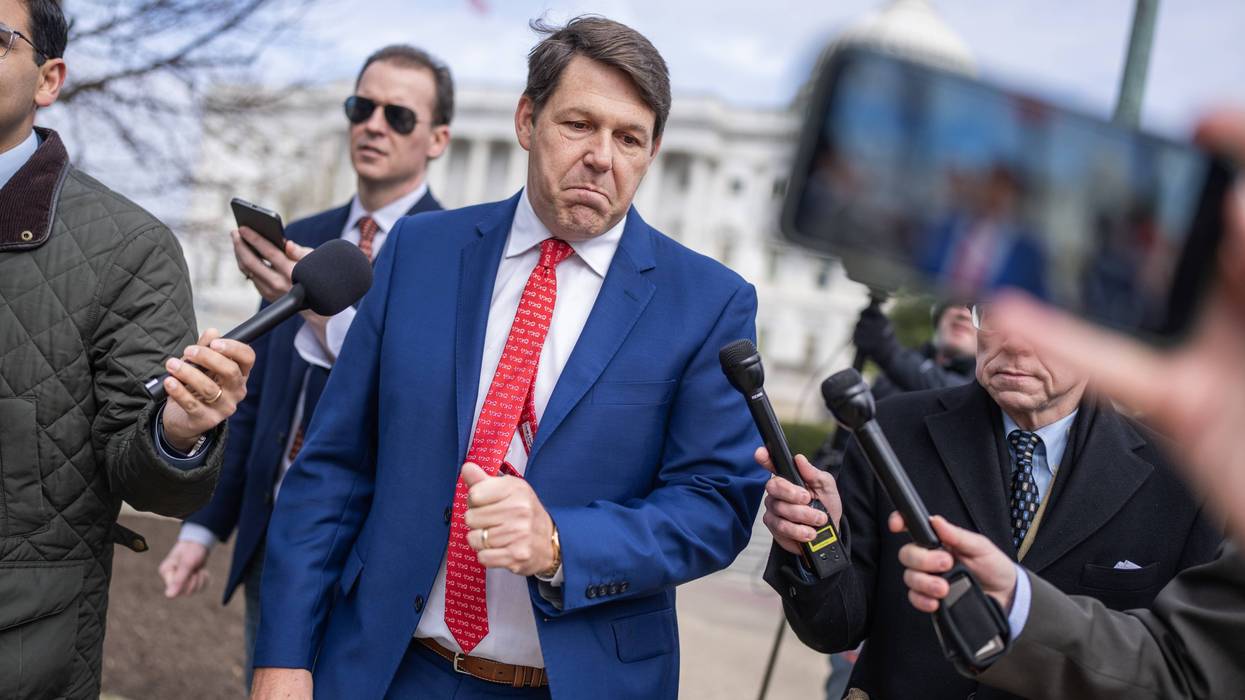
"Republicans in Congress want to cut Americans' healthcare to pay for more war in Iran. Let that sink in."
"Republicans won't think twice about *literally* sacrificing you to get their way."
That's how Democrats on the US House Ways and Means Committee responded to Axios' Monday reporting on congressional Republicans considering more healthcare cuts to help fulfill President Donald Trump's request for $200 billion to continue partnering with Israel for an unconstitutional war on Iran—including a potential ground invasion.
Other critics said:
Michael Hardaway, a geopolitical strategist who has worked for top Democrats, argued that they "must convert this into a House AND Senate majority in November," noting that Republicans "took healthcare away from millions of Americans to pay for tax cuts for the 1%."
That was last year, when congressional Republicans and Trump used the budget reconciliation process to pass their so-called One Big Beautiful Bill Act. Between $1 trillion cuts to Medicaid over the next decade and failing to extend expiring Affordable Care Act (ACA) tax credits, the OBBBA is expected to strip healthcare coverage from up to 15 million Americans.
While the impacts of the OBBBA will play out over years, already, "in red states and blue states alike, Republican healthcare cuts are hitting communities like a wrecking ball," Senate Finance Committee Ranking Member Ron Wyden (D-Ore.) said last week, while releasing a related report with House Energy and Commerce Committee Ranking Member Frank Pallone Jr. (D-NJ).
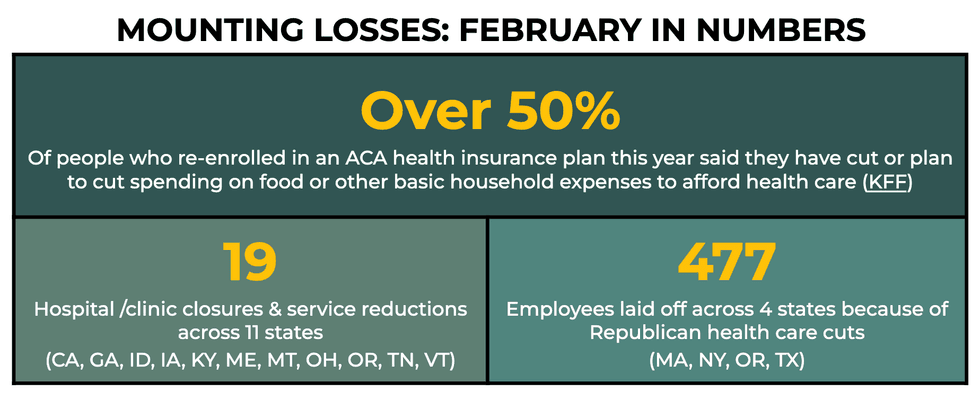
Wyden and Pallone found that over half of the people who reenrolled in an ACA plan this year have had to or plan to reduce spending on other essentials; at least 19 health facilities have closed across 11 states; and nearly 500 employees were laid off in four states because of the GOP's healthcare cuts last year.
"Despite attempts by Trump and his allies to cast blame elsewhere, the stories and facts are rolling in from across the country," Wyden said. "Democrats will not stop elevating the voices of Americans whose health is in harm's way as a result of Republicans' healthcare cuts."
One proposal that the GOP considered but ultimately did not include in the OBBBA related to ACA cost-sharing reductions. The Congressional Budget Office estimated that the specific policy considered last year would save $31 billion but leave 300,000 more Americans uninsured through 2034.
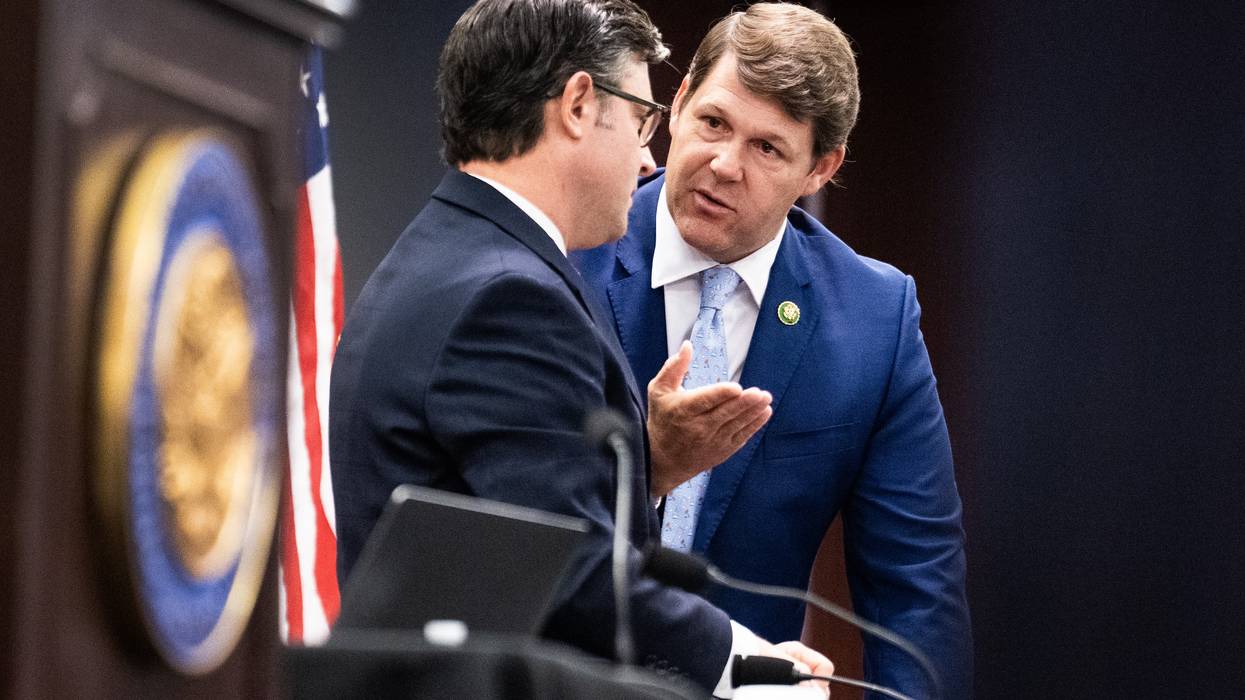
Reporting emerged last week that House Budget Committee Chair Jodey Arrington (R-Texas) wants to bring back the push for that policy. It quickly spurred criticism, with Sen. Elizabeth Warren (D-Mass.) saying: "Republicans in Congress want to cut Americans' healthcare to pay for more war in Iran. Let that sink in."
"Republicans ransacked $1 trillion from Medicaid, and then they more than doubled premiums for over 20 million Americans in order to fund tax breaks for billionaires and big corporations," Leslie Dach, chair of the advocacy group Protect Our Care, said in a statement last week. "Now, care for 15 million working Americans will be ripped away, nursing homes and hospitals are on the chopping block nationwide, and Americans are buried under skyrocketing healthcare hikes."
"But that's not enough for Republicans who have been at war with working families' healthcare for decades—now they want to slash healthcare even more to bankroll the war in the Middle East and to fund ICE, Trump's unaccountable, lawless paramilitary force," Dach continued, referring to US Immigration and Customs Enforcement. "The American people reject these Republican priorities and will make their voice known in November."
Axios reported Monday on Arrington's preferred timeline for a new budget package: "60 to 90 days," he said.
Arrington is also eyeing some potential changes to Medicare, which provides health insurance coverage to Americans age 65 and older, according to Axios:
As for Medicaid, one of the programs attacked by the OBBBA, Arrington told the outlet that there is hesitancy "to open that back up," but some policies considered in 2025 could be revived.
In a Monday statement, Democratic National Committee rapid response director Kendall Witmer called out Trump and Vice President JD Vance for past and possible future GOP healthcare cuts, accusing them of breaking their campaign promises.
"Donald Trump and Republicans already made the largest cuts to healthcare in history, causing healthcare costs to skyrocket for millions of Americans while billionaires and big corporations get massive tax cuts," Witmer said. "Now, Republicans want to slash even more healthcare funding for working families to pay for their war with Iran."
"After promising on the campaign trail to stop the endless wars, reduce the national debt, and lower costs," Witmer added, "Trump and JD Vance have done the opposite: putting everyday Americans on the chopping block to wage their deadly and costly war of choice."
"Voters are clear about what they want: lower prices, better jobs, vital programs protected and expanded, and for the wealthy to pay their fair share in taxes."
The Republican Party is intent on permanently extending the 2017 tax cuts which primarily benefited the wealthiest earners and corporations—a priority that would cost an estimated $4.6 trillion and which has sent lawmakers searching for potential spending offsets including cuts to Medicare, food assistance, and renewable energy programs.
But polling released Tuesday suggested the GOP is likely to face widespread outcry—and potential opposition from vulnerable Republicans who don't want to risk angering voters—as a majority of Americans are vehemently opposed to paying for tax cuts for the wealthy by slashing public programs.
The new poll, taken by Data for Progress on behalf of the progressive advocacy groups Groundwork Collaborative and the Student Borrower Protection Center, found that although Republican lawmakers have demonized efforts to provide relief to student loan borrowers, the party's potential overhaul of the income-based repayment program isn't popular among voters of any political ideology.
Nearly two-thirds of respondents said they don't want the repayment plan eliminated, including 56% of Republican voters and 70% of Independents who said they oppose funding cuts for federal student loans and grants.
The GOP's plan would save an estimated $127.3 billion over 10 years by forcing the average student loan borrower to pay nearly $200 more per month.
"Most people don't have an extra $200 a month to throw toward their student loan bill," Michele Shepard Zampini, senior director of college affordability at the Institute for College Access & Success, told CNBC on Monday.
"Voters overwhelmingly reject efforts to cut critical supports that working families rely on."
Despite that fact, said Aissa Canchola Bañez, policy director for the Student Borrower Protection Center, the GOP's budget proposals would "cut taxes for their billionaire buddies by raiding the pockets of Americans with student debt and families already struggling to pay for college."
"This polling makes it crystal clear," she said. "Voters overwhelmingly reject efforts to cut critical supports that working families rely on."
Republicans can also expect to see pushback if they attempt cuts to Medicare and Medicaid, the survey found. Ninety percent of respondents said they want Medicare funding to increase or remain the same; 87% said the same for Medicaid. Republicans are planning to unveil the first-ever work requirements for Medicaid, which provides healthcare coverage for low-income people and those with disabilities, in an upcoming budget bill.
As Politico reported Sunday, Republican lawmakers are "increasingly alarmed" that Rep. Jodey Arrington (R-Texas), chair of the House Budget Committee, "keeps raising Medicare reforms as a potential spending offset."
More than 80% of respondents also don't want Republicans to make cuts to the Supplemental Nutrition Assistance Program (SNAP), commonly known as food stamps, which the GOP is also planning to make subject to expanded work requirements.
Those who want funding for SNAP to increase or stay the same include 67% of Republicans and 75% of Independents.
The polling may leave Republican leaders wondering what programs they will be able to cut without facing outcry from angry voters who rely on public services—but Elizabeth Pancotti, managing director of policy and advocacy for Groundwork Collaborative, suggested in a statement Tuesday that the answer is simple: The GOP must abandon its plan to dole out more tax breaks for the rich.
"Voters are clear about what they want: Lower prices, better jobs, vital programs protected and expanded, and for the wealthy to pay their fair share in taxes," said Pancotti. "And yet, Republicans in both chambers of Congress are working overtime to achieve the exact opposite."
President Donald Trump has called on the GOP to advance his taxation, immigration, and energy agenda in "one big, beautiful bill," while Senate Republican leaders have begun work on two separate bills, with taxes dealt with later in the year.
"Whether one bill or two," said Pancotti, "House and Senate GOP members are aligned on wanting to cut lifesaving programs in order to enrich their billionaire friends and donors, and voters are taking note."
"It won't be any consolation to struggling Americans that their hardship allows some rich buddy of Donald Trump's to buy a bigger yacht," said Sen. Ron Wyden.
Policy analysts and Democratic lawmakers raised alarm over the weekend at a leaked document indicating that House Republicans intend to pursue massive cuts to Medicaid, a program that provides sometimes lifesaving coverage to roughly 80 million people across the United States.
Near the top of a list of "spending reform options" that House Republicans are considering to help finance additional tax cuts for the rich and large corporations are proposals that would strip Medicaid coverage from millions of Americans, including children, seniors, and people with disabilities.
One of the changes listed in the leaked document, obtained by Politico last week, would convert Medicaid's funding structure to a "per-capita cap," under which the federal government would only provide states with a fixed amount of funding for each beneficiary rather than paying a percentage of states' overall Medicaid costs.
The document, which reportedly comes from the House Budget Committee, suggests the reform would result in up to $918 billion in cuts over a 10-year period.
Edwin Park, a research professor at the Georgetown University McCourt School of Public Policy's Center for Children and Families, noted in a blog post that such a change would "radically restructure Medicaid financing."
"These funding caps are typically designed to fail to keep pace with expected growth in healthcare costs in order to severely cut federal Medicaid spending, with those cuts growing larger and larger over time," Park wrote. "Moreover, the caps would also fail to account for any unexpected cost growth such as from another public health emergency or a new, costly drug therapy, which would make the federal funding cuts even larger than originally anticipated."
"These cuts would only help bankroll Trump's tax cuts for his billionaire friends and corporate interests."
The Center on Budget and Policy Priorities warned in an
analysis published last week that cuts to federal funding under a per-capita cap "would impose significant strain on states and put millions of people at risk of losing benefits and coverage."
The document also includes a call to "Equalize Medicaid Payments for Able Bodied Adults"—a proposal seen as an indication that the GOP plans to go after the Affordable Care Act's Medicaid expansion—and confirms that Republicans intend to push for Medicaid work requirements, which have proved disastrous in the states that have tried such mandates.
Park argued that work requirements—and the "onerous red tape" they entail—would amplify the harms of cuts to federal Medicaid funding.
"As a result, these proposals would take away coverage and access from tens of millions of low-income children, families, seniors, people with disabilities, and other adults who rely on Medicaid," Park wrote. "Moreover, because Medicaid is the largest source of federal funding for states—accounting for 56.1% of all federal funding for state budgets in 2024—these large cost-shifts to states would also threaten deep, damaging budget cuts to other state spending including for K-12 education."
Overall, the leaked Republican document proposes up to $5.7 trillion in spending cuts over 10 years—with Medicaid cuts making up $2.3 trillion of that total—as President-elect Donald Trump pushes for a sprawling reconciliation bill that includes another round of tax cuts that would disproportionately benefit the wealthiest Americans.
In addition to Medicaid cuts, the House GOP policy menu calls for slashing Temporary Assistance for Needy Families and federal nutrition assistance, repealing "major Biden health rules," and eliminating renewable energy funding under the Inflation Reduction Act.
"This won't lower costs for Americans," Rep. Mike Levin (D-Calif.) wrote in response to the GOP document. "These cuts would only help bankroll Trump's tax cuts for his billionaire friends and corporate interests."
Sen. Ron Wyden (D-Ore.), the top Democrat on the Senate Finance Committee, said the leaked policy list shows that "Republicans are gearing up for a class war against everyday families in America."
"This list outlines a plan to increase child hunger, boot tens of millions off their health insurance, and lay off hundreds of thousands of clean energy workers to fund tax handouts for the wealthy," said Wyden. "It won't be any consolation to struggling Americans that their hardship allows some rich buddy of Donald Trump's to buy a bigger yacht."

"Americans: We just want higher wages and lower costs. Republicans: We are going to take away your healthcare."
Some Democratic lawmakers and other critics of congressional Republicans on Friday pointed to a document obtained by Politico as just the latest evidence that the looming GOP trifecta at the federal level poses a threat to working families nationwide.
"Americans: We just want higher wages and lower costs. Republicans: We are going to take away your healthcare," Rep. Pramila Jayapal (D-Wash.), chair emeritus of the Congressional Progressive Caucus, said in response to the reporting, which came as Republicans have taken control of both chambers of Congress and prepare for President-elect Donald Trump's inauguration in just over a week.
The one-page list originated from the House Budget Committee, chaired by Rep. Jodey Arrington (R-Texas), Politico reported, citing five unnamed sources. One of them explained that the "document is not intended to serve as a proposal, but instead as a menu of potential spending reductions for members to consider."
The document lists various policies that it claims would collectively cut up to $5.7 trillion. Republicans have been discussing how to offset the high costs of top priorities—specifically, Trump's immigration policies and plans for tax cuts that critics warn would largely benefit the wealthy, like the law he signed in 2017.
"In order to make his rich, billionaire buddies richer, Trump wants to kick millions off healthcare coverage and starve families. How does this help working families thrive?"
The policies are divided into eight sections, with headings that critics called "dystopian" and "Orwellian." The first calls for repealing "major" health rules from outgoing President Joe Biden's administration, which would supposedly cut $420 billion. The second section takes aim at Medicare, the federal health program for seniors, proposing policies that would cut $479 billion.
A large share of the potential cuts would come from section three, which lists seven potential changes to Medicaid, a program that provides health coverage to low-income people. The policies include per capita caps, work requirements, and lowering the federal medical assistance percentages (FMAP) floor.
"In order to make his rich, billionaire buddies richer, Trump wants to kick millions off healthcare coverage and starve families. How does this help working families thrive?" Michigan state Rep. Carrie Rheingans (D-47) asked on social media. "In this leaked list of cuts, 'lower FMAP floor' for Medicaid means states pay a higher proportion of Medicaid costs for enrollees—this just shoves [federal] costs to states so billionaires get more yacht money."
Section four of the document calls for "reimagining" the Affordable Care Act (ACA) to cut $151 billion, with changes that include repealing the Prevention and Public Health Fund, limiting eligibility based on citizenship status, and reclaiming $46 billion from subsidies set to expire at the end of the year.
The fifth section lays out $347 billion in cuts by "ending cradle-to-grave dependence," targeting initiatives including Temporary Assistance for Needy Families (TANF) and Supplemental Nutrition Assistance Program (SNAP), often called food stamps.
Section six claims "reversing Biden climate policies" would cut $468 billion: $300 billion by discontinuing some provisions from the 2021 bipartisan infrastructure legislation, $112 billion by rolling back electric vehicle policies, and $56 billion by repealing green energy grants from the Inflation Reduction Act (IRA).
The seventh section is a catchall, listing up to $1 trillion in potential cuts through moves that include ending student debt forgiveness, restricting emergency spending, and reforming federal employee benefits. Section eight identifies up to $527 in potential tax offsets from requiring Social Security numbers for the child tax credit and green energy credits.
House Speaker Mike Johnson (R-La.), who recently agreed to use the budget reconciliation process to cut $2.5 trillion, "can't afford any Republican defections if he wants to pass a package on party lines," Politico reported. "Even proposed cuts to green energy tax credits, worth as much as $500 billion, could be tricky—as the document notes, they depend 'on political viability.' Already 18 House Republicans—14 of whom won reelection in November—warned Johnson against prematurely repealing some of the IRA's energy tax credits, which are funding multiple manufacturing projects in GOP districts."
Sharing the report on social media Friday, Rep. Nydia Velázquez (D-N.Y.) stressed that "Republicans want to cut vital food and healthcare support programs to pay for a tax cut for billionaires and large corporations. The GOP wants working families to pay for their billionaire handouts."

"If there are a lot of details still to be filled in," wrote one analyst, "the theme of the GOP's healthcare agenda is clear: cuts."
Having secured control of both chambers of the U.S. Congress and the White House starting in January, Republicans are making no secret of their intention to pursue sweeping healthcare cuts that would raise costs and imperil insurance coverage for millions of people across the country.
Rep. Jodey Arrington (R-Texas), chairman of the House Budget Committee, told reporters earlier this week that the GOP is looking to use the filibuster-evading reconciliation process to pursue cuts to "mandatory programs"—a category that includes Medicare, Medicaid, and Social Security.
Bobby Kogan, senior director of federal budget policy at the Center for American Progress, noted in response to Arrington's comments that Republicans attempted to cut both Medicaid and Affordable Care Act (ACA) tax credits that help enrollees afford health insurance.
The Republican Study Committee, of which Arrington is a member, proposed eliminating the ACA tax credits in its 2025 budget proposal—a move that could result in around 4 million people losing insurance.
The tax credits are set to expire next year, meaning Republicans could just do nothing and allow them to lapse.
Last time Republicans had a federal trifecta, they tried and failed to fully repeal the ACA—an effort that sparked a
wave of civil disobedience on Capitol Hill.
Both President-elect Donald Trump and House Speaker Mike Johnson (R-La.) said on the campaign trail that they're looking to try again.
"We're going to replace it," Trump said during his lone debate with Vice President Kamala Harris in September—while admitting that he did not have a fully formed alternative plan.
Johnson, for his part, said during a campaign stop in Pennsylvania last month that "healthcare reform's going to be a big part of the agenda." When a voter posed the question, "No Obamacare?" Johnson replied in the affirmative, "No Obamacare."
"The ACA is so deeply ingrained, we need massive reform to make this work," he added, "and we've got a lot of ideas on how to do that."
Sarah Lueck and Allison Orris of the Center on Budget and Policy Priorities
wrote Wednesday that Trump's return to the White House and the GOP's capture of both chambers of Congress poses "big risks to people's ability to access and afford health coverage in Medicaid and the marketplaces."
"While Republicans have moved away from talking about their plans for changing health coverage in the U.S. as 'repeal,'" Lueck and Orris added, "Trump's first term and Republicans' recently released policy agendas suggest they may pursue policies that would have much the same result: higher costs for people, reduced access to care for vulnerable groups, and more people who are uninsured."
"Just as a grassroots movement of Americans around the country succeeded in saving the Affordable Care Act during Trump's first term, we can save Social Security and Medicare."
Even if Republicans don't succeed at enacting major legislative changes to the nation's healthcare system, Trump will still have the power to do significant damage unilaterally. Lueck and Orris noted that the first Trump administration "took numerous administrative steps that made it harder for eligible people to get coverage" and weakened consumer protections, from adding new paperwork requirements to the Medicaid enrollment process to expanding so-called "junk" insurance plans.
Vice President-elect JD Vance also suggested during the 2024 campaign that a second Trump administration could seek to roll back protections for people with preexisting conditions.
"If there are a lot of details still to be filled in, the theme of the GOP's healthcare agenda is clear: cuts," Vox's Dylan Scott wrote days before the November 5 election. "Cutting regulations. Cutting spending."
Stephanie Armour of KFF Health News wrote following Trump's victory that his second term "will likely bring changes that scale back the nation's public health insurance programs—increasing the uninsured rate, while imposing new barriers to abortion and other reproductive care."
Medicaid is particularly vulnerable, Armour noted, with Trump and the Republican Party potentially set to pursue "the imposition of work requirements on beneficiaries in some states" and changes to how the program is funded.
"Now, the federal government pays states a variable percentage of program costs," Armour explained. "Conservatives have long sought to cap the federal allotments to states, which critics say would lead to draconian cuts."
As for Medicare, the Project 2025 agenda authored by many former members of Trump's first administration calls for making privatized Medicare Advantage plans the default enrollment option for the nation's seniors—a change that advocates say would pose an existential threat to traditional Medicare.
"Trump and Republicans will try to cut our earned benefits," Alex Lawson, executive director of the progressive advocacy group Social Security Works, warned in an op-ed for Common Dreams on Wednesday. "But just as a grassroots movement of Americans around the country succeeded in saving the Affordable Care Act during Trump's first term, we can save Social Security and Medicare."
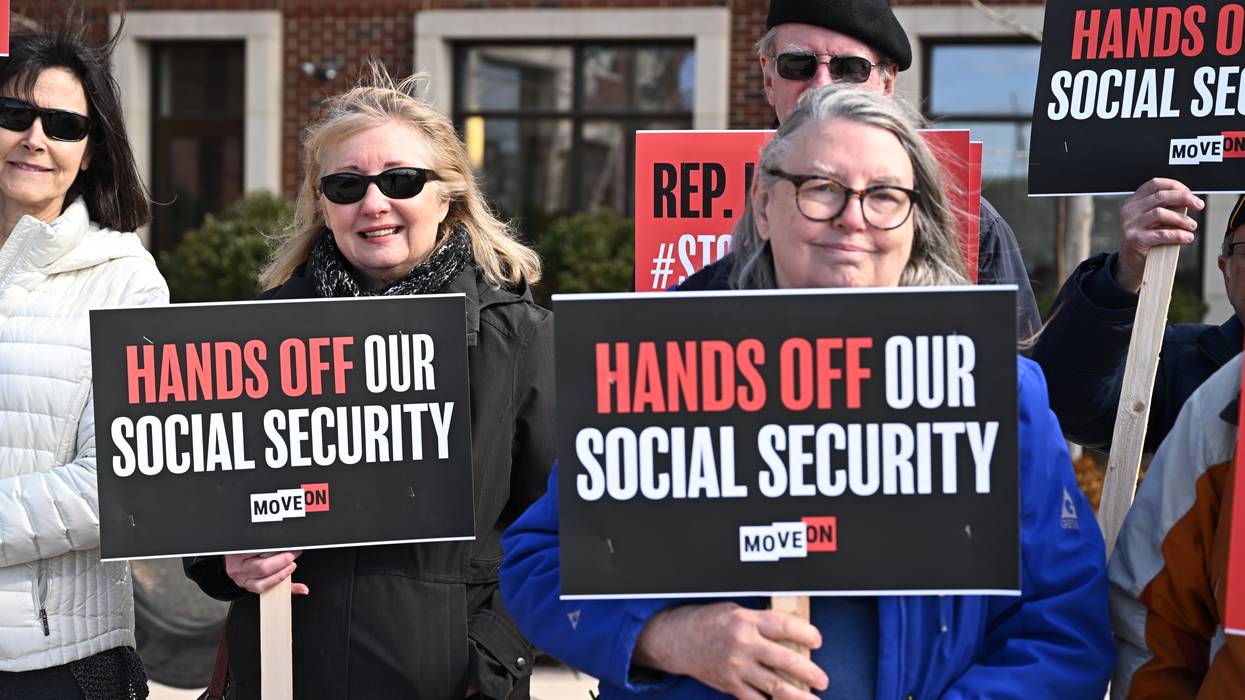
Let there be no doubt: Trump and the Republicans will try to cut our earned benefits. But just as a grassroots movement around the country succeeded in saving the Affordable Care Act during Trump’s first term, we can save Social Security and Medicare.
No one voted to cut Social Security. No one voted to cut Medicare. And no one voted for higher drug prices.
Donald Trump ran on a promise to protect Social Security and Medicare. Based on Trump’s long record of working to cut and undermine our earned benefits, we don’t trust that promise for one second. But we plan to make him keep it.
There’s a good reason Trump didn’t campaign on cutting Social Security: Ninety-two percent of Americans think that’s a terrible idea.
What will Trump do once he’s actually in the White House? During his first term, he tried to cut Social Security every single year. He appointed an unqualified crony, Andrew Saul, to head the Social Security Administration. And he surrounded himself with advisors who had long records of working to cut and privatize Social Security.
Now, Trump has a new advisor, Elon Musk. He just put Musk in charge of a commission to slash $2 trillion of federal spending. That is essentially impossible without cutting Social Security, Medicare, and/or Medicaid. Indeed, incoming Vice President JD Vance has specifically said that Musk will target Social Security.
We are never going to stop fighting to protect and expand Social Security.
Musk is the wealthiest man in the world. It’s no surprise that Musk and his fellow billionaires want to cut our earned benefits rather than pay their fair share in taxes.
Trump’s top priority is to extend the tax cuts he gave the ultra-wealthy in his first term. Then, Republicans will turn around and claim that we “can’t afford” Social Security and Medicare.
Republicans in Congress have already telegraphed what those cuts could look like. The Republican Study Committee (RSC), a caucus that counts over 80 percent of House Republicans as members, released a budget proposal earlier this year that makes massive cuts to Social Security. That includes raising the retirement age to 69, and decimating benefits for the middle class.
The RSC budget would also repeal Medicare’s power to negotiate lower drug prices. That means seniors and people with disabilities would have to turn over more of their hard-earned Social Security checks to Big Pharma.
In case anyone doubted that Republicans are serious about passing these cuts into law, House Budget Chairman Jodey Arrington (who angrily chased me down the street last year after I confronted him about his support for Social Security cuts) just pledged to cut health care benefits through reconciliation—meaning that Republicans would only need 50 votes in the Senate.
Trump and Republicans will try to cut our earned benefits. But just as a grassroots movement of Americans around the country succeeded in saving the Affordable Care Act during Trump’s first term, we can save Social Security and Medicare.
Musk is the wealthiest man in the world. It’s no surprise that Musk and his fellow billionaires want to cut our earned benefits rather than pay their fair share in taxes.
Here’s how:
We are never going to stop fighting to protect and expand Social Security. Social Security has stood strong for nearly a century. It has survived wars, depressions, and pandemics. And with your help, it will survive Donald Trump.
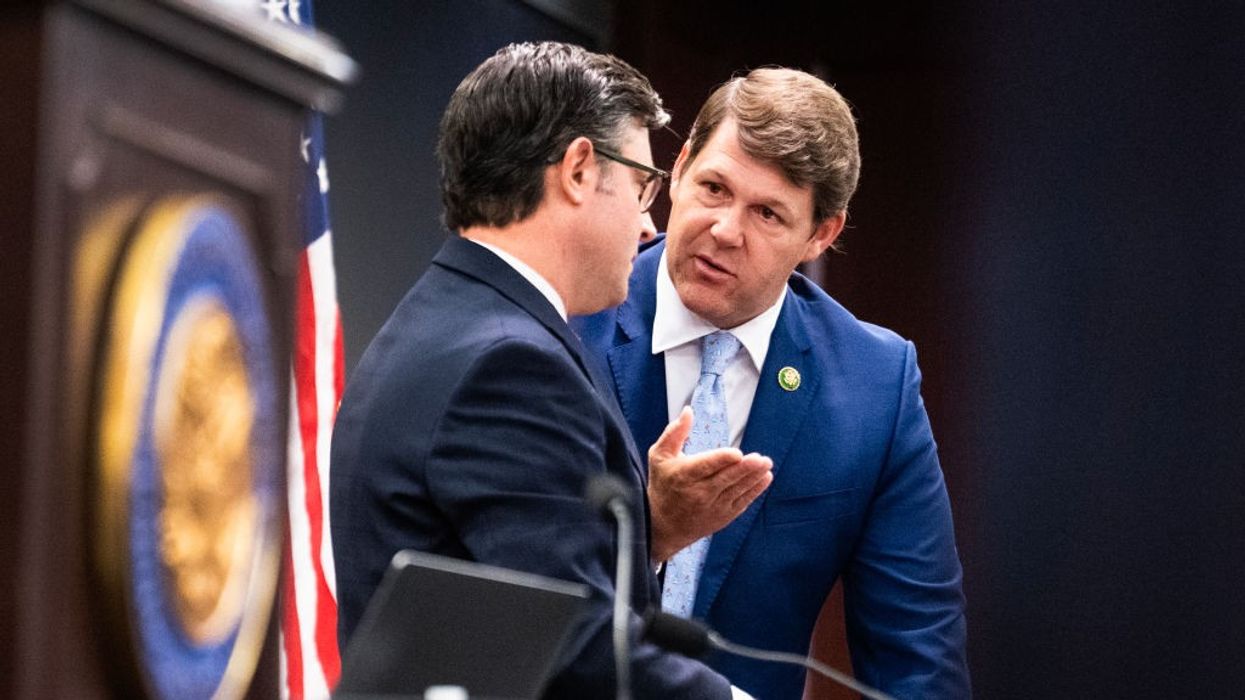
"MAGA House Republicans are demonstrating their hostility to working Americans and retirees," said one critic.
Congressional Democrats and other defenders of Social Security and Medicare responded with alarm after U.S. House Budget Committee Republicans on Thursday advanced a sweeping resolution that includes support for a fiscal commission intended to gut the crucial programs.
While Chair Jodey Arrington (R-Texas) and House Speaker Mike Johnson (R-La.) celebrated the committee's passage of the Concurrent Resolution on the Budget for Fiscal Year 2025, Ranking Member Brendan Boyle (D-Pa.) declared that "today, we saw just how backward and extreme House Republicans' vision for the future really is."
"We saw just how willing Republicans are to sell out American families in order to continue giving trillions in tax cuts to price gouging corporations and the ultrarich," Boyle said. "And we saw just how hellbent they are on gutting critical programs—raising the cost of living and pushing the middle class out of reach for hardworking families."
"Budget Committee Democrats know who we're fighting for. That's why we proposed amendments that would have protected Social Security and Medicare, prevented Republicans from raising healthcare costs, and defended American families against the devastating cuts in this budget resolution," he continued. "By voting for this dangerous budget and by rejecting our amendments today, committee Republicans have made it clear who they're fighting for—the wealthy and the well-connected."
"The commission is designed to slash vital earned benefits through a fast-track, closed-door process, intended to allow Republicans to avoid political accountability."
The committee vote came as President Joe Biden prepared to deliver his third State of the Union speech at 9:00 pm ET. The Democrat is a fierce critic of the GOP's proposed "death panel," as the White House and other opponents call the commission. He is seeking reelection in November and is expected to face former Republican President Donald Trump.
"After hearing Budget Committee Republicans tell us how they'll take us backward, I look forward to hearing President Biden tell us how he'll keep America moving forward at the State of the Union tonight," said Boyle. The congressman was not alone in referencing the Thursday night address in remarks about the GOP attack on key programs.
Social Security Works president Nancy Altman said that "at tonight's State of the Union, President Joe Biden has a golden opportunity to slam the Trump-Arrington death panel. In addition, Biden should renew his promise to protect and expand Social Security—and pay for it by taxing the ultrarich. Then the American people will know which party stands with them and which party stands with the billionaire class."
"The commission is designed to slash vital earned benefits through a fast-track, closed-door process, intended to allow Republicans to avoid political accountability," Altman stressed. "Every Republican who voted for this budget voted to cut Social Security and Medicare."
"This markup comes two days after Donald Trump enthusiastically endorsed Chairman Arrington," she noted. "Arrington is a fervent supporter of the death panel commission, and wants to attach it to must-pass government spending bills. By endorsing Arrington, Trump has endorsed the Social Security death panel."
Max Richtman, president and CEO of the National Committee to Preserve Social Security and Medicare, also took aim at not only the committee's Republicans but also Trump, referencing the Tax Cuts and Jobs Act that he signed into law in 2017.
"MAGA House Republicans are demonstrating their hostility to working Americans and retirees via their fiscal year 2025 budget resolution," he said. "The MAGA budget includes trillions of dollars in cuts to domestic spending while extending the Trump/GOP tax giveaways to the wealthy and profitable corporations that swelled the debt."
Richtman called the commission "equally troubling," adding that "we fiercely oppose such a commission as a scheme for cutting seniors' earned benefits while shielding members of Congress from accountability."
"Social Security and Medicare Part A do not contribute to the debt. Seniors' earned benefits should be protected from a commission that would fast-track benefit cuts," he argued. "If MAGA Republicans really want to reduce the debt, they should start by letting the Trump tax cuts expire. Current and future seniors on fixed incomes should not be punished for the GOP's fiscal recklessness."

"Republicans are plowing ahead with their closed-door commission designed to cut Social Security and Medicare," said Social Security Works president Nancy Altman.
With the help of three Democratic members, the Republican-controlled House Budget Committee on Thursday advanced legislation to establish a fiscal commission that critics say is a trojan horse for Social Security and Medicare cuts.
The final vote to send the bill to the full House was 22-12, with Reps. Earl Blumenauer (D-Ore.), Scott Peters (D-Calif.), and Jimmy Panetta (D-Calif.) joining every present Republican in supporting the
Fiscal Commission Act.
The committee rejected four proposed Democratic amendments, including one supporting tax hikes on the rich to bolster Social Security and Medicare.
"Republicans are plowing ahead with their closed-door commission designed to cut Social Security and Medicare," Nancy Altman, the president of Social Security Works, said in a statement. "Many of the Republicans tried to claim that was not their goal, but they tellingly voted down Democratic amendments to rule out cutting those programs and instead require billionaires to pay their fair share."
"The vast majority of Democrats on the committee rightfully opposed the commission. Shame on the handful of exceptions," Altman added. "They have stabbed the American people in the back, and undermined President Joe Biden."
In his opening remarks at Thursday's hearing, Rep. Brendan Boyle (D-Pa.)—the top Democrat on the committee—warned that "there are absolutely those who are getting ready to use a commission as a backdoor way to force through unpopular cuts" to Social Security and Medicare.
"We can put both trust funds on the path to full solvency for the rest of this century," said Boyle, who introduced legislation last year that would extend Social Security's solvency by at least 75 years by making the wealthy pay a more equitable share into the program. "We don't need a commission to do that."
Early in Thursday's hearing, Social Security Works executive director Alex Lawson interrupted the proceedings to deliver half a million petition signatures to the committee opposing the creation of a fiscal commission.
"We don't need a smoky back room. I would like you to listen to the American people when they say, 'Absolutely no cuts to Social Security,'" Lawson said as he was escorted out of the hearing room by a Capitol police officer. "A vote for a commission is a vote to cut Social Security."
The establishment of a fiscal commission is a top priority of House Speaker Mike Johnson (R-La.), who proposed trillions of dollars in cuts to Social Security and Medicare during his tenure as chair of the Republican Study Commission—which has continued to push for steep cuts to the two programs.
Following Thursday's vote, House Budget Committee Chair Jodey Arrington (R-Texas) rattled off a list of right-wing groups that have supported the push for a fiscal commission, including Citizens Against Government Waste and Americans for Prosperity—an organization founded by the Koch brothers.
The AARP, the AFL-CIO, and other prominent advocacy organizations have vocally criticized the Republican-led demand for a fiscal commission, as Boyle noted at the end of Thursday's hearing.
If passed by Congress, the bill advanced Thursday would establish a 16-member commission tasked with recommending policy changes designed to "balance the budget" and improve the "long-term fiscal outlook" of the nation's trust fund programs.
Any recommendations approved by the panel would be placed on a fast track in both chambers of Congress, with no amendments or delays permitted.
"Fiscal commissions are not the answer," the Alliance for Retired Americans said Thursday. "They are just smokescreens for politicians to hide behind while slashing earned benefits."

GOP lawmakers want the commission to commit the dirty work of slashing Social Security and Medicare to death without leaving their fingerprints on the murder weapon.
This week, House Budget Committee Republicans held a hearing on creating a so-called “fiscal commission.” The hearing made it crystal clear what their real goal is: decimate Social Security and Medicare behind closed doors.
Their commission is a scheme, specifically designed to avoid accountability from voters. They would require Congress to vote on the commission’s recommendations right after the 2024 election, without any amendments. This will allow members to run on the claim that they won’t cut Social Security and Medicare, and then turn around and vote for cuts. They will insist that they hated the cuts, but had to do something about the federal debt, so their hands were tied. Some voting for it will have lost re-election or will be retiring, with nothing to lose. All of them will be as far away from the next election as possible.
During the hearing, Rep. Steve Womack (R-Ark.), one of the witnesses, stated that “If raising the [retirement] age needs to be part of that discussion then a fiscal commission will tell us that.” He added: “You cannot, rationally, take any option off the table.”
Those who are most familiar with past commissions know exactly why a new one would be so dangerous.
“Everything on the table” is Washington-speak for doing what the American people don’t want.
What options do Republicans want to put on the table? That’s not hard to glean for any of us who follow the issue closely. The Republican Study Committee, a group that comprises about 75 percent of House Republicans, has released a budget that would raise the retirement age, decimate middle-class Social Security benefits, and privatize Medicare. Past versions of their plan have also included a stingier cost-of-living adjustment. That’s what Republicans mean when they say that “everything is on the table.” What they want is political cover.
Those who are most familiar with past commissions know exactly why a new one would be so dangerous. Rep. Jan Schakowsky (D-Ill.) served on the Bowles-Simpson Commission, which today’s commission proponents cite as a model. During the hearing, she said that “this kind of commission is a way for members of Congress to get out of having to take the blame for the kinds of cuts that may be presented.”
In a Common Dreams op-ed this week, Schakowsky was even more specific. “The speaker [of the House Mike Johnson]... has devised an accountability-free way to gut [Social Security]. [We] don’t have to guess that this is what will happen, because Republicans have tried this before. During discussions on forming Bowles-Simpson in 2010, Senator Max Baucus (D-Mont.) astutely pointed out that ‘The Chairman and Ranking Republican Member of the Budget Committee have painted a big red bull’s eye on Social Security. Their commission is a Social Security-cutting machine.’ Sen. Baucus was right.”
Those seeking to create another Social Security-cutting machine sometimes argue that the problem isn’t commissions per se, and point to the Greenspan Commission as an example of a successful one. But those who make that claim were not involved 40 years ago. I staffed Alan Greenspan in his capacity as Chair of that commission. Recently, I and other former commission staffers, who worked for both Democrats and Republicans, issued a statement to set the record straight and to argue forcefully against what is being proposed today.
We conclude our statement by quoting the late Robert M. Ball, who then-Speaker of the House Tip O’Neill put on the Greenspan Commission to represent him. As the talk of the Greenspan Commission as a model for today arose, Ball was so concerned that he requested—literally on his deathbed—that the chapter from his memoir about the Greenspan Commission be published as a separate monograph. He made the deathbed request in an effort to avoid the misuse of the Greenspan Commission to force the type of commission that Speaker Johnson is determined to create. In the monograph, Ball warned that “to suggest that the Greenspan Commission provides a model for resolving questions about Social Security’s future would be laughable if it were not so dangerous.”
The real reason—the only reason—to create a closed-door, fast-track commission is to do what the American people don’t want: Cut benefits.
Notably, unlike today’s effort to avoid political accountability, the Greenspan Commission’s recommendations were just that: recommendations. They did not have the force of law and were not fast-tracked. Rather, they went through regular order, with open hearings, and the ability to amend and, in the Senate, to filibuster.
Congress should simply consider, through regular order, one of the several Social Security legislative proposals that have been introduced in this Congress. All the options are already known. No commission is needed – other than to avoid political accountability. Rather than establish a commission to amend Social Security, Congress should do its job: Determine Social Security’s future through regular order, in the light of day, as the Democrats want to do.
As Rep. Jim McGovern (D-Mass.) said at the hearing: “There already is a bipartisan forum where these kinds of decisions should get made. It's called Congress and we shouldn't pass the buck to a fiscal commission to do the work that we ourselves don't want to do.”
McGovern was being diplomatic with his colleagues. What Republicans want is not to avoid the work but rather to cut Social Security without leaving fingerprints on the murder weapon. President Biden understands this clearly. His White House has called the planned commission a death panel for Social Security and Medicare. House Democratic Leader Hakeem Jeffries is staunchly opposed to the commission. So are AARP, the AFL-CIO, Indivisible, MoveOn, the Strengthen Social Security Coalition, and over 100 other organizations who have signed letters in opposition.
What Republicans want is not to avoid the work but rather to cut Social Security without leaving fingerprints on the murder weapon.
Those opposed to a Social Security cutting-machine in the form of a fast-track commission represent the overwhelming will of the American people — Republicans, Democrats, and Independents. Voters of all parties, from MAGA supporters to Democratic socialists, overwhelmingly support protecting and expanding Social Security, not cutting it, and paying for it by requiring the wealthy to contribute their fair share. That’s the real bipartisan solution, and there’s no reason to go behind closed doors to enact it.
The real reason—the only reason—to create a closed-door, fast-track commission is to do what the American people don’t want: Cut benefits.
As Rep. Bobby Scott (D-VA) masterfully explained during the hearing, Republicans like Speaker Mike Johnson (R-LA) and House Budget Chairman Jodey Arrington (R-TX) happily voted for deficit-exploding tax handouts to the wealthy. Now they are crying crocodile tears about the deficit and demanding closed-door cuts to Social Security — which doesn’t contribute a single penny to the deficit.
A few corporate-friendly Democrats testified at the hearing, including retiring Senator Joe Manchin. But they are, thankfully, extreme outliers. They represent wealthy donors (and are uber-wealthy themselves), not their constituents. In fact, Manchin is so uninterested in representing his constituents that he’s leaving the Senate.
At this week’s hearing, Democrats—including Schakowksy, McGovern, Scott, and Ranking Member Brendan Boyle (D-Pa.)—were outspoken in their opposition to a commission. Every Democrat should join them, and make it clear that there’s nothing bipartisan about cutting our earned benefits behind closed doors.

"MAGA Mike Johnson and his fellow Republicans desperately want this commission to give bipartisan cover to benefit cuts," said Social Security Works. "Democrats must stand united against it."
The Republican-controlled House Budget Committee is set to convene a hearing Wednesday to examine legislation that would establish a so-called fiscal commission for the U.S. debt, a proposal that critics have called a Trojan horse for Social Security and Medicare cuts.
House Speaker Mike Johnson (R-La.), a longtime proponent of Social Security cuts, described such a commission as one of his top priorities after winning the gavel last month, and right-wing organizations such as the Koch-connected group FreedomWorks have endorsed the idea.
A fiscal commission of the kind backed by congressional Republicans and some conservative Democrats—including Sen. Joe Manchin (D-W.Va.)—would be tasked with analyzing Social Security, Medicare, and other U.S. trust fund programs and developing policy recommendations ostensibly aimed at improving the programs' finances. The policy proposals would then be put on a fast track in both the House and Senate.
Social Security Works and other progressive organizations have stressed that Social Security does not add to the federal debt and warned against the growing push for a fiscal commission.
"That's code for a death panel designed to cut Social Security and Medicare behind closed doors," Social Security Works wrote in a social media post on Monday in response to the impending hearing.
"MAGA Mike Johnson and his fellow Republicans desperately want this commission to give bipartisan cover to benefit cuts," the group added. "Democrats must stand united against it."
The House Budget Committee's Wednesday hearing will feature testimony from Manchin and Sen. Mitt Romney (R-Utah), who earlier this month teamed up to introduce legislation that would establish a 16-member bipartisan, bicameral fiscal commission comprised of 12 elected officials and four outside experts.
Manchin and Romney have both said they're not running for reelection next year.
Alex Lawson, executive director of Social Security Works, called Manchin and Romney "cowards" who are "quitting and heading out of town, but want to set up a closed-door commission to cut Social Security and Medicare on the way out the door."
"The only reason to make changes to Social Security via a closed-door commission is to cut already modest earned benefits."
According to a legislative summary released by Manchin's office, the commission would "produce a report and propose a package of legislative solutions to improve the long-term fiscal condition of the federal government, stabilize the ratio of public debt to GDP within a 15-year period, and improve solvency of federal trust funds over a 75-year period."
"If the commission approves proposed legislative language, it would receive expedited consideration in both chambers," the summary continues. "While 60 votes would be required to invoke cloture prior to final passage in the Senate, only a simple majority would be needed for the motion to proceed, which would be privileged."
Manchin and Romney's bill is one of three pieces of legislation that the House Budget Committee will discuss during Wednesday's hearing. The committee is chaired by Rep. Jodey Arrington (R-Texas), a fiscal commission supporter and member of a Republican panel that called for raising the Social Security retirement age earlier this year.
Progressive lawmakers and organizations have argued that instead of cutting benefits, Congress could ensure Social Security is fully funded for the next seven-plus decades and expand benefits by lifting the payroll tax cap that allows the rich to avoid taxes on annual income over roughly $160,000.
"All of the options for eliminating Social Security's projected shortfall, manageable in size and still a decade away, are fully understood," more than 100 advocacy groups wrote in a letter to members of Congress earlier this month. "The only reason to make changes to Social Security via a closed-door commission is to cut already modest earned benefits—something the American people overwhelmingly oppose—while avoiding political accountability.