SUBSCRIBE TO OUR FREE NEWSLETTER
Daily news & progressive opinion—funded by the people, not the corporations—delivered straight to your inbox.
5
#000000
#FFFFFF
To donate by check, phone, or other method, see our More Ways to Give page.
Daily news & progressive opinion—funded by the people, not the corporations—delivered straight to your inbox.
Our healthcare ‘system’—with or without the Affordable Care Act—is unsustainable: we have reached the end of the line.
Those without employer sponsored insurance (or Federal insurance like Medicare or the VA) in Red states, who signed up for the Affordable Care Act (aka Obamacare), are now learning what they voted for: higher premiums for health insurance, maybe unaffordable. Meanwhile, premiums continue to rise relentlessly for employers and employees.
Our healthcare "system" is unsustainable: we have reached the end of the line.
Americans pay more for healthcare (about18 percent of GDP) than any other developed country, with mediocre outcomes. Yet the other countries, with better outcomes, have universal coverage.
It is time for change. Extend traditional Medicare to all Americans (gradually, over the course of several years). Medicare is familiar; it works. Private for profit-health insurance, less than a century old, makes no sense today.
Sick and injured patients have turned to medicine—to healers—since time immemorial. Health insurance is new: Blue Cross started as a community non profit organization in 1929, to cover surgery in hospitals.
Private for profit-health insurance, less than a century old, makes no sense today.
Yes, we are a capitalist country, and markets are efficient at producing many things, like commodities: groceries, shoes, cars, even some insurance, when it is straightforward and highly regulated, like auto insurance. But for-profit health insurance does not work.
The idea of insurance is to spread risk over a maximum number of subscribers, each of whom is at the same low risk of unpredictable casualty, like fire. This was essentially the situation of Americans a century ago—illness and injury were acute and unpredictable, patients either recovered or died. Everyone was at similar risk, only surgery was expensive.
Today is different: illness is not only predictable, it can be chronic, even life long. Moreover, today’s scientific care is expensive. The social determinants of health—income security, education, adequate food and shelter, social support (your zip code, not your genetic code)—plus public health, keep healthy people healthy.
Medical care is for the sick.
For-profit health insurers maximize premiums, minimize cost (provider fees), keep the difference, and most important, avoid the sick. Insurers exclude those with “pre-existing” conditions whenever allowed (not under the ACA), deny "authorization" where they can. They tailor "plans" with carefully engineered restrictions you don’t discover until you file a claim. They are not even providing insurance: the payments from the Federal government are risk adjusted, so the insurers are paid more for riskier patients (and they are now illegally upcoding). The providers are not. Making this happen entails huge administrative expense, which adds no value for patients or providers, only massive returns to investors. United Health Group is the third largest company in the Fortune 500.
Healthy people don’t know what plan is "right for them"; they hate the annual "choice." They only know what they can afford. (Sick people know what they need.) They do want to choose their doctor.
Traditional Medicare eliminates these problems for its beneficiaries: by law, everything medically necessary is covered. The Federal government determines fees for doctors and hospitals based on cost, as it did historically when markets didn’t work. Beneficiaries pay premiums based on income.
Fee-for-service works when we pay the right fees for the right services. Today, based on 1950’s medicine, Medicare pays too little for office visits, so-called ‘cognitive’ services (versus procedures) both primary and specialized, so there are too few providers, especially as Medicare rolls expand with retiring
Boomers. No office doctor can make a living from Medicare anymore. That is, however, easy to fix: pay providers more to care for the sickest people, who need the services only highly skilled, experienced physicians can provide. Pay surgeons less.
Best of all, Medicare is simple—ask your grandmother.
But where will the money come from?
Start by eliminating Medicare Advantage (MA) and Part D, while updating Medicare to cover prescription drugs, along with vision, hearing aids, etc. MA was supposed to save taxpayers money by providing care more efficiently. Instead, Medicare pays MA companies 20 percent more than traditional Medicare for comparable patients.
Then, require all employers (including those who currently don’t provide insurance) to pay premiums to Medicare based on payroll. Require employees to pay Medicare premiums based on wages. Just like Social Security (of which Medicare is technically a provision). The Federal government continues to pay a share.
Everyone pays, everyone gets the care they need and nobody is left out. People can choose any qualified provider. Providers remain private, and are paid enough to attract and sustain the clinicians we want and need.
We have tried every kind of private for profit health insurance there is: employer sponsored, government subsidized, market based, capitation, value-based, catastrophic, health savings accounts—it no longer works for employers, taxpayers, or the sick. This year premiums will go up, coverage will go down.
Americans’ health will suffer.
Americans need care, not coverage. We clinicians have dedicated our lives to providing it. Medicare has served millions of us well for 60 years. We cannot allow opportunistic capitalists to stand in the way for the rest.
According to more recent Pentagon figures, it's actually even worse.
Sen. Elizabeth Warren took President Donald Trump to task on Friday for making life "more expensive" with his war in Iran.
"It's costing American taxpayers $1 billion a day to fund this war," the Massachusetts Democrat said in a video posted to her social media accounts. "That is $11,500 every single second."
This is, of course, not an exact amount. The figure is based on a preliminary estimate provided by Pentagon officials to Congress last week, estimating that the war would cost about $1 billion per day.
And so far, the war has actually been even more expensive than Warren initially claimed.
On Tuesday, according to the New York Times, the Pentagon gave a more comprehensive briefing, telling Congress that just the first six days of the war had exceeded $11.3 billion in cost, which puts the price tag at about $1.88 billion per day. That's nearly $21,800 per second.
The Times noted that this was a low-end estimate and that the pricetag did not include many other costs, including those associated with the buildup of military hardware in the region before the war.
Using just these conservative estimates, a live ticker shows that as of Friday afternoon, the estimated cost of the war that began on February 28 is already fast approaching $19 billion, less than two weeks later.
"If we took the money that Donald Trump is demanding to fund the war with Iran and used that money here at home, instead, we could help cover healthcare costs for millions more Americans all across this country," Warren said.
Indeed, an analysis published last week by the Institute for Policy Studies' National Priorities Project (NPP), based on the $1 billion-per-day figure, found that on an annual basis, the cost of the war is “higher than the appropriated budget of any federal agency except the Pentagon itself."
If all that money were spent domestically, it found, it would be enough to cover the daily costs of federal nutrition assistance for more than 40 million Americans, as well as daily Medicaid costs for the roughly 16 million people expected to lose health coverage due to the Republican budget package that Trump signed into law last year.
As Warren pointed out, calculations of military spending do not even take into account the sharp hikes in gas prices Americans are facing as a result of the war, which has led Iran to retaliate by closing one of the world's largest oil shipment routes, the Strait of Hormuz.
According to the American Automobile Association's (AAA) gas price tracker, US gas prices have leaped to $3.63 per gallon on average as of Friday, up from $2.94 a month ago.
"We haven't seen gas prices jump this much since Russia invaded Ukraine," Warren said. "Some cities in Indiana and Ohio have already seen a jump of over 50 cents a gallon. In Texas and Virginia, prices are up by more than 65 cents."
Citing an image of a Chevron station in Los Angeles posted by a user on TikTok, Warren said: "California is seeing gas prices above $8." According to AAA, the average cost of gas in the state is $5.42.
Despite rising anger from voters—more than 7 in 10 of whom said in a recent Quinnipiac poll that they fear higher oil and gas costs as a result of the war—Trump has said carrying out his objectives in Iran "is far more important than having gasoline prices go up a little bit."
In a post to Truth Social on Thursday, the president framed higher prices as a positive: "The United States is the largest Oil Producer in the World, by far, so when oil prices go up, we make a lot of money," he wrote.
While this may be true for Americans who own oil and gas companies, most do not. For the average American, higher gas prices can raise the cost of transportation sometimes by thousands of dollars per year, cutting into spending on food, rent, medicine, and other essentials.
"For someone who campaigned on lowering costs on day one, Donald Trump is constantly raising the bar for how expensive he can make it to live in this country," Warren said.
Referencing Republican opposition to extending Affordable Care Act subsidies that lowered healthcare premiums for more than 20 million Americans, Warren implored viewers to "never forget that Donald Trump said we just can't afford to lower health care costs this year."
"These are about choices," she said, "and Donald Trump is making the wrong ones."
“No one is safe from making these trade-offs,” said a researcher at Gallup, which found even insured Americans in higher income brackets have avoided daily expenses to pay medical bills.
As the Trump administration spends an estimated $1 billion per day in taxpayer money bombing targets across Iran that have reportedly included an elementary school and healthcare facilities, Gallup released a survey Thursday that found one-third of Americans reported making financial trade-offs in order to pay for medical expenses last year.
The West Health-Gallup Center on Healthcare in America polled nearly 20,000 US adults between June and August 2025 and found that roughly one-third of them—equivalent to about 82 million people in the richest country in the world—were forced cut back on at least one expense in order to afford healthcare.
Eleven percent of respondents—equivalent to 28 million Americans—skipped a meal or intentionally drove less in order to pay a medical bill. Fifteen percent, the equivalent of nearly 40 million people, said they prolonged a current prescription or borrowed money, and 9% cut back on utilities.
Those numbers were strikingly similar among people who have health insurance, with 14% of insured people prolonging prescriptions to avoid paying for a new one and 9% skipping meals. Among insured Americans, 29% made at least one trade-off to afford healthcare.
The crisis is also not exclusively affecting low-income people. A quarter of people in households earning $90,000 to $120,000 per year skipped meals or other expenses to pay medical bills, and 11% of people in households earning $240,000 or more did the same.
“No one is safe from making these trade-offs,” Ellyn Maese, a senior researcher at Gallup and research director for the West Health-Gallup Center, told The New York Times.
Sixty-two percent of people without healthcare coverage were forced to make trade-offs, and 55% of people with household incomes lower than $24,000 per year as well as 47% of people earning $24,000 to $48,000 avoided expenses.
Gallup also released the results of a separate poll taken between October and December 2025, which showed how Americans are delaying major life decisions as well as altering their daily lives to afford healthcare under the for-profit insurance system.
As the Trump administration's policies slashed healthcare for 15 million Americans and raised healthcare premiums for tens of millions of people—and as the White House demanded that families have more children—6% of respondents said they had postponed having or adopting a child due to healthcare costs, equivalent to about 16 million Americans.
Nearly 30% said healthcare costs led them to avoid taking a vacation, 18% said they delayed finding a different job, 15% said they postponed pursuing education or job training, and 14% said they postponed buying a home.
The polls are “telling a consistent story here,” Maese said.
The survey results were released weeks after the Trump administration proposed new regulations for healthcare plans purchased through the Affordable Care Act marketplace that would charge deductibles as high as $15,000 for individuals and $31,000 for families to offset lower monthly premiums—underscoring how the healthcare law passed 16 years ago has left American households vulnerable to rising costs under the for-profit health insurance system.
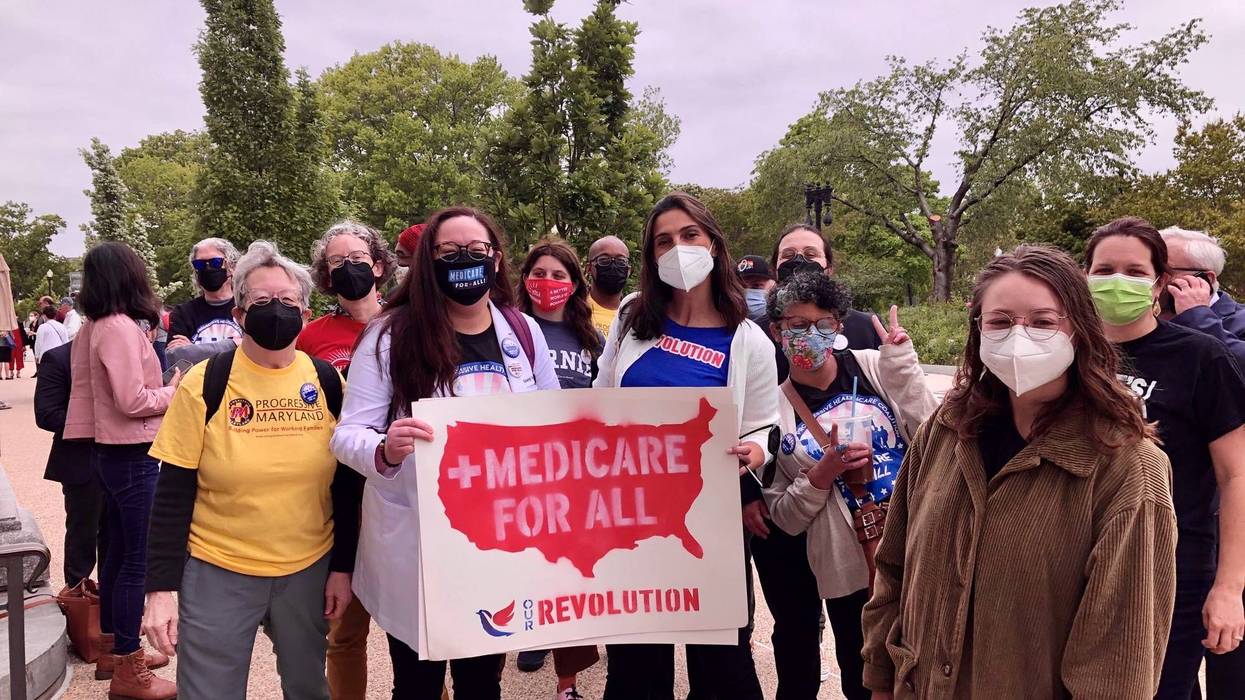
A survey taken last November by Data for Progress found that 65% of voters support expanding the Medicare system to everyone in the US, a proposal that would save an estimated $650 billion annually.
But as Rep. Pramila Jayapal (D-Wash.)—who has sponsored Medicare for All legislation in the House—noted on Wednesday, Republicans and establishment Democrats continue to claim the proposal is unaffordable.
"When we ask for Medicare for All it’s 'too expensive,' and we 'don’t have the money,'" said Jayapal. "When the president drags us into his own personal war, no expense is spared. Our priorities are backwards."