
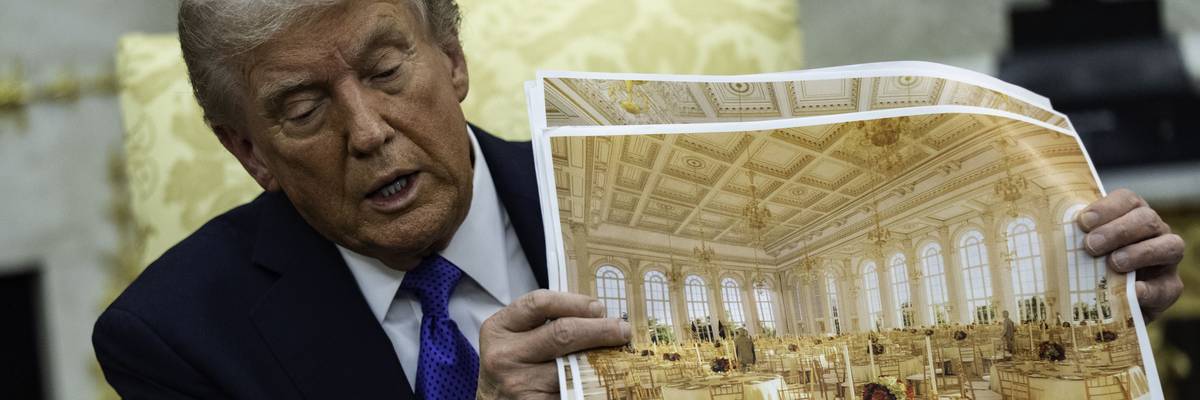
President Donald Trump speaks holding a photos of the new ballroom in the Oval Office of the White House in Washington, DC on October 22, 2025.
'What Are They Hiding?' Trump's Secret Contract for White House Ballroom Revealed
"At every turn, President Trump has sought to conceal the facts about his monstrous multimillion-dollar ballroom,” said Sen. Richard Blumenthal.
While the financing of President Donald Trump's planned $400 million White House ballroom has been shrouded in mystery for months, government watchdog Public Citizen has obtained important new information about the project's funding.
Public Citizen on Tuesday unveiled a copy of the funding agreement the Trump administration has used for the ballroom project after months of legal wrangling that forced the group to file a lawsuit to compel enforcement of a Freedom of Information Act (FOIA) request it made last year.
As summarized by The Washington Post, the ballroom contract's provisions "allow wealthy donors with business before the federal government to contribute anonymously to a sitting president’s pet project, while exempting the White House from key conflict of interest safeguards and limiting scrutiny by Congress and the public."
While dozens of big-name corporate donors—including Amazon, Apple, Lockheed Martin, Google, Altria, and Union Pacific Railroad—have been public about their donations to the project, the fact that some donors can choose to remain anonymous is raising serious concerns among ethics experts.
Charles Tiefer, a retired law professor at the University of Baltimore with a long history of scrutinizing government contracts, told the Post that the contract's anonymity provisions could give the Trump administration an escape hatch from future congressional scrutiny.
"If Congress knocks on the door," Tiefer said, "the White House is going to slam it shut and say, ‘You’re not allowed to know these donors.'"
This means that there is no way to know whether these donors have business before the government, and no way to know if they expect to get something in return for their donations.
Kathleen Clark, a government ethics lawyer and law professor at Washington University in St. Louis, told the Post that the contract's very narrow scope of reviewing for conflicts of interest among donors renders it "nothing more than a sham."
Jon Golinger, democracy advocate for Public Citizen, said the key takeaway from the newly unearthed documents is that "anonymous donations are the heart of this agreement."
"The questions this raises are, of the hundreds of millions being funneled in secret, who are these anonymous donors, and what are they hiding?" Golinger added. "The American people deserve answers, and we’ll keep fighting until they get them."
Wendy Liu, Public Citizen attorney and lead counsel on the lawsuit to obtain the contract, said the administration's initial refusal to comply with a FOIA request was "flatly unlawful," and "the American people are entitled to transparency over this multimillion-dollar project, and this win gets us a bit closer to knowing the truth."
Sen. Richard Blumenthal (D-Conn.) blasted the Trump administration's efforts to hide the contract in a statement given to the Post.
“At every turn, President Trump has sought to conceal the facts about his monstrous multimillion-dollar ballroom,” Blumenthal said. “His administration has kept the contract under wraps, the identities of big dollar donors secret, and the American people in the dark about what big corporations have to gain by funding this boondoggle.”
We are at a crossroads
This country and this world are at a monumental crossroads. In a few short weeks, US voters will have an opportunity to beat back the forces of fascism and confront the billionaires who are rigging the economy, our media system, and our democracy, making it increasingly impossible for ordinary people to get by. We’re not just talking about the election. We’re talking about what must be done once these fascist elements are vanquished from power. We need a bolder set of solutions than what either major party has so far been willing to offer and a working-class movement ready to fight like hell for it. Trump didn't emerge from nowhere. The conditions that fueled MAGA authoritarianism were created by decades of radical neoliberal economic policies and a corrupt political system dominated by corporate interests. They slashed taxes on the super-rich, promising that the benefits would trickle down. They said giveaways to the corporate titans would make life more affordable for the rest of us. It was all bullshit. And when a bitter, betrayed populace searches for someone to blame, right-wing demagogues have little trouble finding scapegoats. People know when they're being lied to, but you won't hear any of this from the corporate media. Only independent journalism—powered and funded by people who believe in building a better world—can deliver truly trustworthy daily news. Our Fall Campaign is underway, and we need your help. To power our newsroom through the rest of the year, we need to raise $125,000 by midnight on October 31. So if you share our vision, please contribute whatever you can to sustain our work. |
While the financing of President Donald Trump's planned $400 million White House ballroom has been shrouded in mystery for months, government watchdog Public Citizen has obtained important new information about the project's funding.
Public Citizen on Tuesday unveiled a copy of the funding agreement the Trump administration has used for the ballroom project after months of legal wrangling that forced the group to file a lawsuit to compel enforcement of a Freedom of Information Act (FOIA) request it made last year.
As summarized by The Washington Post, the ballroom contract's provisions "allow wealthy donors with business before the federal government to contribute anonymously to a sitting president’s pet project, while exempting the White House from key conflict of interest safeguards and limiting scrutiny by Congress and the public."
While dozens of big-name corporate donors—including Amazon, Apple, Lockheed Martin, Google, Altria, and Union Pacific Railroad—have been public about their donations to the project, the fact that some donors can choose to remain anonymous is raising serious concerns among ethics experts.
Charles Tiefer, a retired law professor at the University of Baltimore with a long history of scrutinizing government contracts, told the Post that the contract's anonymity provisions could give the Trump administration an escape hatch from future congressional scrutiny.
"If Congress knocks on the door," Tiefer said, "the White House is going to slam it shut and say, ‘You’re not allowed to know these donors.'"
This means that there is no way to know whether these donors have business before the government, and no way to know if they expect to get something in return for their donations.
Kathleen Clark, a government ethics lawyer and law professor at Washington University in St. Louis, told the Post that the contract's very narrow scope of reviewing for conflicts of interest among donors renders it "nothing more than a sham."
Jon Golinger, democracy advocate for Public Citizen, said the key takeaway from the newly unearthed documents is that "anonymous donations are the heart of this agreement."
"The questions this raises are, of the hundreds of millions being funneled in secret, who are these anonymous donors, and what are they hiding?" Golinger added. "The American people deserve answers, and we’ll keep fighting until they get them."
Wendy Liu, Public Citizen attorney and lead counsel on the lawsuit to obtain the contract, said the administration's initial refusal to comply with a FOIA request was "flatly unlawful," and "the American people are entitled to transparency over this multimillion-dollar project, and this win gets us a bit closer to knowing the truth."
Sen. Richard Blumenthal (D-Conn.) blasted the Trump administration's efforts to hide the contract in a statement given to the Post.
“At every turn, President Trump has sought to conceal the facts about his monstrous multimillion-dollar ballroom,” Blumenthal said. “His administration has kept the contract under wraps, the identities of big dollar donors secret, and the American people in the dark about what big corporations have to gain by funding this boondoggle.”
- Corporate Donors to Trump’s White House Ballroom Beset by Conflicts, Received $279 Billion in Government Contracts in the Past Five Years ›
- 'Blunt Corruption': Trump DOJ Hands Google an Antitrust Win After Tech Giant's Ballroom Donation ›
- Report Details Massive Federal Contracts, Enforcement Actions Against Trump's Ballroom Donors ›
- GOP Senators Unveil Plan to Pay for $400 Million White House Ballroom With Taxpayer Funds | Common Dreams ›
- 50 State Lawmakers Condemn $1 Billion From Taxpayers for Trump Ballroom as Families 'Squeezed' Nationwide | Common Dreams ›
- Trump Demands Senate Fire Parliamentarian as GOP Drops $1 Billion for Ballroom From Bill | Common Dreams ›
While the financing of President Donald Trump's planned $400 million White House ballroom has been shrouded in mystery for months, government watchdog Public Citizen has obtained important new information about the project's funding.
Public Citizen on Tuesday unveiled a copy of the funding agreement the Trump administration has used for the ballroom project after months of legal wrangling that forced the group to file a lawsuit to compel enforcement of a Freedom of Information Act (FOIA) request it made last year.
As summarized by The Washington Post, the ballroom contract's provisions "allow wealthy donors with business before the federal government to contribute anonymously to a sitting president’s pet project, while exempting the White House from key conflict of interest safeguards and limiting scrutiny by Congress and the public."
While dozens of big-name corporate donors—including Amazon, Apple, Lockheed Martin, Google, Altria, and Union Pacific Railroad—have been public about their donations to the project, the fact that some donors can choose to remain anonymous is raising serious concerns among ethics experts.
Charles Tiefer, a retired law professor at the University of Baltimore with a long history of scrutinizing government contracts, told the Post that the contract's anonymity provisions could give the Trump administration an escape hatch from future congressional scrutiny.
"If Congress knocks on the door," Tiefer said, "the White House is going to slam it shut and say, ‘You’re not allowed to know these donors.'"
This means that there is no way to know whether these donors have business before the government, and no way to know if they expect to get something in return for their donations.
Kathleen Clark, a government ethics lawyer and law professor at Washington University in St. Louis, told the Post that the contract's very narrow scope of reviewing for conflicts of interest among donors renders it "nothing more than a sham."
Jon Golinger, democracy advocate for Public Citizen, said the key takeaway from the newly unearthed documents is that "anonymous donations are the heart of this agreement."
"The questions this raises are, of the hundreds of millions being funneled in secret, who are these anonymous donors, and what are they hiding?" Golinger added. "The American people deserve answers, and we’ll keep fighting until they get them."
Wendy Liu, Public Citizen attorney and lead counsel on the lawsuit to obtain the contract, said the administration's initial refusal to comply with a FOIA request was "flatly unlawful," and "the American people are entitled to transparency over this multimillion-dollar project, and this win gets us a bit closer to knowing the truth."
Sen. Richard Blumenthal (D-Conn.) blasted the Trump administration's efforts to hide the contract in a statement given to the Post.
“At every turn, President Trump has sought to conceal the facts about his monstrous multimillion-dollar ballroom,” Blumenthal said. “His administration has kept the contract under wraps, the identities of big dollar donors secret, and the American people in the dark about what big corporations have to gain by funding this boondoggle.”
- Corporate Donors to Trump’s White House Ballroom Beset by Conflicts, Received $279 Billion in Government Contracts in the Past Five Years ›
- 'Blunt Corruption': Trump DOJ Hands Google an Antitrust Win After Tech Giant's Ballroom Donation ›
- Report Details Massive Federal Contracts, Enforcement Actions Against Trump's Ballroom Donors ›
- GOP Senators Unveil Plan to Pay for $400 Million White House Ballroom With Taxpayer Funds | Common Dreams ›
- 50 State Lawmakers Condemn $1 Billion From Taxpayers for Trump Ballroom as Families 'Squeezed' Nationwide | Common Dreams ›
- Trump Demands Senate Fire Parliamentarian as GOP Drops $1 Billion for Ballroom From Bill | Common Dreams ›