

SUBSCRIBE TO OUR FREE NEWSLETTER
Daily news & progressive opinion—funded by the people, not the corporations—delivered straight to your inbox.
5
#000000
#FFFFFF
To donate by check, phone, or other method, see our More Ways to Give page.
Daily news & progressive opinion—funded by the people, not the corporations—delivered straight to your inbox.
"It is Trump’s power grab in legislative garb," said one expert.
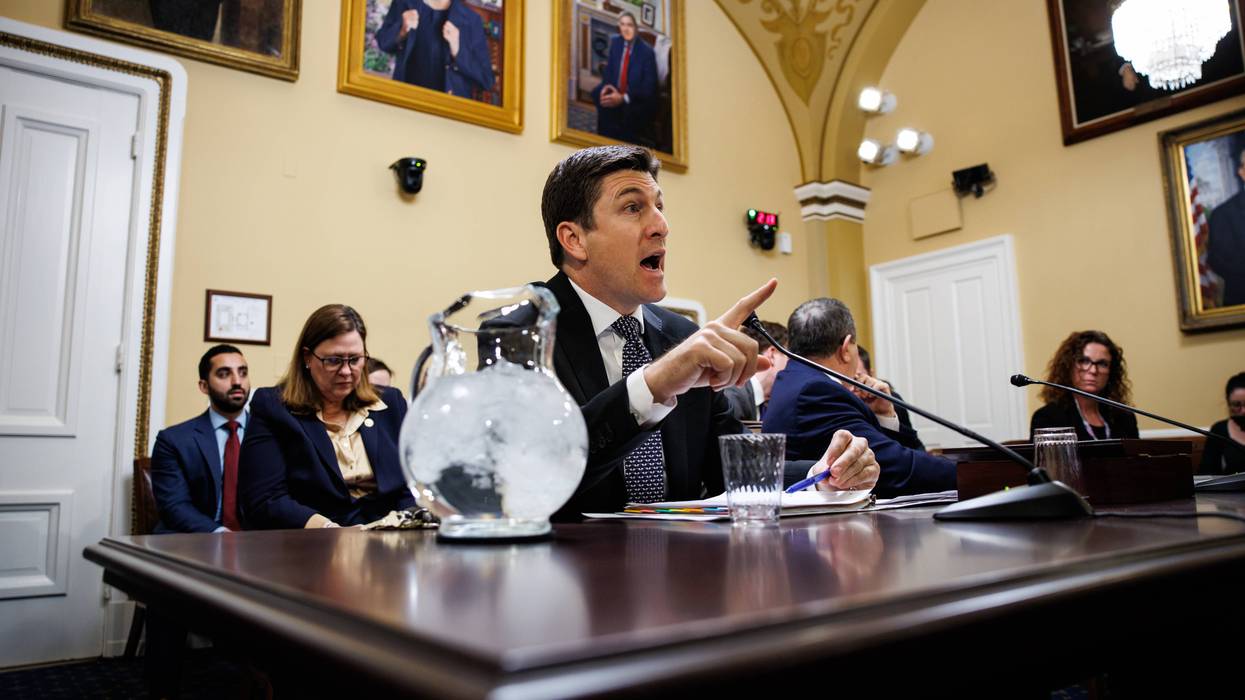
Congressional Republicans on Tuesday held hearings on a pair of bills that watchdogs, election experts, and Democratic lawmakers characterized as brazen and dangerous efforts to suppress voter turnout in service of President Donald Trump's broader assault on democracy—which has included a call for the GOP to "nationalize the voting."
Tuesday's hearings, held by the House Committees on Rules and Administration, featured a revived version of the Safeguard American Voter Eligibility Act (SAVE) Act and Rep. Bryan Steil's (R-Wis.) newly introduced Make Elections Great Again (MEGA) Act, which one analyst described as possibly the "most dangerous attack on voting rights ever" unveiled in the US Congress.
During his opening remarks at the House Administration Committee hearing on the MEGA Act, the panel's ranking member, Rep. Joe Morelle (D-NY), said that "this scheme is not just how Republicans plan to take over our elections, it's how they plan to take over our country."
"Republicans know that they have one hope at winning the next election: change the rules of the game, destroy the rule of law, and desert any last remaining shred of allegiance to the United States Constitution," Morelle added.
@RepJoeMorelle on the anti-voting MEGA Act:
“This scheme is not just how Republicans plan to take over our elections, it’s how they plan to take over our country.”
👇Learn more:https://t.co/kkm6ISuedX pic.twitter.com/g2kRbLIxGX
— Democracy Docket (@DemocracyDocket) February 10, 2026
Both the SAVE Act—which is expected to get a House vote this week—and the MEGA Act would impose severe restrictions on voting access by effectively eliminating voter registration by mail, implementing nationwide photo ID requirements, banning universal mail-in ballots for federal elections, allowing massive voter roll purges, and threatening nonpartisan election officials with imprisonment if they fail to uphold the bills' strict voter documentation requirements.
If passed, the SAVE Act would require anyone registering to vote in federal elections to furnish documentary proof of US citizenship, such as a passport or birth certificate, in person. The Brennan Center for Justice has estimated that 21 million people in the US "lack ready access to these documents," noting that "half of all Americans don’t have a passport, for example, and millions of married women who have changed their names might need to jump through extra hoops to vote."
"Make no mistake: The SAVE Act would stop millions of American citizens from voting," the Brennan Center wrote in an analysis of the legislation on Tuesday. "It would be the most restrictive voting bill ever passed by Congress. It is Trump’s power grab in legislative garb."
The co-chairs of the Not Above the Law Coalition placed the voter suppression bills in the context of Trump's "yearslong campaign of election lies and conspiracy to overturn the 2020 results" as well as "his recent attempts to nationalize election administration, and weaponization of the Department of Justice to intimidate voters and officials."
"Republicans are falling in line by attempting to silence American voters under the guise of 'election integrity,'" the coalition said. "House Republicans are doing Trump's bidding instead of holding him accountable. The real threats to election integrity sit in the White House and among those enabling his authoritarian agenda. Our democracy depends on rejecting this charade and confronting Trump's documented attacks on free and fair elections."
The Trump White House has publicly endorsed the SAVE Act amid mounting fears that the president—animated by false claims of large-scale voter fraud—is moving to undermine the midterm elections later this year.
"It will be up to Democrats to hold their ground and ensure the SAVE Act’s ultimate defeat. It will be up to all of us to not be fooled by the myths and the lies—and protect our elections so they remain free and fair," wrote Brennan Center president Michael Waldman. "And we should stand with election officials who now face threats of groundless criminal prosecution for doing their jobs."
"For voters, who must have the most powerful voice in our democracy," Waldman added, "the stakes are high, and getting higher."
"With what Trump and Musk have been doing, it's more important than ever to get union people, working people, into Congress."
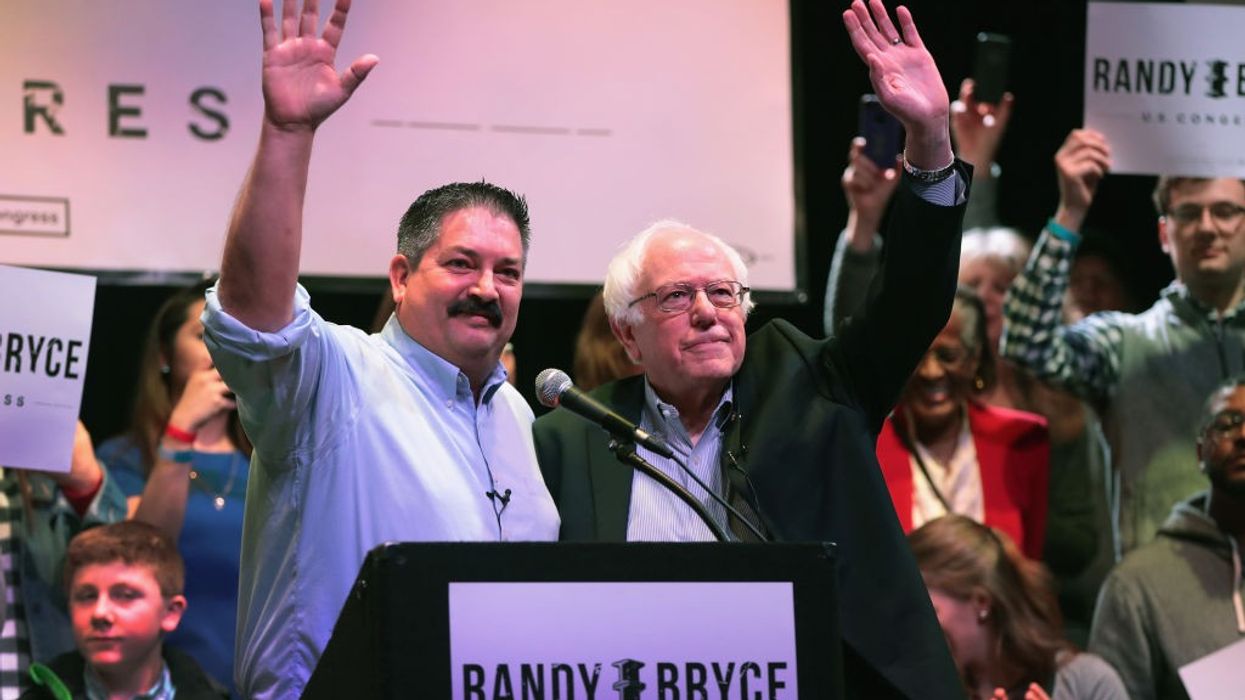
As congressional Republicans and the administration of President Donald Trump set their sites on slashing vital social services, former union ironworker-turned-progressive Democratic U.S. House candidate Randy Bryce announced Tuesday that he will seek to oust the incumbent Trump ally in 2026 and help save Medicaid, Medicare, and Social Security.
Bryce—also known as the "Iron Stache" due to his prominent moustache—is a disabled veteran who launched his 2018 campaign with a viral video skewering then-House Speaker Paul Ryan's (R-Wis.) attacks on healthcare. Bryce, who raised over $7 million with donations averaging around $25, won the Democratic primary but lost to Rep. Bryan Steil (R-Wis.) in the 2018 general election.He aims to face Steil in the next cycle.
"Every great story begins with a spark. Ours began in 2018, when one man stood up to Washington," Bryce said in an ad released Tuesday announcing his new campaign for Wisconsin's 1st Congressional District seat. "Now, as old enemies come out of the shadows, we need him one more time."
"Trump promised to bring manufacturing back," Bryce continued. "Eight years later, we're still waiting. We can't afford to wait any longer—not for jobs, or healthcare, or a damn living wage."
"This isn't about left versus right," he added. "This about the billionaires versus the rest of us, and we've got the numbers!"
As the Milwaukee Journal Sentinel reported Tuesday:
At the time, Bryce ran on supporting "Medicare for All" legislation, raising the minimum wage to $15 per hour, and boosting unions. He remains a member of the Ironworkers Local 853 and in the years since his first campaign, he said, has served as a union representative, worked with Social Security Works, an advocacy group seeking to expand Social Security, and more recently has helped people with disabilities find work.
Like his ally Sen. Bernie Sanders (I-Vt.), Bryce believes that Democrats lack a coherent vision for defeating Trumpism and the oligarchy that's enriching itself at the expense of working-class Americans.
The solution? "With what Trump and Musk have been doing, it's more important than ever to get union people, working people, into Congress," Bryce told Capital Times associate editor and Nation national affairs correspondent John Nichols on Tuesday, referring to de facto Department of Government Efficiency chief and world's richest person, Elon Musk.
Working-class Dem Randy Bryce Takes On Trump Ally Bryan Steil For Key Wisconsin House Seat. — Bryce is the union Ironworker whose 2018 challenge to Speaker Paul Ryan went viral and, ultimately, saw Ryan decide to quit. Bryce says he’s running in 2026 to save Medicaid, Medicare and Social Security.
[image or embed]
— John Nichols (@nicholsuprising.bsky.social) May 20, 2025 at 8:20 AM
"What Trump's doing, and what Bryan Steil is helping him do, is really scaring people," Bryce told Nichols. "I'm talking to veterans, to people who rely on Medicaid, to families that can't keep up with rising prices, to workers. They're all angry."
"You've got an administration that is strangling the Social Security system, laying off people, cutting services," he added. "The Republicans in Washington are pulling what's left of the rug out from under us. I just think this is a going to be an election where people in the 1st District say, Enough!"
"The GOP wants these 'changes' to spread disinformation, justify election denialism, and gain partisan advantage," one lawyer warned.
A key GOP lawmaker made clear in an interview published Thursday that Republicans plan to push for a pair of their voting-related bills when they take control of both chambers of Congress and the White House next month.
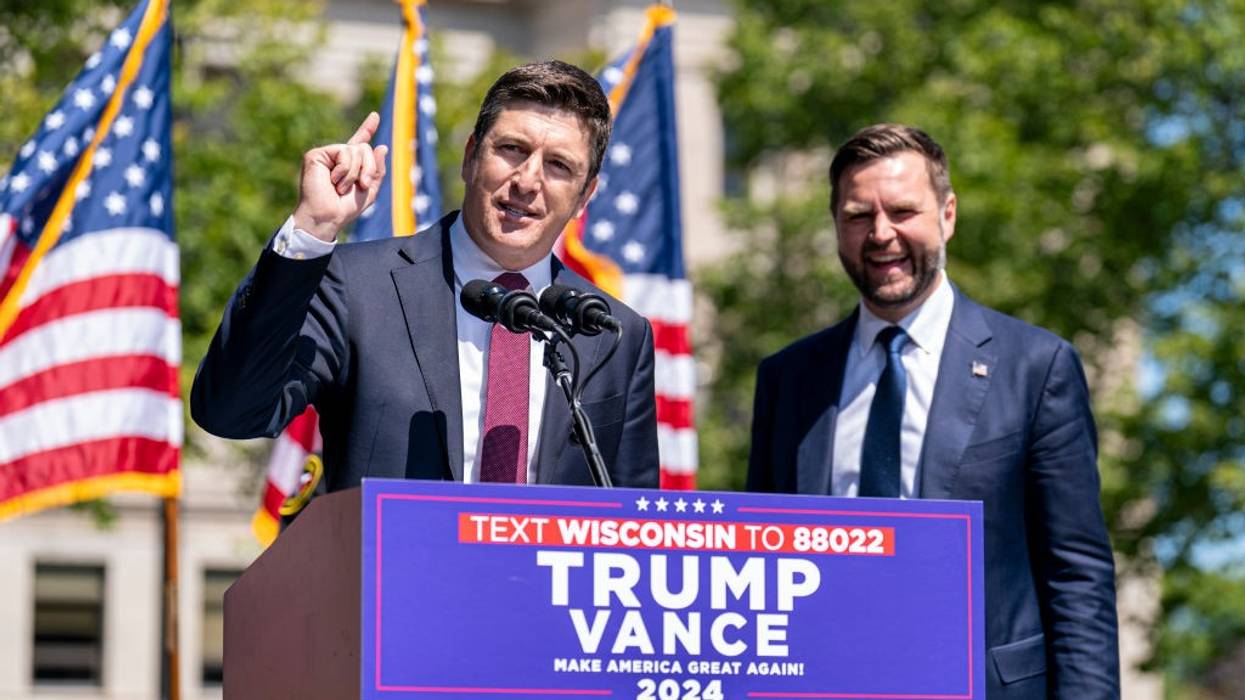
Congressman Bryan Steil (R-Wis.), who campaigned for U.S. President-elect Donald Trump and his running mate, Sen. J.D. Vance (R-Ohio), chairs the Committee on House Administration. He shared the GOP's plans for the American Confidence in Elections (ACE) Act and the Safeguard American Voter Eligibility (SAVE) Act in comments to The Associated Press.
"As we look to the new year with unified Republican government, we have a real opportunity to move these pieces of legislation not only out of committee, but across the House floor and into law," he said. "We need to improve Americans' confidence in elections."
The AP pointed out that "Republicans are likely to face opposition from Democrats and have little wiggle room with their narrow majorities in both the House and Senate. Steil said he expects there will be 'some reforms and tweaks' to the original proposals and hopes Democrats will work with Republicans to refine and ultimately support them."
Steil's ACE Act, which "includes nearly 50 standalone bills sponsored by members of the House Republican Conference," is "the most conservative election integrity bill to be seriously considered in the House in over 20 years," according to his committee.
Dozens of organizations wrote to Steil and Rep. Joe Morelle (D-N.Y.), the panel's ranking Democrat, last year that "we believe Congress has an important role to play in safeguarding free and fair elections and ensuring all Americans have the freedom to vote. Rather than furthering this goal, the ACE Act would be a substantial step backwards."
"The act would nationalize harmful and unnecessary restrictions on voting rights and roll back many of Washington, D.C.'s current pro-voter laws," the coalition explained. "Instead of proceeding with this legislation, Congress should take actions that will help voters and promote democracy such as passing legislation that will strengthen protections against discrimination in voting and expand access to the ballot for all communities."
While that bill didn't get a floor vote in the House this session, Rep. Chip Roy's (R-Texas) SAVE Act did—it was passed by the House 221-198 in July. Every Republican present voted for the bill and all but five House Democrats rejected it.
However, Democrats narrowly controlled the Senate, so the SAVE Act—which would require proof of U.S. citizenship to vote in federal elections—never went further in Congress, despite GOP attempts to tie it to government funding.
Morelle suggested to the AP there could be bipartisan support for some voting policies—such as federal funding for election offices, restricting foreign money in U.S. races, and possibly even identification requirements with certain protections for voters—but he also called out Republicans for spreading conspiracy theories about widespread voting by noncitizens in November.
"You haven't heard a word about this since Election Day," he noted. "It's an Election Day miracle that suddenly the thing that they had spent an inordinate amount of time describing as a rampant problem, epidemic problem, didn't exist at all."
Speaking broadly about voting bills, Morelle told the AP that "our view and the Republicans' view is very different on this point."
"They have spent most of the time in the last two years and beyond really restricting the rights of people to get to ballots—and that's at the state level and the federal level," he added. "And the SAVE Act and the ACE Act both do that—make it harder for people to vote."
Responding to the reporting on social media Thursday, lawyer and Democracy Docket founder Marc Elias said that "Trump is an autocrat. The GOP wants these 'changes' to spread disinformation, justify election denialism, and gain partisan advantage."
"Democrats need to oppose this effort," he warned. "If the GOP enacts new voter suppression laws, I can promise we will sue and win."

One critic warned the legislation would "increase the influence of billionaires, corporations, and secret money in our elections while putting up barriers for eligible voters to vote."
Voting rights advocates across the United States on Monday responded with alarm to Republicans introducing what its backers called "the most conservative election integrity bill to be seriously considered" in the U.S. House of Representatives in decades.
Dubbed the "Big Lie Bill" by critics, the American Confidence in Elections (ACE) Act is spearheaded by Committee on House Administration Chair Bryan Steil (R-Wis.) and includes nearly 50 standalone bills from the chamber's GOP members.
The Declaration for American Democracy (DFAD), a coalition of over 260 groups, said in a statement it was "deeply concerned" about the bill, warning that "the benign-sounding name of this legislation cloaks an extremist, anti-voter effort to increase the role of megadonors in our elections and encourage deliberate barriers to make it harder for eligible voters to cast their ballot."
"This bill would amplify the influence of corporations and billionaires by raising contribution limits and reducing reporting and transparency requirements, opening the floodgates to even more secret money in our elections," DFAD said. "Increasing the role of big money donors in our politics prevents Congress from taking action on the issues that matter most to Americans, such as healthcare, reproductive rights, gun safety, and the environment."
"The ACE Act would disenfranchise millions of voters by encouraging restrictive anti-voter policies that have a disproportionate impact on Black, Indigenous, young, and new American voters," the coalition continued, stressing that widespread U.S. voter fraud doesn't exist. "The bill would be a huge federal government overstep into the governance of Washington D.C., overturning laws that have been enacted to expand and strengthen democracy in the district."
The leftist think tank Dēmos tweeted that "the anti-voter ACE Act is an extremist power grab that would overturn laws that strengthen democracy in D.C. and open the floodgates to secret money. District residents deserve self-determination. The only people cheering this bill are billionaires and corporations."
Fellow coalition members—including Indivisible, NextGen America, and Public Citizen—and other critics also took aim at the GOP bill.
Steil introduced the bill during a field hearing for the committee he leads in Atlanta. During that event and in an opinion piece for the Washington Examiner, the panel chair heralded the Georgia GOP's Senate Bill 202—a sweeping measure passed in 2021 that led to a "staggering" increase in voter suppression, according to a Mother Jones analysis.
"Many of the bill's requirements would replicate Georgia's laws, which already ban outside election funding, require voter ID, and prohibit noncitizen voting," The Atlanta Journal-Constitution reported Monday, noting that the state's Republicans enacted S.B. 202 in response to right-wing complaints about former President Donald Trump's loss in 2020.
The federal proposal comes as the twice-impeached, twice-indicted former president leads the crowded field of candidates for the GOP's 2024 presidential nomination—despite arguments that Trump's "Bie Lie" that the 2020 election was stolen from him incited the January 6, 2021 insurrection, so under the 14th Amendment, he is barred from holding public office again.
The Republican nominee is widely expected to face President Joe Biden, who is seeking reelection. The AJC pointed out that "the bill's rollout in Georgia, a swing state that... Biden won by fewer than 12,000 votes in 2020, creates a contrast between the two political parties ahead of another presidential election year."
When Democrats narrowly controlled both chambers of Congress early last year, right-wing Democratic Sen. Joe Manchin (W.Va.) joined with then-Democratic Sen. Kyrsten Sinema (Ariz.)—who has since become an Independent—to help the GOP block the Freedom to Vote: John R. Lewis Act, a package designed to boost federal protections, limit dark money in politics, and restore the Voting Rights Act of 1965.
Now, the Republicans have a divided majority in the House, while Democrats still have a slim advantage in the Senate, making it highly unlikely that any election-related legislation will make it to Biden's desk for the rest of this congressional session. Still, opponents of the ACE Act urged federal lawmakers to come out against it.
"Congress must reject these efforts to disenfranchise voters and worsen the problem of big money in politics," DFAD said. "To truly increase confidence in our elections, Congress should pass popular, common-sense reforms like those in the Freedom to Vote Act in order to reduce the influence of big money out of politics, ensure our freedom to vote, and guarantee that congressional districts are drawn to give fair representation for all."
"No matter our color, party, or ZIP code," the coalition added, "we all deserve to live in a democracy that represents, reflects, and responds to all of us."
Some Democrats in Congress are speaking out, including U.S. Rep. Nikema Williams, who represents Georgia's 5th District, which includes much of Atlanta.
"Extreme MAGA Republicans are at it again: this time attempting to obstruct voting rights to appease extremist election deniers," she tweeted. "S.B. 202 led to the biggest racial turnout gap in decades and they want to Copy+Paste at the federal level."
Democratic members of the Committee on House Administration declared Monday that "today's hearing is an attempt to appease election deniers."
"President Biden won the 2020 election. The election was secure. The results were accurate. It is undisputable," the panel's Democrats added. "No anti-voting, pro-corruption, #BigLieBill can change that."
"It appears you are acting more like criminal defense counsel trying to gather evidence for a client than a legislative body."
On the heels of former President Donald Trump's historic indictment, Manhattan District Attorney Alvin Bragg's office on Friday told three top Republican lawmakers in the U.S. House that their "attempted interference with an ongoing state criminal investigation—and now prosecution—is an unprecedented and illegitimate incursion on New York's sovereign interests."
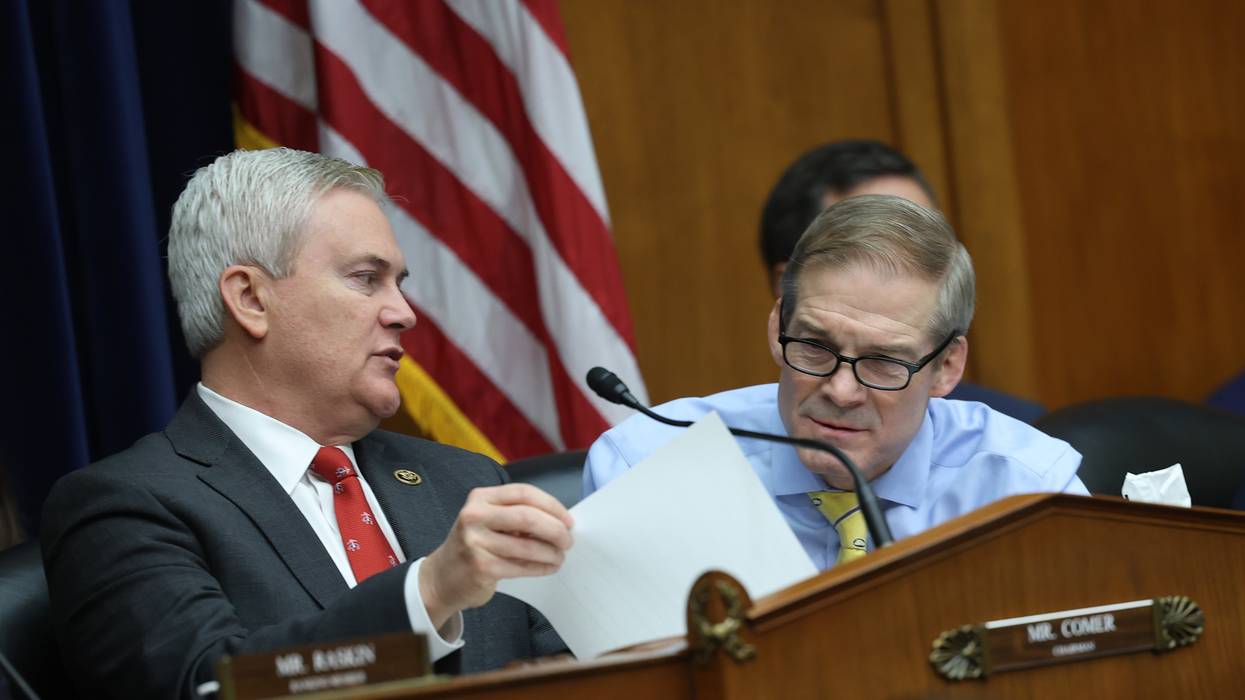
U.S. Reps. Jim Jordan (R-Ohio), James Comer (R-Ky.), and Bryan Steil (R-Wis.)—who chair the House Judiciary, Oversight, and Administration committees, respectively—initially wrote to Bragg last week demanding documents and testimony. In response, the general counsel for Bragg's office, Leslie Dubeck, called their requests an "unlawful incursion" into state sovereignty.
A second letter from Jordan, Comer, and Steil—public allies of Trump—prompted the six-page response from Bragg's office on Friday, less than 24 hours after the New York grand jury convened by Bragg over a hush money payment to a porn star voted to indict the former president and 2024 GOP candidate, who is expected to be arraigned Tuesday.
"You and many of your colleagues have chosen to collaborate with Mr. Trump's efforts to vilify and denigrate the integrity of elected state prosecutors and trial judges and made unfounded allegations."
"Your first letter made an unprecedented request to the district attorney for confidential information about the status of the state grand jury investigation—now indictment—of Mr. Trump," Dubeck wrote to the lawmakers. "Your second letter asserts that, by failing to provide it, the district attorney somehow failed to dispute your baseless and inflammatory allegations that our investigation is politically motivated. That conclusion is misleading and meritless."
"We did not engage in a point-by-point rebuttal of your letter because our office is legally constrained in how it publicly discusses pending criminal proceedings, as prosecutorial offices are across the country and as you well know," the general counsel continued. "That secrecy is critical to protecting the privacy of the target of any criminal investigation as well as the integrity of the independent grand jury's proceedings."
The letter lays out why the congressmen's committees "lack jurisdiction to oversee a state criminal prosecution," and declares that "based on your reportedly close collaboration with Mr. Trump in attacking this office and the grand jury process, it appears you are acting more like criminal defense counsel trying to gather evidence for a client than a legislative body seeking to achieve a legitimate legislative objective."
Dubeck also took aim at their "vague and shifting legislative purpose." Only noting it in the second letter suggests "your proposal to 'insulate current and former presidents' from state criminal investigations is a baseless pretext to interfere with our office's work," she wrote. "Even if you were seriously considering such legislation and had the constitutional authority to enact it (which you do not), your request for information from the district attorney and his former attorneys concerning an ongoing criminal probe is unnecessary and unjustified."
After highlighting that the lawmakers' initial rationale for the inquiry related to the use of federal funding, the letter notes that over the past 15 years, the DA's office has helped the federal government secure over $1 billion from asset forfeiture and the office itself "receives only a small fraction of those forfeited funds."
Dubeck disclosed that from October 2019 to August 2021, approximately $5,000 of the federal forfeiture money was spent investigating the former president or the Trump Organization; most of those costs were related to a case that led to the conviction of Trump Organization CFO Allen Weisselberg and two Trump business entities, and "no expenses incurred relating to this matter have been paid from funds that the office receives through federal grant programs."
The letter explains the DA office's current participation in federal grant programs, then forcefully calls out the congressmen:
Finally, as you are no doubt aware, former President Trump has directed harsh invective against District Attorney Bragg and threatened on social media that his arrest or indictment in New York may unleash "death and destruction." As committee chairmen, you could use the stature of your office to denounce these attacks and urge respect for the fairness of our justice system and for the work of the impartial grand jury. Instead, you and many of your colleagues have chosen to collaborate with Mr. Trump's efforts to vilify and denigrate the integrity of elected state prosecutors and trial judges and made unfounded allegations that the office's investigation, conducted via an independent grand jury of average citizens serving New York state, is politically motivated. We urge you to refrain from these inflammatory accusations, withdraw your demand for information, and let the criminal justice process proceed without unlawful political interference.
Dubeck asked that if the lawmakers won't withdraw their request, they agree to a meeting and provide a list of questions for Bragg as well as a description of documents they believe could be turned over to Congress "without violating New York grand jury secrecy rules or interfering with the criminal case now before a court."
"We trust you will make a good-faith effort to reach a negotiated resolution," she concluded, "before taking the unprecedented and unconstitutional step of serving a subpoena on a district attorney for information related to an ongoing state criminal prosecution."
The latest letter from the DA's office "is really a work of art," independent journalist Marcy Wheeler said in a series of tweets on Friday. "It was a joy to read. Bragg is not fucking around and... well, Jimmy Jordan is."
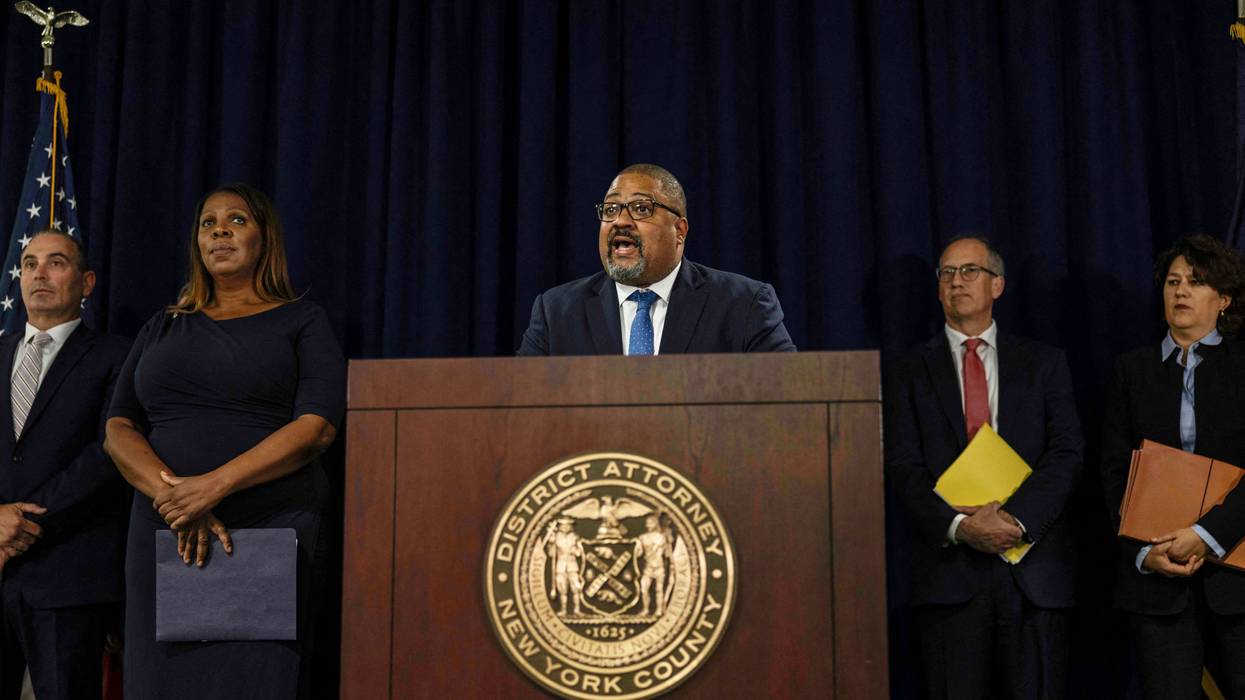
"The district attorney is obliged by the federal and state constitutions to protect the independence of state law enforcement functions from federal interference," wrote the district attorney's general counsel.
The office of Manhattan District Attorney Alvin Bragg on Thursday accused House Republicans of an "unlawful incursion" into New York authorities' investigation of former President Donald Trump, who is expected to face criminal charges over a 2016 pre-election hush-money payment to porn star Stormy Daniels.
In a letter to Reps. Jim Jordan (R-Ohio), Bryan Steil (R-Wis.), and James Comer (R-Tenn.)—respectively the chairs of the House Judiciary, Administration, and Oversight Committees—the Manhattan DA's general counsel Leslie Dubeck wrote that the lawmakers' request earlier this week for confidential information pertaining to the Trump probe amounted to "an unprecedented inquiry into a pending local prosecution."
Dubeck wrote that the GOP lawmakers' Monday letter demanding that Bragg turn over communications and other documents related to the investigation "only came after Donald Trump created a false expectation that he would be arrested the next day and his lawyers reportedly urged you to intervene."
"Neither fact is a legitimate basis for congressional inquiry," Dubeck continued. "The district attorney is obliged by the federal and state constitutions to protect the independence of state law enforcement functions from federal interference."
The reply from Bragg's office came just before news broke that the Manhattan grand jury tasked with considering possible criminal charges against the former president is not expected to convene again until at least Monday of next week.
Trump set off a firestorm over the weekend by claiming on his social media platform that he would be arrested on Tuesday and urging his supporters to mobilize in response. The arrest did not take place as the former president and 2024 candidate predicted, but the post did lead to a flood of donations from his right-wing political supporters.
As Insider reported, Trump "raised $1.5 million in the three days after he claimed on Truth Social that he'd be arrested."
"The resulting average of $500,000 a day," the outlet noted, "is almost double the daily average from the weeks before and after he announced his bid for the White House in November."
In addition to requesting documents and testimony from Bragg, Jordan on Wednesday wrote letters demanding communications and other materials from two former prosecutors who previously led the Trump hush-money investigation.
As The Washington Post summarized on Thursday: "Daniels, whose legal name is Stephanie Clifford, was paid $130,000 by Michael Cohen, Trump's former lawyer and fixer," to stay quiet about an alleged affair.
"Trump reimbursed [Cohen] after becoming president, in installments that were designated legal fees," the Post added. "Bragg (D) has declined to give details of the investigation. But he is believed to be considering charges related to the payments that would include falsifying business records, possibly in commission of another, campaign-related crime. It is up to him to decide whether to ask the grand jury to vote on charging Trump with a crime."