

SUBSCRIBE TO OUR FREE NEWSLETTER
Daily news & progressive opinion—funded by the people, not the corporations—delivered straight to your inbox.
5
#000000
#FFFFFF
To donate by check, phone, or other method, see our More Ways to Give page.
Daily news & progressive opinion—funded by the people, not the corporations—delivered straight to your inbox.

"U.S. agribusiness exporters, the biotech industry, and their allies in Congress are pushing this case, intent on compelling Mexico to accept U.S. exports without debate," said one expert.
After two-and-a-half months of failed negotiations, the U.S. government on Thursday intensified its effort to quash Mexico's limits on genetically modified corn imports by calling for the formation of a dispute settlement panel under a North American trade deal.
In a 2020 decree backed by agricultural, consumer, environmental, public health, and worker groups, Mexican President Andrés Manuel López Obrador (AMLO) announced plans to phase out genetically modified (GM) corn and the herbicide glyphosate by January 2024.
Under pressure from the U.S. government and impacted industries, he issued a new decree in February reiterating plans to block GM corn imports for human consumption by then but lifting the deadline for imports intended for livestock feed and industrial use.
"The Mexican government will show what has occurred: Its cherished tortillas are being contaminated with glyphosate and GM corn. And they intend to put a stop to that."
While AMLO's move was seen as a concession to the U.S. and lobbyists challenging his policies, the Biden administration in June still requested 75 days of formal negotiations. After talks ended Wednesday, U.S. Trade Representative (USTR) Katherine Tai confirmed the decision to form a panel under the United States-Mexico-Canada Agreement (USMCA).
"Through the USMCA dispute panel, we seek to resolve our concerns and help ensure consumers can continue to access safe and affordable food and agricultural products," Tai said Thursday. "It is critical that Mexico eliminate its USMCA-inconsistent biotechnology measures so that American farmers can continue to access the Mexican market and use innovative tools to respond to climate and food security challenges. Our bilateral relationship with Mexico, one of our oldest and strongest trading partners, is rooted in trust and honesty, and there are many areas where we will continue to cooperate and work together."
U.S. Agriculture Secretary Tom Vilsack similarly said that "Mexico's approach to biotechnology is not based on science" and "the United States is continuing to exercise its rights under the USMCA to ensure that U.S. producers and exporters have full and fair access to the Mexican market."
The Mexican Ministry of Economy responded in a statement that "Mexico does not agree with the position of the United States" and "is prepared to defend the Mexican position before this international panel and demonstrate: 1) that the national regulation is consistent with the commitments signed in the treaty; and 2) that the challenged measures do not have commercial effects."
The Institute for Agriculture and Trade Policy (IATP) has previously supported Mexico's efforts to phase out GM corn and glyphosate and on Thursday challenged claims by U.S. officials and agribusiness about Mexican obligations under the treaty and the potential economic impact of the policies.
"U.S. agribusiness exporters, the biotech industry, and their allies in Congress are pushing this case, intent on compelling Mexico to accept U.S. exports without debate. It is an assault on Mexico's food sovereignty," said Karen Hansen-Kuhn, IATP director of trade and international strategies. "Trade rules should provide a forum to protect and advance rights, rather than block them."
Hansen-Kuhn on Thursday authored an op-ed about Mexico's rights under the USMCA while ITAP senior adviser Timothy A. Wise wrote about "exaggerated claims of economic damage" that "sprang from a convenient set of assumptions, all of which are flawed and now outdated in light of the more recent presidential decree."
"As Mexican Economy Minister Raquel Buenrostro stated in response to the USTR request for technical consultations, Mexico's decree is based on science, and she will challenge the U.S. government in the consultations to show 'quantitatively, with numbers, something that has not occurred: that the corn decree has commercially affected U.S. exporters,'" Wise also said.
"The Mexican government will show what has occurred: Its cherished tortillas are being contaminated with glyphosate and GM corn," he continued. "And they intend to put a stop to that."
As Reuters detailed Thursday:
Under USMCA's dispute settlement rules, a five-person panel, chosen from a roster of pre-approved experts, must be convened within 30 days, with a chair jointly chosen and the U.S. side choosing two Mexican panelists and Mexico choosing two American panelists. The panel will review testimony and written submissions and its initial report is due 150 days after the panel is convened.
Previous USMCA dispute panels last year ruled in the U.S.'s favor in a dispute over Canadian dairy quotas, and against the U.S. on automotive rules of origin, siding with Mexico and Canada.
There have been other disagreements between the U.S. and Mexico, most notably over energy in which the U.S. has argued that Mexico's nationalist policy prejudices foreign companies.
Arturo Sarukhán, a former Mexican ambassador to the United States, said on social media Thursday that "of the two consultation processes—energy and yellow corn—this is the one that is politically most relevant for the White House in 2024," given the significance of agricultural states such as Michigan, Minnesota, and Wisconsin to Democratic U.S. President Joe Biden, who is seeking reelection, and the GOP nominee, which could be former President Donald Trump, who signed the USMCA.

Privacy advocates on Monday urged lawmakers to ban facial recognition in schools in response to a new study finding that use of the technology in educational settings would likely lead to a number of negative consequences including the normalization of surveillance and worsening of racial biases.
"Using facial recognition in schools amounts to unethical experimentation on children," said Evan Greer, deputy director of Fight for the Future.
The digital rights group has been vocal in its opposition to facial recognition, or FR, and last year launched the BanFacialRecognition.com website along with dozens of other groups.
Greer, in her statement, said that the moves being made during the covoravirus crisis by companies that sell the technology are simply adding more urgency to the demand for a ban.
"We're already seeing surveillance vendors attempt to exploit the Covid-19 pandemic to push for the use of this ineffective, invasive, and blatantly racist technology," she said. "It's time to draw a line in the sand right now."
"Lawmakers should act quickly to ban facial recognition in schools, as well as its use by law enforcement and corporations," added Greer.
The new comments from Greer follow a study (pdf) out Monday from researchers at the University of Michigan's Ford School of Science, Technology, and Public Policy Program (STPP) entitled "Cameras in the Classroom."
"Schools have also begun to use [FR] to track students and visitors for a range of uses, from automating attendance to school security," the researchers wrote, though they noted that the technology's use in schools is "not yet widespread."
But, the authors added, there's good reason to stop its spread:
[O]ur analysis reveals that FR will likely have five types of implications: exacerbatingracism, normalizing surveillance and eroding privacy, narrowing the definition of the "acceptable" student, commodifying data, and institutionalizing inaccuracy. Because FR is automated, it will extend these effects to more students than any manual system could.
FR "is likely to mimic the impacts of school resource officers (SROs), stop-and-frisk policies, and airport security," all of which "purport to be objective and neutral systems, but in practice they reflect the structural and systemic biases of the societies around them," the study says.
"All of these practices have had racist outcomes due to the users of the systems disproportionately targeting people of color," the researchers wrote.
The technology further stands to "normalize the experience of being constantly surveilled starting at a young age" and holds the possibility of "mission creep," the researchers warned, "as administrators expand the usage of the technology outside of what was originally defined."
According to lead author Shobita Parthasarathy, STPP director and professor of public policy, "The research shows that prematurely deploying the technology without understanding its implications would be unethical and dangerous."
The American Farm Bureau organized letter on proposed new rules regulating genetically engineered (GE) crops is short, just two pages, with three pages of agribusiness signatories, 103 organizations. The authors don't address the agency proposing a new rule--the U.S. Department of Agriculture's Animal Plant and Health Inspection Service (APHIS).
The American Farm Bureau organized letter on proposed new rules regulating genetically engineered (GE) crops is short, just two pages, with three pages of agribusiness signatories, 103 organizations. The authors don't address the agency proposing a new rule--the U.S. Department of Agriculture's Animal Plant and Health Inspection Service (APHIS). They instead write to USDA Secretary Sonny Perdue, the Biotechnology Industry Organization's Governor of the Year in 2009, to voice their displeasure. They expect that he will instruct APHIS to redraft the rule, overturning a rulemaking process that began in 2008.
Secretary Perdue's special assistant for deregulation, Rebeckah Adcock, previously worked for the Farm Bureau and Crop Life International, a pesticide industry lobby group, according to a lengthy New York Times article on Trump administration deregulation teams in each federal agency. For farmers, farm workers, rural communities and consumers, successful deregulation will result in greater damage to environmental and public health from more toxic and bio-persistent pesticides and herbicides that the GE crops are designed to survive.
The first page of the Farm Bureau led letter is full of praise for APHIS' 30-year history of invariably approving the first generation of GE plants, mostly to make cotton, corn and soy resistant to herbicide that just happen to be produced by the biotech seed developer, or to engineer corn to produce a pesticide. (As detailed below, the synergy of GE seed technology and herbicides has resulted in millions of acres of glyphosate resistant super-weeds, and the use of yet more toxic and bio-persistent pesticides to try to kill them.) The second page is a list of recommendations to overhaul the rule that will apply to the new GE techniques for modifying plant traits, e.g. corn engineered to produce pharmaceuticals and industrial chemicals.
These recommendations, with a farmer face, are drawn from a 23-page comment from the Biotechnology Innovation Organization (formerly the Biotechnology Industry Organization now rebranded under the tag lines "Heal the world, Fuel the world, Feed the word"). The coordination between the Farm Bureau and BIO letters is impressive. The content of the letters, which argue to accelerate and broaden current deregulation procedures to keep pace with the promised waves of genome edited plants, is alarming.
IATP also wrote to APHIS about the proposed rule, but with little expectation that APHIS will change the rule to begin regulating GE plants. Part of this low expectation is informed by the USDA's overall deregulation initiative, explained by Adcock, at a May 24 meeting at the Farm Foundation Forum. Adcock said (in the ca. first 18 minutes of a MP3 recording) that USDA would work to "get out of your way" in agribusiness, while adhering to the law and President Donald Trump's executive order to eliminate two regulations for every new one issued. (A coalition of NGOs have challenged this executive order in court, charging that it violates the Constitution and the Administrative Procedures Act, the main statutory basis for developing regulations.)
IATP opposed APHIS' proposed "upfront risk assessment," a paperwork review to determine whether a biotech product developer's GE modification would produce a "noxious weed" or a plant pest, as defined by the Plant Protection Act (PPA). IATP urged APHIS to regulate GE plants using the entire definition of "noxious weed" in the PPA to include the "indirect injury" to farmers, farmworkers and rural communities that has resulted from the more than 100 million U.S. acres and growing of super-weeds resistant to the pesticides and herbicides of the GE varieties.
The biotech companies' "innovation" to combat super-weeds is yet more toxic herbicides, including dicamba. Dicamba drift has damaged non-dicamba resistant plants, leading one farmer to write to Arkansas plant health authorities, ""I feel that the need to plant a [dicamba resistant] technology to protect your crop from off-target [dicamba drift] movement is tantamount to extortion." After at least 242 farmer complaints about crops ruined by dicamba drift, the Arkansas Plant Board voted 9 to 5 to ban dicamba use for 120 days. Missouri, the home state of Monsanto's headquarters, has also banned dicamba use for the remainder of the 2017 growing season.
APHIS is not authorized to prevent forced purchase of dicamba resistant seed varieties by regulating how and where dicamba is used. However, APHIS could coordinate its regulation of GE crops with the Environmental Protection Agency's regulation of pesticide products to prevent approval of products which, if used per company instructions, result in damage to dicamba non-resistant crops and forced purchase of dicamba resistant seeds.
IATP is alarmed that APHIS proposes to "generally not require data from outdoor plantings" for the GE crops that it's "upfront risk assessment" determines to pose no risk of producing a noxious weed or plant pest. Field trial data, albeit classified as Confidential Business Information, had been used by U.S. agencies to verify product developer claims about GE plant traits and performance. We hope, but are not certain, that the proposed rule's general exemption of field trial data in risk assessment will not be extended to plant genomes edited to produce pharmaceuticals and industry chemicals. IATP is a signatory to a Center for Food Safety drafted comment letter that stated "We urge USDA to strictly regulate GE crops that produce experimental pharmaceutical or industrial compounds, as USDA itself proposed to do over a decade ago." There is no science that shows that such "pharma crops," if developed in open pollinating plants, such as corn, can be kept out of the general food supply.
We hope, but are not certain, that the proposed rule's general exemption of field trial data in risk assessment will not be extended to CRISPR genome editing to control agricultural pests by creating a genetic modification that is driven through a pest population by sexual reproduction. A public debate about gene drive based pest control is just beginning. IATP's April 2016 comment to APHIS on its proposed options for an environmental impact assessment of gene edited crops, cited the following passage from a Nature editorial, "What is new is the advent of CRISPR . . . because it make gene drives much easier to create and could dramatically accelerate the timeline for a potential release--accidental or intentional [of a gene drive] . . . efforts to understand the ecological consequences of a gene drive should be made an urgent priority." APHIS does not show, in the proposed rule, that it understands those consequences nor that it has a plan to prevent environmental damage that could result from releasing CRISPR edited gene drives into agricultural fields.
BIO, like IATP, opposes APHIS' "up front" regulatory status review for GE plants, but not because of the lack of a subsequent requirement of field trial data for risk assessment of "pharma crops," CRISPR gene drives or other future GE techniques, following the regulatory status review. (BIO falsely assumes that every regulatory status review will be preceded by a scientifically informed risk assessment, while the proposed rule makes it clear that the regulatory status review is a policy, rather than a science-based, tool.) Rather, BIO wants APHIS to review "whole classes of organisms. . . .to dramatically increase agency efficiency" in determining what not to regulate.
Without a mechanism to expedite the non-regulation of whole categories of organisms, BIO contends that biotech products will be caught in a "regulatory limbo," that innovations will be stymied, investment decisions will be postponed, and sales of the new GE technologies, crops and their pesticides will be "lost" to foreign competitors. However, BIO's 3,000+ members in more than 30 countries include global agribusinesses, such as Cargill, Dupont, Monsanto, Bayer etc. that benefit from deregulation everywhere they trade.
BIO (and the Farm Bureau) need not fear losing trade opportunities to too slow APHIS deregulation. As IATP noted in its comment, the U.S. Trade Representative announced in June that it would initiate trade disputes at the World Trade Organization for any barrier to trade that it determined not to be "science based." The U.S. Biotech Trade Alliance wrote to the USTR to propose new disciplines for the renegotiation of the North American Free Trade Agreement, beyond those of the Transpacific Partnership Agreement (TPP), to expedite trade in products of biotechnology.
The Alliance revives an old BIO proposal that once a GE plant is deregulated in one jurisdiction in a trade agreement, it must be deregulated and accepted for import everywhere. So, for example, a CRISPR edited gene drive designed to kill corn rootworm in the Midwest must be accepted for import and use in Oaxaca, ecological consequences and other science-based differences be damned.
By now it is well understood that the Trump administration will break all the Trump campaign's promises about opposing the TPP by seeking to adopt much of that agreement's text in a renegotiated NAFTA. The APHIS proposed rule, which IATP characterized as consisting largely "of legal and policy reasons about why APHIS will not regulate GE organisms," combined with trade rules to force the import of unregulated GE organisms, may globalize a new generation of GE crops through the same methods that the Arkansas farmer forced to buy dicamba resistant crops characterized as "tantamount to extortion."
The people are taking Monsanto to court.
An international tribunal is being staged in front of The Hague this weekend to highlight the human rights violations and ecological devastation wreaked by the GMO and chemical giant around the world, as well as to draw attention to the failure of the International Criminal Court (ICC) to bring such corporate criminals to justice.
| #MonsantoTribunal Tweets |
The three-day "moral trial," arranged by an international coalition of rights and environmental groups, begins Friday.
People's assemblies at the Hague and around the globe will draw attention to the unprecedented trial.
"This tribunal might not be legally binding, but it will highlight the urgent need for similar legal mechanisms to hold corporations accountable for the damage they cause in the pursuit of profit," said Global Justice Now food campaigner Heidi Chow in a statement.
The tribunal comes as Monsanto comes closer to merging with chemical giant Bayer, to form the largest GMO and pesticide company in the world.
Monsanto has attempted to dismiss the trial as a "stunt." But activists say it is a "test of international law," as the Guardian reports, and argue that Monsanto's ongoing crimes must be brought to light.
"Monsanto is able to ignore the human and environmental damage caused by its products, and maintain its devastating activities through a strategy of systemic concealment: by lobbying regulatory agencies and governments, by resorting to lying and corruption, by financing fraudulent scientific studies, by pressuring independent scientists, and by manipulating the press and media," said Andre Leu, president of IFOAM-Organics International, one of the groups behind the tribunal.
Indeed, it's not just Monsanto's products that have been so harmful: a new report by the Corporate Europe Observatory (CEO) finds that Monsanto's political influence and lobbying efforts have also contributed to a global erosion of democracy, environmental chaos, and social injustice.
"Corporate crimes have become visible everywhere, the corporations become bigger, claiming absolute power, absolute rights, absolute immunity, deploying more violent tools against nature and people."
--Vandana Shiva
The report (pdf) published Thursday by CEO, "Monsanto Lobbying: An attack on us, our planet and democracy," is intended to be a guide to the tribunal's proceedings.
"Monsanto's history reads like a text-book case of impunity, benefiting transnational corporations and their executives, whose activities contribute to climate and biosphere crises and threaten the safety of the planet," as Leu said.
EcoWatch summarizes the notoriously long history of Monsanto's ill effects on human rights and the environment:
Monsanto, which is inching closer to a $66 billion takeover from German pharmaceuticals giant Bayer, has faced a never-ending slew of health and environmental controversies over its products since, well, the beginning of the twentieth century.
Monsanto's historical line-up of products includes banned and highly toxic chemicals such as 2,4,5-trichlorophenoxyacetic acid (a dioxin-containing component of the defoliant Agent Orange); PCBs(polychlorinated biphenyl); and Lasso, a herbicide banned in Europe. Glyphosate, the controversialmain ingredient in Monsanto's best-selling weedkiller RoundUp, is the most widely used pesticide in the world. Monsanto is also the world's largest genetically modified (GMO) seed maker, giving them a major hand over the world food supply.
With Monsanto's and other large corporations' growing power has come increasing devastation to people and the planet, activists argue.
"Corporate crimes have become visible everywhere, the corporations become bigger, claiming absolute power, absolute rights, absolute immunity, deploying more violent tools against nature and people," wrote anti-GMO crusader Vandana Shiva in a Common Dreams op-ed earlier this week. "The People's Assembly will not just take stock of the past and present crimes. It will look at future crimes with the aim of preventing them."
Golden rice is a false miracle. It is a disease of nutritionally empty monocultures offered as a cure for nutritional deficiency. In fact, golden rice, if successful, will be 400% less efficient in providing Vitamin A...
Norman Borlaug, father of the Green Revolution, died on September 9, 2009. Alfred G. Gilman died on December 23, 2015. Both were Nobel laureates and now both dead. Gilman was a signatory to a recent letter condemning Greenpeace and its opposition to genetic engineering.
How many Nobel laureates does it take to write a letter? Easily ascertained--the dead Gilman and 106 others were enlisted in "supporting GMOs and golden rice". Correct answer--107, dead or alive.
The laureates were rounded up by Val Giddings (senior fellow, Information Technology and Innovation Foundation), Jon Entine (author of Abraham's Children: Race, Identity and the DNA of the Chosen People) and Jay Byrne (former head of corporate communications, Monsanto). Real people don't have the luxury of getting Nobel laureates to write 1/107th of a letter, "chosen" folk do. Evidently.
Cornell University is a "chosen" institution -- central to genetically modified public relations. The Cornell Alliance of Science is funded by Bill Gates, just like the failed golden rice experiment.
The Nobel laureates accuse Greenpeace of killing millions by delaying ghost rice -- something the biotech industry accuses me of doing, for the same reason. Unlike golden rice -- whose failure to launch is the industry's own failure, the opposition to genetic engineering (and hence golden rice) is very real and successful. As Glenn Stone, a rice scientist at Washington University, states: "The simple fact is that after 24 years of research and breeding, golden rice is still years away from being ready for release."
It is Borlaug's Green Revolution monocultures that contributed to malnutrition by destroying biodiversity, which destroys the diversity of nutrients we need to be healthy. As Navdanya research has shown, biodiversity produces more food and nutrition per acre. Borlaug's ghost is still shaping the industrial agriculture "miracles" based on monocultures of the mind and spin in place of science.
It is now more than 20 years since the "miracle" golden rice began to be promoted as the excuse to allow patents on life. The last time golden rice was resurrected when Patrick Moore of Allow Golden Rice Now was sent to Asia to push the failed promise. Women of the world organised and responded to Moore -- Diverse Women for Diversity issued a declaration on International Women's Day in 2015 titled Women and Biodiversity Feed the World, not Corporations and GMOs.
Golden rice is genetically engineered rice with two genes from a daffodil and one gene from a bacterium. The resulting GMO rice is said to have a yellow colouring, which is supposed to increase beta-carotene -- a precursor of Vitamin A. It has been offered as a potential miracle cure for Vitamin A deficiency for 20 years.
But golden rice is a false miracle. It is a disease of nutritionally empty monocultures offered as a cure for nutritional deficiency. In fact, golden rice, if successful, will be 400 per cent less efficient in providing Vitamin A than the biodiversity alternatives that women have to offer. To get your daily requirement of Vitamin A, all you need to eat is one of the following:
Two tablespoons of spinach or cholai (amaranth) leaves or radish leaves
Four tablespoons of mustard or bathua leaves
One tablespoon of coriander chutney
One-and-a-half tablespoon of mint chutney
One carrot
One mango
So, if you want to be four times more efficient than 107 Nobel laureates, just eat a carrot!
Not only do these indigenous alternatives based on women's knowledge provide more Vitamin A than golden rice ever will, and at a lower cost, but also provide multiple other nutrients. Our critique of golden rice is that even if it is developed, it will be inferior to the alternatives women have in their hands and minds. Women are being blocked from growing biodiversity and spreading their knowledge to address malnutrition, by rich and powerful men and their corporations who are blind to the richness of the earth and our cultures.
Through their monoculture of the mind, they keep imposing monocultures of failed technologies, blocking the potential of abundance and nourishment. As I wrote in 2000, blindness to biodiversity and women's knowledge is a blind approach to blindness prevention.
Grain.org concluded in Grains of delusion: Golden rice seen from the ground, way back in 2001: "The best chance of success in fighting Vitamin A deficiency and malnutrition is to better use the inexpensive and nutritious foods already available, and in diversifying food production systems in the fields and in the household. The euphoria created by the Green Revolution greatly stifled research to develop and promote these efforts, and the introduction of golden rice will further compromise them. Golden rice is merely a marketing event. But international and national research agendas will be taken by it."
The Giddings-Entine-Byrne Nobel PR stunt was timed to coincide with the US Senate vote on the Dark Act -- the denial to Americans of the right to know what they eat. With two decades of the GMO experiment failing to control pests and weeds, creating super pests and super weeds instead, there is now an attempt to push through the "next generation" of GMOs -- such as "gene drives" for exterminating nutrient-rich species like the amaranth. Amaranth, a weed to the 107 Nobel laureates, is a richer source of Vitamin A than golden rice has promised it will be, when it grows up. The laureates would have us round up all the Vitamin A we already have in abundance, create deficiencies by exterminating it with RoundUp, and provide golden rice to alleviate the absence of Vitamin A.
Mr Gates is also supporting this failed miracle, as well as the failed communication through the Cornell Alliance for Science. He also funds the Global Alliance for Improved Nutrition and Harvest Plus, the corporate alliance for biofortification.
The corporate-controlled World Food Prize for 2016 has been announced for "Biofortification". Scientists funded by Mr Gates have been given the prize for inventing an orange sweet potato. But the Maori in New Zealand had developed kumara, orange (beauregard) sweet potato, centuries ago.
Mr Gates is also funding the biopiracy research of James Dale of Queensland, who took the Vitamin A-rich indigenous bananas of Micronesia and declared them to be his invention.
The biopiracy of people's biodiversity and indigenous knowledge is what Mr Gates is funding. The Gates fortification or Nobel fortification, will not nourish people. Fraud is not food.
Despite opposition from consumer advocacy groups, a controversial bill on the labeling of genetically modified (GM or GMO) food passed a cloture vote in the U.S. Senate on Wednesday, even as critics warned the legislation is needlessly complicated and bends to the agriculture lobby interests.
According to The Hill, "the Democrats who voted in support of the bill included Sens. Tammy Baldwin (Wis.), Michael Bennet (Colo.), Tom Carper (Del.), Bob Casey (Pa.), Chris Coons (Del.), Joe Donnelly (Ind.), Dianne Feinstein (Calif.), Al Franken (Minn.), Heidi Heitkamp (N.D.), Tim Kaine (Va.), Amy Klobuchar (Minn.), Joe Manchin (W.V.), Claire McCaskill (Mo.), Robert Menendez (N.J.), Gary Peters (Mich.), Jeanne Shaheen (N.H.), Debbie Stabenow (Mich.) and Mark Warner (Va.)."
The so-called "compromise" bill, introduced in June by Sens. Debbie Stabenow (D-Mich.) and Pat Roberts (R-Kan.), allows food companies to label GMOs by using codes, symbols, or packaging language.
Critics slammed the bill's sponsors for negotiating the legislation behind closed doors, accusing Stabenow and Roberts, among others, of being in Big Ag's pocket. According to an analysis of OpenSecrets.org data by the group Organic Consumers Association (OCA), supporters of the bill received more than twice as much money in campaign donations from companies like Monsanto than opponents. Ahead of the vote Wednesday, OCA activists disrupted the Senate session to dump $2,000 on the chamber floor to protest the back-room dealings.
In addition to being confusing, the bill discriminates against certain consumers, including low-income, minority, rural, and elderly populations, by allowing food companies to use QR codes that require being scanned by smartphones, the Center for Food Safety (CFS) said on Wednesday.
"It is deeply disturbing that a majority in the Senate would support a bill that openly discriminates against America's low income, rural and elderly populations. This denies them their right to know simply because they are not able to afford or have access to smartphones," said CFS executive director Andrew Kimbrell. "The bill itself is poorly drafted and would exempt many and perhaps most current genetically engineered foods from labeling. It was written behind closed doors between a handful of Senators and the big chemical and food companies. It is a non-labeling bill disguised as a labeling bill, a sham and a legislative embarrassment."
Opponents also noted that the bill simply goes against public opinion, with recent polls showing that more than 90 percent of Americans want GMO labeling on their food. If the bill passes into law, it will nullify state-level labeling efforts, such as the historic Vermont law that requires companies to use explicit language on their packages.
Wenonah Hauter, executive director of the environmental advocacy group Food & Water Watch, wrote in a blog post on Wednesday:
This is a slap in the face for all of the advocates that have worked hard to pass state-level measures because they believe strongly that labels should be transparent, and people should have the choice to decide whether or not they purchase and consume foods with genetically engineered ingredients. The majority of Americans support labeling for GMOs and will hold their elected officials accountable for stripping away this transparency.
If this bill becomes law, the industry wins what are essentially voluntary requirements under this GMO labeling "compromise," which does not mandate recalls, penalties or fines for noncompliance with the incredibly weak requirements of the bill that will likely leave many GMO ingredients exempt from any labeling requirements. And the bill gives companies the option to use discriminatory QR codes that require a smartphone to access basic information about the food on store shelves.
The bill is expected to get final approval in the Senate as early as this week. The U.S. House of Representatives will also have to pass its own version of the legislation before the Senate bill can become law. Hauter called on President Barack Obama not to sign it if it reaches his desk.
Ahead of Wednesday's vote, Vermont's Sen. Bernie Sanders (I) tweeted to the Senate Committee on Agriculture, Nutrition and Forestry--where Stabenow is a ranking member:
Just before a controversial genetically modified (GM or GMO) labeling bill came up for a cloture vote in the U.S. Senate on Wednesday, food and consumer advocates dropped over $2,000 on the chamber floor in a symbolic protest against what they are calling the "Deny Americans the Right to Know" (DARK) Act.
The action aimed to highlight the fact that senators who took money from biotechnology giants like Monsanto are voting against majority public opinion, as recent polls have found that roughly 90 percent of Americans want labels on GMO foods.
The legislation, a so-called "compromise" bill introduced in June by Sens. Pat Roberts (R-Kan.) and Debbie Stabenow (D-Mich.), would mandate GMO labeling nationwide but allow food companies to choose between using symbols, electronic codes, or packaging language--an unnecessary and confusing method, according to critics. The bill would also undo Vermont's landmark labeling law, which went into effect July 1.
Roberts and Stabenow are reportedly pulling out all the lobbying stops to get the bill passed in the days before the Senate breaks for the summer. According to Politico, that includes "letters being sent, staffs briefed, reports and FDA assessments flaunted, and farmers and consumers are being encouraged to inundate lawmakers with phone calls."
Politico notes that "The cloture vote is expected sometime after 3 p.m. If successful in winning the 60 votes needed, lawmakers can limit debate to 30 hours, setting up a floor vote as soon as Thursday." If they can't reach 60 votes, Sen. Bernie Sanders has vowed to put a hold on the bill.
"The American people have a right to know what they're eating," Sanders said during a press conference on Capitol Hill on Wednesday. "The timing of this legislation is not an accident. Its goal is to overturn and rescind the very significant legislation passed in the state of Vermont. I will do everything that I can to see that it's defeated."
Activists say the legislation was negotiated behind closed doors with executives from Monsanto as well as other corporate organic companies, including Whole Foods, Stonyfield, and Smucker's. Lobbyists from the Organic Trade Association were also involved.
"This bill was written and approved by Monsanto and America's most corrupt food companies in a last ditch effort to avoid common sense, mandatory labeling of GMOs, while keeping the doors wide open for a flood of campaign cash," Dave Murphy, executive director of Food Democracy Now!, said Wednesday.
Murphy's group, along with other advocacy organizations, also staged actions in New Hampshire this week targeting the state's Republican Sen. Kelly Ayotte and the Londonderry-based Stonyfield Yogurt's headquarters for their central roles in the lobbying blitz. The activists say Ayotte has taken more than $10,000 from Monsanto in campaign donations.
The Senate last week approved the bill 68-29 in a procedural vote. According to an analysis of OpenSecrets.org data by the Organic Consumers Association (OCA), senators who voted 'Yes' received more than twice as much in contributions from the agriculture lobby than those who voted 'No' ($867,518 for the supporters vs. $350,877 for opponents).
OCA political director Alexis Baden-Mayer, who participated in the money drop, said, "When Congress moves to crush the will of 9 out of 10 Americans because they need companies like Monsanto to fund their campaigns, you know our democracy is in real trouble."
"The corporate lobbyists are totally corrupt," Baden-Mayer said. "These companies have organic brands, but they also sell a lot of GMOs that they don't want to label."
Public interest groups urged the U.S. Department of Justice (DOJ) to block the mega-merger of chemical corporations Dow and DuPont, which the organizations argue is part of a larger effort to put a "corporate cabal" in charge of the nation's food system.
If the merger is allowed, "[Dow and Monsanto] would control 76% of the market for corn and 66% of the market for soybeans, giving them the power to charge farmers higher prices and effectively decide which seeds farmers could plant."
--FWW, NFU, AAIDow and DuPont announced in December plans "to merge into a $130 billion giant, thereby establishing the world's biggest seed and pesticide conglomerate," as Common Dreams reported.
Food & Water Watch (FWW), National Farmers Union (NFU), and the American Antitrust Institute (AAI) authored the letter (pdf) to the DOJ sent Tuesday.
"The Department of Justice must block this biotechnology mega-merger that would raise farmers' prices and severely limit the choices for farmers, consumers and rural communities," said Food & Water Watch executive director Wenonah Hauter in a statement. "Today's wave of agribusiness and food company mega-mergers is surrendering our food system to a corporate cabal that thwarts our efforts to build an fair and healthy food system."
Tuesday's letter argued that the mega-merger "would further consolidate an already highly concentrated biotechnology industry and would likely curtail innovation, raise prices, and reduce cultivation choices for farmers, consumers and the food system."
The watchdog groups also noted that the "current rumored or announced deals--including Dow-DuPont, ChemChina-Syngenta, and Bayer-Monsanto--would be a third wave of consolidation. Two previous merger waves eliminated the majority of small to medium-sized biotechnology R&D firms to create the Big Six--Monsanto, Syngenta, Bayer, DuPont, Dow and BASF."
The letter illustrated the successive waves of consolidation that have transformed DuPont and Dow into the biotech behemoths they are today:
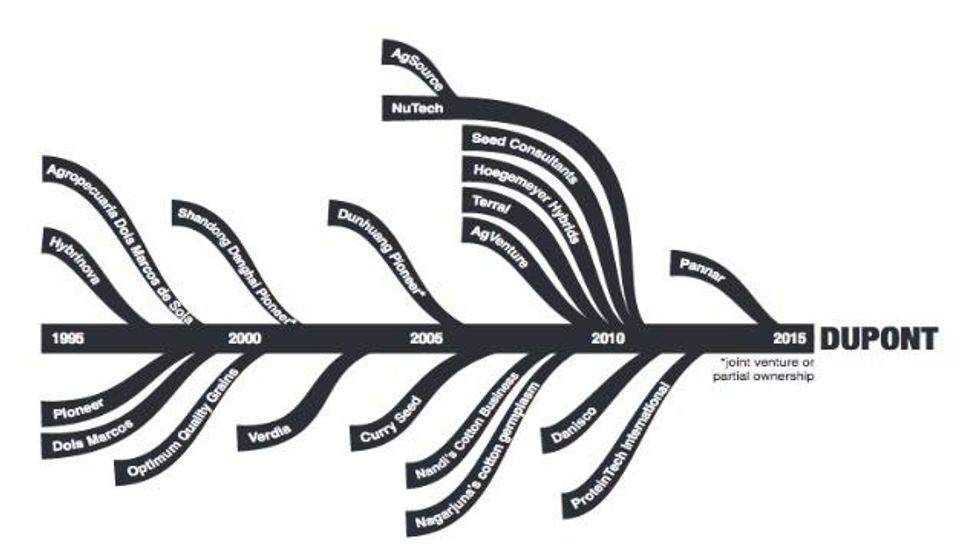
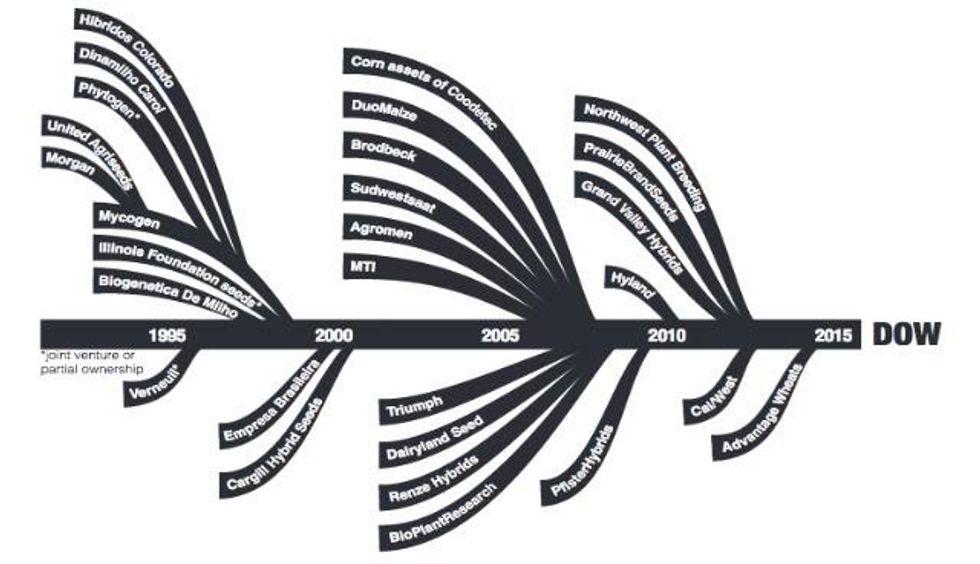
"The proposed merger would create a powerful duopoly between Dow-DuPont and Monsanto," the organizations added. "Together, the two companies would control 76% of the market for corn and 66% of the market for soybeans, giving them the power to charge farmers higher prices and effectively decide which seeds farmers could plant."
Two farmers quoted in the letter to the DOJ argued, "We need more competition to keep prices down," and "We don't like to see more consolidation; it means higher [costs] for farmers."
"Seed costs are the highest input expense for farmers," explained NFU president Roger Johnson. "We have seen time and again that consolidation and market restructuring has increased the cost of crop inputs. In a lagging farm economy with multi-year trends of low commodity prices, additional cost increases for crop inputs could cripple a lot of family farms in this country."
Executives at both corporations seem highly optimistic that the DOJ would approve the mega-merger deal, as last week they announced the chief executives who would helm the newly created company. According to the Wall Street Journal, the deal is expected to close in the second half of 2016.
May 22 has been declared International Biodiversity Day by the United Nations. It gives us an opportunity to become aware of the rich biodiversity that has been evolved by our farmers as co-creators with nature. It also provides an opportunity to acknowledge the threats to our biodiversity and our rights from IPR monopolies and monocultures.
"Seed as a common good has become a commodity of private seed companies. Unless protected and put back in the hands of our farmers, it is at risk of being lost forever."
Just as our Vedas and Upanishads have no individual authors, our rich biodiversity, including seeds, have been evolved cumulatively. They are a common heritage of present and future farm communities who have evolved them collectively. I recently joined tribals in Central India who have evolved thousands of rice varieties for their festival of "Akti". Akti is a celebration of the relationship of the seed and the soil, and the sharing of the seed as a sacred duty to the Earth and the community.
In addition to learning about seeds from women and peasants, I had the honor to participate and contribute to international and national laws on biodiversity. I worked closely with our government in the run-up to the 1992 Rio Earth Summit, when the UN Convention on Biodiversity (CBD) was adopted by the international community. Three key commitments in the CBD are protection of the sovereign rights of countries to their biodiversity, the traditional knowledge of communities and biosafety in the context of genetically-modified foods.
The UN appointed me on the expert panel for the framework for the biosafety protocol, now adopted as the Cartagena protocol on biosafety. I was appointed a member of the expert group to draft the National Biodiversity Act, as well as the Plant Variety and Farmers Rights Act. We ensured that farmers rights are recognized in our laws. "A farmer shall be deemed to be entitled to save, use, sow, resow, exchange, share or sell his farm produce, including seed of a variety protected under this act, in the same manner as he was entitled before the coming into force of this act", it says.
We have worked for the past three decades to protect the diversity and integrity of our seeds, the rights of farmers, and resist and challenge the illegitimate IPR monopolies of companies like Monsanto which do genetic engineering to claim patents and royalties.
Patents on seeds are unjust and unjustified. A patent or any intellectual property right is a monopoly granted by society in exchange for benefits. But society has no benefit in toxic, non-renewable seeds. We are losing biodiversity and cultural diversity, we are losing nutrition, taste and quality of our food. Above all, we are losing our fundamental freedom to decide what seeds we will sow, how we will grow our food and what we will eat.
Seed as a common good has become a commodity of private seed companies. Unless protected and put back in the hands of our farmers, it is at risk of being lost forever.
Across the world, communities are saving and exchanging seeds in diverse ways, appropriate to their context. They are creating and recreating freedom -- for the seed, for seed keepers, and for all life and all people. When we save the seed, we also reclaim and rejuvenate knowledge -- the knowledge of breeding and conservation, the knowledge of food and farming. Uniformity as a pseudo-scientific measure has been used to establish unjust IPR monopolies on seed. Once a company has patents on seeds, it pushes its patented crops on farmers in order to collect royalties.
Humanity has been eating thousands and thousands (8,500) of plant species. Today we are being condemned to eat GM corn and soya in various forms. Four primary crops -- corn, soya, canola and cotton -- have all been grown at the cost of other crops because they generate a royalty for every acre planted. For example, India had 1,500 different kinds of cotton, now 95 per cent of the cotton planted is GMO Bt Cotton for which Monsanto collects royalties. Over 11 million hectares of land are used to cultivate cotton, of which 9.5 million hectares is used to grow Monsanto's Bt variety.
A common question is: Why do farmers adopt Bt cotton which harms them? But farmers do not choose Bt cotton. They have to buy Bt cotton as all other choices are destroyed. Monsanto establishes its seed monopoly through three mechanisms:
These coercive, corrupt mechanisms are now falling apart. Navdanya created community seed banks and farmers have access to open pollinated, native organic seeds. The CCIR, under the leadership of Dr Keshav Kranti, is developing native cotton varieties. Finally, the government also intervened to regulate Monsanto's monopoly. On March 8, it passed a seed price control order regulating the price of seed under the Essential Commodities Act.
Monsanto and the biotechnology industry challenged the government order. We were impleaded in the Karnataka high court. On May 3, Justice Bopanna gave an order reaffirming that the government has a duty to regulate seed prices and Monsanto does not have a right to seed monopoly. Biodiversity and small farmers are the foundation of food security, not corporations like Monsanto which are destroying biodiversity and pushing farmers to suicide. These crimes against humanity must stop. That is why on October 16, International Food Day, we will organize a Monsanto Tribunal at The Hague to "try" Monsanto for its various crimes.
Despite a sustained effort from public health and climate activists, genetically modified (GM or GMO) salmon has been officially sanctioned for sale in Canada.
And if that wasn't foreboding enough, a pending trade deal between Canada and the European Union means the country's first approved GMO food animal, known colloquially as the "Frankenfish," could soon be sold and eaten internationally.
Health Canada and the Canadian Food Inspection Agency announced their approval of the U.S.-based biotechnology company AquaBounty's salmon--which will be shipped as eggs from Prince Edward Island to laboratories in Panama, where they will be grown to their adult full size and sent back to Canada for sale and consumption--on Thursday.
The approval comes despite two ongoing court battles against the Canadian government and the U.S. Food and Drug Administration (FDA), which were filed by environmental groups including the Ecology Action Centre in Nova Scotia and the Center for Food Safety in Washington, D.C.
Ecology Action Centre filed its lawsuit in 2015 after the Canadian government approved the manufacturing of the GMO salmon eggs, which the group said was done in secret and violated environmental protections.
On Thursday, the group's policy coordinator Mark Butler told CBC that there was "no consultation with Canadians" on the salmon.
Friends of the Earth, another of the groups involved in the lawsuit against the FDA, denounced the approval and noted that it comes despite a draft risk assessment from the Canadian Department of Fisheries and Oceans that raised concerns about the safety of the fish themselves, finding that they are more susceptible to disease-causing bacteria.
"Health Canada's approval is irresponsible and disappointing," said Dana Perls, food and technology campaigner at Friends of the Earth.
Lucy Sharratt, coordinator of the Canadian Biotechnology Action Network, said that "Canadians could now be faced with the world's first GMO food animal, approved with no public consultation and no labeling."
Meanwhile, the social action organization Council of Canadians pointed out a new concern now that the Frankenfish have been approved--where exactly they will be sold. Under the controversial pending Canada-EU Comprehensive Economic and Trade Agreement (CETA), tariff rates on salmon would be eliminated, "meaning more Canadian salmon will be sold in Europe," the group said.
Like the similar TransAtlantic Trade and Investment Partnership (TTIP) deal percolating in the U.S., CETA includes regulatory provisions that would empower corporate interests to "push against" standards that reject GMO foods--standards that tend to be higher in Europe, the Council of Canadians said, concluding, "CETA and TTIP are a threat to food safety."
Friends of the Earth called on grocery retailers to keep the product out of their aisles.
"GM salmon production threatens the future of wild Atlantic salmon," said Calinda Brown of the Ecology Action Centre. "Retailers can protect consumers and the environment by making sure this GM fish never makes it to grocery store shelves."

