SUBSCRIBE TO OUR FREE NEWSLETTER
Daily news & progressive opinion—funded by the people, not the corporations—delivered straight to your inbox.
5
#000000
#FFFFFF
To donate by check, phone, or other method, see our More Ways to Give page.
Daily news & progressive opinion—funded by the people, not the corporations—delivered straight to your inbox.
"U.S. agribusiness exporters, the biotech industry, and their allies in Congress are pushing this case, intent on compelling Mexico to accept U.S. exports without debate," said one expert.
After two-and-a-half months of failed negotiations, the U.S. government on Thursday intensified its effort to quash Mexico's limits on genetically modified corn imports by calling for the formation of a dispute settlement panel under a North American trade deal.
In a 2020 decree backed by agricultural, consumer, environmental, public health, and worker groups, Mexican President Andrés Manuel López Obrador (AMLO) announced plans to phase out genetically modified (GM) corn and the herbicide glyphosate by January 2024.
Under pressure from the U.S. government and impacted industries, he issued a new decree in February reiterating plans to block GM corn imports for human consumption by then but lifting the deadline for imports intended for livestock feed and industrial use.
"The Mexican government will show what has occurred: Its cherished tortillas are being contaminated with glyphosate and GM corn. And they intend to put a stop to that."
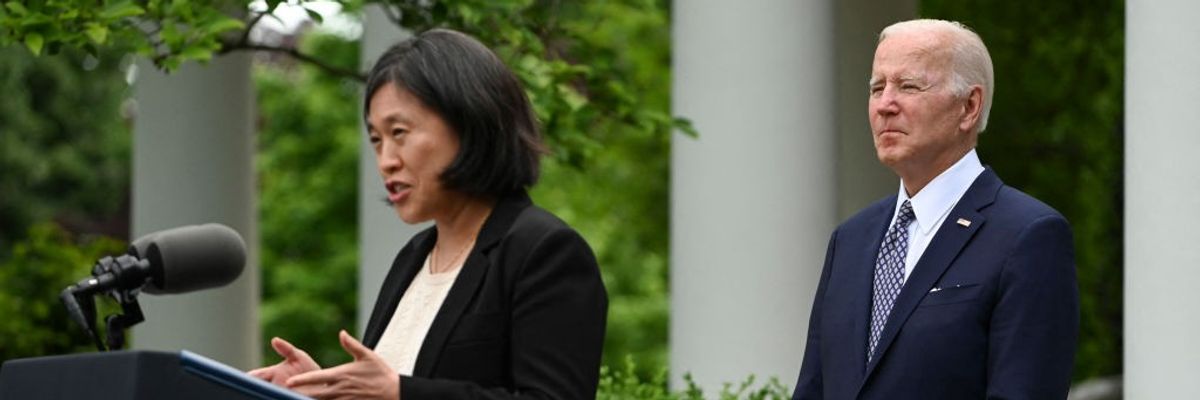
While AMLO's move was seen as a concession to the U.S. and lobbyists challenging his policies, the Biden administration in June still requested 75 days of formal negotiations. After talks ended Wednesday, U.S. Trade Representative (USTR) Katherine Tai confirmed the decision to form a panel under the United States-Mexico-Canada Agreement (USMCA).
"Through the USMCA dispute panel, we seek to resolve our concerns and help ensure consumers can continue to access safe and affordable food and agricultural products," Tai said Thursday. "It is critical that Mexico eliminate its USMCA-inconsistent biotechnology measures so that American farmers can continue to access the Mexican market and use innovative tools to respond to climate and food security challenges. Our bilateral relationship with Mexico, one of our oldest and strongest trading partners, is rooted in trust and honesty, and there are many areas where we will continue to cooperate and work together."
U.S. Agriculture Secretary Tom Vilsack similarly said that "Mexico's approach to biotechnology is not based on science" and "the United States is continuing to exercise its rights under the USMCA to ensure that U.S. producers and exporters have full and fair access to the Mexican market."
The Mexican Ministry of Economy responded in a statement that "Mexico does not agree with the position of the United States" and "is prepared to defend the Mexican position before this international panel and demonstrate: 1) that the national regulation is consistent with the commitments signed in the treaty; and 2) that the challenged measures do not have commercial effects."
The Institute for Agriculture and Trade Policy (IATP) has previously supported Mexico's efforts to phase out GM corn and glyphosate and on Thursday challenged claims by U.S. officials and agribusiness about Mexican obligations under the treaty and the potential economic impact of the policies.
"U.S. agribusiness exporters, the biotech industry, and their allies in Congress are pushing this case, intent on compelling Mexico to accept U.S. exports without debate. It is an assault on Mexico's food sovereignty," said Karen Hansen-Kuhn, IATP director of trade and international strategies. "Trade rules should provide a forum to protect and advance rights, rather than block them."
Hansen-Kuhn on Thursday authored an op-ed about Mexico's rights under the USMCA while ITAP senior adviser Timothy A. Wise wrote about "exaggerated claims of economic damage" that "sprang from a convenient set of assumptions, all of which are flawed and now outdated in light of the more recent presidential decree."
"As Mexican Economy Minister Raquel Buenrostro stated in response to the USTR request for technical consultations, Mexico's decree is based on science, and she will challenge the U.S. government in the consultations to show 'quantitatively, with numbers, something that has not occurred: that the corn decree has commercially affected U.S. exporters,'" Wise also said.
"The Mexican government will show what has occurred: Its cherished tortillas are being contaminated with glyphosate and GM corn," he continued. "And they intend to put a stop to that."
As Reuters detailed Thursday:
Under USMCA's dispute settlement rules, a five-person panel, chosen from a roster of pre-approved experts, must be convened within 30 days, with a chair jointly chosen and the U.S. side choosing two Mexican panelists and Mexico choosing two American panelists. The panel will review testimony and written submissions and its initial report is due 150 days after the panel is convened.
Previous USMCA dispute panels last year ruled in the U.S.'s favor in a dispute over Canadian dairy quotas, and against the U.S. on automotive rules of origin, siding with Mexico and Canada.
There have been other disagreements between the U.S. and Mexico, most notably over energy in which the U.S. has argued that Mexico's nationalist policy prejudices foreign companies.
Arturo Sarukhán, a former Mexican ambassador to the United States, said on social media Thursday that "of the two consultation processes—energy and yellow corn—this is the one that is politically most relevant for the White House in 2024," given the significance of agricultural states such as Michigan, Minnesota, and Wisconsin to Democratic U.S. President Joe Biden, who is seeking reelection, and the GOP nominee, which could be former President Donald Trump, who signed the USMCA.
Dear Common Dreams reader, It’s been nearly 30 years since I co-founded Common Dreams with my late wife, Lina Newhouser. We had the radical notion that journalism should serve the public good, not corporate profits. It was clear to us from the outset what it would take to build such a project. No paid advertisements. No corporate sponsors. No millionaire publisher telling us what to think or do. Many people said we wouldn't last a year, but we proved those doubters wrong. Together with a tremendous team of journalists and dedicated staff, we built an independent media outlet free from the constraints of profits and corporate control. Our mission has always been simple: To inform. To inspire. To ignite change for the common good. Building Common Dreams was not easy. Our survival was never guaranteed. When you take on the most powerful forces—Wall Street greed, fossil fuel industry destruction, Big Tech lobbyists, and uber-rich oligarchs who have spent billions upon billions rigging the economy and democracy in their favor—the only bulwark you have is supporters who believe in your work. But here’s the urgent message from me today. It's never been this bad out there. And it's never been this hard to keep us going. At the very moment Common Dreams is most needed, the threats we face are intensifying. We need your support now more than ever. We don't accept corporate advertising and never will. We don't have a paywall because we don't think people should be blocked from critical news based on their ability to pay. Everything we do is funded by the donations of readers like you. When everyone does the little they can afford, we are strong. But if that support retreats or dries up, so do we. Will you donate now to make sure Common Dreams not only survives but thrives? —Craig Brown, Co-founder |
After two-and-a-half months of failed negotiations, the U.S. government on Thursday intensified its effort to quash Mexico's limits on genetically modified corn imports by calling for the formation of a dispute settlement panel under a North American trade deal.
In a 2020 decree backed by agricultural, consumer, environmental, public health, and worker groups, Mexican President Andrés Manuel López Obrador (AMLO) announced plans to phase out genetically modified (GM) corn and the herbicide glyphosate by January 2024.
Under pressure from the U.S. government and impacted industries, he issued a new decree in February reiterating plans to block GM corn imports for human consumption by then but lifting the deadline for imports intended for livestock feed and industrial use.
"The Mexican government will show what has occurred: Its cherished tortillas are being contaminated with glyphosate and GM corn. And they intend to put a stop to that."
While AMLO's move was seen as a concession to the U.S. and lobbyists challenging his policies, the Biden administration in June still requested 75 days of formal negotiations. After talks ended Wednesday, U.S. Trade Representative (USTR) Katherine Tai confirmed the decision to form a panel under the United States-Mexico-Canada Agreement (USMCA).
"Through the USMCA dispute panel, we seek to resolve our concerns and help ensure consumers can continue to access safe and affordable food and agricultural products," Tai said Thursday. "It is critical that Mexico eliminate its USMCA-inconsistent biotechnology measures so that American farmers can continue to access the Mexican market and use innovative tools to respond to climate and food security challenges. Our bilateral relationship with Mexico, one of our oldest and strongest trading partners, is rooted in trust and honesty, and there are many areas where we will continue to cooperate and work together."
U.S. Agriculture Secretary Tom Vilsack similarly said that "Mexico's approach to biotechnology is not based on science" and "the United States is continuing to exercise its rights under the USMCA to ensure that U.S. producers and exporters have full and fair access to the Mexican market."
The Mexican Ministry of Economy responded in a statement that "Mexico does not agree with the position of the United States" and "is prepared to defend the Mexican position before this international panel and demonstrate: 1) that the national regulation is consistent with the commitments signed in the treaty; and 2) that the challenged measures do not have commercial effects."
The Institute for Agriculture and Trade Policy (IATP) has previously supported Mexico's efforts to phase out GM corn and glyphosate and on Thursday challenged claims by U.S. officials and agribusiness about Mexican obligations under the treaty and the potential economic impact of the policies.
"U.S. agribusiness exporters, the biotech industry, and their allies in Congress are pushing this case, intent on compelling Mexico to accept U.S. exports without debate. It is an assault on Mexico's food sovereignty," said Karen Hansen-Kuhn, IATP director of trade and international strategies. "Trade rules should provide a forum to protect and advance rights, rather than block them."
Hansen-Kuhn on Thursday authored an op-ed about Mexico's rights under the USMCA while ITAP senior adviser Timothy A. Wise wrote about "exaggerated claims of economic damage" that "sprang from a convenient set of assumptions, all of which are flawed and now outdated in light of the more recent presidential decree."
"As Mexican Economy Minister Raquel Buenrostro stated in response to the USTR request for technical consultations, Mexico's decree is based on science, and she will challenge the U.S. government in the consultations to show 'quantitatively, with numbers, something that has not occurred: that the corn decree has commercially affected U.S. exporters,'" Wise also said.
"The Mexican government will show what has occurred: Its cherished tortillas are being contaminated with glyphosate and GM corn," he continued. "And they intend to put a stop to that."
As Reuters detailed Thursday:
Under USMCA's dispute settlement rules, a five-person panel, chosen from a roster of pre-approved experts, must be convened within 30 days, with a chair jointly chosen and the U.S. side choosing two Mexican panelists and Mexico choosing two American panelists. The panel will review testimony and written submissions and its initial report is due 150 days after the panel is convened.
Previous USMCA dispute panels last year ruled in the U.S.'s favor in a dispute over Canadian dairy quotas, and against the U.S. on automotive rules of origin, siding with Mexico and Canada.
There have been other disagreements between the U.S. and Mexico, most notably over energy in which the U.S. has argued that Mexico's nationalist policy prejudices foreign companies.
Arturo Sarukhán, a former Mexican ambassador to the United States, said on social media Thursday that "of the two consultation processes—energy and yellow corn—this is the one that is politically most relevant for the White House in 2024," given the significance of agricultural states such as Michigan, Minnesota, and Wisconsin to Democratic U.S. President Joe Biden, who is seeking reelection, and the GOP nominee, which could be former President Donald Trump, who signed the USMCA.
After two-and-a-half months of failed negotiations, the U.S. government on Thursday intensified its effort to quash Mexico's limits on genetically modified corn imports by calling for the formation of a dispute settlement panel under a North American trade deal.
In a 2020 decree backed by agricultural, consumer, environmental, public health, and worker groups, Mexican President Andrés Manuel López Obrador (AMLO) announced plans to phase out genetically modified (GM) corn and the herbicide glyphosate by January 2024.
Under pressure from the U.S. government and impacted industries, he issued a new decree in February reiterating plans to block GM corn imports for human consumption by then but lifting the deadline for imports intended for livestock feed and industrial use.
"The Mexican government will show what has occurred: Its cherished tortillas are being contaminated with glyphosate and GM corn. And they intend to put a stop to that."
While AMLO's move was seen as a concession to the U.S. and lobbyists challenging his policies, the Biden administration in June still requested 75 days of formal negotiations. After talks ended Wednesday, U.S. Trade Representative (USTR) Katherine Tai confirmed the decision to form a panel under the United States-Mexico-Canada Agreement (USMCA).
"Through the USMCA dispute panel, we seek to resolve our concerns and help ensure consumers can continue to access safe and affordable food and agricultural products," Tai said Thursday. "It is critical that Mexico eliminate its USMCA-inconsistent biotechnology measures so that American farmers can continue to access the Mexican market and use innovative tools to respond to climate and food security challenges. Our bilateral relationship with Mexico, one of our oldest and strongest trading partners, is rooted in trust and honesty, and there are many areas where we will continue to cooperate and work together."
U.S. Agriculture Secretary Tom Vilsack similarly said that "Mexico's approach to biotechnology is not based on science" and "the United States is continuing to exercise its rights under the USMCA to ensure that U.S. producers and exporters have full and fair access to the Mexican market."
The Mexican Ministry of Economy responded in a statement that "Mexico does not agree with the position of the United States" and "is prepared to defend the Mexican position before this international panel and demonstrate: 1) that the national regulation is consistent with the commitments signed in the treaty; and 2) that the challenged measures do not have commercial effects."
The Institute for Agriculture and Trade Policy (IATP) has previously supported Mexico's efforts to phase out GM corn and glyphosate and on Thursday challenged claims by U.S. officials and agribusiness about Mexican obligations under the treaty and the potential economic impact of the policies.
"U.S. agribusiness exporters, the biotech industry, and their allies in Congress are pushing this case, intent on compelling Mexico to accept U.S. exports without debate. It is an assault on Mexico's food sovereignty," said Karen Hansen-Kuhn, IATP director of trade and international strategies. "Trade rules should provide a forum to protect and advance rights, rather than block them."
Hansen-Kuhn on Thursday authored an op-ed about Mexico's rights under the USMCA while ITAP senior adviser Timothy A. Wise wrote about "exaggerated claims of economic damage" that "sprang from a convenient set of assumptions, all of which are flawed and now outdated in light of the more recent presidential decree."
"As Mexican Economy Minister Raquel Buenrostro stated in response to the USTR request for technical consultations, Mexico's decree is based on science, and she will challenge the U.S. government in the consultations to show 'quantitatively, with numbers, something that has not occurred: that the corn decree has commercially affected U.S. exporters,'" Wise also said.
"The Mexican government will show what has occurred: Its cherished tortillas are being contaminated with glyphosate and GM corn," he continued. "And they intend to put a stop to that."
As Reuters detailed Thursday:
Under USMCA's dispute settlement rules, a five-person panel, chosen from a roster of pre-approved experts, must be convened within 30 days, with a chair jointly chosen and the U.S. side choosing two Mexican panelists and Mexico choosing two American panelists. The panel will review testimony and written submissions and its initial report is due 150 days after the panel is convened.
Previous USMCA dispute panels last year ruled in the U.S.'s favor in a dispute over Canadian dairy quotas, and against the U.S. on automotive rules of origin, siding with Mexico and Canada.
There have been other disagreements between the U.S. and Mexico, most notably over energy in which the U.S. has argued that Mexico's nationalist policy prejudices foreign companies.
Arturo Sarukhán, a former Mexican ambassador to the United States, said on social media Thursday that "of the two consultation processes—energy and yellow corn—this is the one that is politically most relevant for the White House in 2024," given the significance of agricultural states such as Michigan, Minnesota, and Wisconsin to Democratic U.S. President Joe Biden, who is seeking reelection, and the GOP nominee, which could be former President Donald Trump, who signed the USMCA.