“China is not a future threat,” the U.S. Secretary of the Air Force Frank Kendall responded in September. “China is a threat today.” Over the past 15 years, Beijing’s ability to project power in the Western Pacific, he claimed, had risen to alarming levels, with the likelihood of war “increasing” and, he predicted, it will only “continue to do so.” An anonymous senior Pentagon official added that China “continues to be the only U.S. competitor with the intent and… the capability to overturn the rules-based infrastructure that has kept peace in the Indo-Pacific since the end of the Second World War.”
After a decade of fighting misbegotten wars in Afghanistan and Iraq, Washington was stunned when a rising China began to turn its economic gains into a serious bid for global power.
Indeed, regional tensions in the Pacific have profound global implications. For the past 80 years, an island chain of military bastions running from Japan to Australia has served as a crucial fulcrum for American global power. To ensure that it will be able to continue to anchor its “defense” on that strategic shoal, Washington has recently added new overlapping alliances while encouraging a massive militarization of the Indo-Pacific region. Though bristling with armaments and seemingly strong, this ad hoc Western coalition may yet prove, like NATO in Europe, vulnerable to sudden setbacks from rising partisan pressures, both in the United States and among its allies.
Building a Pacific Bastion
For well over a century, the U.S. has struggled to secure its vulnerable western frontier from Pacific threats. During the early decades of the 20th century, Washington maneuvered against a rising Japanese presence in the region, producing geopolitical tensions that led to Tokyo’s attack on the American naval bastion at Pearl Harbor that began World War II in the Pacific. After fighting for four years and suffering nearly 300,000 casualties, the U.S. defeated Japan and won unchallenged control of the entire region.
Aware that the advent of the long-range bomber and the future possibility of atomic warfare had rendered the historic concept of coastal defense remarkably irrelevant, in the post-war years Washington extended its North American “defenses” deep into the Western Pacific. Starting with the expropriation of 100 Japanese military bases, the U.S. built its initial postwar Pacific naval bastions at Okinawa and, thanks to a 1947 agreement, at Subic Bay in the Philippines. As the Cold War engulfed Asia in 1950 with the beginning of the Korean conflict, the U.S. extended those bases for 5,000 miles along the entire Pacific littoral through mutual-defense agreements with five Asia-Pacific allies—Japan, South Korea, Taiwan, the Philippines, and Australia.
For the next 40 years to the very end of the Cold War, the Pacific littoral remained the geopolitical fulcrum of American global power, allowing it to defend one continent (North America) and dominate another (Eurasia). In many ways, in fact, the U.S. geopolitical position astride the axial ends of Eurasia would prove the key to its ultimate victory in the Cold War.
After the Cold War
Once the Soviet Union collapsed in 1991 and the Cold War ended, Washington cashed in its peace dividend, weakening that once-strong island chain. Between 1998 and 2014, the U.S. Navy declined from 333 ships to 271. That 20% reduction, combined with a shift to long-term deployments in the Middle East, degraded the Navy’s position in the Pacific. Even so, for the 20 years following the Cold War, the U.S. would enjoy what the Pentagon called “uncontested or dominant superiority in every operating domain. We could generally deploy our forces when we wanted, assemble them where we wanted, operate how we wanted.”
After the September 2001 terrorist attack on the U.S., Washington turned from heavy-metal strategic forces to mobile infantry readily deployed for counterterror operations against lightly armed guerrillas. After a decade of fighting misbegotten wars in Afghanistan and Iraq, Washington was stunned when a rising China began to turn its economic gains into a serious bid for global power. As its opening gambit, Beijing started building bases in the South China Sea, where oil and natural gas deposits are rife, and expanding its navy, an unexpected challenge that the once-all-powerful American Pacific command was remarkably ill-prepared to meet.
In response, in 2011, President Barack Obama proclaimed a strategic “pivot to Asia” before the Australian parliament and began rebuilding the American military position on the Pacific littoral. After withdrawing some U.S. forces from Iraq in 2012 and refusing to commit significant numbers of troops for regime change in Syria, the Obama White House deployed a battalion of Marines to Darwin in northern Australia in 2014. In quick succession, Washington gained access to five Philippine bases near the South China Sea and a new South Korean naval base at Jeju Island on the Yellow Sea. According to Secretary of Defense Chuck Hagel, to operate those installations, the Pentagon planned to “forward base 60% of our naval assets in the Pacific by 2020.” Nonetheless, the unending insurgency in Iraq continued to slow the pace of that strategic pivot to the Pacific.
Growing Chinese aggressiveness in the region and an American urge to strengthen a military alliance ominously encircling that country could threaten to turn the latest Cold War ever hotter, transforming the Pacific into a genuine powder keg.
Despite such setbacks, senior diplomatic and military officials, working under three different administrations, launched a long-term effort to slowly rebuild the U.S. military posture in the Asia-Pacific region. After proclaiming “a return to great power competition” in 2016, Chief of Naval Operations Admiral John Richardson reported that China’s “growing and modernized fleet” was “shrinking” the traditional American advantage in the region. “The competition is on,” the admiral warned, adding, “We must shake off any vestiges of comfort or complacency.”
Responding to such pressure, the Trump administration added the construction of 46 new ships to the Pentagon budget, which was to raise the total fleet to 326 vessels by 2023. Still, setting aside support ships, when it came to an actual “fighting force,” by 2024 China had the world’s largest navy with 234 “warships,” while the U.S. deployed 219—with Chinese combat capacity, according to American Naval Intelligence, “increasingly of comparable quality to U.S. ships.”
Paralleling the military buildup, the State Department reinforced the U.S. position on the Pacific littoral by negotiating three relatively new diplomatic agreements with Asia-Pacific allies Australia, Britain, India, and the Philippines. Though those ententes added some depth and resilience to the U.S. posture, the truth is that this Pacific network may ultimately prove more susceptible to political rupture than a formal multilateral alliance like NATO.
Military Cooperation with the Philippines
After nearly a century as close allies through decades of colonial rule, two world wars, and the Cold War, American relations with the Philippines suffered a severe setback in 1991 when that country’s senate refused to renew a long-term military bases agreement, forcing the U.S. 7th Fleet out of its massive naval base at Subic Bay.
After just three years, however, China occupied some shoals also claimed by the Philippines in the South China Sea during a raging typhoon. Within a decade, the Chinese had started transforming them into a network of military bases, while pressing their claims to most of the rest of the South China Sea. Manila’s only response was to ground a rusting World War II naval vessel on Ayungin shoal in the Spratly Islands, where Filipino soldiers had to fish for their supper. With its external defense in tatters, in April 2014 the Philippines signed an Enhanced Defense Cooperation Agreement with Washington, allowing the U.S. military quasi-permanent facilities at five Filipino bases, including two on the shores of the South China Sea.
Although Manila won a unanimous ruling from the Permanent Court of Arbitration at the Hague that Beijing’s claims to the South China Sea were “without lawful effect,” China dismissed that decision and continued to build its bases there. And when Rodrigo Duterte became president in 2016, he revealed a new policy that included a “separation” from America and a strategic tilt toward China, which that country rewarded with promises of massive developmental aid. By 2018, however, China’s army was operating anti-aircraft missiles, mobile missile launchers, and military radar on five artificial “islands” in the Spratly archipelago that it had built from sand its dredgers sucked from the seabed.
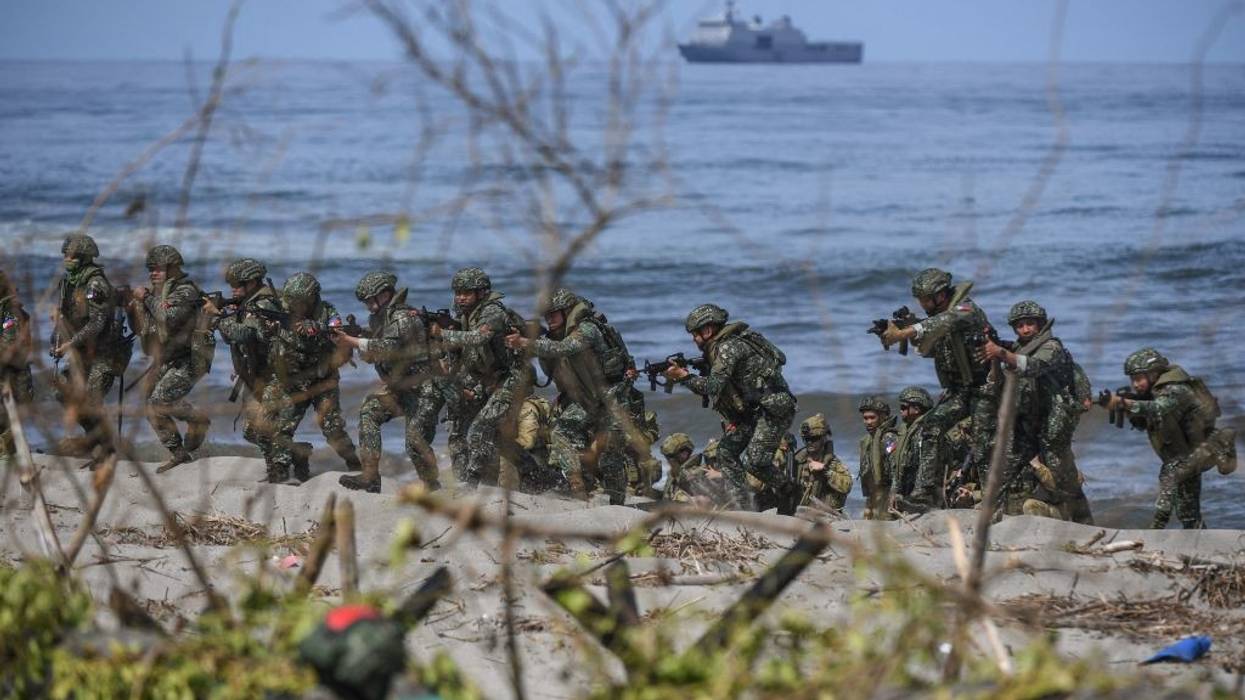
Once Duterte left office, as China’s Coast Guard harassed Filipino fishermen and blasted Philippine naval vessels with water cannons in their own territory, Manila once again started calling on Washington for help. Soon, U.S. Navy vessels were conducting “freedom of navigation” patrols in Philippine waters and the two nations had staged their biggest military maneuvers ever. In the April 2024 edition of that exercise, the U.S. deployed its mobile Typhon Mid-Range Missile Launcher capable of hitting China’s coast, sparking a bitter complaint from Beijing that such weaponry “intensifies geopolitical confrontation.”
Manila has matched its new commitment to the U.S. alliance with an unprecedented rearmament program of its own. Just last spring, it signed a $400 million deal with Tokyo to purchase five new Coast Guard cutters, started receiving Brahmos cruise missiles from India under a $375 million contract, and continued a billion-dollar deal with South Korea’s Hyundai Heavy Industries that will result in 10 new naval vessels. After the government announced a $35 billion military modernization plan, Manila has been negotiating with Korean suppliers to procure 40 modern jet fighters—a far cry from a decade earlier when it had no operational jets.
Showing the scope of the country’s reintegration into the Western alliance, just last month Manila hosted joint freedom of navigation maneuvers in the South China Sea with ships from five allied nations—Australia, Japan, New Zealand, the Philippines, and the United States.
Quadrilateral Security Dialogue
While the Philippine Defense Agreement renewed U.S. relations with an old Pacific ally, the Quadrilateral Security Dialogue involving Australia, India, Japan, and the U.S., first launched in 2007, has now extended American military power into the waters of the Indian Ocean. At the 2017 ASEAN summit in Manila, four conservative national leaders led by Japan’s Shinzo Abe, India’s Narendra Modi, and Donald Trump decided to revive the “Quad” entente (after a decade-long hiatus while Australia’s Labour governments cozied up to China).
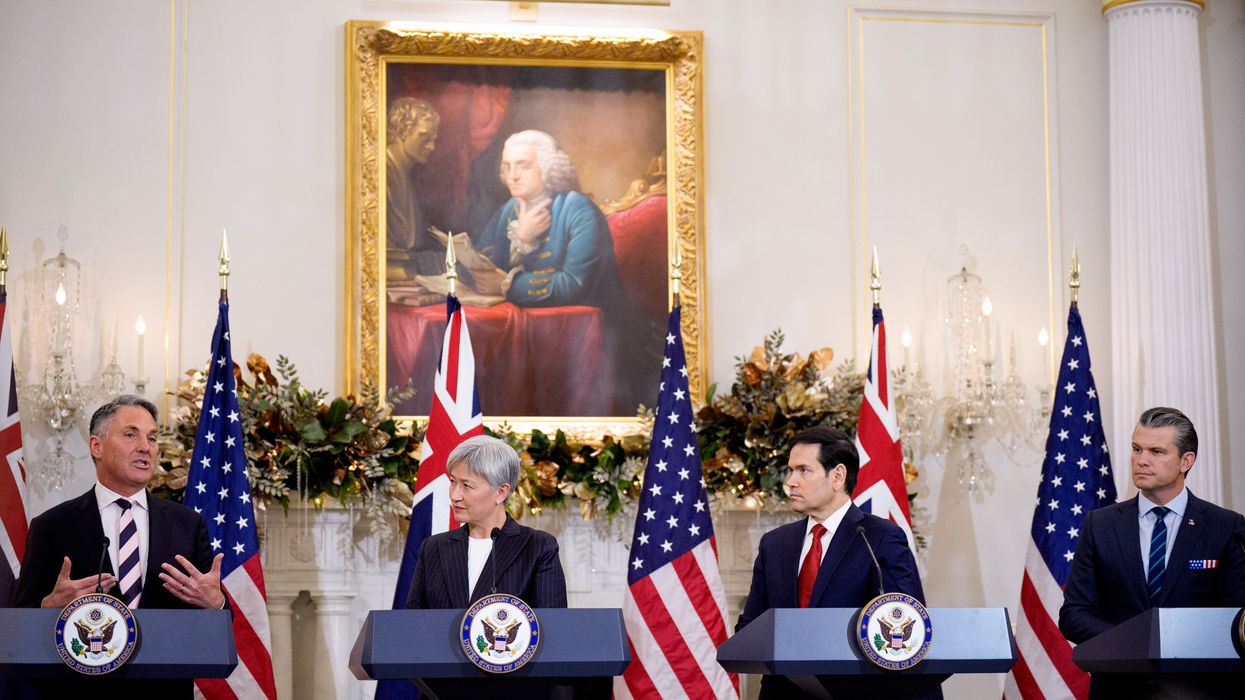
Just last month, President Joe Biden hosted a “Quad Summit” where the four leaders agreed to expand joint air operations. In a hot-mike moment, Biden bluntly said: “China continues to behave aggressively, testing us all across the region. It is true in the South China Sea, the East China Sea, South Asia, and the Taiwan Straits.” China’s Foreign Ministry replied: “The U.S. is lying through its teeth” and needs to “get rid of its obsession with perpetuating its supremacy and containing China.”
Since 2020, however, the Quad has made the annual Malabar (India) naval exercise into an elaborate four-power drill in which aircraft carrier battle groups maneuver in waters ranging from the Arabian Sea to the East China Sea. To contest “China’s growing assertiveness in the Indo-Pacific region,” India announced that the latest exercise this October would feature live-fire maneuvers in the Bay of Bengal, led by its flagship aircraft carrier and a complement of MiG-29K all-weather jet fighters. Clearly, as Prime Minister Narendra Modi put it, the Quad is “here to stay.”
AUKUS Alliance
While the Trump administration revived the Quad, the Biden White House has promoted a complementary and controversial AUKUS defense compact between Australia, Great Britain, and the U.S. (part of what Michael Klare has called the “Anglo-Saxonization” of American foreign and military policy). After months of secret negotiations, their leaders announced that agreement in September 2021 as a way to fulfill “a shared ambition to support Australia in acquiring nuclear-powered submarines for the Royal Australian Navy.”
Such a goal sparked howls of diplomatic protests. Angry over the sudden loss of a $90 billion contract to supply 12 French submarines to Australia, France called the decision “a stab in the back” and immediately recalled its ambassadors from both Canberra and Washington. With equal speed, China’s Foreign Ministry condemned the new alliance for “severely damaging regional peace… and intensifying the arms race.” In a pointed remark, Beijing’s official Global Times newspaper said Australia had now “turned itself into an adversary of China.”
To achieve extraordinary prosperity, thanks in significant part to its iron ore and other exports to China, Australia had exited the Quad entente for nearly a decade. Now, through this single defense decision, Australia has allied itself firmly with the United States and will gain access to British submarine designs and top-secret U.S. nuclear propulsion, joining the elite ranks of just six powers with such complex technology.
Not only will Australia spend a monumental $360 billion to build eight nuclear submarines at its Adelaide shipyards over a decade, but it will also host four American Virginia-class nuclear subs at a naval base in Western Australia and buy as many as five of those stealthy submarines from the U.S. in the early 2030s. Under the tripartite alliance with the U.S. and Britain, Canberra will also face additional costs for the joint development of undersea drones, hypersonic missiles, and quantum sensing. Through that stealthy arms deal, Washington has, it seems, won a major geopolitical and military ally in any future conflict with China.
Stand-Off Along the Pacific Littoral
Just as Russia’s aggression in Ukraine strengthened the NATO alliance, so China’s challenge in the fossil-fuel-rich South China Sea and elsewhere has helped the U.S. rebuild its island bastions along the Pacific littoral. Through a sedulous courtship under three successive administrations, Washington has won back two wayward allies, Australia and the Philippines, making them once again anchors for an island chain that remains the geopolitical fulcrum for American global power in the Pacific.
Still, with more than 200 times the ship-building capacity of the United States, China’s advantage in warships will almost certainly continue to grow. In compensating for such a future deficit, America’s four active allies along the Pacific littoral will likely play a critical role. (Japan’s navy has more than 50 warships and South Korea’s 30 more.)
Despite such renewed strength in what is distinctly becoming a new cold war, America’s Asia-Pacific alliances face both immediate challenges and a fraught future. Beijing is already putting relentless pressure on Taiwan’s sovereignty, breaching that island’s airspace and crossing the median line in the Taiwan Straits hundreds of times monthly. If Beijing turns those breaches into a crippling embargo of Taiwan, the U.S. Navy will face a hard choice between losing a carrier or two in a confrontation with China or backing off. Either way, the loss of Taiwan would sever America’s island chain in the Pacific littoral, pushing it back to a “second island chain” in the mid-Pacific.
As for that fraught future, the maintenance of such alliances requires a kind of national political will that is by no means assured in an age of populist nationalism. In the Philippines, the anti-American nationalism that Duterte personified retains its appeal and may well be adopted by some future leader. More immediately in Australia, the current Labour Party government has already faced strong dissent from members blasting the AUKUS entente as a dangerous transgression of their country’s sovereignty. And in the United States, Republican populism, whether Donald Trump’s or that of a future leader like JD Vance could curtail cooperation with such Asia-Pacific allies, simply walk away from a costly conflict over Taiwan, or deal directly with China in a way that would undercut that web of hard-won alliances.
And that, of course, might be the good news (so to speak), given the possibility that a growing Chinese aggressiveness in the region and an American urge to strengthen a military alliance ominously encircling that country could threaten to turn the latest Cold War ever hotter, transforming the Pacific into a genuine powder keg and leading to the possibility of a war that would, in our present world, be almost unimaginably dangerous and destructive.