SUBSCRIBE TO OUR FREE NEWSLETTER
Daily news & progressive opinion—funded by the people, not the corporations—delivered straight to your inbox.
5
#000000
#FFFFFF
To donate by check, phone, or other method, see our More Ways to Give page.
Daily news & progressive opinion—funded by the people, not the corporations—delivered straight to your inbox.
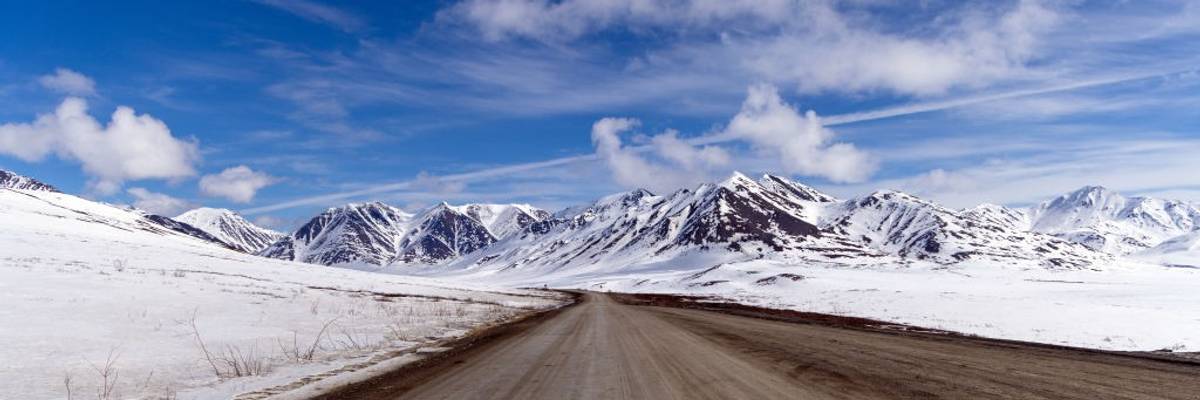
A view of the Dalton Highway on May 10, 2024 in the Brooks Range area of North Slope Borough, Alaska. The Dalton Highway (Alaska Route 11) stretches 414 miles across northern Alaska from Livengood (53 miles north of Fairbanks) to Prudhoe Bay.
With Trump’s return to the Oval Office, fossil fuel giants will get another chance to turn this pristine wilderness into the country’s largest gas station.
I’ve guided trips to Alaska’s North Slope and Brooks Range Mountains for 31 years, and I always start out with the same speech: “You are headed to some real wild country.” Alaska’s Arctic is home to some of our most iconic landscapes. This is probably the wildest place left in the United States and some of the most remote country in North America. What you see there—and what you won’t see–are things you’ll never forget.
I had guided rafting trips for a number of years across the western U.S., but I was unprepared for the sheer scale of this country. At all points of the compass, nothing but tundra for days and a river filled with exotically beautiful aufeis–layer upon frozen layer of ice. I’ve seen caribou, wolves, bears–a muskox nearly trampled my tent. I’ve had the good fortune to return to this landscape every year and it still is as wild and free from development as ever–for now. But with the return of Donald Trump to the White House, that could soon change.
To stem the tide of species loss and to give our environment a fighting chance, we need to protect more lands and waters by the end of the decade than we did in the last century.
The Arctic as we currently know it is thanks to Jimmy Carter, who passed away last week at the age of 100. Carter signed the Alaska National Interest Lands Conservation Act created 16 wildlife refuges, 13 national parks, two national monuments, two national forests, two conservation areas, and 26 wild and scenic rivers, and designated 57 million acres of wilderness. Ironically, Carter’s funeral will happen the same day the Biden administration holds its final lease sale in the Arctic Refuge—the smallest version they could legally offer. It’s a fitting move from an administration that, unlike Carter, had a complicated approach to the Arctic.
The Western Arctic was the setting for one of President Biden’s worst climate decisions—the March 2023 approval of the Willow project. Instead of preserving these landscapes from extraction, the president seemed to extend a new and dark era for the Arctic that began with Trump’s approval of oil drilling in the Arctic Refuge in 2017.
But a lot can change in a few months, and the Biden administration seemingly shifted strategies in the Western Arctic from extraction to preservation. Beginning last summer, the White House advanced a slate of new protections to safeguard millions of acres of public lands from oil and gas drilling. This summer was my 31st leading people into the Brooks Range mountains and the tundra beyond to the north in those little planes, and as we flew over wild Alaskan landscapes, we saw no signs of human development—in part due to Biden’s actions. But oil and gas companies will soon have a new ally to turn to.
With Trump’s return to the Oval Office, those same companies will get another chance to turn this pristine wilderness into the country’s largest gas station. On the campaign trail, Trump made it clear he would “drill, baby, drill” and give those Big Oil CEOs free rein to drill wherever and whenever they could. Opening up the Arctic Refuge to drilling was one of the first actions the Republican trifecta took in 2017, and extending that law is one of their top priorities this time around. For Arctic communities, wildlife, and ecosystems, it’s the biggest threat in a generation.
We’re currently witnessing an extinction crisis driven by habitat destruction, and the key driver of habitat destruction is development. At the same time, the effects of the climate crisis are being exacerbated by development that destabilizes ecosystems and natural carbon absorption. To stem the tide of species loss and to give our environment a fighting chance, we need to protect more lands and waters by the end of the decade than we did in the last century. The Arctic survived four years of Trump, but it’s up to us to ensure it survives another four.
Dear Common Dreams reader, It’s been nearly 30 years since I co-founded Common Dreams with my late wife, Lina Newhouser. We had the radical notion that journalism should serve the public good, not corporate profits. It was clear to us from the outset what it would take to build such a project. No paid advertisements. No corporate sponsors. No millionaire publisher telling us what to think or do. Many people said we wouldn't last a year, but we proved those doubters wrong. Together with a tremendous team of journalists and dedicated staff, we built an independent media outlet free from the constraints of profits and corporate control. Our mission has always been simple: To inform. To inspire. To ignite change for the common good. Building Common Dreams was not easy. Our survival was never guaranteed. When you take on the most powerful forces—Wall Street greed, fossil fuel industry destruction, Big Tech lobbyists, and uber-rich oligarchs who have spent billions upon billions rigging the economy and democracy in their favor—the only bulwark you have is supporters who believe in your work. But here’s the urgent message from me today. It's never been this bad out there. And it's never been this hard to keep us going. At the very moment Common Dreams is most needed, the threats we face are intensifying. We need your support now more than ever. We don't accept corporate advertising and never will. We don't have a paywall because we don't think people should be blocked from critical news based on their ability to pay. Everything we do is funded by the donations of readers like you. When everyone does the little they can afford, we are strong. But if that support retreats or dries up, so do we. Will you donate now to make sure Common Dreams not only survives but thrives? —Craig Brown, Co-founder |
I’ve guided trips to Alaska’s North Slope and Brooks Range Mountains for 31 years, and I always start out with the same speech: “You are headed to some real wild country.” Alaska’s Arctic is home to some of our most iconic landscapes. This is probably the wildest place left in the United States and some of the most remote country in North America. What you see there—and what you won’t see–are things you’ll never forget.
I had guided rafting trips for a number of years across the western U.S., but I was unprepared for the sheer scale of this country. At all points of the compass, nothing but tundra for days and a river filled with exotically beautiful aufeis–layer upon frozen layer of ice. I’ve seen caribou, wolves, bears–a muskox nearly trampled my tent. I’ve had the good fortune to return to this landscape every year and it still is as wild and free from development as ever–for now. But with the return of Donald Trump to the White House, that could soon change.
To stem the tide of species loss and to give our environment a fighting chance, we need to protect more lands and waters by the end of the decade than we did in the last century.
The Arctic as we currently know it is thanks to Jimmy Carter, who passed away last week at the age of 100. Carter signed the Alaska National Interest Lands Conservation Act created 16 wildlife refuges, 13 national parks, two national monuments, two national forests, two conservation areas, and 26 wild and scenic rivers, and designated 57 million acres of wilderness. Ironically, Carter’s funeral will happen the same day the Biden administration holds its final lease sale in the Arctic Refuge—the smallest version they could legally offer. It’s a fitting move from an administration that, unlike Carter, had a complicated approach to the Arctic.
The Western Arctic was the setting for one of President Biden’s worst climate decisions—the March 2023 approval of the Willow project. Instead of preserving these landscapes from extraction, the president seemed to extend a new and dark era for the Arctic that began with Trump’s approval of oil drilling in the Arctic Refuge in 2017.
But a lot can change in a few months, and the Biden administration seemingly shifted strategies in the Western Arctic from extraction to preservation. Beginning last summer, the White House advanced a slate of new protections to safeguard millions of acres of public lands from oil and gas drilling. This summer was my 31st leading people into the Brooks Range mountains and the tundra beyond to the north in those little planes, and as we flew over wild Alaskan landscapes, we saw no signs of human development—in part due to Biden’s actions. But oil and gas companies will soon have a new ally to turn to.
With Trump’s return to the Oval Office, those same companies will get another chance to turn this pristine wilderness into the country’s largest gas station. On the campaign trail, Trump made it clear he would “drill, baby, drill” and give those Big Oil CEOs free rein to drill wherever and whenever they could. Opening up the Arctic Refuge to drilling was one of the first actions the Republican trifecta took in 2017, and extending that law is one of their top priorities this time around. For Arctic communities, wildlife, and ecosystems, it’s the biggest threat in a generation.
We’re currently witnessing an extinction crisis driven by habitat destruction, and the key driver of habitat destruction is development. At the same time, the effects of the climate crisis are being exacerbated by development that destabilizes ecosystems and natural carbon absorption. To stem the tide of species loss and to give our environment a fighting chance, we need to protect more lands and waters by the end of the decade than we did in the last century. The Arctic survived four years of Trump, but it’s up to us to ensure it survives another four.
I’ve guided trips to Alaska’s North Slope and Brooks Range Mountains for 31 years, and I always start out with the same speech: “You are headed to some real wild country.” Alaska’s Arctic is home to some of our most iconic landscapes. This is probably the wildest place left in the United States and some of the most remote country in North America. What you see there—and what you won’t see–are things you’ll never forget.
I had guided rafting trips for a number of years across the western U.S., but I was unprepared for the sheer scale of this country. At all points of the compass, nothing but tundra for days and a river filled with exotically beautiful aufeis–layer upon frozen layer of ice. I’ve seen caribou, wolves, bears–a muskox nearly trampled my tent. I’ve had the good fortune to return to this landscape every year and it still is as wild and free from development as ever–for now. But with the return of Donald Trump to the White House, that could soon change.
To stem the tide of species loss and to give our environment a fighting chance, we need to protect more lands and waters by the end of the decade than we did in the last century.
The Arctic as we currently know it is thanks to Jimmy Carter, who passed away last week at the age of 100. Carter signed the Alaska National Interest Lands Conservation Act created 16 wildlife refuges, 13 national parks, two national monuments, two national forests, two conservation areas, and 26 wild and scenic rivers, and designated 57 million acres of wilderness. Ironically, Carter’s funeral will happen the same day the Biden administration holds its final lease sale in the Arctic Refuge—the smallest version they could legally offer. It’s a fitting move from an administration that, unlike Carter, had a complicated approach to the Arctic.
The Western Arctic was the setting for one of President Biden’s worst climate decisions—the March 2023 approval of the Willow project. Instead of preserving these landscapes from extraction, the president seemed to extend a new and dark era for the Arctic that began with Trump’s approval of oil drilling in the Arctic Refuge in 2017.
But a lot can change in a few months, and the Biden administration seemingly shifted strategies in the Western Arctic from extraction to preservation. Beginning last summer, the White House advanced a slate of new protections to safeguard millions of acres of public lands from oil and gas drilling. This summer was my 31st leading people into the Brooks Range mountains and the tundra beyond to the north in those little planes, and as we flew over wild Alaskan landscapes, we saw no signs of human development—in part due to Biden’s actions. But oil and gas companies will soon have a new ally to turn to.
With Trump’s return to the Oval Office, those same companies will get another chance to turn this pristine wilderness into the country’s largest gas station. On the campaign trail, Trump made it clear he would “drill, baby, drill” and give those Big Oil CEOs free rein to drill wherever and whenever they could. Opening up the Arctic Refuge to drilling was one of the first actions the Republican trifecta took in 2017, and extending that law is one of their top priorities this time around. For Arctic communities, wildlife, and ecosystems, it’s the biggest threat in a generation.
We’re currently witnessing an extinction crisis driven by habitat destruction, and the key driver of habitat destruction is development. At the same time, the effects of the climate crisis are being exacerbated by development that destabilizes ecosystems and natural carbon absorption. To stem the tide of species loss and to give our environment a fighting chance, we need to protect more lands and waters by the end of the decade than we did in the last century. The Arctic survived four years of Trump, but it’s up to us to ensure it survives another four.