SUBSCRIBE TO OUR FREE NEWSLETTER
Daily news & progressive opinion—funded by the people, not the corporations—delivered straight to your inbox.
5
#000000
#FFFFFF
To donate by check, phone, or other method, see our More Ways to Give page.
Daily news & progressive opinion—funded by the people, not the corporations—delivered straight to your inbox.
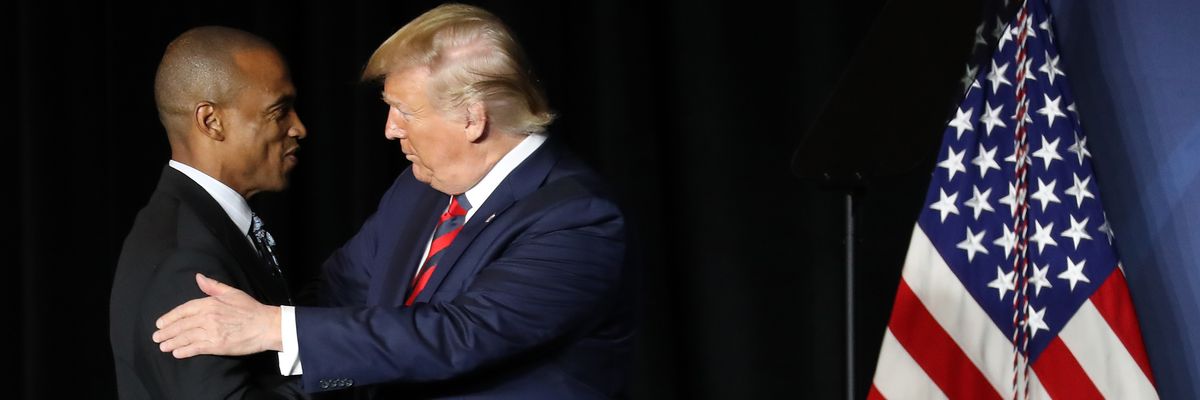
Then-U.S. President Donald Trump (R) welcomes then-White House Opportunity and Revitalization Council Executive Director Scott Turner to the stage during the National Historically Black Colleges and Universities Week Conference at the Renaissance Hotel September 10, 2019 in Washington, D.C.
A Trump-Turner housing agenda appears destined to continue the worst aspects of our nation’s approach to affordable housing: a relentless diversion to the already-wealthy of resources supposedly designated for the housing needs of the poor.
Donald Trump has nominated former Texas state representative Scott Turner as his secretary of Housing and Urban Development, the $70 billion federal agency that administers rental assistance and public housing programs, enforces fair housing laws, and provides community development grants to local communities.
Other Trump cabinet nominees, like potential Health and Human Services Secretary Robert F. Kennedy Jr., have attracted attention for the ways they may shift the traditional priorities of the agencies they would lead. Turner has flown under the radar.
Perhaps that is because dramatic changes to HUD would need congressional approval, which was denied when Trump tried to slash the department during his first administration. Or maybe it is because, in many respects, Turner does not seem inclined to significantly alter U.S. housing policies.
As for likely HUD Secretary Turner, he is most associated with yet another housing giveaway to the rich.
That is not a good thing.
A Trump-Turner housing agenda appears destined to continue the worst aspects of our nation’s approach to affordable housing: a relentless diversion to the already-wealthy of resources supposedly designated for the housing needs of the poor.
This reverse Robin Hood approach to U.S. housing began in the 1970’s, when the Nixon administration and Congress began switching our affordable housing investment away from public housing to subsidizing for-profit landlords. Now, we fund wealthy landlords, often corporate landlords, via direct payments such as the Housing Choice Voucher program and Project-Based Section 8 program, in return for the for-profit landlords temporarily housing low-income tenants. 558F Low-Income Housing Tax Credits are designed to provide a tax shelter for wealthy investors.
This profit-soaked combination costs taxpayers six times more each year than public housing does. But public housing is far more efficient, for the simple reason that it bypasses private profits. Public housing is also hugely successful in providing high-quality, low-cost housing when there is adequate investment in maintenance and upkeep.
That is why other nations, who have far less homelessness, evictions, and housing-insecure people than we do, prioritize public housing. They divert little if any government support to for-profit landlords. And it is why U.S. for-profit landlords have been pushing for generations to block U.S. public housing from the funds it needs to ensure safety and keep up maintenance. The resulting deterioration of U.S. public housing undercuts competition for private landlords and creates a narrative justifying the delivery of housing dollars to the private sector.
But those privatized programs are deeply flawed. The Low-Income Housing Tax Credit often leads to rents higher than poor families can afford. The program known as LIHTC has been characterized by housing researchers as “a better-than-nothing gimmick that helps the poor by rewarding the rich.” Even that characterization is too generous for some legislators, who call LIHTC “legalized theft of government assets.”
Similarly, project-based Section 8 housing directs government dollars to for-profit landlords as payment for low-income tenants’ rent. But, like LIHTC, the program allows those landlords to convert their buildings to market-rate rentals after they use the government subsidies to pay off their debt on the properties. By contrast, public housing provides affordable housing in perpetuity.
There is even less lasting impact coming from the largest low-income housing program in the country, Housing Choice Vouchers. We provide a full $30 billion per year in voucher payments to landlords, often large corporate landlords, but those landlords can end their involvement at the end of each tenant’s lease, leaving the low-income renter without housing. It is another low-risk high-yield arrangement for the wealthy and raw deal for the poor: little wonder that the Project 2025 blueprint drafted by Trump supporters champions vouchers even as it slams other HUD programs.
As for likely HUD Secretary Turner, he is most associated with yet another housing giveaway to the rich. During Trump’s first administration, Turner served as executive director of the White House Opportunity and Revitalization Council, which focused on promoting opportunity zones, a program created by Trump’s 2017 Tax Cuts and Jobs Act.
The program rewards the wealthy’s investment in economically distressed areas—opportunity zones—with huge tax breaks. But investigations by ProPublica and Congress show that the definition of what areas count as opportunity zones is far too broad, and the guidelines for who benefits from the investments are far too loose. As a result, money invested in expensive hotels, high-rent apartment buildings, and even luxury condominiums as a superyacht marina escapes taxation. Politically connected billionaires lobby for the land where they develop to be designated an opportunity zone, then rake in the benefits.
The Brookings Institution says opportunity zones operate as a subsidy for gentrification. “The direct tax benefits of opportunity zones will flow overwhelmingly to wealthy investors,” the Center on Budget and Policy Priorities says. “But the tax break might not do much to help low-income communities, and it could even harm some current residents of such communities.”
So, despite the relative quiet around Scott Turner’s nomination, we know some important things about him. We know that he champions opportunity zones as an addition to the already abundant tax benefits the U.S. showers on landlords and real estate investors. And we know that he is a fierce critic of anti-poverty programs, as he has made multiple public statements about government assistance being harmful and even disastrous.
But we also know that the likely next HUD secretary is concerned about that alleged harm only when assistance is provided to the poor. The wealthy can count on Trump and Turner to keep the pipeline of government housing money wide open and flowing their way.
This country and this world are at a monumental crossroads. US voters have an opportunity to beat back the forces of fascism and confront the billionaires who are rigging the economy, our media system, and our democracy, making it increasingly impossible for ordinary people to get by. We’re not just talking about the election. We’re talking about what must be done once these fascist elements are vanquished from power. We need a bolder set of solutions than what either major party has so far been willing to offer and a working-class movement ready to fight like hell for it. Trump didn't emerge from nowhere. The conditions that fueled MAGA authoritarianism were created by decades of radical neoliberal economic policies and a corrupt political system dominated by corporate interests. They slashed taxes on the super-rich, promising that the benefits would trickle down. They said giveaways to the corporate titans would make life more affordable for the rest of us. It was all bullshit. And when a bitter, betrayed populace searches for someone to blame, right-wing demagogues have little trouble finding scapegoats. People know when they're being lied to, but you won't hear any of this from the corporate media. Only independent journalism—powered and funded by people who believe in building a better world—can deliver truly trustworthy daily news. If you share our vision, please contribute whatever you can to sustain our work. |
Donald Trump has nominated former Texas state representative Scott Turner as his secretary of Housing and Urban Development, the $70 billion federal agency that administers rental assistance and public housing programs, enforces fair housing laws, and provides community development grants to local communities.
Other Trump cabinet nominees, like potential Health and Human Services Secretary Robert F. Kennedy Jr., have attracted attention for the ways they may shift the traditional priorities of the agencies they would lead. Turner has flown under the radar.
Perhaps that is because dramatic changes to HUD would need congressional approval, which was denied when Trump tried to slash the department during his first administration. Or maybe it is because, in many respects, Turner does not seem inclined to significantly alter U.S. housing policies.
As for likely HUD Secretary Turner, he is most associated with yet another housing giveaway to the rich.
That is not a good thing.
A Trump-Turner housing agenda appears destined to continue the worst aspects of our nation’s approach to affordable housing: a relentless diversion to the already-wealthy of resources supposedly designated for the housing needs of the poor.
This reverse Robin Hood approach to U.S. housing began in the 1970’s, when the Nixon administration and Congress began switching our affordable housing investment away from public housing to subsidizing for-profit landlords. Now, we fund wealthy landlords, often corporate landlords, via direct payments such as the Housing Choice Voucher program and Project-Based Section 8 program, in return for the for-profit landlords temporarily housing low-income tenants. 558F Low-Income Housing Tax Credits are designed to provide a tax shelter for wealthy investors.
This profit-soaked combination costs taxpayers six times more each year than public housing does. But public housing is far more efficient, for the simple reason that it bypasses private profits. Public housing is also hugely successful in providing high-quality, low-cost housing when there is adequate investment in maintenance and upkeep.
That is why other nations, who have far less homelessness, evictions, and housing-insecure people than we do, prioritize public housing. They divert little if any government support to for-profit landlords. And it is why U.S. for-profit landlords have been pushing for generations to block U.S. public housing from the funds it needs to ensure safety and keep up maintenance. The resulting deterioration of U.S. public housing undercuts competition for private landlords and creates a narrative justifying the delivery of housing dollars to the private sector.
But those privatized programs are deeply flawed. The Low-Income Housing Tax Credit often leads to rents higher than poor families can afford. The program known as LIHTC has been characterized by housing researchers as “a better-than-nothing gimmick that helps the poor by rewarding the rich.” Even that characterization is too generous for some legislators, who call LIHTC “legalized theft of government assets.”
Similarly, project-based Section 8 housing directs government dollars to for-profit landlords as payment for low-income tenants’ rent. But, like LIHTC, the program allows those landlords to convert their buildings to market-rate rentals after they use the government subsidies to pay off their debt on the properties. By contrast, public housing provides affordable housing in perpetuity.
There is even less lasting impact coming from the largest low-income housing program in the country, Housing Choice Vouchers. We provide a full $30 billion per year in voucher payments to landlords, often large corporate landlords, but those landlords can end their involvement at the end of each tenant’s lease, leaving the low-income renter without housing. It is another low-risk high-yield arrangement for the wealthy and raw deal for the poor: little wonder that the Project 2025 blueprint drafted by Trump supporters champions vouchers even as it slams other HUD programs.
As for likely HUD Secretary Turner, he is most associated with yet another housing giveaway to the rich. During Trump’s first administration, Turner served as executive director of the White House Opportunity and Revitalization Council, which focused on promoting opportunity zones, a program created by Trump’s 2017 Tax Cuts and Jobs Act.
The program rewards the wealthy’s investment in economically distressed areas—opportunity zones—with huge tax breaks. But investigations by ProPublica and Congress show that the definition of what areas count as opportunity zones is far too broad, and the guidelines for who benefits from the investments are far too loose. As a result, money invested in expensive hotels, high-rent apartment buildings, and even luxury condominiums as a superyacht marina escapes taxation. Politically connected billionaires lobby for the land where they develop to be designated an opportunity zone, then rake in the benefits.
The Brookings Institution says opportunity zones operate as a subsidy for gentrification. “The direct tax benefits of opportunity zones will flow overwhelmingly to wealthy investors,” the Center on Budget and Policy Priorities says. “But the tax break might not do much to help low-income communities, and it could even harm some current residents of such communities.”
So, despite the relative quiet around Scott Turner’s nomination, we know some important things about him. We know that he champions opportunity zones as an addition to the already abundant tax benefits the U.S. showers on landlords and real estate investors. And we know that he is a fierce critic of anti-poverty programs, as he has made multiple public statements about government assistance being harmful and even disastrous.
But we also know that the likely next HUD secretary is concerned about that alleged harm only when assistance is provided to the poor. The wealthy can count on Trump and Turner to keep the pipeline of government housing money wide open and flowing their way.