SUBSCRIBE TO OUR FREE NEWSLETTER
Daily news & progressive opinion—funded by the people, not the corporations—delivered straight to your inbox.
5
#000000
#FFFFFF
To donate by check, phone, or other method, see our More Ways to Give page.
Daily news & progressive opinion—funded by the people, not the corporations—delivered straight to your inbox.

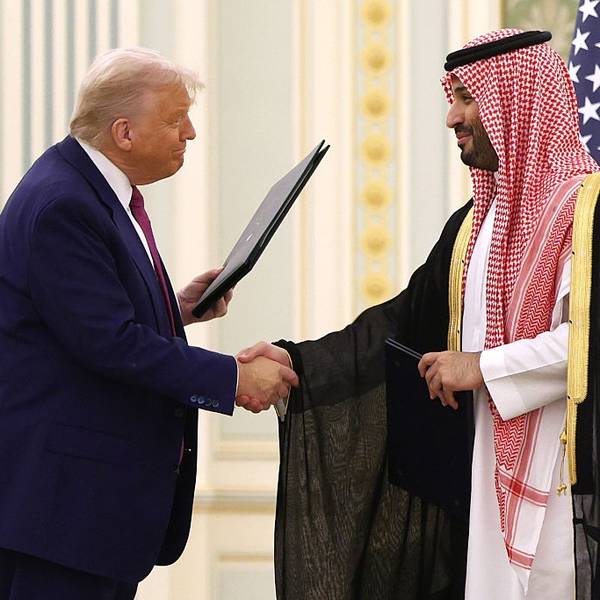
US President Donald Trump and Saudi Crown Prince Mohammed bin Salman speak as they arrive during the Gulf Cooperation Council (GCC) Leaders’ Summit at The Ritz-Carlton on May 14, 2025, in Riyadh, Saudi Arabia.
The assumption of US backing allowed the Saudis to wage a brutal war in Yemen that cost close to 400,000 lives without fear of consequences. "Now imagine if Saudi Arabia had an ironclad US security guarantee," wrote one scholar.
As Saudi Crown Prince Mohammed bin Salman prepares to meet with US President Donald Trump next week, experts are warning that it could cause even greater instability in the Middle East if the president agrees to the Gulf regime's requests for a defense pact.
On November 18, the crown prince, commonly known as MBS, will be welcomed in Washington for the first time since 2018. That meeting with Trump came just months before the prince signed off on the infamous murder of the Washington Post journalist Jamal Khashoggi as part of a brutal crackdown on dissenters in the country.
Trump defended MBS from international outrage and isolation at the time and has continued to sing his praises since returning to office. In May, after inking a record $142 billion weapons sale to the Saudis during a tour of the Middle East, Trump gave a speech, practically salivating over the crown prince.
“We have great partners in the world, but we have none stronger, and nobody like the gentleman that’s right before me, he’s your greatest representative, your greatest representative,” Trump said. “And if I didn’t like him, I would get out of here so fast. You know that, don’t you? He knows me well.”
“I do, I like him a lot. I like him too much, that’s why we give so much, you know?” the president continued. “Too much. I like you too much!”
“Oh, what I do for the crown prince,” he added.
Now, according to a report Tuesday from the Financial Times, the Saudis are coming to Washington seeking a similar security guarantee to the one Trump recently granted Qatar, which one State Department diplomat referred to as "on par with the mutual defense commitments the United States provides its closest allies.”
Trump signed an executive order stating that the US would respond to any attack on Qatar by taking all “lawful and appropriate measures—including diplomatic, economic, and, if necessary, military."
That agreement came weeks after Israel launched an unprecedented assault on Hamas leadership as they met for negotiations in Qatar's capital city of Doha to end the two-year genocide in Gaza. Without the security agreement, the Qataris had threatened to walk away from their role in mediating the talks that ultimately led to October's "ceasefire" agreement.
The deal expected to be reached between Trump and the Saudis has been described as "Qatar-plus," not just pledging defense of the state were it to come under attack, but regarding it as a threat to American “peace and security."
Such an agreement was already underway during the tenure of former President Joe Biden, following the normalization of relations with Israel, but was upended by Hamas's October 7 attacks and two years of indiscriminate slaughter Israel launched in response, which bin Salman referred to as a "genocide."
While MBS has publicly stated that he would not agree to continue normalization with Israel without a Palestinian state, he has not shied away from a separate security deal with the US, which reportedly includes "enhanced military and intelligence cooperation."
According to Christopher Preble and Will Smith, a pair of foreign policy researchers at the Stimson Center's Reimagining US Grand Strategy program, the Trump team hopes that by pursuing a heightened security and financial relationship with the Saudis, they can coax them back towards detente with Israel and bring them back into the US orbit in response to what Trump views as an overly flirtatious posture toward China.
"These developments suggest a troubling belief that handing out security guarantees is a quick, cost-free way to reassure anxious partners and ensure their alignment with US priorities. That belief is mistaken," the researchers wrote in Responsible Statecraft Tuesday. "A US-Saudi defense pact would be unnecessary, risky, and unlikely to achieve its unclear aims. Rather than revive the misguided Biden administration initiative, the Trump administration should shelve the idea once and for all."
They said there are few upsides to the normalization between Saudi Arabia and Israel, and that if it were to occur, it would be little more than a formal recognition of the cooperation between the two nations that already exists in combating Iran's influence.
While a deal would lead to few benefits, they argued it would "come with significant downsides," potentially forcing the US to ride along with "reckless driving" by the Saudis, especially with its neighbors in Yemen.
"Extensive US support emboldened Saudi Arabia to wage a disastrous, failed intervention there that dragged on for seven years, fueling a war that claimed close to 400,000 lives, including nearly 20,000 civilians killed by airstrikes," the researchers said.
International relations scholar Adam Gallagher pointed out that the Saudis did all of this merely "because of what it assumed would be continual US backing."
"Now imagine if Saudi Arabia had an ironclad US security guarantee," he said.
The result, he warned, would be something akin to Israel's sense of total impunity to wage destruction in Gaza.
"When a great power provides a security pledge to a less powerful ally, the weaker state is more willing to take on risk, and the patron often ends up paying the price," he wrote. "There is simply no strategic reason for the United States to imperil its interests or incur costs if Saudi Arabia engaged in renewed adventurism."
Human rights groups have noted that a deal also has massive implications for the Saudi regime's actions at home, where its leaders have faced little accountability for their repression of dissent.
“Saudi Arabia’s crown prince is trying to rebrand himself as a global statesman, but the reality at home is mass repression, record numbers of executions, and zero tolerance for dissent," said Sarah Yager, the Washington director at Human Rights Watch. "US officials should be pressing for change, not posing for photos.”
Matt Wells, the deputy director of Reprieve US, emphasized that outside pressure on the regime has mattered in the past: "In the fallout from Jamal Khashoggi’s assassination, Mohammed bin Salman’s regime felt international pressure to improve its human rights record, and that pressure made a difference. Some child defendants on death row were resentenced and released, and from July 2021 to July 2025, there were no executions for childhood crimes.”
“Beneath Saudi Arabia’s glittering facade, the repression of Saudi citizens and residents continues unabated," said Abdullah Aljuraywi, monitoring and campaigns officer at ALQST for Human Rights. "To avoid emboldening this, the US should use its leverage to secure concrete commitments, including the release of detained activists, lifting of arbitrary travel bans, and an end to politically motivated executions.”
Dear Common Dreams reader, It’s been nearly 30 years since I co-founded Common Dreams with my late wife, Lina Newhouser. We had the radical notion that journalism should serve the public good, not corporate profits. It was clear to us from the outset what it would take to build such a project. No paid advertisements. No corporate sponsors. No millionaire publisher telling us what to think or do. Many people said we wouldn't last a year, but we proved those doubters wrong. Together with a tremendous team of journalists and dedicated staff, we built an independent media outlet free from the constraints of profits and corporate control. Our mission has always been simple: To inform. To inspire. To ignite change for the common good. Building Common Dreams was not easy. Our survival was never guaranteed. When you take on the most powerful forces—Wall Street greed, fossil fuel industry destruction, Big Tech lobbyists, and uber-rich oligarchs who have spent billions upon billions rigging the economy and democracy in their favor—the only bulwark you have is supporters who believe in your work. But here’s the urgent message from me today. It's never been this bad out there. And it's never been this hard to keep us going. At the very moment Common Dreams is most needed, the threats we face are intensifying. We need your support now more than ever. We don't accept corporate advertising and never will. We don't have a paywall because we don't think people should be blocked from critical news based on their ability to pay. Everything we do is funded by the donations of readers like you. When everyone does the little they can afford, we are strong. But if that support retreats or dries up, so do we. Will you donate now to make sure Common Dreams not only survives but thrives? —Craig Brown, Co-founder |
As Saudi Crown Prince Mohammed bin Salman prepares to meet with US President Donald Trump next week, experts are warning that it could cause even greater instability in the Middle East if the president agrees to the Gulf regime's requests for a defense pact.
On November 18, the crown prince, commonly known as MBS, will be welcomed in Washington for the first time since 2018. That meeting with Trump came just months before the prince signed off on the infamous murder of the Washington Post journalist Jamal Khashoggi as part of a brutal crackdown on dissenters in the country.
Trump defended MBS from international outrage and isolation at the time and has continued to sing his praises since returning to office. In May, after inking a record $142 billion weapons sale to the Saudis during a tour of the Middle East, Trump gave a speech, practically salivating over the crown prince.
“We have great partners in the world, but we have none stronger, and nobody like the gentleman that’s right before me, he’s your greatest representative, your greatest representative,” Trump said. “And if I didn’t like him, I would get out of here so fast. You know that, don’t you? He knows me well.”
“I do, I like him a lot. I like him too much, that’s why we give so much, you know?” the president continued. “Too much. I like you too much!”
“Oh, what I do for the crown prince,” he added.
Now, according to a report Tuesday from the Financial Times, the Saudis are coming to Washington seeking a similar security guarantee to the one Trump recently granted Qatar, which one State Department diplomat referred to as "on par with the mutual defense commitments the United States provides its closest allies.”
Trump signed an executive order stating that the US would respond to any attack on Qatar by taking all “lawful and appropriate measures—including diplomatic, economic, and, if necessary, military."
That agreement came weeks after Israel launched an unprecedented assault on Hamas leadership as they met for negotiations in Qatar's capital city of Doha to end the two-year genocide in Gaza. Without the security agreement, the Qataris had threatened to walk away from their role in mediating the talks that ultimately led to October's "ceasefire" agreement.
The deal expected to be reached between Trump and the Saudis has been described as "Qatar-plus," not just pledging defense of the state were it to come under attack, but regarding it as a threat to American “peace and security."
Such an agreement was already underway during the tenure of former President Joe Biden, following the normalization of relations with Israel, but was upended by Hamas's October 7 attacks and two years of indiscriminate slaughter Israel launched in response, which bin Salman referred to as a "genocide."
While MBS has publicly stated that he would not agree to continue normalization with Israel without a Palestinian state, he has not shied away from a separate security deal with the US, which reportedly includes "enhanced military and intelligence cooperation."
According to Christopher Preble and Will Smith, a pair of foreign policy researchers at the Stimson Center's Reimagining US Grand Strategy program, the Trump team hopes that by pursuing a heightened security and financial relationship with the Saudis, they can coax them back towards detente with Israel and bring them back into the US orbit in response to what Trump views as an overly flirtatious posture toward China.
"These developments suggest a troubling belief that handing out security guarantees is a quick, cost-free way to reassure anxious partners and ensure their alignment with US priorities. That belief is mistaken," the researchers wrote in Responsible Statecraft Tuesday. "A US-Saudi defense pact would be unnecessary, risky, and unlikely to achieve its unclear aims. Rather than revive the misguided Biden administration initiative, the Trump administration should shelve the idea once and for all."
They said there are few upsides to the normalization between Saudi Arabia and Israel, and that if it were to occur, it would be little more than a formal recognition of the cooperation between the two nations that already exists in combating Iran's influence.
While a deal would lead to few benefits, they argued it would "come with significant downsides," potentially forcing the US to ride along with "reckless driving" by the Saudis, especially with its neighbors in Yemen.
"Extensive US support emboldened Saudi Arabia to wage a disastrous, failed intervention there that dragged on for seven years, fueling a war that claimed close to 400,000 lives, including nearly 20,000 civilians killed by airstrikes," the researchers said.
International relations scholar Adam Gallagher pointed out that the Saudis did all of this merely "because of what it assumed would be continual US backing."
"Now imagine if Saudi Arabia had an ironclad US security guarantee," he said.
The result, he warned, would be something akin to Israel's sense of total impunity to wage destruction in Gaza.
"When a great power provides a security pledge to a less powerful ally, the weaker state is more willing to take on risk, and the patron often ends up paying the price," he wrote. "There is simply no strategic reason for the United States to imperil its interests or incur costs if Saudi Arabia engaged in renewed adventurism."
Human rights groups have noted that a deal also has massive implications for the Saudi regime's actions at home, where its leaders have faced little accountability for their repression of dissent.
“Saudi Arabia’s crown prince is trying to rebrand himself as a global statesman, but the reality at home is mass repression, record numbers of executions, and zero tolerance for dissent," said Sarah Yager, the Washington director at Human Rights Watch. "US officials should be pressing for change, not posing for photos.”
Matt Wells, the deputy director of Reprieve US, emphasized that outside pressure on the regime has mattered in the past: "In the fallout from Jamal Khashoggi’s assassination, Mohammed bin Salman’s regime felt international pressure to improve its human rights record, and that pressure made a difference. Some child defendants on death row were resentenced and released, and from July 2021 to July 2025, there were no executions for childhood crimes.”
“Beneath Saudi Arabia’s glittering facade, the repression of Saudi citizens and residents continues unabated," said Abdullah Aljuraywi, monitoring and campaigns officer at ALQST for Human Rights. "To avoid emboldening this, the US should use its leverage to secure concrete commitments, including the release of detained activists, lifting of arbitrary travel bans, and an end to politically motivated executions.”
As Saudi Crown Prince Mohammed bin Salman prepares to meet with US President Donald Trump next week, experts are warning that it could cause even greater instability in the Middle East if the president agrees to the Gulf regime's requests for a defense pact.
On November 18, the crown prince, commonly known as MBS, will be welcomed in Washington for the first time since 2018. That meeting with Trump came just months before the prince signed off on the infamous murder of the Washington Post journalist Jamal Khashoggi as part of a brutal crackdown on dissenters in the country.
Trump defended MBS from international outrage and isolation at the time and has continued to sing his praises since returning to office. In May, after inking a record $142 billion weapons sale to the Saudis during a tour of the Middle East, Trump gave a speech, practically salivating over the crown prince.
“We have great partners in the world, but we have none stronger, and nobody like the gentleman that’s right before me, he’s your greatest representative, your greatest representative,” Trump said. “And if I didn’t like him, I would get out of here so fast. You know that, don’t you? He knows me well.”
“I do, I like him a lot. I like him too much, that’s why we give so much, you know?” the president continued. “Too much. I like you too much!”
“Oh, what I do for the crown prince,” he added.
Now, according to a report Tuesday from the Financial Times, the Saudis are coming to Washington seeking a similar security guarantee to the one Trump recently granted Qatar, which one State Department diplomat referred to as "on par with the mutual defense commitments the United States provides its closest allies.”
Trump signed an executive order stating that the US would respond to any attack on Qatar by taking all “lawful and appropriate measures—including diplomatic, economic, and, if necessary, military."
That agreement came weeks after Israel launched an unprecedented assault on Hamas leadership as they met for negotiations in Qatar's capital city of Doha to end the two-year genocide in Gaza. Without the security agreement, the Qataris had threatened to walk away from their role in mediating the talks that ultimately led to October's "ceasefire" agreement.
The deal expected to be reached between Trump and the Saudis has been described as "Qatar-plus," not just pledging defense of the state were it to come under attack, but regarding it as a threat to American “peace and security."
Such an agreement was already underway during the tenure of former President Joe Biden, following the normalization of relations with Israel, but was upended by Hamas's October 7 attacks and two years of indiscriminate slaughter Israel launched in response, which bin Salman referred to as a "genocide."
While MBS has publicly stated that he would not agree to continue normalization with Israel without a Palestinian state, he has not shied away from a separate security deal with the US, which reportedly includes "enhanced military and intelligence cooperation."
According to Christopher Preble and Will Smith, a pair of foreign policy researchers at the Stimson Center's Reimagining US Grand Strategy program, the Trump team hopes that by pursuing a heightened security and financial relationship with the Saudis, they can coax them back towards detente with Israel and bring them back into the US orbit in response to what Trump views as an overly flirtatious posture toward China.
"These developments suggest a troubling belief that handing out security guarantees is a quick, cost-free way to reassure anxious partners and ensure their alignment with US priorities. That belief is mistaken," the researchers wrote in Responsible Statecraft Tuesday. "A US-Saudi defense pact would be unnecessary, risky, and unlikely to achieve its unclear aims. Rather than revive the misguided Biden administration initiative, the Trump administration should shelve the idea once and for all."
They said there are few upsides to the normalization between Saudi Arabia and Israel, and that if it were to occur, it would be little more than a formal recognition of the cooperation between the two nations that already exists in combating Iran's influence.
While a deal would lead to few benefits, they argued it would "come with significant downsides," potentially forcing the US to ride along with "reckless driving" by the Saudis, especially with its neighbors in Yemen.
"Extensive US support emboldened Saudi Arabia to wage a disastrous, failed intervention there that dragged on for seven years, fueling a war that claimed close to 400,000 lives, including nearly 20,000 civilians killed by airstrikes," the researchers said.
International relations scholar Adam Gallagher pointed out that the Saudis did all of this merely "because of what it assumed would be continual US backing."
"Now imagine if Saudi Arabia had an ironclad US security guarantee," he said.
The result, he warned, would be something akin to Israel's sense of total impunity to wage destruction in Gaza.
"When a great power provides a security pledge to a less powerful ally, the weaker state is more willing to take on risk, and the patron often ends up paying the price," he wrote. "There is simply no strategic reason for the United States to imperil its interests or incur costs if Saudi Arabia engaged in renewed adventurism."
Human rights groups have noted that a deal also has massive implications for the Saudi regime's actions at home, where its leaders have faced little accountability for their repression of dissent.
“Saudi Arabia’s crown prince is trying to rebrand himself as a global statesman, but the reality at home is mass repression, record numbers of executions, and zero tolerance for dissent," said Sarah Yager, the Washington director at Human Rights Watch. "US officials should be pressing for change, not posing for photos.”
Matt Wells, the deputy director of Reprieve US, emphasized that outside pressure on the regime has mattered in the past: "In the fallout from Jamal Khashoggi’s assassination, Mohammed bin Salman’s regime felt international pressure to improve its human rights record, and that pressure made a difference. Some child defendants on death row were resentenced and released, and from July 2021 to July 2025, there were no executions for childhood crimes.”
“Beneath Saudi Arabia’s glittering facade, the repression of Saudi citizens and residents continues unabated," said Abdullah Aljuraywi, monitoring and campaigns officer at ALQST for Human Rights. "To avoid emboldening this, the US should use its leverage to secure concrete commitments, including the release of detained activists, lifting of arbitrary travel bans, and an end to politically motivated executions.”