SUBSCRIBE TO OUR FREE NEWSLETTER
Daily news & progressive opinion—funded by the people, not the corporations—delivered straight to your inbox.
5
#000000
#FFFFFF
To donate by check, phone, or other method, see our More Ways to Give page.
Daily news & progressive opinion—funded by the people, not the corporations—delivered straight to your inbox.
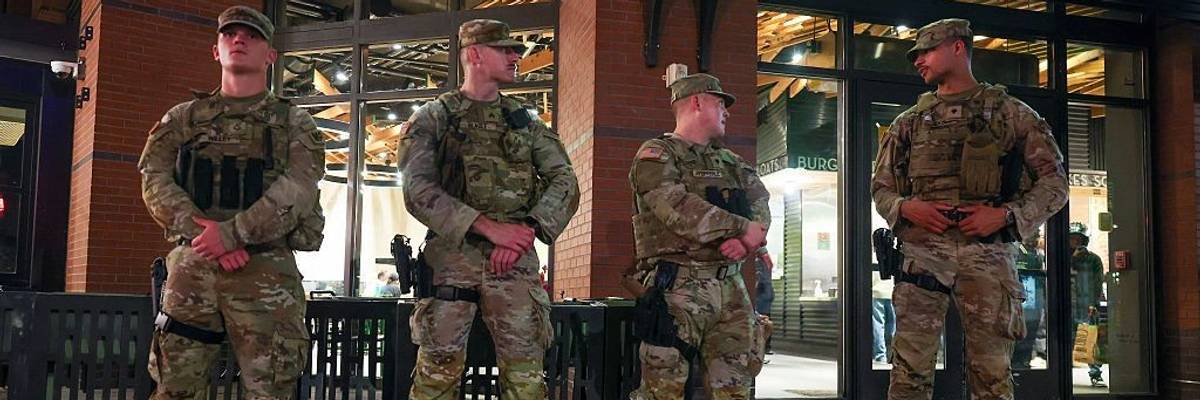
National Guard Members patrol 14th street, working with Washington DC Metro police on August 24, 2025 in Washington, DC.
The deployment of out-of-state troops to occupy cities cannot plausibly promote public order. It’s blunt force, a brutal power grab, and it runs afoul of the Constitution and the proper role for states.
US President Donald Trump has threatened to send troops to Chicago to “straighten that one out.” New York City, he says, might be next.
Already, armed National Guard regiments are patrolling the streets of Washington, DC. All this on top of the deployment of troops to Los Angeles earlier in the summer.
The deployment of out-of-state troops to occupy cities cannot plausibly promote public order. It’s blunt force, a brutal power grab. It runs afoul of the Constitution and the proper role for states.
I write history books and consider myself an expert on the presidency. I can think of few analogies—not in this country, anyway—for such a move by a chief executive.
Why is this particular turn so alarming? After all, public safety is important, and fighting crime is a worthy goal. My colleague Liza Goitein explains the legal and constitutional issues:
Trump is on even thinner legal ice with this plan than he is in Los Angeles and DC. Unlike in the capital, the president doesn’t command the Illinois National Guard unless he calls them into federal service (i.e., “federalizes” them). There are various laws that authorize him to federalize the guard, but none of them would apply here.
In Los Angeles, Trump is relying on a law (Section 12406 of Title 10 of the US Code) that authorizes federalization when “the President is unable with the regular forces to execute the laws of the United States,” meaning federal law. Immigration law is federal law. Trump claimed that the protests rendered him “unable... to execute” ICE raids. Although dozens of raids happened during the protests and the administration did not cite a single raid that was thwarted, the Ninth Circuit Court of Appeals deferred to Trump’s assessment.
But that law simply wouldn’t apply to the type of crime Trump has cited in Chicago—essentially, violent street crime. The laws that are implicated are largely those of Illinois and Chicago, not the “laws of the United States.”
Even under the Insurrection Act—which is the main exception to the law barring deployment of the military for domestic law enforcement—the president may deploy troops to execute the law only in situations involving either federal laws or those state laws designed to protect the constitutional rights of classes of people (basically, civil rights laws).
Nor can Trump ask other states’ governors to send their guard forces into Chicago, as he did in DC under a law known as Section 502(f), which authorizes governors to voluntarily use their guard forces for missions requested by the president or secretary of defense. Under this law, presidents have asked governors to deploy guard forces within their own states, in other states that consent, or (as only Trump has done) in DC without local consent. No governor has sent guard troops into another state that did not consent, as would be the case here. That’s because guard forces deployed under this law remain state officers as a legal matter. And under the Constitution, states are sovereign entities vis-à-vis one another. That means one state cannot invade another, even at the president’s request.
If the president wants to send one state’s National Guard forces into an unwilling state, he must federalize them first. But to federalize them, he needs statutory authority. And there is no statutory authority to federalize the guard to police local crime.
The Pentagon reportedly sees its planned military deployment in Chicago as a model for other cities. And of course, the other cities Trump has name-checked in this context are governed by Democrats: Baltimore, Los Angeles, New York, and Oakland.
Flooding “blue” cities with soldiers on the pretext of fighting crime would be an unprecedented abuse of power that would violate states’ rights and threaten our most fundamental liberties. The plan is profoundly un-American. And it is illegal.
Public safety matters greatly. But facts belie the (ever shifting) rationale. New York, for example, remains one of the nation’s safest large cities. As Police Commissioner Jessica Tisch told Attorney General Pam Bondi yesterday, crime has dropped dramatically, even this year. Fighting crime is not a rationale—it’s a pretext.
The cities targeted so far have two things in common: a Black mayor and a fusillade of presidential rhetoric denouncing them as “hellholes.”
Bill Kristol, founder of The Bulwark and a longtime prominent Republican, surveyed events and put it this way: “What we are seeing is not merely a ‘slide toward authoritarianism.’ It’s a march toward despotism. And it’s a march whose pace is accelerating.”
What can be done to push back? Illinois Gov. JB Pritzker warned federal forces: “Do not come to Chicago. You are neither wanted here nor needed here.” Trump, in turn, mused: “They say... ‘He’s a dictator. He’s a dictator.’ A lot of people are saying, ‘Maybe we’d like a dictator.’” He added, “I don’t like a dictator. I’m not a dictator.” (As presidential quotations go, it’s about as reassuring as Richard Nixon’s “I am not a crook.”)
Pritzker and New York Gov. Kathy Hochul can play pivotal roles. States and cities can go to court—an epic legal battle. They can rally the public in their states and around the country. They can monitor and document the conduct of deployed forces.
We must all speak out when our Constitution is under threat.
Hopefully you got some rest this Labor Day. It’s going to be a busy fall.
Dear Common Dreams reader, It’s been nearly 30 years since I co-founded Common Dreams with my late wife, Lina Newhouser. We had the radical notion that journalism should serve the public good, not corporate profits. It was clear to us from the outset what it would take to build such a project. No paid advertisements. No corporate sponsors. No millionaire publisher telling us what to think or do. Many people said we wouldn't last a year, but we proved those doubters wrong. Together with a tremendous team of journalists and dedicated staff, we built an independent media outlet free from the constraints of profits and corporate control. Our mission has always been simple: To inform. To inspire. To ignite change for the common good. Building Common Dreams was not easy. Our survival was never guaranteed. When you take on the most powerful forces—Wall Street greed, fossil fuel industry destruction, Big Tech lobbyists, and uber-rich oligarchs who have spent billions upon billions rigging the economy and democracy in their favor—the only bulwark you have is supporters who believe in your work. But here’s the urgent message from me today. It's never been this bad out there. And it's never been this hard to keep us going. At the very moment Common Dreams is most needed, the threats we face are intensifying. We need your support now more than ever. We don't accept corporate advertising and never will. We don't have a paywall because we don't think people should be blocked from critical news based on their ability to pay. Everything we do is funded by the donations of readers like you. When everyone does the little they can afford, we are strong. But if that support retreats or dries up, so do we. Will you donate now to make sure Common Dreams not only survives but thrives? —Craig Brown, Co-founder |
US President Donald Trump has threatened to send troops to Chicago to “straighten that one out.” New York City, he says, might be next.
Already, armed National Guard regiments are patrolling the streets of Washington, DC. All this on top of the deployment of troops to Los Angeles earlier in the summer.
The deployment of out-of-state troops to occupy cities cannot plausibly promote public order. It’s blunt force, a brutal power grab. It runs afoul of the Constitution and the proper role for states.
I write history books and consider myself an expert on the presidency. I can think of few analogies—not in this country, anyway—for such a move by a chief executive.
Why is this particular turn so alarming? After all, public safety is important, and fighting crime is a worthy goal. My colleague Liza Goitein explains the legal and constitutional issues:
Trump is on even thinner legal ice with this plan than he is in Los Angeles and DC. Unlike in the capital, the president doesn’t command the Illinois National Guard unless he calls them into federal service (i.e., “federalizes” them). There are various laws that authorize him to federalize the guard, but none of them would apply here.
In Los Angeles, Trump is relying on a law (Section 12406 of Title 10 of the US Code) that authorizes federalization when “the President is unable with the regular forces to execute the laws of the United States,” meaning federal law. Immigration law is federal law. Trump claimed that the protests rendered him “unable... to execute” ICE raids. Although dozens of raids happened during the protests and the administration did not cite a single raid that was thwarted, the Ninth Circuit Court of Appeals deferred to Trump’s assessment.
But that law simply wouldn’t apply to the type of crime Trump has cited in Chicago—essentially, violent street crime. The laws that are implicated are largely those of Illinois and Chicago, not the “laws of the United States.”
Even under the Insurrection Act—which is the main exception to the law barring deployment of the military for domestic law enforcement—the president may deploy troops to execute the law only in situations involving either federal laws or those state laws designed to protect the constitutional rights of classes of people (basically, civil rights laws).
Nor can Trump ask other states’ governors to send their guard forces into Chicago, as he did in DC under a law known as Section 502(f), which authorizes governors to voluntarily use their guard forces for missions requested by the president or secretary of defense. Under this law, presidents have asked governors to deploy guard forces within their own states, in other states that consent, or (as only Trump has done) in DC without local consent. No governor has sent guard troops into another state that did not consent, as would be the case here. That’s because guard forces deployed under this law remain state officers as a legal matter. And under the Constitution, states are sovereign entities vis-à-vis one another. That means one state cannot invade another, even at the president’s request.
If the president wants to send one state’s National Guard forces into an unwilling state, he must federalize them first. But to federalize them, he needs statutory authority. And there is no statutory authority to federalize the guard to police local crime.
The Pentagon reportedly sees its planned military deployment in Chicago as a model for other cities. And of course, the other cities Trump has name-checked in this context are governed by Democrats: Baltimore, Los Angeles, New York, and Oakland.
Flooding “blue” cities with soldiers on the pretext of fighting crime would be an unprecedented abuse of power that would violate states’ rights and threaten our most fundamental liberties. The plan is profoundly un-American. And it is illegal.
Public safety matters greatly. But facts belie the (ever shifting) rationale. New York, for example, remains one of the nation’s safest large cities. As Police Commissioner Jessica Tisch told Attorney General Pam Bondi yesterday, crime has dropped dramatically, even this year. Fighting crime is not a rationale—it’s a pretext.
The cities targeted so far have two things in common: a Black mayor and a fusillade of presidential rhetoric denouncing them as “hellholes.”
Bill Kristol, founder of The Bulwark and a longtime prominent Republican, surveyed events and put it this way: “What we are seeing is not merely a ‘slide toward authoritarianism.’ It’s a march toward despotism. And it’s a march whose pace is accelerating.”
What can be done to push back? Illinois Gov. JB Pritzker warned federal forces: “Do not come to Chicago. You are neither wanted here nor needed here.” Trump, in turn, mused: “They say... ‘He’s a dictator. He’s a dictator.’ A lot of people are saying, ‘Maybe we’d like a dictator.’” He added, “I don’t like a dictator. I’m not a dictator.” (As presidential quotations go, it’s about as reassuring as Richard Nixon’s “I am not a crook.”)
Pritzker and New York Gov. Kathy Hochul can play pivotal roles. States and cities can go to court—an epic legal battle. They can rally the public in their states and around the country. They can monitor and document the conduct of deployed forces.
We must all speak out when our Constitution is under threat.
Hopefully you got some rest this Labor Day. It’s going to be a busy fall.
US President Donald Trump has threatened to send troops to Chicago to “straighten that one out.” New York City, he says, might be next.
Already, armed National Guard regiments are patrolling the streets of Washington, DC. All this on top of the deployment of troops to Los Angeles earlier in the summer.
The deployment of out-of-state troops to occupy cities cannot plausibly promote public order. It’s blunt force, a brutal power grab. It runs afoul of the Constitution and the proper role for states.
I write history books and consider myself an expert on the presidency. I can think of few analogies—not in this country, anyway—for such a move by a chief executive.
Why is this particular turn so alarming? After all, public safety is important, and fighting crime is a worthy goal. My colleague Liza Goitein explains the legal and constitutional issues:
Trump is on even thinner legal ice with this plan than he is in Los Angeles and DC. Unlike in the capital, the president doesn’t command the Illinois National Guard unless he calls them into federal service (i.e., “federalizes” them). There are various laws that authorize him to federalize the guard, but none of them would apply here.
In Los Angeles, Trump is relying on a law (Section 12406 of Title 10 of the US Code) that authorizes federalization when “the President is unable with the regular forces to execute the laws of the United States,” meaning federal law. Immigration law is federal law. Trump claimed that the protests rendered him “unable... to execute” ICE raids. Although dozens of raids happened during the protests and the administration did not cite a single raid that was thwarted, the Ninth Circuit Court of Appeals deferred to Trump’s assessment.
But that law simply wouldn’t apply to the type of crime Trump has cited in Chicago—essentially, violent street crime. The laws that are implicated are largely those of Illinois and Chicago, not the “laws of the United States.”
Even under the Insurrection Act—which is the main exception to the law barring deployment of the military for domestic law enforcement—the president may deploy troops to execute the law only in situations involving either federal laws or those state laws designed to protect the constitutional rights of classes of people (basically, civil rights laws).
Nor can Trump ask other states’ governors to send their guard forces into Chicago, as he did in DC under a law known as Section 502(f), which authorizes governors to voluntarily use their guard forces for missions requested by the president or secretary of defense. Under this law, presidents have asked governors to deploy guard forces within their own states, in other states that consent, or (as only Trump has done) in DC without local consent. No governor has sent guard troops into another state that did not consent, as would be the case here. That’s because guard forces deployed under this law remain state officers as a legal matter. And under the Constitution, states are sovereign entities vis-à-vis one another. That means one state cannot invade another, even at the president’s request.
If the president wants to send one state’s National Guard forces into an unwilling state, he must federalize them first. But to federalize them, he needs statutory authority. And there is no statutory authority to federalize the guard to police local crime.
The Pentagon reportedly sees its planned military deployment in Chicago as a model for other cities. And of course, the other cities Trump has name-checked in this context are governed by Democrats: Baltimore, Los Angeles, New York, and Oakland.
Flooding “blue” cities with soldiers on the pretext of fighting crime would be an unprecedented abuse of power that would violate states’ rights and threaten our most fundamental liberties. The plan is profoundly un-American. And it is illegal.
Public safety matters greatly. But facts belie the (ever shifting) rationale. New York, for example, remains one of the nation’s safest large cities. As Police Commissioner Jessica Tisch told Attorney General Pam Bondi yesterday, crime has dropped dramatically, even this year. Fighting crime is not a rationale—it’s a pretext.
The cities targeted so far have two things in common: a Black mayor and a fusillade of presidential rhetoric denouncing them as “hellholes.”
Bill Kristol, founder of The Bulwark and a longtime prominent Republican, surveyed events and put it this way: “What we are seeing is not merely a ‘slide toward authoritarianism.’ It’s a march toward despotism. And it’s a march whose pace is accelerating.”
What can be done to push back? Illinois Gov. JB Pritzker warned federal forces: “Do not come to Chicago. You are neither wanted here nor needed here.” Trump, in turn, mused: “They say... ‘He’s a dictator. He’s a dictator.’ A lot of people are saying, ‘Maybe we’d like a dictator.’” He added, “I don’t like a dictator. I’m not a dictator.” (As presidential quotations go, it’s about as reassuring as Richard Nixon’s “I am not a crook.”)
Pritzker and New York Gov. Kathy Hochul can play pivotal roles. States and cities can go to court—an epic legal battle. They can rally the public in their states and around the country. They can monitor and document the conduct of deployed forces.
We must all speak out when our Constitution is under threat.
Hopefully you got some rest this Labor Day. It’s going to be a busy fall.