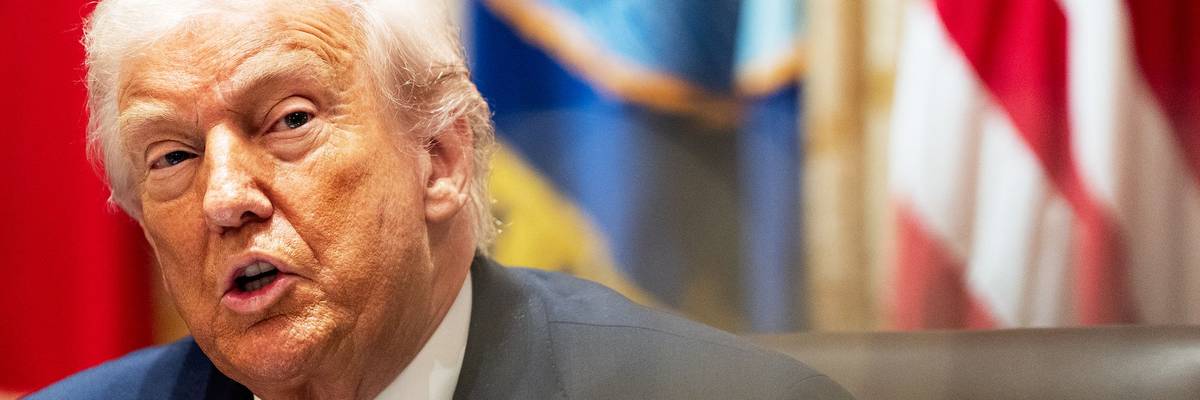
US President Donald Trump speaks to reporters in the White House in Washington, DC on December 8, 2025.
Trump Says Ground Attack on Venezuela Imminent—Plus Colombia, Mexico Also in US Crosshairs
"It's now taken as a given... that Trump is mulling a ground invasion of Venezuela and a dramatic expansion in his bombing campaign with no congressional authorization," said one critic.
President Donald Trump said in an interview published Tuesday that a US land attack on Venezuela is coming and signaled that he is open to launching similar military action against Colombia and Mexico.
“We’re gonna hit ’em on land very soon, too,” Trump told Politico's Dasha Burns, citing the pretext of stopping fentanyl from entering the United States.
Trump repeated his baseless claim that during the administration of his predecessor, the "very stupid" former President Joe Biden, Venezuelan President Nicolás Maduro "sent us millions of people, many from prisons, many drug dealers, drug lords," and "people in mental institutions."
Burns then noted that most of the illicit fentanyl sold in the United States "is actually produced in Mexico," which along with Colombia is "even more responsible" for trafficking the potent synthetic opioid into the US. She asked Trump if he would "consider doing something similar" to those countries.
"I would," Trump replied. "Sure, I would."
Pressed on his contradictory pardon of convicted narco-trafficking former Honduran President Juan Orlando Hernández while threatening war against Venezuela, Trump feigned ignorance, claiming that "I don't know him" and asserting that "he was set up."
Trump's latest threat against Venezuela comes amid his deployment of warships and thousands of troops off the coast of the oil-rich South American nation, his approval of covert CIA action against Maduro's government, and more than 20 airstrikes on boats his administration claims without evidence were smuggling drugs in the southern Caribbean Sea and eastern Pacific Ocean.
The Trump administration's targeting of Venezuela evokes the long history of US "gunboat diplomacy" in Latin America and continues more than a century of Washington's meddling in Venezuelan affairs. It also marks a historic escalation of aggression, as the US has never attacked Venezuelan territory.
Officials in Venezuela and Colombia, as well as relatives of men killed in the boat bombings, contend that at least some of the victims were fishermen who were not involved in drug trafficking.
The strikes have killed at least 87 people since early September, according to administration figures—including shipwrecked survivors slain in a so-called double-tap bombing. Legal experts and some former US military officials contend that the strikes are a violation of international law, murders, war crimes, or all of these.
Critics also assert that the boat strikes violate the War Powers Act, which requires the president to report any military action to Congress within 48 hours and mandates that lawmakers must approve troop deployments after 60 days. The Trump administration argues that it is not bound by the War Powers Resolution, citing as precedent the Obama administration's highly questionable claim of immunity from the law when the US attacked Libya in 2011.
A bipartisan bid to block the boat bombings on the grounds that they run afoul of the War Powers Act failed to muster enough votes in the Senate in October.
"Note that it’s now taken as a given—as an unremarkable and baked-in fact about our politics—that Trump is mulling a ground invasion of Venezuela and a dramatic expansion in his bombing campaign with no congressional authorization," New Republic staff writer Greg Sargent observed Tuesday in response to the president's remarks to Politico.
"What emerges from this interview," he added, "is that Trump is pulling all of this—the substantive case for these bombings, the legal justification for them, the rationale for mulling a massive military escalation in the Western Hemisphere—out of his rear end."
We are at a crossroads
This country and this world are at a monumental crossroads. In a few short weeks, US voters will have an opportunity to beat back the forces of fascism and confront the billionaires who are rigging the economy, our media system, and our democracy, making it increasingly impossible for ordinary people to get by. We’re not just talking about the election. We’re talking about what must be done once these fascist elements are vanquished from power. We need a bolder set of solutions than what either major party has so far been willing to offer and a working-class movement ready to fight like hell for it. Trump didn't emerge from nowhere. The conditions that fueled MAGA authoritarianism were created by decades of radical neoliberal economic policies and a corrupt political system dominated by corporate interests. They slashed taxes on the super-rich, promising that the benefits would trickle down. They said giveaways to the corporate titans would make life more affordable for the rest of us. It was all bullshit. And when a bitter, betrayed populace searches for someone to blame, right-wing demagogues have little trouble finding scapegoats. People know when they're being lied to, but you won't hear any of this from the corporate media. Only independent journalism—powered and funded by people who believe in building a better world—can deliver truly trustworthy daily news. Our Fall Campaign is underway, and we need your help. To power our newsroom through the rest of the year, we need to raise $125,000 by midnight on October 31. So if you share our vision, please contribute whatever you can to sustain our work. |
President Donald Trump said in an interview published Tuesday that a US land attack on Venezuela is coming and signaled that he is open to launching similar military action against Colombia and Mexico.
“We’re gonna hit ’em on land very soon, too,” Trump told Politico's Dasha Burns, citing the pretext of stopping fentanyl from entering the United States.
Trump repeated his baseless claim that during the administration of his predecessor, the "very stupid" former President Joe Biden, Venezuelan President Nicolás Maduro "sent us millions of people, many from prisons, many drug dealers, drug lords," and "people in mental institutions."
Burns then noted that most of the illicit fentanyl sold in the United States "is actually produced in Mexico," which along with Colombia is "even more responsible" for trafficking the potent synthetic opioid into the US. She asked Trump if he would "consider doing something similar" to those countries.
"I would," Trump replied. "Sure, I would."
Pressed on his contradictory pardon of convicted narco-trafficking former Honduran President Juan Orlando Hernández while threatening war against Venezuela, Trump feigned ignorance, claiming that "I don't know him" and asserting that "he was set up."
Trump's latest threat against Venezuela comes amid his deployment of warships and thousands of troops off the coast of the oil-rich South American nation, his approval of covert CIA action against Maduro's government, and more than 20 airstrikes on boats his administration claims without evidence were smuggling drugs in the southern Caribbean Sea and eastern Pacific Ocean.
The Trump administration's targeting of Venezuela evokes the long history of US "gunboat diplomacy" in Latin America and continues more than a century of Washington's meddling in Venezuelan affairs. It also marks a historic escalation of aggression, as the US has never attacked Venezuelan territory.
Officials in Venezuela and Colombia, as well as relatives of men killed in the boat bombings, contend that at least some of the victims were fishermen who were not involved in drug trafficking.
The strikes have killed at least 87 people since early September, according to administration figures—including shipwrecked survivors slain in a so-called double-tap bombing. Legal experts and some former US military officials contend that the strikes are a violation of international law, murders, war crimes, or all of these.
Critics also assert that the boat strikes violate the War Powers Act, which requires the president to report any military action to Congress within 48 hours and mandates that lawmakers must approve troop deployments after 60 days. The Trump administration argues that it is not bound by the War Powers Resolution, citing as precedent the Obama administration's highly questionable claim of immunity from the law when the US attacked Libya in 2011.
A bipartisan bid to block the boat bombings on the grounds that they run afoul of the War Powers Act failed to muster enough votes in the Senate in October.
"Note that it’s now taken as a given—as an unremarkable and baked-in fact about our politics—that Trump is mulling a ground invasion of Venezuela and a dramatic expansion in his bombing campaign with no congressional authorization," New Republic staff writer Greg Sargent observed Tuesday in response to the president's remarks to Politico.
"What emerges from this interview," he added, "is that Trump is pulling all of this—the substantive case for these bombings, the legal justification for them, the rationale for mulling a massive military escalation in the Western Hemisphere—out of his rear end."
- ‘No War Crimes Are Off Limits' as Trump Reportedly Mulling Bombing Targets in Venezuela ›
- Fetterman Joins GOP to Kill War Powers Resolution Against Trump's Extrajudicial Venezuela Bombings ›
- Senators Launch Bipartisan Bid to Block Trump War on Venezuela ›
- Trump Administration Has ‘Made the Decision to Attack Military Installations Inside Venezuela’: Report ›
- 'It's All About the Oil,' Says Venezuelan Defense Minister After 'Incoherent' Trump Claims | Common Dreams ›
- Trump Suggests US Bombed 'Big Facility' in Venezuela. No One Seems to Know What He's Talking About | Common Dreams ›
President Donald Trump said in an interview published Tuesday that a US land attack on Venezuela is coming and signaled that he is open to launching similar military action against Colombia and Mexico.
“We’re gonna hit ’em on land very soon, too,” Trump told Politico's Dasha Burns, citing the pretext of stopping fentanyl from entering the United States.
Trump repeated his baseless claim that during the administration of his predecessor, the "very stupid" former President Joe Biden, Venezuelan President Nicolás Maduro "sent us millions of people, many from prisons, many drug dealers, drug lords," and "people in mental institutions."
Burns then noted that most of the illicit fentanyl sold in the United States "is actually produced in Mexico," which along with Colombia is "even more responsible" for trafficking the potent synthetic opioid into the US. She asked Trump if he would "consider doing something similar" to those countries.
"I would," Trump replied. "Sure, I would."
Pressed on his contradictory pardon of convicted narco-trafficking former Honduran President Juan Orlando Hernández while threatening war against Venezuela, Trump feigned ignorance, claiming that "I don't know him" and asserting that "he was set up."
Trump's latest threat against Venezuela comes amid his deployment of warships and thousands of troops off the coast of the oil-rich South American nation, his approval of covert CIA action against Maduro's government, and more than 20 airstrikes on boats his administration claims without evidence were smuggling drugs in the southern Caribbean Sea and eastern Pacific Ocean.
The Trump administration's targeting of Venezuela evokes the long history of US "gunboat diplomacy" in Latin America and continues more than a century of Washington's meddling in Venezuelan affairs. It also marks a historic escalation of aggression, as the US has never attacked Venezuelan territory.
Officials in Venezuela and Colombia, as well as relatives of men killed in the boat bombings, contend that at least some of the victims were fishermen who were not involved in drug trafficking.
The strikes have killed at least 87 people since early September, according to administration figures—including shipwrecked survivors slain in a so-called double-tap bombing. Legal experts and some former US military officials contend that the strikes are a violation of international law, murders, war crimes, or all of these.
Critics also assert that the boat strikes violate the War Powers Act, which requires the president to report any military action to Congress within 48 hours and mandates that lawmakers must approve troop deployments after 60 days. The Trump administration argues that it is not bound by the War Powers Resolution, citing as precedent the Obama administration's highly questionable claim of immunity from the law when the US attacked Libya in 2011.
A bipartisan bid to block the boat bombings on the grounds that they run afoul of the War Powers Act failed to muster enough votes in the Senate in October.
"Note that it’s now taken as a given—as an unremarkable and baked-in fact about our politics—that Trump is mulling a ground invasion of Venezuela and a dramatic expansion in his bombing campaign with no congressional authorization," New Republic staff writer Greg Sargent observed Tuesday in response to the president's remarks to Politico.
"What emerges from this interview," he added, "is that Trump is pulling all of this—the substantive case for these bombings, the legal justification for them, the rationale for mulling a massive military escalation in the Western Hemisphere—out of his rear end."
- ‘No War Crimes Are Off Limits' as Trump Reportedly Mulling Bombing Targets in Venezuela ›
- Fetterman Joins GOP to Kill War Powers Resolution Against Trump's Extrajudicial Venezuela Bombings ›
- Senators Launch Bipartisan Bid to Block Trump War on Venezuela ›
- Trump Administration Has ‘Made the Decision to Attack Military Installations Inside Venezuela’: Report ›
- 'It's All About the Oil,' Says Venezuelan Defense Minister After 'Incoherent' Trump Claims | Common Dreams ›
- Trump Suggests US Bombed 'Big Facility' in Venezuela. No One Seems to Know What He's Talking About | Common Dreams ›