

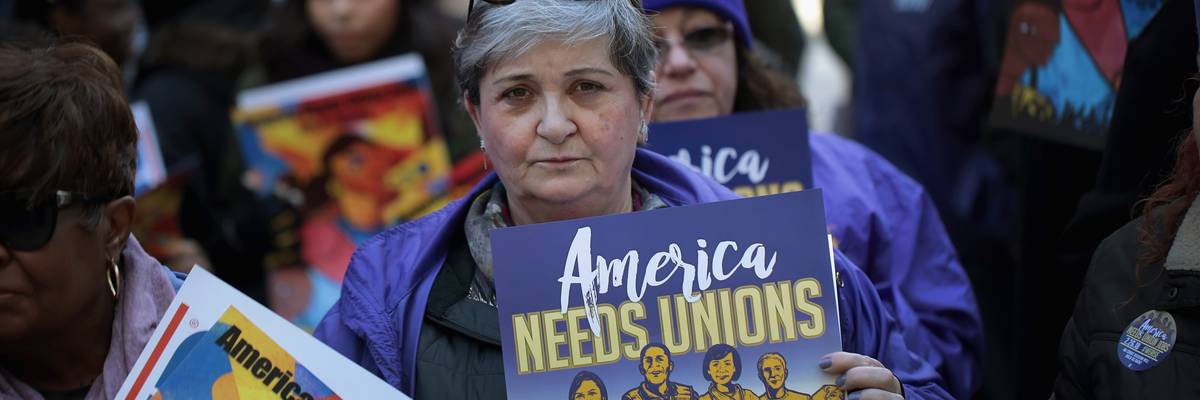
Members of the Service Employees International Union (SEIU) hold a rally in support of the American Federation of State County and Municipal Employees (AFSCME) union at the Richard J. Daley Center plaza on February 26, 2018 in Chicago, Illinois.
Want to Fix the Economy? Triple Union Membership
Tripling union membership would raise the pay of the median worker by more than $7,700 a year, or nearly $270,000 over a 35-year career. That’s enough to more than cover the cost of sending two children to a four-year public university.
This Labor Day, workers across the country are sending a clear message: They want a greater voice on the job. A near-record 71% of Americans approve of unions, and surveys show over 50 million nonunion workers would join a union if they could.
At a time when many are struggling to afford basic necessities, it’s easy to understand why. Through unions and collective bargaining, workers have more power to win higher wages, better benefits, safer working conditions, and a fairer share of the wealth they create. Unions help build a strong middle class, reduce inequality, narrow racial economic disparities, and boost participation in our democracy.
Yet only 1 in 10 US workers are in a union today—a sharp decline from the more than 1 in 3 workers who belonged to a union in the 1950s. That drop did not happen because workers stopped wanting or needing unions. It happened due to relentless attacks on unions and collective bargaining, and lawmakers’ failure to fix the broken labor laws that have allowed those attacks to succeed.
The consequences have been enormous. As union power has declined, workers have seen less of the gains from the economic growth they have helped create. Since 1979, productivity (how much average value workers produce in an hour of work) has grown 2.8 times as much as pay for typical workers.
This Labor Day, let’s recommit to putting more power in the hands of working people.
New Economic Policy Institute research makes clear just how much working people stand to gain by rebuilding union power to 1950s’ levels.
Tripling union membership would raise the pay of the median worker by more than $7,700 a year, or nearly $270,000 over a 35-year career. That’s enough to more than cover the cost of sending two children to a four-year public university, for example. Crucially, both union and nonunion workers would see these gains because stronger unions raise standards across the labor market.
Scaled across the workforce, tripling union membership would shift an estimated $1.2 trillion to the pockets of working people every year. This is enough to reverse roughly one-third of the increase in inequality since 1979.
Stronger unions are also good for businesses and the broader economy. When workers earn more, they have more money to spend in their communities, strengthening consumer demand. Businesses would benefit from lower worker turnover, higher productivity, and workers who have a greater stake in the success of their workplaces.
Tripling union membership won’t be easy, but it’s far from a nostalgic pipe dream. It will take continued nationwide organizing and decisive policy action that makes it easier for workers to unionize. Federal lawmakers can start by passing legislation that expands collective bargaining rights, closes loopholes in existing law that allows employers to suppress worker organizing, and holds employers accountable when they violate workers’ labor rights. Further, state lawmakers should provide all public-sector workers with collective bargaining rights and repeal so-called right-to-work laws that weaken workers’ ability to organize and bargain collectively.
This Labor Day, let’s recommit to putting more power in the hands of working people. That means giving more workers the freedom to organize. And it means setting an ambitious goal worthy of the moment: tripling union membership and building an economy that works for working people.
We are at a crossroads
This country and this world are at a monumental crossroads. In a few short weeks, US voters will have an opportunity to beat back the forces of fascism and confront the billionaires who are rigging the economy, our media system, and our democracy, making it increasingly impossible for ordinary people to get by. We’re not just talking about the election. We’re talking about what must be done once these fascist elements are vanquished from power. We need a bolder set of solutions than what either major party has so far been willing to offer and a working-class movement ready to fight like hell for it. Trump didn't emerge from nowhere. The conditions that fueled MAGA authoritarianism were created by decades of radical neoliberal economic policies and a corrupt political system dominated by corporate interests. They slashed taxes on the super-rich, promising that the benefits would trickle down. They said giveaways to the corporate titans would make life more affordable for the rest of us. It was all bullshit. And when a bitter, betrayed populace searches for someone to blame, right-wing demagogues have little trouble finding scapegoats. People know when they're being lied to, but you won't hear any of this from the corporate media. Only independent journalism—powered and funded by people who believe in building a better world—can deliver truly trustworthy daily news. Our Fall Campaign is underway, and we need your help. To power our newsroom through the rest of the year, we need to raise $125,000 by midnight on October 31. So if you share our vision, please contribute whatever you can to sustain our work. |
This Labor Day, workers across the country are sending a clear message: They want a greater voice on the job. A near-record 71% of Americans approve of unions, and surveys show over 50 million nonunion workers would join a union if they could.
At a time when many are struggling to afford basic necessities, it’s easy to understand why. Through unions and collective bargaining, workers have more power to win higher wages, better benefits, safer working conditions, and a fairer share of the wealth they create. Unions help build a strong middle class, reduce inequality, narrow racial economic disparities, and boost participation in our democracy.
Yet only 1 in 10 US workers are in a union today—a sharp decline from the more than 1 in 3 workers who belonged to a union in the 1950s. That drop did not happen because workers stopped wanting or needing unions. It happened due to relentless attacks on unions and collective bargaining, and lawmakers’ failure to fix the broken labor laws that have allowed those attacks to succeed.
The consequences have been enormous. As union power has declined, workers have seen less of the gains from the economic growth they have helped create. Since 1979, productivity (how much average value workers produce in an hour of work) has grown 2.8 times as much as pay for typical workers.
This Labor Day, let’s recommit to putting more power in the hands of working people.
New Economic Policy Institute research makes clear just how much working people stand to gain by rebuilding union power to 1950s’ levels.
Tripling union membership would raise the pay of the median worker by more than $7,700 a year, or nearly $270,000 over a 35-year career. That’s enough to more than cover the cost of sending two children to a four-year public university, for example. Crucially, both union and nonunion workers would see these gains because stronger unions raise standards across the labor market.
Scaled across the workforce, tripling union membership would shift an estimated $1.2 trillion to the pockets of working people every year. This is enough to reverse roughly one-third of the increase in inequality since 1979.
Stronger unions are also good for businesses and the broader economy. When workers earn more, they have more money to spend in their communities, strengthening consumer demand. Businesses would benefit from lower worker turnover, higher productivity, and workers who have a greater stake in the success of their workplaces.
Tripling union membership won’t be easy, but it’s far from a nostalgic pipe dream. It will take continued nationwide organizing and decisive policy action that makes it easier for workers to unionize. Federal lawmakers can start by passing legislation that expands collective bargaining rights, closes loopholes in existing law that allows employers to suppress worker organizing, and holds employers accountable when they violate workers’ labor rights. Further, state lawmakers should provide all public-sector workers with collective bargaining rights and repeal so-called right-to-work laws that weaken workers’ ability to organize and bargain collectively.
This Labor Day, let’s recommit to putting more power in the hands of working people. That means giving more workers the freedom to organize. And it means setting an ambitious goal worthy of the moment: tripling union membership and building an economy that works for working people.
- Trade Unionism vs. the Oligarchy on Labor Day and Every Day ›
- How Can the Dem Win Back Working-Class Voters? Run Union Candidates ›
- UAW President Says Workers Must 'Flex Our Collective Muscles' to Win Class War ›
- Why We Need Solidarity Unionism on an Industrial Scale: The IWW Goes on Tour (Again) ›
- Labor Militancy Is the Only Way to Increase Union Membership ›
- Low Union Numbers Amid Organizing Wave Spark Calls for US Labor Law Fixes ›
This Labor Day, workers across the country are sending a clear message: They want a greater voice on the job. A near-record 71% of Americans approve of unions, and surveys show over 50 million nonunion workers would join a union if they could.
At a time when many are struggling to afford basic necessities, it’s easy to understand why. Through unions and collective bargaining, workers have more power to win higher wages, better benefits, safer working conditions, and a fairer share of the wealth they create. Unions help build a strong middle class, reduce inequality, narrow racial economic disparities, and boost participation in our democracy.
Yet only 1 in 10 US workers are in a union today—a sharp decline from the more than 1 in 3 workers who belonged to a union in the 1950s. That drop did not happen because workers stopped wanting or needing unions. It happened due to relentless attacks on unions and collective bargaining, and lawmakers’ failure to fix the broken labor laws that have allowed those attacks to succeed.
The consequences have been enormous. As union power has declined, workers have seen less of the gains from the economic growth they have helped create. Since 1979, productivity (how much average value workers produce in an hour of work) has grown 2.8 times as much as pay for typical workers.
This Labor Day, let’s recommit to putting more power in the hands of working people.
New Economic Policy Institute research makes clear just how much working people stand to gain by rebuilding union power to 1950s’ levels.
Tripling union membership would raise the pay of the median worker by more than $7,700 a year, or nearly $270,000 over a 35-year career. That’s enough to more than cover the cost of sending two children to a four-year public university, for example. Crucially, both union and nonunion workers would see these gains because stronger unions raise standards across the labor market.
Scaled across the workforce, tripling union membership would shift an estimated $1.2 trillion to the pockets of working people every year. This is enough to reverse roughly one-third of the increase in inequality since 1979.
Stronger unions are also good for businesses and the broader economy. When workers earn more, they have more money to spend in their communities, strengthening consumer demand. Businesses would benefit from lower worker turnover, higher productivity, and workers who have a greater stake in the success of their workplaces.
Tripling union membership won’t be easy, but it’s far from a nostalgic pipe dream. It will take continued nationwide organizing and decisive policy action that makes it easier for workers to unionize. Federal lawmakers can start by passing legislation that expands collective bargaining rights, closes loopholes in existing law that allows employers to suppress worker organizing, and holds employers accountable when they violate workers’ labor rights. Further, state lawmakers should provide all public-sector workers with collective bargaining rights and repeal so-called right-to-work laws that weaken workers’ ability to organize and bargain collectively.
This Labor Day, let’s recommit to putting more power in the hands of working people. That means giving more workers the freedom to organize. And it means setting an ambitious goal worthy of the moment: tripling union membership and building an economy that works for working people.
- Trade Unionism vs. the Oligarchy on Labor Day and Every Day ›
- How Can the Dem Win Back Working-Class Voters? Run Union Candidates ›
- UAW President Says Workers Must 'Flex Our Collective Muscles' to Win Class War ›
- Why We Need Solidarity Unionism on an Industrial Scale: The IWW Goes on Tour (Again) ›
- Labor Militancy Is the Only Way to Increase Union Membership ›
- Low Union Numbers Amid Organizing Wave Spark Calls for US Labor Law Fixes ›