SUBSCRIBE TO OUR FREE NEWSLETTER
Daily news & progressive opinion—funded by the people, not the corporations—delivered straight to your inbox.
5
#000000
#FFFFFF
To donate by check, phone, or other method, see our More Ways to Give page.
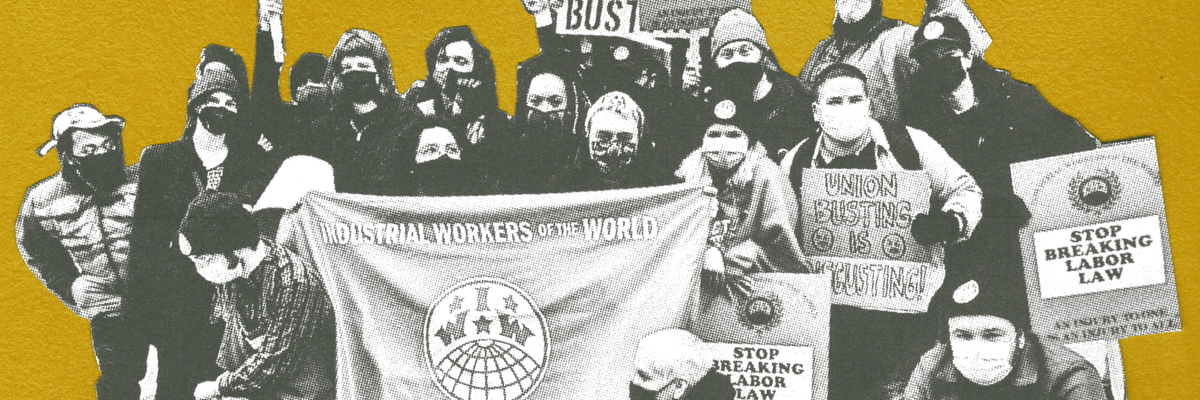
This summer, the Industrial Workers of the World, or IWW is once again going on tour nationally. Wobblies in multiple cities have organized the Fire Your Boss Tour to, well, show all workers how to fire your boss and to spread the principles of industrial unionism, solidarity unionism, and radical workplace organizing.
The Industrial Workers of the World (IWW) was once feared by capitalists and the state. The IWW, often referred to as the “One Big Union,” represented a fundamentally different vision of working-class power than had existed. At its peak in 1917, the union counted roughly 150,000 members, nearly half a percent of the entire United States’ working class. Half a percent might sound small, but that amounted to 150,000 or more worker-organizers, across industries and across the country, all working to build a revolutionary union. Imagine what that would mean today. If even half a percent of the modern working class were organized around the same vision, it would amount to nearly 1 million worker-organizers fighting together for the same goal.
Today, as workers across the country face renewed repression and new (or old) forms of exploitation, we would not be ill-served to look to the example of the IWW for inspiration. We do not seek to romanticize the past, but the conditions the early IWW confronted then are strikingly familiar today: massive concentration of wealth; rampant inequality; and a divided, collaborationist labor movement. Against this world, the early IWW offered a bold vision, one in which workers organized as a class, across every artificial division imposed on them, and fought capitalism right where it hurt: at work. The IWW’s scale, industrial approach, and insistence on worker-led organizing still offer powerful lessons for worker-organizers seeking to break through the barriers that divide us and unite the working class to build a force capable of real, transformative change.
So, how did the IWW become such a powerful force back in 1917? What drew so many workers to this union and inspired them to organize under its banner?
Workers do not need to wait for permission from employers, courts, or labor boards to act collectively; our power begins at the precise point when we collectively recognize our shared conditions and organize to change them.
First, the IWW was committed to a united working class. While other unions excluded workers based on their skill level, gender, race, ethnicity, or trade, the IWW welcomed all workers. Its grand vision was “an organization formed in such a way that all its members in any one industry, or in all industries if necessary, cease work whenever a strike or lockout is on in any department thereof, thus making an injury to one an injury to all.” The IWW sought to break down the divisions that existed among the working class and unite against our common enemy, the employing class, and it was working. That is precisely why the ruling class feared the IWW.
Second, the IWW was committed to radical democracy and rank-and-file control. Rather than building a union that depended on paid staff, the IWW developed worker-organizers on the shop floor, and all decisions were made by the workers themselves. This model is critical for building a mass movement. It engages large swaths of workers in the struggle; empowers them to take direct, autonomous action; and creates a sustainable model by continuously developing new organizers rather than relying on charismatic leaders or “superhero” organizers. We still see traces of this organizing culture today. The Starbucks Workers United campaign, which was preceded by an IWW Starbucks workers campaign nearly 20 years earlier, has been driven by baristas organizing democratically at the shop level, with workers themselves taking the lead and engaging in collective decision-making rather than relying on external union staff as is still too often the expectation in other unions.
One famous story from 1916 captures this culture of rank-and-file democracy:
In 1916 in Everett, Washington, a passenger ferry loaded with Industrial Workers of the World (IWW) free speech activists attempted to dock. On the dock, the local sheriff, along with armed deputies and armed guards hired by local businesses, attempted to block the ship from docking. According to lore, when the sheriff asked, "Who are your leaders?" the response from the ferry was a shout from everyone aboard, declaring, "We are all leaders here." As folk musician Utah Phillips explains, "That scared the tar out of the ol’ law you know’"
The power of the early IWW did not lie in any single leader who could be arrested, bought off, discredited, or removed. Its power lay in the collective capacity of everyday rank-and-file workers to lead themselves.
Finally, the IWW was committed to working-class dignity in its deepest sense. The Preamble to the Constitution of the IWW (1905) famously declares: “Instead of the conservative motto, 'A fair day’s wage for a fair day’s work,' we must inscribe on our banner the revolutionary watchword, ‘Abolition of the wage system.’ It is the historic mission of the working class to do away with capitalism.” When the IWW said it wants more of the good things in life, they were not just talking about getting the bosses to fork over a bit more cash. The IWW’s goals are bigger than that. We want a better life here and now. This can be contrasted with the trade union movement, which disheartened (and continues to dishearten) workers by making shady backroom deals with bosses.
The IWW is, was, and will always be a union for and by the working class.
The contemporary IWW is still committed to all of these things, and the grand vision that it set forth in the early 1900s is just as relevant and necessary today as it was then. Its contemporary form is not identical to that of the early 20th century, but the grand vision it set forth remains urgently relevant.
In 1911, Big Bill Haywood, a founding member of the IWW, gave a speech about "the general strike as a weapon of the working class." In response to a question from the audience about political action and what distinguishes the IWW from the AFL, he replied:
The Industrial Workers of the World is an economic organization without affiliation with any political party or any non-political sect. I as an Industrialist say that industrial unionism is the broadest possible political interpretation of the working-class political power, because by organizing the workers industrially you at once enfranchise the women in the shops, you at once give the black men who are disenfranchised politically a voice in the operation of the industries; and the same would extend to every worker. That to my mind is the kind of political action that the working class wants. You must not be content to come to the ballot box on the first Tuesday after the first Monday in November, the ballot box erected by the capitalist class, guarded by capitalist henchmen, and deposit your ballot to be counted by black-handed thugs, and say, “That is political action.” You must protect your ballot with an organization that will enforce the mandates of your class. I want political action that counts. I want a working class that can hold an election every day if they want to.
As Haywood made clear, the IWW did not reject politics so much as it rejected reducing politics to the electoral kind. For the Wobblies, the workplace itself was a political arena. In fact, it was the political arena. It was and remains where workers spend most of their waking hours (and often their sleeping hours). Industrial unionism for the Wobblies was a means of democratizing power where workers actually lived, labored, and were disciplined. Industrial unionism could also extend real political power to workers excluded from or marginalized within formal citizenship. The ballot box is an institution shaped, guarded, and constrained by capitalist power. What mattered, then, was not simply the right to vote, but the collective capacity to enforce working-class demands through organization at the point of production. When Haywood says that he wants a working class that can hold an election every day if they want to, he means that his vision of democracy is not one in which (some) workers get to delegate periodic representation within capitalist institutions, but rather one in which continuous collective power is exercised directly by workers who have wrested control of their workplaces.
For the founding members of the IWW, the fundamental flaw in established labor organizations like the AFL extended far beyond mere conservatism. They argued that the very structure of trade unions was inherently incapable of addressing the monopolistic tendencies of modern capitalism. In the Preamble to the Constitution of the IWW (1905), the founding members of the IWW observed that, as capital became increasingly concentrated into the hands of a few monopolies, the trade union model, focused narrowly on specific skilled crafts, was no more than an obsolete barrier. Faced with the overwhelming power of an employing class that had consolidated industries into vast monopolies, the IWW believed that the AFL's approach of protecting only skilled workers served only to fragment and ultimately weaken the working class.
Consequently, the Wobblies championed a radically different vision of worker power, described by William Trautmann at the 1905 IWW founding convention as one in which workers refused to be "bound by the sacredness or the sanctity of a contract." Instead, the IWW sought to unite all workers, regardless of trade, whether capital and state deemed them skilled or unskilled, into a single, cohesive force capable of achieving true economic justice, and thus social and political justice, through industrial unionism. This vision of industrial unionism relied on what Alice and Staughton Lynd would later describe as solidarity unionism, namely a form of organizing in which workers learn to be in solidarity with each other, rejecting the many divisions imposed on them by employers and the state, in order to directly take collective action to improve their lives. For the Wobblies, the union was not to be a service organization that represented workers from above, but rather the self-organization of workers themselves, capable of forming and enforcing their own demands through various forms of direct action that they would collectively and democratically decide. The point was not simply to win better contracts within capitalism, but to cultivate the everyday practices of true working-class democracy and power that would eventually challenge capitalist authority at its source.
Consolidating our power and coming together across entire industries opens up a world of opportunities for what workers can achieve. Our bosses (or our owners, as a co-worker once quipped) already understand this. Capital is always consolidating: Four corporations own a third of all grocery stores in this country, and just 12 corporations own virtually every product and brand on those shelves. The wealth and power accumulated by these corporations is staggering, but the structure is not new. In many ways, the conditions of the 21st century resemble those of the early 20th century, when the IWW emerged in response to monopolies, deskilling, precarious work (what we call gig work is, of course, a new name for an old form of exploitation), and, above all, the concentration of entire industries in the hands of a few powerful capitalists. Then, as now, workers were divided by job, workplace, race, gender, citizenship, whether they were deemed skilled or unskilled, while capital operated across all of those divisions.
If capital organizes industrially, workers must do the same. What if we did the same and organized into a One Big Union? What if we formed cross-workplace organizing committees that brought together workers from different shops within the same industries? It is by building these connections and structures that we will lay the groundwork for industrial solidarity, thereby creating working-class networks that make any one group of workers that much harder to isolate, intimidate, and, ultimately, defeat. Above all, like our Wobbly ancestors, we must begin to practice the basic principle of solidarity unionism: that workers do not need to wait for permission from employers, courts, or labor boards to act collectively; our power begins at the precise point when we collectively recognize our shared conditions and organize to change them.
From another perspective, while wealth inequality is at an all-time high, government repression against activists is at an all-time high as well. That too is another key similarity between our time and that of the early Wobblies. From Prairieland to the FBI raids in Minnesota and Michigan, the government is once again trying to quash dissent; building a militant, industrially organized labor movement is one of the most effective ways to fight back against these attacks. We have to build the power necessary to defend ourselves as a class. Imagine if when the FBI or ICE came to Minneapolis, the entire country came to a screeching halt and we actually shut shit down. Imagine if we went on the offensive instead of always reacting. That is what is possible through revolutionary, industrial unionism.

The Fire Your Boss Tour marks the first coordinated national organizing event by Wobblies in recent history. In Portland, Oregon; Seattle, Washington; Sacramento, California; Denver, Colorado; Burlington, Vermont; Boston, Massachusetts; Chicago, Illinois; Ypsilanti, Michigan; New York City; and potentially additional cities, Wobblies will once again preach the Wobbly Gospel of industrial unionism, solidarity unionism, and revolutionary unionism. Unlike a traditional speaking tour, where a few "experts" deliver speeches nationwide, this is a decentralized initiative in which local IWW branches organize their own events while collectively coordinating the tour. Depending on the city, events during the tour include workshops on workplace organizing, discussions on organizing strategy, and sessions where workers can share experiences.
Most importantly, each stop on the tour is an opportunity to connect with fellow workers in your region who are committed to building a stronger labor movement. As our precarious working and living conditions increasingly resemble those of the original Wobblies, the principles and strategy of solidarity unionism and industrial unionism are now more critical than ever. Workers of the World, Unite (and RSVP to the tour)!
This summer, the Industrial Workers of the World, or IWW is once again going on tour nationally. Wobblies in multiple cities have organized the Fire Your Boss Tour to, well, show all workers how to fire your boss and to spread the principles of industrial unionism, solidarity unionism, and radical workplace organizing.
The Industrial Workers of the World (IWW) was once feared by capitalists and the state. The IWW, often referred to as the “One Big Union,” represented a fundamentally different vision of working-class power than had existed. At its peak in 1917, the union counted roughly 150,000 members, nearly half a percent of the entire United States’ working class. Half a percent might sound small, but that amounted to 150,000 or more worker-organizers, across industries and across the country, all working to build a revolutionary union. Imagine what that would mean today. If even half a percent of the modern working class were organized around the same vision, it would amount to nearly 1 million worker-organizers fighting together for the same goal.
Today, as workers across the country face renewed repression and new (or old) forms of exploitation, we would not be ill-served to look to the example of the IWW for inspiration. We do not seek to romanticize the past, but the conditions the early IWW confronted then are strikingly familiar today: massive concentration of wealth; rampant inequality; and a divided, collaborationist labor movement. Against this world, the early IWW offered a bold vision, one in which workers organized as a class, across every artificial division imposed on them, and fought capitalism right where it hurt: at work. The IWW’s scale, industrial approach, and insistence on worker-led organizing still offer powerful lessons for worker-organizers seeking to break through the barriers that divide us and unite the working class to build a force capable of real, transformative change.
So, how did the IWW become such a powerful force back in 1917? What drew so many workers to this union and inspired them to organize under its banner?
Workers do not need to wait for permission from employers, courts, or labor boards to act collectively; our power begins at the precise point when we collectively recognize our shared conditions and organize to change them.
First, the IWW was committed to a united working class. While other unions excluded workers based on their skill level, gender, race, ethnicity, or trade, the IWW welcomed all workers. Its grand vision was “an organization formed in such a way that all its members in any one industry, or in all industries if necessary, cease work whenever a strike or lockout is on in any department thereof, thus making an injury to one an injury to all.” The IWW sought to break down the divisions that existed among the working class and unite against our common enemy, the employing class, and it was working. That is precisely why the ruling class feared the IWW.
Second, the IWW was committed to radical democracy and rank-and-file control. Rather than building a union that depended on paid staff, the IWW developed worker-organizers on the shop floor, and all decisions were made by the workers themselves. This model is critical for building a mass movement. It engages large swaths of workers in the struggle; empowers them to take direct, autonomous action; and creates a sustainable model by continuously developing new organizers rather than relying on charismatic leaders or “superhero” organizers. We still see traces of this organizing culture today. The Starbucks Workers United campaign, which was preceded by an IWW Starbucks workers campaign nearly 20 years earlier, has been driven by baristas organizing democratically at the shop level, with workers themselves taking the lead and engaging in collective decision-making rather than relying on external union staff as is still too often the expectation in other unions.
One famous story from 1916 captures this culture of rank-and-file democracy:
In 1916 in Everett, Washington, a passenger ferry loaded with Industrial Workers of the World (IWW) free speech activists attempted to dock. On the dock, the local sheriff, along with armed deputies and armed guards hired by local businesses, attempted to block the ship from docking. According to lore, when the sheriff asked, "Who are your leaders?" the response from the ferry was a shout from everyone aboard, declaring, "We are all leaders here." As folk musician Utah Phillips explains, "That scared the tar out of the ol’ law you know’"
The power of the early IWW did not lie in any single leader who could be arrested, bought off, discredited, or removed. Its power lay in the collective capacity of everyday rank-and-file workers to lead themselves.
Finally, the IWW was committed to working-class dignity in its deepest sense. The Preamble to the Constitution of the IWW (1905) famously declares: “Instead of the conservative motto, 'A fair day’s wage for a fair day’s work,' we must inscribe on our banner the revolutionary watchword, ‘Abolition of the wage system.’ It is the historic mission of the working class to do away with capitalism.” When the IWW said it wants more of the good things in life, they were not just talking about getting the bosses to fork over a bit more cash. The IWW’s goals are bigger than that. We want a better life here and now. This can be contrasted with the trade union movement, which disheartened (and continues to dishearten) workers by making shady backroom deals with bosses.
The IWW is, was, and will always be a union for and by the working class.
The contemporary IWW is still committed to all of these things, and the grand vision that it set forth in the early 1900s is just as relevant and necessary today as it was then. Its contemporary form is not identical to that of the early 20th century, but the grand vision it set forth remains urgently relevant.
In 1911, Big Bill Haywood, a founding member of the IWW, gave a speech about "the general strike as a weapon of the working class." In response to a question from the audience about political action and what distinguishes the IWW from the AFL, he replied:
The Industrial Workers of the World is an economic organization without affiliation with any political party or any non-political sect. I as an Industrialist say that industrial unionism is the broadest possible political interpretation of the working-class political power, because by organizing the workers industrially you at once enfranchise the women in the shops, you at once give the black men who are disenfranchised politically a voice in the operation of the industries; and the same would extend to every worker. That to my mind is the kind of political action that the working class wants. You must not be content to come to the ballot box on the first Tuesday after the first Monday in November, the ballot box erected by the capitalist class, guarded by capitalist henchmen, and deposit your ballot to be counted by black-handed thugs, and say, “That is political action.” You must protect your ballot with an organization that will enforce the mandates of your class. I want political action that counts. I want a working class that can hold an election every day if they want to.
As Haywood made clear, the IWW did not reject politics so much as it rejected reducing politics to the electoral kind. For the Wobblies, the workplace itself was a political arena. In fact, it was the political arena. It was and remains where workers spend most of their waking hours (and often their sleeping hours). Industrial unionism for the Wobblies was a means of democratizing power where workers actually lived, labored, and were disciplined. Industrial unionism could also extend real political power to workers excluded from or marginalized within formal citizenship. The ballot box is an institution shaped, guarded, and constrained by capitalist power. What mattered, then, was not simply the right to vote, but the collective capacity to enforce working-class demands through organization at the point of production. When Haywood says that he wants a working class that can hold an election every day if they want to, he means that his vision of democracy is not one in which (some) workers get to delegate periodic representation within capitalist institutions, but rather one in which continuous collective power is exercised directly by workers who have wrested control of their workplaces.
For the founding members of the IWW, the fundamental flaw in established labor organizations like the AFL extended far beyond mere conservatism. They argued that the very structure of trade unions was inherently incapable of addressing the monopolistic tendencies of modern capitalism. In the Preamble to the Constitution of the IWW (1905), the founding members of the IWW observed that, as capital became increasingly concentrated into the hands of a few monopolies, the trade union model, focused narrowly on specific skilled crafts, was no more than an obsolete barrier. Faced with the overwhelming power of an employing class that had consolidated industries into vast monopolies, the IWW believed that the AFL's approach of protecting only skilled workers served only to fragment and ultimately weaken the working class.
Consequently, the Wobblies championed a radically different vision of worker power, described by William Trautmann at the 1905 IWW founding convention as one in which workers refused to be "bound by the sacredness or the sanctity of a contract." Instead, the IWW sought to unite all workers, regardless of trade, whether capital and state deemed them skilled or unskilled, into a single, cohesive force capable of achieving true economic justice, and thus social and political justice, through industrial unionism. This vision of industrial unionism relied on what Alice and Staughton Lynd would later describe as solidarity unionism, namely a form of organizing in which workers learn to be in solidarity with each other, rejecting the many divisions imposed on them by employers and the state, in order to directly take collective action to improve their lives. For the Wobblies, the union was not to be a service organization that represented workers from above, but rather the self-organization of workers themselves, capable of forming and enforcing their own demands through various forms of direct action that they would collectively and democratically decide. The point was not simply to win better contracts within capitalism, but to cultivate the everyday practices of true working-class democracy and power that would eventually challenge capitalist authority at its source.
Consolidating our power and coming together across entire industries opens up a world of opportunities for what workers can achieve. Our bosses (or our owners, as a co-worker once quipped) already understand this. Capital is always consolidating: Four corporations own a third of all grocery stores in this country, and just 12 corporations own virtually every product and brand on those shelves. The wealth and power accumulated by these corporations is staggering, but the structure is not new. In many ways, the conditions of the 21st century resemble those of the early 20th century, when the IWW emerged in response to monopolies, deskilling, precarious work (what we call gig work is, of course, a new name for an old form of exploitation), and, above all, the concentration of entire industries in the hands of a few powerful capitalists. Then, as now, workers were divided by job, workplace, race, gender, citizenship, whether they were deemed skilled or unskilled, while capital operated across all of those divisions.
If capital organizes industrially, workers must do the same. What if we did the same and organized into a One Big Union? What if we formed cross-workplace organizing committees that brought together workers from different shops within the same industries? It is by building these connections and structures that we will lay the groundwork for industrial solidarity, thereby creating working-class networks that make any one group of workers that much harder to isolate, intimidate, and, ultimately, defeat. Above all, like our Wobbly ancestors, we must begin to practice the basic principle of solidarity unionism: that workers do not need to wait for permission from employers, courts, or labor boards to act collectively; our power begins at the precise point when we collectively recognize our shared conditions and organize to change them.
From another perspective, while wealth inequality is at an all-time high, government repression against activists is at an all-time high as well. That too is another key similarity between our time and that of the early Wobblies. From Prairieland to the FBI raids in Minnesota and Michigan, the government is once again trying to quash dissent; building a militant, industrially organized labor movement is one of the most effective ways to fight back against these attacks. We have to build the power necessary to defend ourselves as a class. Imagine if when the FBI or ICE came to Minneapolis, the entire country came to a screeching halt and we actually shut shit down. Imagine if we went on the offensive instead of always reacting. That is what is possible through revolutionary, industrial unionism.
The Fire Your Boss Tour marks the first coordinated national organizing event by Wobblies in recent history. In Portland, Oregon; Seattle, Washington; Sacramento, California; Denver, Colorado; Burlington, Vermont; Boston, Massachusetts; Chicago, Illinois; Ypsilanti, Michigan; New York City; and potentially additional cities, Wobblies will once again preach the Wobbly Gospel of industrial unionism, solidarity unionism, and revolutionary unionism. Unlike a traditional speaking tour, where a few "experts" deliver speeches nationwide, this is a decentralized initiative in which local IWW branches organize their own events while collectively coordinating the tour. Depending on the city, events during the tour include workshops on workplace organizing, discussions on organizing strategy, and sessions where workers can share experiences.
Most importantly, each stop on the tour is an opportunity to connect with fellow workers in your region who are committed to building a stronger labor movement. As our precarious working and living conditions increasingly resemble those of the original Wobblies, the principles and strategy of solidarity unionism and industrial unionism are now more critical than ever. Workers of the World, Unite (and RSVP to the tour)!
This summer, the Industrial Workers of the World, or IWW is once again going on tour nationally. Wobblies in multiple cities have organized the Fire Your Boss Tour to, well, show all workers how to fire your boss and to spread the principles of industrial unionism, solidarity unionism, and radical workplace organizing.
The Industrial Workers of the World (IWW) was once feared by capitalists and the state. The IWW, often referred to as the “One Big Union,” represented a fundamentally different vision of working-class power than had existed. At its peak in 1917, the union counted roughly 150,000 members, nearly half a percent of the entire United States’ working class. Half a percent might sound small, but that amounted to 150,000 or more worker-organizers, across industries and across the country, all working to build a revolutionary union. Imagine what that would mean today. If even half a percent of the modern working class were organized around the same vision, it would amount to nearly 1 million worker-organizers fighting together for the same goal.
Today, as workers across the country face renewed repression and new (or old) forms of exploitation, we would not be ill-served to look to the example of the IWW for inspiration. We do not seek to romanticize the past, but the conditions the early IWW confronted then are strikingly familiar today: massive concentration of wealth; rampant inequality; and a divided, collaborationist labor movement. Against this world, the early IWW offered a bold vision, one in which workers organized as a class, across every artificial division imposed on them, and fought capitalism right where it hurt: at work. The IWW’s scale, industrial approach, and insistence on worker-led organizing still offer powerful lessons for worker-organizers seeking to break through the barriers that divide us and unite the working class to build a force capable of real, transformative change.
So, how did the IWW become such a powerful force back in 1917? What drew so many workers to this union and inspired them to organize under its banner?
Workers do not need to wait for permission from employers, courts, or labor boards to act collectively; our power begins at the precise point when we collectively recognize our shared conditions and organize to change them.
First, the IWW was committed to a united working class. While other unions excluded workers based on their skill level, gender, race, ethnicity, or trade, the IWW welcomed all workers. Its grand vision was “an organization formed in such a way that all its members in any one industry, or in all industries if necessary, cease work whenever a strike or lockout is on in any department thereof, thus making an injury to one an injury to all.” The IWW sought to break down the divisions that existed among the working class and unite against our common enemy, the employing class, and it was working. That is precisely why the ruling class feared the IWW.
Second, the IWW was committed to radical democracy and rank-and-file control. Rather than building a union that depended on paid staff, the IWW developed worker-organizers on the shop floor, and all decisions were made by the workers themselves. This model is critical for building a mass movement. It engages large swaths of workers in the struggle; empowers them to take direct, autonomous action; and creates a sustainable model by continuously developing new organizers rather than relying on charismatic leaders or “superhero” organizers. We still see traces of this organizing culture today. The Starbucks Workers United campaign, which was preceded by an IWW Starbucks workers campaign nearly 20 years earlier, has been driven by baristas organizing democratically at the shop level, with workers themselves taking the lead and engaging in collective decision-making rather than relying on external union staff as is still too often the expectation in other unions.
One famous story from 1916 captures this culture of rank-and-file democracy:
In 1916 in Everett, Washington, a passenger ferry loaded with Industrial Workers of the World (IWW) free speech activists attempted to dock. On the dock, the local sheriff, along with armed deputies and armed guards hired by local businesses, attempted to block the ship from docking. According to lore, when the sheriff asked, "Who are your leaders?" the response from the ferry was a shout from everyone aboard, declaring, "We are all leaders here." As folk musician Utah Phillips explains, "That scared the tar out of the ol’ law you know’"
The power of the early IWW did not lie in any single leader who could be arrested, bought off, discredited, or removed. Its power lay in the collective capacity of everyday rank-and-file workers to lead themselves.
Finally, the IWW was committed to working-class dignity in its deepest sense. The Preamble to the Constitution of the IWW (1905) famously declares: “Instead of the conservative motto, 'A fair day’s wage for a fair day’s work,' we must inscribe on our banner the revolutionary watchword, ‘Abolition of the wage system.’ It is the historic mission of the working class to do away with capitalism.” When the IWW said it wants more of the good things in life, they were not just talking about getting the bosses to fork over a bit more cash. The IWW’s goals are bigger than that. We want a better life here and now. This can be contrasted with the trade union movement, which disheartened (and continues to dishearten) workers by making shady backroom deals with bosses.
The IWW is, was, and will always be a union for and by the working class.
The contemporary IWW is still committed to all of these things, and the grand vision that it set forth in the early 1900s is just as relevant and necessary today as it was then. Its contemporary form is not identical to that of the early 20th century, but the grand vision it set forth remains urgently relevant.
In 1911, Big Bill Haywood, a founding member of the IWW, gave a speech about "the general strike as a weapon of the working class." In response to a question from the audience about political action and what distinguishes the IWW from the AFL, he replied:
The Industrial Workers of the World is an economic organization without affiliation with any political party or any non-political sect. I as an Industrialist say that industrial unionism is the broadest possible political interpretation of the working-class political power, because by organizing the workers industrially you at once enfranchise the women in the shops, you at once give the black men who are disenfranchised politically a voice in the operation of the industries; and the same would extend to every worker. That to my mind is the kind of political action that the working class wants. You must not be content to come to the ballot box on the first Tuesday after the first Monday in November, the ballot box erected by the capitalist class, guarded by capitalist henchmen, and deposit your ballot to be counted by black-handed thugs, and say, “That is political action.” You must protect your ballot with an organization that will enforce the mandates of your class. I want political action that counts. I want a working class that can hold an election every day if they want to.
As Haywood made clear, the IWW did not reject politics so much as it rejected reducing politics to the electoral kind. For the Wobblies, the workplace itself was a political arena. In fact, it was the political arena. It was and remains where workers spend most of their waking hours (and often their sleeping hours). Industrial unionism for the Wobblies was a means of democratizing power where workers actually lived, labored, and were disciplined. Industrial unionism could also extend real political power to workers excluded from or marginalized within formal citizenship. The ballot box is an institution shaped, guarded, and constrained by capitalist power. What mattered, then, was not simply the right to vote, but the collective capacity to enforce working-class demands through organization at the point of production. When Haywood says that he wants a working class that can hold an election every day if they want to, he means that his vision of democracy is not one in which (some) workers get to delegate periodic representation within capitalist institutions, but rather one in which continuous collective power is exercised directly by workers who have wrested control of their workplaces.
For the founding members of the IWW, the fundamental flaw in established labor organizations like the AFL extended far beyond mere conservatism. They argued that the very structure of trade unions was inherently incapable of addressing the monopolistic tendencies of modern capitalism. In the Preamble to the Constitution of the IWW (1905), the founding members of the IWW observed that, as capital became increasingly concentrated into the hands of a few monopolies, the trade union model, focused narrowly on specific skilled crafts, was no more than an obsolete barrier. Faced with the overwhelming power of an employing class that had consolidated industries into vast monopolies, the IWW believed that the AFL's approach of protecting only skilled workers served only to fragment and ultimately weaken the working class.
Consequently, the Wobblies championed a radically different vision of worker power, described by William Trautmann at the 1905 IWW founding convention as one in which workers refused to be "bound by the sacredness or the sanctity of a contract." Instead, the IWW sought to unite all workers, regardless of trade, whether capital and state deemed them skilled or unskilled, into a single, cohesive force capable of achieving true economic justice, and thus social and political justice, through industrial unionism. This vision of industrial unionism relied on what Alice and Staughton Lynd would later describe as solidarity unionism, namely a form of organizing in which workers learn to be in solidarity with each other, rejecting the many divisions imposed on them by employers and the state, in order to directly take collective action to improve their lives. For the Wobblies, the union was not to be a service organization that represented workers from above, but rather the self-organization of workers themselves, capable of forming and enforcing their own demands through various forms of direct action that they would collectively and democratically decide. The point was not simply to win better contracts within capitalism, but to cultivate the everyday practices of true working-class democracy and power that would eventually challenge capitalist authority at its source.
Consolidating our power and coming together across entire industries opens up a world of opportunities for what workers can achieve. Our bosses (or our owners, as a co-worker once quipped) already understand this. Capital is always consolidating: Four corporations own a third of all grocery stores in this country, and just 12 corporations own virtually every product and brand on those shelves. The wealth and power accumulated by these corporations is staggering, but the structure is not new. In many ways, the conditions of the 21st century resemble those of the early 20th century, when the IWW emerged in response to monopolies, deskilling, precarious work (what we call gig work is, of course, a new name for an old form of exploitation), and, above all, the concentration of entire industries in the hands of a few powerful capitalists. Then, as now, workers were divided by job, workplace, race, gender, citizenship, whether they were deemed skilled or unskilled, while capital operated across all of those divisions.
If capital organizes industrially, workers must do the same. What if we did the same and organized into a One Big Union? What if we formed cross-workplace organizing committees that brought together workers from different shops within the same industries? It is by building these connections and structures that we will lay the groundwork for industrial solidarity, thereby creating working-class networks that make any one group of workers that much harder to isolate, intimidate, and, ultimately, defeat. Above all, like our Wobbly ancestors, we must begin to practice the basic principle of solidarity unionism: that workers do not need to wait for permission from employers, courts, or labor boards to act collectively; our power begins at the precise point when we collectively recognize our shared conditions and organize to change them.
From another perspective, while wealth inequality is at an all-time high, government repression against activists is at an all-time high as well. That too is another key similarity between our time and that of the early Wobblies. From Prairieland to the FBI raids in Minnesota and Michigan, the government is once again trying to quash dissent; building a militant, industrially organized labor movement is one of the most effective ways to fight back against these attacks. We have to build the power necessary to defend ourselves as a class. Imagine if when the FBI or ICE came to Minneapolis, the entire country came to a screeching halt and we actually shut shit down. Imagine if we went on the offensive instead of always reacting. That is what is possible through revolutionary, industrial unionism.
The Fire Your Boss Tour marks the first coordinated national organizing event by Wobblies in recent history. In Portland, Oregon; Seattle, Washington; Sacramento, California; Denver, Colorado; Burlington, Vermont; Boston, Massachusetts; Chicago, Illinois; Ypsilanti, Michigan; New York City; and potentially additional cities, Wobblies will once again preach the Wobbly Gospel of industrial unionism, solidarity unionism, and revolutionary unionism. Unlike a traditional speaking tour, where a few "experts" deliver speeches nationwide, this is a decentralized initiative in which local IWW branches organize their own events while collectively coordinating the tour. Depending on the city, events during the tour include workshops on workplace organizing, discussions on organizing strategy, and sessions where workers can share experiences.
Most importantly, each stop on the tour is an opportunity to connect with fellow workers in your region who are committed to building a stronger labor movement. As our precarious working and living conditions increasingly resemble those of the original Wobblies, the principles and strategy of solidarity unionism and industrial unionism are now more critical than ever. Workers of the World, Unite (and RSVP to the tour)!