SUBSCRIBE TO OUR FREE NEWSLETTER
Daily news & progressive opinion—funded by the people, not the corporations—delivered straight to your inbox.
5
#000000
#FFFFFF
To donate by check, phone, or other method, see our More Ways to Give page.
Daily news & progressive opinion—funded by the people, not the corporations—delivered straight to your inbox.
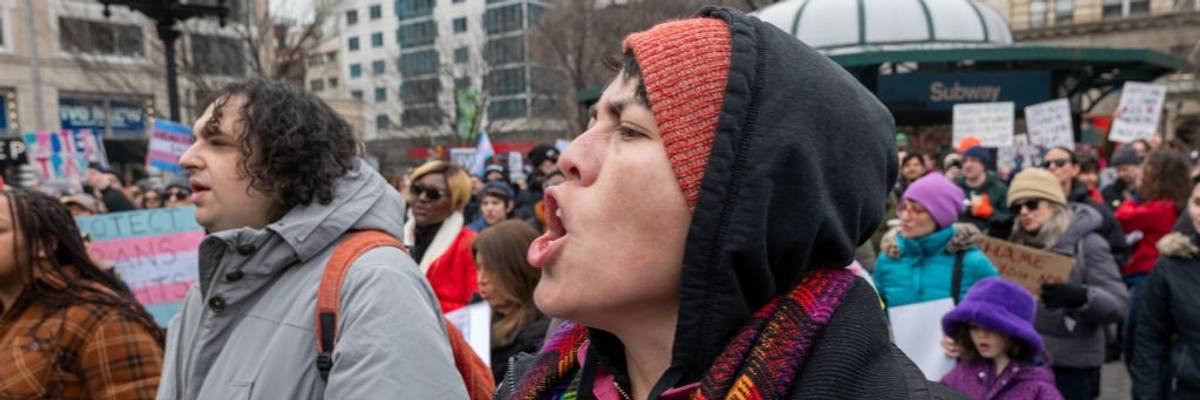
People attend a rally in Union Square in Manhattan supporting transgender youth on February 08, 2025 in New York City.
We Americans have an obligation to each other and future generations to take on the root causes behind our suffering.
How often do I hear friends and political commentators lamenting America’s polarized culture. “Polarization” is so commonplace that it was Merriam Webster’s 2024 word of the year. Whether it’s Democrats v. Republican, Conservative v. Liberal, Right v. Left, or Red v. Blue, the feeling conveyed is that we’re simply stuck in opposing camps, sharing little common ground.
Yes, of course, these labels capture real differences. But thinking that our opposing “poles” are our real problem can deter us from seeing solutions or even believing positive change is possible. The truth is, we’re less divided than we imagine ourselves to be.
Plus, “polarization” feels fixed—discouraging us from probing deeply the forces that underlie our differences—forces that we can indeed address.
When we dig in, our hunch is that much of today’s painful divide arises from economic forces and realities that aren’t front-and-center in Americans’ view of our nation. Exposing this reality could release energy for much-needed action.
The truth is, we’re less divided than we imagine ourselves to be.
Of course, Americans are aware of class differences, but we assume that they are more-or-less static—just the way it’s long been—and at least close to the norm in other democracies.
Few of us likely appreciate that we are a global outlier in the depth of our economic disparity—coming in more extreme than roughly 120 nations and far below our peers. Consider this: Three Americans control more wealth than bottom half of us which together hold only 2 percent.
Deep inequality threatens democracy itself. History suggests that if wealth is concentrated at the top, the moneyed elite will infect and distort the political process in its favor, thus undermining democracy.
Combine these realities: First, the inherent hardships—daily stress, lack of leisure as well as the real deprivations of so many Americans, including our low-minimum wage, the dangerously poor-quality of our most-affordable diets, and our failure to assure access to healthcare for everyone. Then add to all that the long-sung tune that anyone with drive and decent character can “make it” in our free market system.
And what do you get?
Painful self-blame and fear…and, yes, exhaustion. Understandably, then, we seek someone to blame—a tragic pattern that has been repeated throughout history.
Take the 1863 New York City "draft" riots, during which poor, white (mostly Irish) workers feeling the pressure of exploitation and poverty took their anger out against New York’s Black population in the one of the most significant insurrections in U.S. history. The draft riots are a grave warning of what can happen when two disenfranchised groups are pitted against each other. Division is sowed where unity and solidarity are most needed.
Hitler’s rise to power is another terrifying tale of how scapegoating minority groups can be a potent—and devastating—political strategy, especially during times when citizens are struggling to make ends meet and a country is in a period of unrest.
Today, the president of our nation is successfully casting himself as a big, angry man who names our oppressors and will fight against the bad guys for the rest of us. Trump has targeted immigrants, spreading dangerous lies and authorizing deeply damaging policies. Likewise, he has taken swift action to disenfranchise transgender people, justifying it through harmful rhetoric.
Donald J. Trump’s core demeanor is anger. So, it’s understandable that many believe he’ll use his loudmouth to fight for them. Casting himself as an outsider is brilliant.
Of course, his policies belie his pose. They hurt the most vulnerable and reward the most powerful. Beyond his attacks on immigrants and trans people, here are just a few: Trump's attempted federal funding freeze could severely impede early childhood education, infrastructure projects, and social-benefit organizations. He has also promised to limit SNAP benefits and cut healthcare spending—all while expanding tax cuts primarily benefiting the wealthiest. In addition, he’s rolled back environmental protections.
Sadly, Trump’s posturing and scapegoating effectively engage many Americans. But, getting stuck on what feels like an insurmountable chasm does not serve us. Progress comes when we focus on our common ground and go from there.
So what can we do? Remember: We are all influencers. Each of us can share what we know with family, friends, and colleagues. They are likely to do the same. Hey, we never know the ripples of our own courage to speak out.
We can fight destructive disinformation on social media that the president and his now right-hand man Elon Musk have weaponized.
We can reach out to our representatives in government, helping them find the courage to take on the painful realities of extreme inequity and the false messaging pitting us against each other.
Blaming “polarization” is a dangerous distraction. It is a symptom of our real problems. We Americans have an obligation to each other and future generations to take on the root causes behind our suffering.
It’s still a new year. Let’s make it a new beginning as well.
Dear Common Dreams reader, It’s been nearly 30 years since I co-founded Common Dreams with my late wife, Lina Newhouser. We had the radical notion that journalism should serve the public good, not corporate profits. It was clear to us from the outset what it would take to build such a project. No paid advertisements. No corporate sponsors. No millionaire publisher telling us what to think or do. Many people said we wouldn't last a year, but we proved those doubters wrong. Together with a tremendous team of journalists and dedicated staff, we built an independent media outlet free from the constraints of profits and corporate control. Our mission has always been simple: To inform. To inspire. To ignite change for the common good. Building Common Dreams was not easy. Our survival was never guaranteed. When you take on the most powerful forces—Wall Street greed, fossil fuel industry destruction, Big Tech lobbyists, and uber-rich oligarchs who have spent billions upon billions rigging the economy and democracy in their favor—the only bulwark you have is supporters who believe in your work. But here’s the urgent message from me today. It's never been this bad out there. And it's never been this hard to keep us going. At the very moment Common Dreams is most needed, the threats we face are intensifying. We need your support now more than ever. We don't accept corporate advertising and never will. We don't have a paywall because we don't think people should be blocked from critical news based on their ability to pay. Everything we do is funded by the donations of readers like you. When everyone does the little they can afford, we are strong. But if that support retreats or dries up, so do we. Will you donate now to make sure Common Dreams not only survives but thrives? —Craig Brown, Co-founder |
How often do I hear friends and political commentators lamenting America’s polarized culture. “Polarization” is so commonplace that it was Merriam Webster’s 2024 word of the year. Whether it’s Democrats v. Republican, Conservative v. Liberal, Right v. Left, or Red v. Blue, the feeling conveyed is that we’re simply stuck in opposing camps, sharing little common ground.
Yes, of course, these labels capture real differences. But thinking that our opposing “poles” are our real problem can deter us from seeing solutions or even believing positive change is possible. The truth is, we’re less divided than we imagine ourselves to be.
Plus, “polarization” feels fixed—discouraging us from probing deeply the forces that underlie our differences—forces that we can indeed address.
When we dig in, our hunch is that much of today’s painful divide arises from economic forces and realities that aren’t front-and-center in Americans’ view of our nation. Exposing this reality could release energy for much-needed action.
The truth is, we’re less divided than we imagine ourselves to be.
Of course, Americans are aware of class differences, but we assume that they are more-or-less static—just the way it’s long been—and at least close to the norm in other democracies.
Few of us likely appreciate that we are a global outlier in the depth of our economic disparity—coming in more extreme than roughly 120 nations and far below our peers. Consider this: Three Americans control more wealth than bottom half of us which together hold only 2 percent.
Deep inequality threatens democracy itself. History suggests that if wealth is concentrated at the top, the moneyed elite will infect and distort the political process in its favor, thus undermining democracy.
Combine these realities: First, the inherent hardships—daily stress, lack of leisure as well as the real deprivations of so many Americans, including our low-minimum wage, the dangerously poor-quality of our most-affordable diets, and our failure to assure access to healthcare for everyone. Then add to all that the long-sung tune that anyone with drive and decent character can “make it” in our free market system.
And what do you get?
Painful self-blame and fear…and, yes, exhaustion. Understandably, then, we seek someone to blame—a tragic pattern that has been repeated throughout history.
Take the 1863 New York City "draft" riots, during which poor, white (mostly Irish) workers feeling the pressure of exploitation and poverty took their anger out against New York’s Black population in the one of the most significant insurrections in U.S. history. The draft riots are a grave warning of what can happen when two disenfranchised groups are pitted against each other. Division is sowed where unity and solidarity are most needed.
Hitler’s rise to power is another terrifying tale of how scapegoating minority groups can be a potent—and devastating—political strategy, especially during times when citizens are struggling to make ends meet and a country is in a period of unrest.
Today, the president of our nation is successfully casting himself as a big, angry man who names our oppressors and will fight against the bad guys for the rest of us. Trump has targeted immigrants, spreading dangerous lies and authorizing deeply damaging policies. Likewise, he has taken swift action to disenfranchise transgender people, justifying it through harmful rhetoric.
Donald J. Trump’s core demeanor is anger. So, it’s understandable that many believe he’ll use his loudmouth to fight for them. Casting himself as an outsider is brilliant.
Of course, his policies belie his pose. They hurt the most vulnerable and reward the most powerful. Beyond his attacks on immigrants and trans people, here are just a few: Trump's attempted federal funding freeze could severely impede early childhood education, infrastructure projects, and social-benefit organizations. He has also promised to limit SNAP benefits and cut healthcare spending—all while expanding tax cuts primarily benefiting the wealthiest. In addition, he’s rolled back environmental protections.
Sadly, Trump’s posturing and scapegoating effectively engage many Americans. But, getting stuck on what feels like an insurmountable chasm does not serve us. Progress comes when we focus on our common ground and go from there.
So what can we do? Remember: We are all influencers. Each of us can share what we know with family, friends, and colleagues. They are likely to do the same. Hey, we never know the ripples of our own courage to speak out.
We can fight destructive disinformation on social media that the president and his now right-hand man Elon Musk have weaponized.
We can reach out to our representatives in government, helping them find the courage to take on the painful realities of extreme inequity and the false messaging pitting us against each other.
Blaming “polarization” is a dangerous distraction. It is a symptom of our real problems. We Americans have an obligation to each other and future generations to take on the root causes behind our suffering.
It’s still a new year. Let’s make it a new beginning as well.
How often do I hear friends and political commentators lamenting America’s polarized culture. “Polarization” is so commonplace that it was Merriam Webster’s 2024 word of the year. Whether it’s Democrats v. Republican, Conservative v. Liberal, Right v. Left, or Red v. Blue, the feeling conveyed is that we’re simply stuck in opposing camps, sharing little common ground.
Yes, of course, these labels capture real differences. But thinking that our opposing “poles” are our real problem can deter us from seeing solutions or even believing positive change is possible. The truth is, we’re less divided than we imagine ourselves to be.
Plus, “polarization” feels fixed—discouraging us from probing deeply the forces that underlie our differences—forces that we can indeed address.
When we dig in, our hunch is that much of today’s painful divide arises from economic forces and realities that aren’t front-and-center in Americans’ view of our nation. Exposing this reality could release energy for much-needed action.
The truth is, we’re less divided than we imagine ourselves to be.
Of course, Americans are aware of class differences, but we assume that they are more-or-less static—just the way it’s long been—and at least close to the norm in other democracies.
Few of us likely appreciate that we are a global outlier in the depth of our economic disparity—coming in more extreme than roughly 120 nations and far below our peers. Consider this: Three Americans control more wealth than bottom half of us which together hold only 2 percent.
Deep inequality threatens democracy itself. History suggests that if wealth is concentrated at the top, the moneyed elite will infect and distort the political process in its favor, thus undermining democracy.
Combine these realities: First, the inherent hardships—daily stress, lack of leisure as well as the real deprivations of so many Americans, including our low-minimum wage, the dangerously poor-quality of our most-affordable diets, and our failure to assure access to healthcare for everyone. Then add to all that the long-sung tune that anyone with drive and decent character can “make it” in our free market system.
And what do you get?
Painful self-blame and fear…and, yes, exhaustion. Understandably, then, we seek someone to blame—a tragic pattern that has been repeated throughout history.
Take the 1863 New York City "draft" riots, during which poor, white (mostly Irish) workers feeling the pressure of exploitation and poverty took their anger out against New York’s Black population in the one of the most significant insurrections in U.S. history. The draft riots are a grave warning of what can happen when two disenfranchised groups are pitted against each other. Division is sowed where unity and solidarity are most needed.
Hitler’s rise to power is another terrifying tale of how scapegoating minority groups can be a potent—and devastating—political strategy, especially during times when citizens are struggling to make ends meet and a country is in a period of unrest.
Today, the president of our nation is successfully casting himself as a big, angry man who names our oppressors and will fight against the bad guys for the rest of us. Trump has targeted immigrants, spreading dangerous lies and authorizing deeply damaging policies. Likewise, he has taken swift action to disenfranchise transgender people, justifying it through harmful rhetoric.
Donald J. Trump’s core demeanor is anger. So, it’s understandable that many believe he’ll use his loudmouth to fight for them. Casting himself as an outsider is brilliant.
Of course, his policies belie his pose. They hurt the most vulnerable and reward the most powerful. Beyond his attacks on immigrants and trans people, here are just a few: Trump's attempted federal funding freeze could severely impede early childhood education, infrastructure projects, and social-benefit organizations. He has also promised to limit SNAP benefits and cut healthcare spending—all while expanding tax cuts primarily benefiting the wealthiest. In addition, he’s rolled back environmental protections.
Sadly, Trump’s posturing and scapegoating effectively engage many Americans. But, getting stuck on what feels like an insurmountable chasm does not serve us. Progress comes when we focus on our common ground and go from there.
So what can we do? Remember: We are all influencers. Each of us can share what we know with family, friends, and colleagues. They are likely to do the same. Hey, we never know the ripples of our own courage to speak out.
We can fight destructive disinformation on social media that the president and his now right-hand man Elon Musk have weaponized.
We can reach out to our representatives in government, helping them find the courage to take on the painful realities of extreme inequity and the false messaging pitting us against each other.
Blaming “polarization” is a dangerous distraction. It is a symptom of our real problems. We Americans have an obligation to each other and future generations to take on the root causes behind our suffering.
It’s still a new year. Let’s make it a new beginning as well.