SUBSCRIBE TO OUR FREE NEWSLETTER
Daily news & progressive opinion—funded by the people, not the corporations—delivered straight to your inbox.
5
#000000
#FFFFFF
To donate by check, phone, or other method, see our More Ways to Give page.
Daily news & progressive opinion—funded by the people, not the corporations—delivered straight to your inbox.
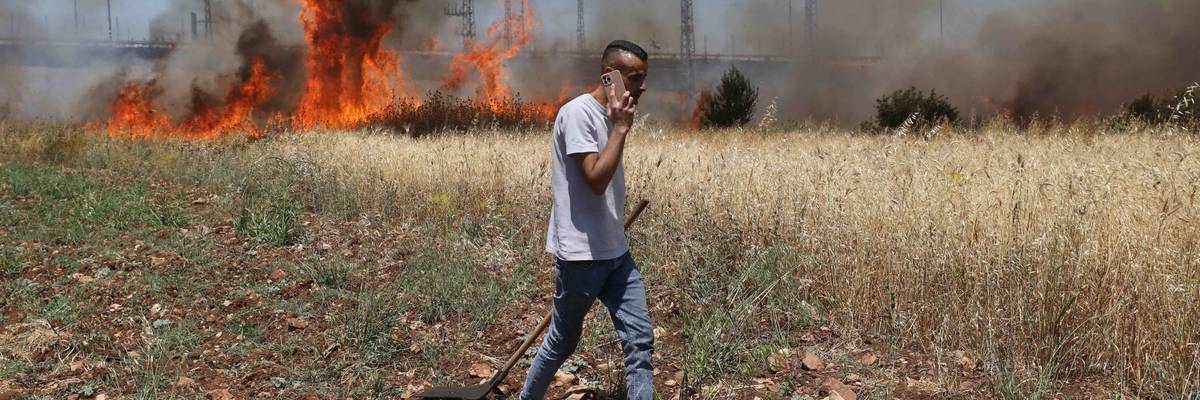
Palestinians attempt to extinguish the fire using their own means after Israeli settlers set fire to agricultural fields belonging to Palestinians in the town of Huwara, near Nablus, West Bank, Palestine on June 6, 2026.
Between the handshake of 1993 and the map of 2026 lies the story of 33 years. At its heart is one question: Who controls the land—and who is still able to remain on it?
On September 13, 1993, Yasser Arafat and Yitzhak Rabin stood on the White House lawn and shook hands before the world.
For Palestinians, that image carried a larger hope: that a transitional process would lead to the end of occupation and the establishment of a Palestinian state.
The five years that were supposed to be transitional passed.
Then 20 years. Then 20.
Now, 33 years have passed.
Perhaps we do not need the thousands of pages written about Oslo to understand where we have arrived.
We only need to look at the map.
Israeli settlements have expanded. Outposts have spread across the hills. Roads connect many of them to Israel and to one another. Palestinian land has been confiscated or become increasingly difficult to reach.
East Jerusalem is increasingly surrounded by settlements. Area C, more than 60% of the West Bank, remains under extensive Israeli control over planning, construction, and land.
In Area A, which was supposed to be under Palestinian civil and security control, Israeli forces continue to enter Palestinian cities and refugee camps and carry out arrests, demolitions, and road closures.
In Jenin, Tulkarm, and Nur Shams refugee camps, more than 33,000 Palestinian refugees displaced since early 2025 remain unable to return home.
And then there is Gaza—part of the same Palestinian territory Palestinians entered Oslo believing would one day become their state.
If two states are made impossible, can anyone defend a permanent one-state reality in which Palestinians and Israelis do not enjoy equal national and political rights?
Between the handshake of 1993 and the map of 2026 lies the story of 33 years.
At its heart is one question: Who controls the land—and who is still able to remain on it?
Less than five months after Oslo was signed, Israeli settler Baruch Goldstein entered the Ibrahimi Mosque in Hebron during dawn prayers in Ramadan and opened fire on Palestinian worshippers, killing 29.
Less than two years later, Israeli extremist Yigal Amir assassinated Prime Minister Yitzhak Rabin because he opposed the political path Rabin had pursued.
The events were different, but both revealed early on the strength of the forces opposing any process that might eventually end Israel's occupation of Palestinian territory.
Negotiations continued.
So did settlement expansion.
And this became Oslo's central contradiction: Palestinians were negotiating over a state while the land on which that state was supposed to exist was changing beneath their feet.
Perhaps no place illustrates this more clearly than E1.
The area lies between occupied East Jerusalem and the Israeli settlement of Ma'ale Adumim. Its importance is not simply how many settlement homes may be built there, but what construction would do to the map.
Expansion in E1 threatens Palestinian territorial continuity between the northern and southern West Bank and further separates East Jerusalem from its Palestinian surroundings.
If the international community still speaks seriously about a Palestinian state on the 1967 borders, with East Jerusalem as its capital, where exactly is that state supposed to exist if the territory itself continues to be fragmented?
Governments can issue endless statements supporting two states.
But maps do not read statements.
They record what is built, who controls the land, and who is allowed to reach it.
The same contradiction appears in Area A.
The division of the West Bank into Areas A, B, and C was meant to be temporary. Yet what was temporary has become almost permanent, while the boundaries created by Oslo do not prevent Israeli forces from entering areas supposedly under Palestinian control.
Since early 2025, large-scale Israeli military operations have displaced more than 33,000 Palestinian refugees from Jenin, Tulkarm, and Nur Shams camps. Many remain unable to return.
For me, this is one of the most painful images of the post-Oslo era: A Palestinian refugee, whose family was displaced once before, being displaced again—this time from the refugee camp itself.
There are political arguments about Oslo, security arrangements, and who violated which agreement.
But what language describes a refugee becoming a refugee for a second time?
Settlement expansion, too, is often reduced to an image of houses appearing on a hill.
But for Palestinians living nearby, a settlement is not simply a house.
It is also a road, a checkpoint, a gate, an outpost, a field a farmer can no longer safely reach, and a grazing area a shepherd can no longer use.
During the first eight months of 2026, the United Nations documented more than 1,600 settler attacks resulting in Palestinian casualties or property damage across 275 communities.
But numbers alone do not explain what happens afterward.
Can the farmer return to his field after an attack?
Can the shepherd return to the same hill tomorrow?
Can a family continue to live where every journey to its land becomes a confrontation?
Consider Al-Mughayyir, northeast of Ramallah.
By early September, more than 56 settler attacks resulting in casualties or property damage had been documented there during 2026.
Settlement outposts have expanded around the village, while access to agricultural and grazing land has become increasingly restricted.
On September 2, two Palestinian children were shot and killed by Israeli forces there amid another period of settler attacks and military operations.
At that point, settlement expansion is no longer simply construction on a hill.
It becomes a system of pressure on a village and on the ability of its people to remain.
Then there is water.
A Palestinian farmer may legally own his land. But what does ownership mean if he cannot water it?
This question is especially acute in the Jordan Valley.
In Bardala this year, Israeli forces demolished seven agricultural greenhouses covering about 11 dunums and destroyed the water networks connected to them.
It may sound like a small incident beside the headlines of war and killing.
It is not small to a farmer waiting for water to save his crop.
If water disappears for days, he may lose a harvest. If the problem continues, he may lose his income. If access to water becomes a permanent struggle, farming itself may become impossible.
And when farming becomes impossible, a Palestinian does not simply lose a crop.
He loses one of the strongest reasons he has for remaining on his land.
This is why displacement does not always begin with a bulldozer demolishing a home.
The house may remain standing while the field goes dry, grazing land shrinks, the road closes, and attacks continue.
Eventually, a family packs its belongings and leaves.
From a distance, that departure may look voluntary.
But it did not happen in a vacuum.
And then there is Gaza.
Not because Gaza and the West Bank have experienced the same reality.
They have not.
But both were part of the Palestinian territory Palestinians entered Oslo believing would eventually become their state.
In 2005, Israel removed its settlements from Gaza and withdrew its permanent ground forces from inside the territory. While settlements disappeared from Gaza, the settlement project continued expanding in the West Bank.
After Hamas took control of Gaza in 2007, Israel imposed a severe blockade, while Egypt also maintained restrictions on the Rafah crossing.
On October 7, 2023, Hamas and other Palestinian armed groups launched a large-scale attack on Israel. Israeli civilians and soldiers were killed, and hostages were taken into Gaza.
That is a fact, and it should be stated.
But it does not tell the story of what followed.
By September 9, 2026, the reported Palestinian death toll in Gaza since October 2023 had reached 73,669, with 174,652 people reported injured, according to Gaza's Ministry of Health.
Entire neighborhoods have been devastated. Families have been displaced repeatedly. Hundreds of thousands of homes have been damaged or destroyed, alongside hospitals, schools, roads, water networks, and other essential infrastructure.
In September 2025, the United Nations Independent International Commission of Inquiry concluded that Israeli authorities and security forces had committed and were continuing to commit genocide against Palestinians in Gaza. In June 2026, the commission issued further findings concerning violations against Palestinian children and concluded that the deliberate targeting of children had resulted in acts of genocide,, crimes against humanity, and war crimes.
Israel has rejected those findings and denied committing genocide.
But Gaza does not need legal language or statistics alone to tell its story.
Ask one family a simpler question: Is there still a home to return to?
And in the West Bank, ask another: Will Palestinians still be able to remain on their land at all?
The experiences are different.
But in both places, the ability to remain has itself become a political and human question.
Put these realities on one map, and the picture becomes difficult to ignore.
In Gaza: killing, destruction, and repeated displacement.
In East Jerusalem: settlement expansion, demolitions, and displacement.
In Area C: settlements, outposts, and pressure on Palestinian communities.
In E1: a threat to territorial continuity.
In the Jordan Valley: a struggle not only over land, but over the water that determines whether people can farm and remain.
These realities are not identical.
But they lead back to the same question: Who will still be able to remain on the land?
After 33 years, it is no longer enough for governments to say they remain committed to the two-state solution.
If the world genuinely wants two states, it must protect the physical possibility of a Palestinian state now—an independent and sovereign state on the 1967 borders, with East Jerusalem as its capital.
Stopping settlement expansion, preventing displacement, protecting Palestinian land and water resources, and halting projects that destroy territorial continuity are not issues that can be postponed until another negotiation.
They determine whether there will still be something left to negotiate.
But if the international community continues to speak about two states while, on the ground, one state consolidates control over the territory between the Mediterranean Sea and the Jordan River, then another question can no longer be avoided: If two states are made impossible, can anyone defend a permanent one-state reality in which Palestinians and Israelis do not enjoy equal national and political rights?
It is not for me, or for this article, to decide on behalf of Palestinians and Israelis what the final political arrangement must look like.
But one principle should be simpler than every map and every negotiating formula: The future cannot be the permanent domination of one people by another.
Either there are two real states: Israel and an independent, sovereign Palestinian state on the 1967 borders with East Jerusalem as its capital.
Or, if the reality created on the ground makes that solution impossible, there must be one democratic state in which Palestinians and Israelis live with equal rights and equal citizenship.
The international community cannot defend the two-state solution in words, accept one-state control in practice, and reject equal rights within the reality that emerges.
In September 1993, the world watched Arafat and Rabin shake hands
The question then was: When will the Palestinian state be established?
Thirty-three years later, another question comes first: What land will remain for that state—and who will still be there to live on it?
Maps do not record intentions.
They record outcomes.
When a farmer is prevented from reaching his land, when a shepherd loses his grazing ground, when water no longer reaches a field, when a home is demolished, and when a refugee is displaced again from a refugee camp, it is not only individual lives that change.
The map changes.
That is why the question is no longer simply: Where is the Palestinian state?
It is also: Is there still enough connected land for such a state to exist—and will Palestinians still be able to remain on it?
We can disagree over the name, borders, or structure of the eventual solution.
But no permanent solution can mean one people enjoying full national and political rights while another remains under its control without the same fundamental rights.
A bombing may stop. A military raid may end. A bulldozer may leave. A checkpoint may be removed.
But if a family has lost its home, if a farmer has lost access to his land, if a crop has died because water no longer reaches it, or if a refugee has been displaced once again, the result remains visible on the map.
The land stays where it is.
What changes is who is able to remain on it.
Dear Common Dreams reader, It’s been nearly 30 years since I co-founded Common Dreams with my late wife, Lina Newhouser. We had the radical notion that journalism should serve the public good, not corporate profits. It was clear to us from the outset what it would take to build such a project. No paid advertisements. No corporate sponsors. No millionaire publisher telling us what to think or do. Many people said we wouldn't last a year, but we proved those doubters wrong. Together with a tremendous team of journalists and dedicated staff, we built an independent media outlet free from the constraints of profits and corporate control. Our mission has always been simple: To inform. To inspire. To ignite change for the common good. Building Common Dreams was not easy. Our survival was never guaranteed. When you take on the most powerful forces—Wall Street greed, fossil fuel industry destruction, Big Tech lobbyists, and uber-rich oligarchs who have spent billions upon billions rigging the economy and democracy in their favor—the only bulwark you have is supporters who believe in your work. But here’s the urgent message from me today. It's never been this bad out there. And it's never been this hard to keep us going. At the very moment Common Dreams is most needed, the threats we face are intensifying. We need your support now more than ever. We don't accept corporate advertising and never will. We don't have a paywall because we don't think people should be blocked from critical news based on their ability to pay. Everything we do is funded by the donations of readers like you. When everyone does the little they can afford, we are strong. But if that support retreats or dries up, so do we. Will you donate now to make sure Common Dreams not only survives but thrives? —Craig Brown, Co-founder |
On September 13, 1993, Yasser Arafat and Yitzhak Rabin stood on the White House lawn and shook hands before the world.
For Palestinians, that image carried a larger hope: that a transitional process would lead to the end of occupation and the establishment of a Palestinian state.
The five years that were supposed to be transitional passed.
Then 20 years. Then 20.
Now, 33 years have passed.
Perhaps we do not need the thousands of pages written about Oslo to understand where we have arrived.
We only need to look at the map.
Israeli settlements have expanded. Outposts have spread across the hills. Roads connect many of them to Israel and to one another. Palestinian land has been confiscated or become increasingly difficult to reach.
East Jerusalem is increasingly surrounded by settlements. Area C, more than 60% of the West Bank, remains under extensive Israeli control over planning, construction, and land.
In Area A, which was supposed to be under Palestinian civil and security control, Israeli forces continue to enter Palestinian cities and refugee camps and carry out arrests, demolitions, and road closures.
In Jenin, Tulkarm, and Nur Shams refugee camps, more than 33,000 Palestinian refugees displaced since early 2025 remain unable to return home.
And then there is Gaza—part of the same Palestinian territory Palestinians entered Oslo believing would one day become their state.
If two states are made impossible, can anyone defend a permanent one-state reality in which Palestinians and Israelis do not enjoy equal national and political rights?
Between the handshake of 1993 and the map of 2026 lies the story of 33 years.
At its heart is one question: Who controls the land—and who is still able to remain on it?
Less than five months after Oslo was signed, Israeli settler Baruch Goldstein entered the Ibrahimi Mosque in Hebron during dawn prayers in Ramadan and opened fire on Palestinian worshippers, killing 29.
Less than two years later, Israeli extremist Yigal Amir assassinated Prime Minister Yitzhak Rabin because he opposed the political path Rabin had pursued.
The events were different, but both revealed early on the strength of the forces opposing any process that might eventually end Israel's occupation of Palestinian territory.
Negotiations continued.
So did settlement expansion.
And this became Oslo's central contradiction: Palestinians were negotiating over a state while the land on which that state was supposed to exist was changing beneath their feet.
Perhaps no place illustrates this more clearly than E1.
The area lies between occupied East Jerusalem and the Israeli settlement of Ma'ale Adumim. Its importance is not simply how many settlement homes may be built there, but what construction would do to the map.
Expansion in E1 threatens Palestinian territorial continuity between the northern and southern West Bank and further separates East Jerusalem from its Palestinian surroundings.
If the international community still speaks seriously about a Palestinian state on the 1967 borders, with East Jerusalem as its capital, where exactly is that state supposed to exist if the territory itself continues to be fragmented?
Governments can issue endless statements supporting two states.
But maps do not read statements.
They record what is built, who controls the land, and who is allowed to reach it.
The same contradiction appears in Area A.
The division of the West Bank into Areas A, B, and C was meant to be temporary. Yet what was temporary has become almost permanent, while the boundaries created by Oslo do not prevent Israeli forces from entering areas supposedly under Palestinian control.
Since early 2025, large-scale Israeli military operations have displaced more than 33,000 Palestinian refugees from Jenin, Tulkarm, and Nur Shams camps. Many remain unable to return.
For me, this is one of the most painful images of the post-Oslo era: A Palestinian refugee, whose family was displaced once before, being displaced again—this time from the refugee camp itself.
There are political arguments about Oslo, security arrangements, and who violated which agreement.
But what language describes a refugee becoming a refugee for a second time?
Settlement expansion, too, is often reduced to an image of houses appearing on a hill.
But for Palestinians living nearby, a settlement is not simply a house.
It is also a road, a checkpoint, a gate, an outpost, a field a farmer can no longer safely reach, and a grazing area a shepherd can no longer use.
During the first eight months of 2026, the United Nations documented more than 1,600 settler attacks resulting in Palestinian casualties or property damage across 275 communities.
But numbers alone do not explain what happens afterward.
Can the farmer return to his field after an attack?
Can the shepherd return to the same hill tomorrow?
Can a family continue to live where every journey to its land becomes a confrontation?
Consider Al-Mughayyir, northeast of Ramallah.
By early September, more than 56 settler attacks resulting in casualties or property damage had been documented there during 2026.
Settlement outposts have expanded around the village, while access to agricultural and grazing land has become increasingly restricted.
On September 2, two Palestinian children were shot and killed by Israeli forces there amid another period of settler attacks and military operations.
At that point, settlement expansion is no longer simply construction on a hill.
It becomes a system of pressure on a village and on the ability of its people to remain.
Then there is water.
A Palestinian farmer may legally own his land. But what does ownership mean if he cannot water it?
This question is especially acute in the Jordan Valley.
In Bardala this year, Israeli forces demolished seven agricultural greenhouses covering about 11 dunums and destroyed the water networks connected to them.
It may sound like a small incident beside the headlines of war and killing.
It is not small to a farmer waiting for water to save his crop.
If water disappears for days, he may lose a harvest. If the problem continues, he may lose his income. If access to water becomes a permanent struggle, farming itself may become impossible.
And when farming becomes impossible, a Palestinian does not simply lose a crop.
He loses one of the strongest reasons he has for remaining on his land.
This is why displacement does not always begin with a bulldozer demolishing a home.
The house may remain standing while the field goes dry, grazing land shrinks, the road closes, and attacks continue.
Eventually, a family packs its belongings and leaves.
From a distance, that departure may look voluntary.
But it did not happen in a vacuum.
And then there is Gaza.
Not because Gaza and the West Bank have experienced the same reality.
They have not.
But both were part of the Palestinian territory Palestinians entered Oslo believing would eventually become their state.
In 2005, Israel removed its settlements from Gaza and withdrew its permanent ground forces from inside the territory. While settlements disappeared from Gaza, the settlement project continued expanding in the West Bank.
After Hamas took control of Gaza in 2007, Israel imposed a severe blockade, while Egypt also maintained restrictions on the Rafah crossing.
On October 7, 2023, Hamas and other Palestinian armed groups launched a large-scale attack on Israel. Israeli civilians and soldiers were killed, and hostages were taken into Gaza.
That is a fact, and it should be stated.
But it does not tell the story of what followed.
By September 9, 2026, the reported Palestinian death toll in Gaza since October 2023 had reached 73,669, with 174,652 people reported injured, according to Gaza's Ministry of Health.
Entire neighborhoods have been devastated. Families have been displaced repeatedly. Hundreds of thousands of homes have been damaged or destroyed, alongside hospitals, schools, roads, water networks, and other essential infrastructure.
In September 2025, the United Nations Independent International Commission of Inquiry concluded that Israeli authorities and security forces had committed and were continuing to commit genocide against Palestinians in Gaza. In June 2026, the commission issued further findings concerning violations against Palestinian children and concluded that the deliberate targeting of children had resulted in acts of genocide,, crimes against humanity, and war crimes.
Israel has rejected those findings and denied committing genocide.
But Gaza does not need legal language or statistics alone to tell its story.
Ask one family a simpler question: Is there still a home to return to?
And in the West Bank, ask another: Will Palestinians still be able to remain on their land at all?
The experiences are different.
But in both places, the ability to remain has itself become a political and human question.
Put these realities on one map, and the picture becomes difficult to ignore.
In Gaza: killing, destruction, and repeated displacement.
In East Jerusalem: settlement expansion, demolitions, and displacement.
In Area C: settlements, outposts, and pressure on Palestinian communities.
In E1: a threat to territorial continuity.
In the Jordan Valley: a struggle not only over land, but over the water that determines whether people can farm and remain.
These realities are not identical.
But they lead back to the same question: Who will still be able to remain on the land?
After 33 years, it is no longer enough for governments to say they remain committed to the two-state solution.
If the world genuinely wants two states, it must protect the physical possibility of a Palestinian state now—an independent and sovereign state on the 1967 borders, with East Jerusalem as its capital.
Stopping settlement expansion, preventing displacement, protecting Palestinian land and water resources, and halting projects that destroy territorial continuity are not issues that can be postponed until another negotiation.
They determine whether there will still be something left to negotiate.
But if the international community continues to speak about two states while, on the ground, one state consolidates control over the territory between the Mediterranean Sea and the Jordan River, then another question can no longer be avoided: If two states are made impossible, can anyone defend a permanent one-state reality in which Palestinians and Israelis do not enjoy equal national and political rights?
It is not for me, or for this article, to decide on behalf of Palestinians and Israelis what the final political arrangement must look like.
But one principle should be simpler than every map and every negotiating formula: The future cannot be the permanent domination of one people by another.
Either there are two real states: Israel and an independent, sovereign Palestinian state on the 1967 borders with East Jerusalem as its capital.
Or, if the reality created on the ground makes that solution impossible, there must be one democratic state in which Palestinians and Israelis live with equal rights and equal citizenship.
The international community cannot defend the two-state solution in words, accept one-state control in practice, and reject equal rights within the reality that emerges.
In September 1993, the world watched Arafat and Rabin shake hands
The question then was: When will the Palestinian state be established?
Thirty-three years later, another question comes first: What land will remain for that state—and who will still be there to live on it?
Maps do not record intentions.
They record outcomes.
When a farmer is prevented from reaching his land, when a shepherd loses his grazing ground, when water no longer reaches a field, when a home is demolished, and when a refugee is displaced again from a refugee camp, it is not only individual lives that change.
The map changes.
That is why the question is no longer simply: Where is the Palestinian state?
It is also: Is there still enough connected land for such a state to exist—and will Palestinians still be able to remain on it?
We can disagree over the name, borders, or structure of the eventual solution.
But no permanent solution can mean one people enjoying full national and political rights while another remains under its control without the same fundamental rights.
A bombing may stop. A military raid may end. A bulldozer may leave. A checkpoint may be removed.
But if a family has lost its home, if a farmer has lost access to his land, if a crop has died because water no longer reaches it, or if a refugee has been displaced once again, the result remains visible on the map.
The land stays where it is.
What changes is who is able to remain on it.
On September 13, 1993, Yasser Arafat and Yitzhak Rabin stood on the White House lawn and shook hands before the world.
For Palestinians, that image carried a larger hope: that a transitional process would lead to the end of occupation and the establishment of a Palestinian state.
The five years that were supposed to be transitional passed.
Then 20 years. Then 20.
Now, 33 years have passed.
Perhaps we do not need the thousands of pages written about Oslo to understand where we have arrived.
We only need to look at the map.
Israeli settlements have expanded. Outposts have spread across the hills. Roads connect many of them to Israel and to one another. Palestinian land has been confiscated or become increasingly difficult to reach.
East Jerusalem is increasingly surrounded by settlements. Area C, more than 60% of the West Bank, remains under extensive Israeli control over planning, construction, and land.
In Area A, which was supposed to be under Palestinian civil and security control, Israeli forces continue to enter Palestinian cities and refugee camps and carry out arrests, demolitions, and road closures.
In Jenin, Tulkarm, and Nur Shams refugee camps, more than 33,000 Palestinian refugees displaced since early 2025 remain unable to return home.
And then there is Gaza—part of the same Palestinian territory Palestinians entered Oslo believing would one day become their state.
If two states are made impossible, can anyone defend a permanent one-state reality in which Palestinians and Israelis do not enjoy equal national and political rights?
Between the handshake of 1993 and the map of 2026 lies the story of 33 years.
At its heart is one question: Who controls the land—and who is still able to remain on it?
Less than five months after Oslo was signed, Israeli settler Baruch Goldstein entered the Ibrahimi Mosque in Hebron during dawn prayers in Ramadan and opened fire on Palestinian worshippers, killing 29.
Less than two years later, Israeli extremist Yigal Amir assassinated Prime Minister Yitzhak Rabin because he opposed the political path Rabin had pursued.
The events were different, but both revealed early on the strength of the forces opposing any process that might eventually end Israel's occupation of Palestinian territory.
Negotiations continued.
So did settlement expansion.
And this became Oslo's central contradiction: Palestinians were negotiating over a state while the land on which that state was supposed to exist was changing beneath their feet.
Perhaps no place illustrates this more clearly than E1.
The area lies between occupied East Jerusalem and the Israeli settlement of Ma'ale Adumim. Its importance is not simply how many settlement homes may be built there, but what construction would do to the map.
Expansion in E1 threatens Palestinian territorial continuity between the northern and southern West Bank and further separates East Jerusalem from its Palestinian surroundings.
If the international community still speaks seriously about a Palestinian state on the 1967 borders, with East Jerusalem as its capital, where exactly is that state supposed to exist if the territory itself continues to be fragmented?
Governments can issue endless statements supporting two states.
But maps do not read statements.
They record what is built, who controls the land, and who is allowed to reach it.
The same contradiction appears in Area A.
The division of the West Bank into Areas A, B, and C was meant to be temporary. Yet what was temporary has become almost permanent, while the boundaries created by Oslo do not prevent Israeli forces from entering areas supposedly under Palestinian control.
Since early 2025, large-scale Israeli military operations have displaced more than 33,000 Palestinian refugees from Jenin, Tulkarm, and Nur Shams camps. Many remain unable to return.
For me, this is one of the most painful images of the post-Oslo era: A Palestinian refugee, whose family was displaced once before, being displaced again—this time from the refugee camp itself.
There are political arguments about Oslo, security arrangements, and who violated which agreement.
But what language describes a refugee becoming a refugee for a second time?
Settlement expansion, too, is often reduced to an image of houses appearing on a hill.
But for Palestinians living nearby, a settlement is not simply a house.
It is also a road, a checkpoint, a gate, an outpost, a field a farmer can no longer safely reach, and a grazing area a shepherd can no longer use.
During the first eight months of 2026, the United Nations documented more than 1,600 settler attacks resulting in Palestinian casualties or property damage across 275 communities.
But numbers alone do not explain what happens afterward.
Can the farmer return to his field after an attack?
Can the shepherd return to the same hill tomorrow?
Can a family continue to live where every journey to its land becomes a confrontation?
Consider Al-Mughayyir, northeast of Ramallah.
By early September, more than 56 settler attacks resulting in casualties or property damage had been documented there during 2026.
Settlement outposts have expanded around the village, while access to agricultural and grazing land has become increasingly restricted.
On September 2, two Palestinian children were shot and killed by Israeli forces there amid another period of settler attacks and military operations.
At that point, settlement expansion is no longer simply construction on a hill.
It becomes a system of pressure on a village and on the ability of its people to remain.
Then there is water.
A Palestinian farmer may legally own his land. But what does ownership mean if he cannot water it?
This question is especially acute in the Jordan Valley.
In Bardala this year, Israeli forces demolished seven agricultural greenhouses covering about 11 dunums and destroyed the water networks connected to them.
It may sound like a small incident beside the headlines of war and killing.
It is not small to a farmer waiting for water to save his crop.
If water disappears for days, he may lose a harvest. If the problem continues, he may lose his income. If access to water becomes a permanent struggle, farming itself may become impossible.
And when farming becomes impossible, a Palestinian does not simply lose a crop.
He loses one of the strongest reasons he has for remaining on his land.
This is why displacement does not always begin with a bulldozer demolishing a home.
The house may remain standing while the field goes dry, grazing land shrinks, the road closes, and attacks continue.
Eventually, a family packs its belongings and leaves.
From a distance, that departure may look voluntary.
But it did not happen in a vacuum.
And then there is Gaza.
Not because Gaza and the West Bank have experienced the same reality.
They have not.
But both were part of the Palestinian territory Palestinians entered Oslo believing would eventually become their state.
In 2005, Israel removed its settlements from Gaza and withdrew its permanent ground forces from inside the territory. While settlements disappeared from Gaza, the settlement project continued expanding in the West Bank.
After Hamas took control of Gaza in 2007, Israel imposed a severe blockade, while Egypt also maintained restrictions on the Rafah crossing.
On October 7, 2023, Hamas and other Palestinian armed groups launched a large-scale attack on Israel. Israeli civilians and soldiers were killed, and hostages were taken into Gaza.
That is a fact, and it should be stated.
But it does not tell the story of what followed.
By September 9, 2026, the reported Palestinian death toll in Gaza since October 2023 had reached 73,669, with 174,652 people reported injured, according to Gaza's Ministry of Health.
Entire neighborhoods have been devastated. Families have been displaced repeatedly. Hundreds of thousands of homes have been damaged or destroyed, alongside hospitals, schools, roads, water networks, and other essential infrastructure.
In September 2025, the United Nations Independent International Commission of Inquiry concluded that Israeli authorities and security forces had committed and were continuing to commit genocide against Palestinians in Gaza. In June 2026, the commission issued further findings concerning violations against Palestinian children and concluded that the deliberate targeting of children had resulted in acts of genocide,, crimes against humanity, and war crimes.
Israel has rejected those findings and denied committing genocide.
But Gaza does not need legal language or statistics alone to tell its story.
Ask one family a simpler question: Is there still a home to return to?
And in the West Bank, ask another: Will Palestinians still be able to remain on their land at all?
The experiences are different.
But in both places, the ability to remain has itself become a political and human question.
Put these realities on one map, and the picture becomes difficult to ignore.
In Gaza: killing, destruction, and repeated displacement.
In East Jerusalem: settlement expansion, demolitions, and displacement.
In Area C: settlements, outposts, and pressure on Palestinian communities.
In E1: a threat to territorial continuity.
In the Jordan Valley: a struggle not only over land, but over the water that determines whether people can farm and remain.
These realities are not identical.
But they lead back to the same question: Who will still be able to remain on the land?
After 33 years, it is no longer enough for governments to say they remain committed to the two-state solution.
If the world genuinely wants two states, it must protect the physical possibility of a Palestinian state now—an independent and sovereign state on the 1967 borders, with East Jerusalem as its capital.
Stopping settlement expansion, preventing displacement, protecting Palestinian land and water resources, and halting projects that destroy territorial continuity are not issues that can be postponed until another negotiation.
They determine whether there will still be something left to negotiate.
But if the international community continues to speak about two states while, on the ground, one state consolidates control over the territory between the Mediterranean Sea and the Jordan River, then another question can no longer be avoided: If two states are made impossible, can anyone defend a permanent one-state reality in which Palestinians and Israelis do not enjoy equal national and political rights?
It is not for me, or for this article, to decide on behalf of Palestinians and Israelis what the final political arrangement must look like.
But one principle should be simpler than every map and every negotiating formula: The future cannot be the permanent domination of one people by another.
Either there are two real states: Israel and an independent, sovereign Palestinian state on the 1967 borders with East Jerusalem as its capital.
Or, if the reality created on the ground makes that solution impossible, there must be one democratic state in which Palestinians and Israelis live with equal rights and equal citizenship.
The international community cannot defend the two-state solution in words, accept one-state control in practice, and reject equal rights within the reality that emerges.
In September 1993, the world watched Arafat and Rabin shake hands
The question then was: When will the Palestinian state be established?
Thirty-three years later, another question comes first: What land will remain for that state—and who will still be there to live on it?
Maps do not record intentions.
They record outcomes.
When a farmer is prevented from reaching his land, when a shepherd loses his grazing ground, when water no longer reaches a field, when a home is demolished, and when a refugee is displaced again from a refugee camp, it is not only individual lives that change.
The map changes.
That is why the question is no longer simply: Where is the Palestinian state?
It is also: Is there still enough connected land for such a state to exist—and will Palestinians still be able to remain on it?
We can disagree over the name, borders, or structure of the eventual solution.
But no permanent solution can mean one people enjoying full national and political rights while another remains under its control without the same fundamental rights.
A bombing may stop. A military raid may end. A bulldozer may leave. A checkpoint may be removed.
But if a family has lost its home, if a farmer has lost access to his land, if a crop has died because water no longer reaches it, or if a refugee has been displaced once again, the result remains visible on the map.
The land stays where it is.
What changes is who is able to remain on it.