SUBSCRIBE TO OUR FREE NEWSLETTER
Daily news & progressive opinion—funded by the people, not the corporations—delivered straight to your inbox.
5
#000000
#FFFFFF
To donate by check, phone, or other method, see our More Ways to Give page.
Daily news & progressive opinion—funded by the people, not the corporations—delivered straight to your inbox.
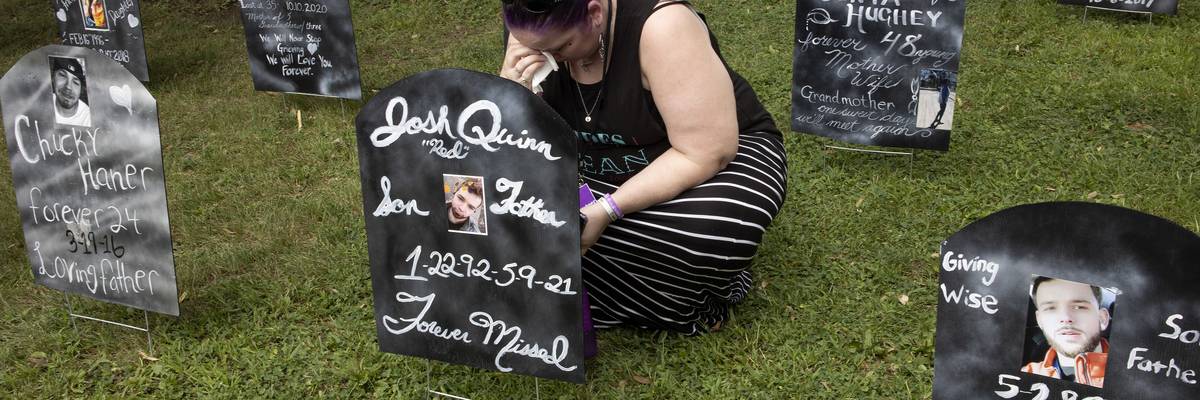
Family members of people who have died from overdosing on opioids mark International Overdose Awareness Day on August 21, 2021 in Binghamton, New York.
This money was won because communities suffered extraordinary harm and hundreds of thousands of people lost their lives, so funds should build and expand capacity of much-needed health infrastructure and create lasting systems of care.
Nearly $58 billion is now flowing into states and local governments after the recent settlement with Purdue Pharma and other companies whose actions fueled the overdose epidemic, one of the deadliest public health crises in American history. For the first time in a generation, local communities have a critical opportunity to decide how this money is spent and allocate funding to build systems on their own terms, systems that actually save lives and provide care rooted in dignity.
The question is whether state, county, and municipal officials will actually take that chance.
The settlement money belongs to the people that paid the price. It is restitution for those lives lost, for families devastated, and for communities harmed not only by addiction and overdose, but by decades of failed punitive policies that criminalized suffering instead of treating it. It doesn’t belong to politicians, hospital systems, police departments, or consultants.
That means people directly impacted by overdose, addiction, incarceration, homelessness, and family separation should help decide how these dollars are spent. Too often, they are shut out of that decision entirely. In many states, opioid settlement decisions are made in private meetings with little public awareness, minimal reporting requirements, and limited opportunities for ordinary residents to participate. Some local governments still have no meaningful public process at all.
As federal health and social service funding faces growing cuts, many states and localities are quietly eyeing opioid settlement dollars to backfill budget gaps or prop up systems that should already be publicly funded.
When people get involved, the results improve. More states are passing legislation requiring reports on opioid settlement spending. In Hancock County, Maine, there was initially no public framework for opioid settlement spending. After a local advocate stepped forward to engage county officials, authorities created a committee of community stakeholders, including people with firsthand lived experience, to help advise how to spend those funds. In Buffalo, New York, public scrutiny and press attention around the use of settlement spending on things like police equipment and snowblowers pushed local leaders toward better investments, such as recovery coaches and treatment clinic upgrades, in later funding rounds. We can see how public engagement changes outcomes.
New Jersey committed nearly $119 million to expand harm reduction centers offering naloxone distribution, syringe access, mobile outreach, and connections to care. Kentucky continues to invest in a network of legal aid providers helping people impacted by drug use expunge their criminal records. Portland, Maine spreads its opioid funds across three efforts: a needle buyback program that removes used syringes from public spaces; a housing first program that gets people into stable housing without requiring sobriety first; and contingency management, which rewards people with incentives like gift cards for staying off stimulants such as meth and cocaine.
We also know what does not work. Nevertheless, across the country, settlement dollars are still being spent on police equipment, surveillance technology, jail expansions, and outmoded treatment programs that forbid modern medications, and ineffective "just say no" style prevention campaigns. Some jurisdictions have purchased drones, tasers, license plate readers, police dogs, and narcotics detection equipment using funds that were supposed to heal communities harmed by overdose.
The most insidious trend may be one the public cannot easily see: supplantation. According to best practice guidance from Johns Hopkins University and endorsed by more than 60 organizations including my own, supplantation advises that opioid settlement funds must not replace existing funding sources. But as federal health and social service funding faces growing cuts, many states and localities are quietly eyeing opioid settlement dollars to backfill budget gaps or prop up systems that should already be publicly funded. Settlement dollars should not replace Medicaid; they should not compensate for cuts to public health infrastructure. They were never meant to become a government slush fund.
This money was won because communities suffered extraordinary harm and hundreds of thousands of people lost their lives. Funds should build and expand capacity of much-needed health infrastructure and create lasting systems of care, not patch holes created by shifting political priorities. It’s not that settlement funds should never stabilize existing programs; in some cases, communities may need to use these dollars temporarily to sustain lifesaving services that would otherwise disappear. But those decisions must happen transparently, with public input, and with a clear understanding of the trade-offs involved. Advocates have issued guidelines that can help jurisdictions think through these challenging decisions.
There is reason for cautious optimism. Advocates, impacted families, and community organizations across the country are building models for transparency, accountability, and evidence-based investment. A new National Roadmap for Spending Opioid Settlement Funds can help communities understand their local processes and push for smarter spending. It also documents problematic and promising spending across the country. Advocates in Maine, New York, and New Jersey have created websites to help community members get involved in directing opioid settlement funds. The Maine Recovery Action Project has created a national toolkit that anyone can use to start organizing residents to have a say in spending decisions.
Residents should ask simple but critical questions, such as: Where is the money going? Who benefits? What evidence supports these investments? Who was consulted?
The overdose crisis was perpetrated by decisions, made over the course of decades, that never faced accountability. We cannot afford to repeat that mistake now with resources made available to repair the damage.
Dear Common Dreams reader, It’s been nearly 30 years since I co-founded Common Dreams with my late wife, Lina Newhouser. We had the radical notion that journalism should serve the public good, not corporate profits. It was clear to us from the outset what it would take to build such a project. No paid advertisements. No corporate sponsors. No millionaire publisher telling us what to think or do. Many people said we wouldn't last a year, but we proved those doubters wrong. Together with a tremendous team of journalists and dedicated staff, we built an independent media outlet free from the constraints of profits and corporate control. Our mission has always been simple: To inform. To inspire. To ignite change for the common good. Building Common Dreams was not easy. Our survival was never guaranteed. When you take on the most powerful forces—Wall Street greed, fossil fuel industry destruction, Big Tech lobbyists, and uber-rich oligarchs who have spent billions upon billions rigging the economy and democracy in their favor—the only bulwark you have is supporters who believe in your work. But here’s the urgent message from me today. It's never been this bad out there. And it's never been this hard to keep us going. At the very moment Common Dreams is most needed, the threats we face are intensifying. We need your support now more than ever. We don't accept corporate advertising and never will. We don't have a paywall because we don't think people should be blocked from critical news based on their ability to pay. Everything we do is funded by the donations of readers like you. When everyone does the little they can afford, we are strong. But if that support retreats or dries up, so do we. Will you donate now to make sure Common Dreams not only survives but thrives? —Craig Brown, Co-founder |
Nearly $58 billion is now flowing into states and local governments after the recent settlement with Purdue Pharma and other companies whose actions fueled the overdose epidemic, one of the deadliest public health crises in American history. For the first time in a generation, local communities have a critical opportunity to decide how this money is spent and allocate funding to build systems on their own terms, systems that actually save lives and provide care rooted in dignity.
The question is whether state, county, and municipal officials will actually take that chance.
The settlement money belongs to the people that paid the price. It is restitution for those lives lost, for families devastated, and for communities harmed not only by addiction and overdose, but by decades of failed punitive policies that criminalized suffering instead of treating it. It doesn’t belong to politicians, hospital systems, police departments, or consultants.
That means people directly impacted by overdose, addiction, incarceration, homelessness, and family separation should help decide how these dollars are spent. Too often, they are shut out of that decision entirely. In many states, opioid settlement decisions are made in private meetings with little public awareness, minimal reporting requirements, and limited opportunities for ordinary residents to participate. Some local governments still have no meaningful public process at all.
As federal health and social service funding faces growing cuts, many states and localities are quietly eyeing opioid settlement dollars to backfill budget gaps or prop up systems that should already be publicly funded.
When people get involved, the results improve. More states are passing legislation requiring reports on opioid settlement spending. In Hancock County, Maine, there was initially no public framework for opioid settlement spending. After a local advocate stepped forward to engage county officials, authorities created a committee of community stakeholders, including people with firsthand lived experience, to help advise how to spend those funds. In Buffalo, New York, public scrutiny and press attention around the use of settlement spending on things like police equipment and snowblowers pushed local leaders toward better investments, such as recovery coaches and treatment clinic upgrades, in later funding rounds. We can see how public engagement changes outcomes.
New Jersey committed nearly $119 million to expand harm reduction centers offering naloxone distribution, syringe access, mobile outreach, and connections to care. Kentucky continues to invest in a network of legal aid providers helping people impacted by drug use expunge their criminal records. Portland, Maine spreads its opioid funds across three efforts: a needle buyback program that removes used syringes from public spaces; a housing first program that gets people into stable housing without requiring sobriety first; and contingency management, which rewards people with incentives like gift cards for staying off stimulants such as meth and cocaine.
We also know what does not work. Nevertheless, across the country, settlement dollars are still being spent on police equipment, surveillance technology, jail expansions, and outmoded treatment programs that forbid modern medications, and ineffective "just say no" style prevention campaigns. Some jurisdictions have purchased drones, tasers, license plate readers, police dogs, and narcotics detection equipment using funds that were supposed to heal communities harmed by overdose.
The most insidious trend may be one the public cannot easily see: supplantation. According to best practice guidance from Johns Hopkins University and endorsed by more than 60 organizations including my own, supplantation advises that opioid settlement funds must not replace existing funding sources. But as federal health and social service funding faces growing cuts, many states and localities are quietly eyeing opioid settlement dollars to backfill budget gaps or prop up systems that should already be publicly funded. Settlement dollars should not replace Medicaid; they should not compensate for cuts to public health infrastructure. They were never meant to become a government slush fund.
This money was won because communities suffered extraordinary harm and hundreds of thousands of people lost their lives. Funds should build and expand capacity of much-needed health infrastructure and create lasting systems of care, not patch holes created by shifting political priorities. It’s not that settlement funds should never stabilize existing programs; in some cases, communities may need to use these dollars temporarily to sustain lifesaving services that would otherwise disappear. But those decisions must happen transparently, with public input, and with a clear understanding of the trade-offs involved. Advocates have issued guidelines that can help jurisdictions think through these challenging decisions.
There is reason for cautious optimism. Advocates, impacted families, and community organizations across the country are building models for transparency, accountability, and evidence-based investment. A new National Roadmap for Spending Opioid Settlement Funds can help communities understand their local processes and push for smarter spending. It also documents problematic and promising spending across the country. Advocates in Maine, New York, and New Jersey have created websites to help community members get involved in directing opioid settlement funds. The Maine Recovery Action Project has created a national toolkit that anyone can use to start organizing residents to have a say in spending decisions.
Residents should ask simple but critical questions, such as: Where is the money going? Who benefits? What evidence supports these investments? Who was consulted?
The overdose crisis was perpetrated by decisions, made over the course of decades, that never faced accountability. We cannot afford to repeat that mistake now with resources made available to repair the damage.
Nearly $58 billion is now flowing into states and local governments after the recent settlement with Purdue Pharma and other companies whose actions fueled the overdose epidemic, one of the deadliest public health crises in American history. For the first time in a generation, local communities have a critical opportunity to decide how this money is spent and allocate funding to build systems on their own terms, systems that actually save lives and provide care rooted in dignity.
The question is whether state, county, and municipal officials will actually take that chance.
The settlement money belongs to the people that paid the price. It is restitution for those lives lost, for families devastated, and for communities harmed not only by addiction and overdose, but by decades of failed punitive policies that criminalized suffering instead of treating it. It doesn’t belong to politicians, hospital systems, police departments, or consultants.
That means people directly impacted by overdose, addiction, incarceration, homelessness, and family separation should help decide how these dollars are spent. Too often, they are shut out of that decision entirely. In many states, opioid settlement decisions are made in private meetings with little public awareness, minimal reporting requirements, and limited opportunities for ordinary residents to participate. Some local governments still have no meaningful public process at all.
As federal health and social service funding faces growing cuts, many states and localities are quietly eyeing opioid settlement dollars to backfill budget gaps or prop up systems that should already be publicly funded.
When people get involved, the results improve. More states are passing legislation requiring reports on opioid settlement spending. In Hancock County, Maine, there was initially no public framework for opioid settlement spending. After a local advocate stepped forward to engage county officials, authorities created a committee of community stakeholders, including people with firsthand lived experience, to help advise how to spend those funds. In Buffalo, New York, public scrutiny and press attention around the use of settlement spending on things like police equipment and snowblowers pushed local leaders toward better investments, such as recovery coaches and treatment clinic upgrades, in later funding rounds. We can see how public engagement changes outcomes.
New Jersey committed nearly $119 million to expand harm reduction centers offering naloxone distribution, syringe access, mobile outreach, and connections to care. Kentucky continues to invest in a network of legal aid providers helping people impacted by drug use expunge their criminal records. Portland, Maine spreads its opioid funds across three efforts: a needle buyback program that removes used syringes from public spaces; a housing first program that gets people into stable housing without requiring sobriety first; and contingency management, which rewards people with incentives like gift cards for staying off stimulants such as meth and cocaine.
We also know what does not work. Nevertheless, across the country, settlement dollars are still being spent on police equipment, surveillance technology, jail expansions, and outmoded treatment programs that forbid modern medications, and ineffective "just say no" style prevention campaigns. Some jurisdictions have purchased drones, tasers, license plate readers, police dogs, and narcotics detection equipment using funds that were supposed to heal communities harmed by overdose.
The most insidious trend may be one the public cannot easily see: supplantation. According to best practice guidance from Johns Hopkins University and endorsed by more than 60 organizations including my own, supplantation advises that opioid settlement funds must not replace existing funding sources. But as federal health and social service funding faces growing cuts, many states and localities are quietly eyeing opioid settlement dollars to backfill budget gaps or prop up systems that should already be publicly funded. Settlement dollars should not replace Medicaid; they should not compensate for cuts to public health infrastructure. They were never meant to become a government slush fund.
This money was won because communities suffered extraordinary harm and hundreds of thousands of people lost their lives. Funds should build and expand capacity of much-needed health infrastructure and create lasting systems of care, not patch holes created by shifting political priorities. It’s not that settlement funds should never stabilize existing programs; in some cases, communities may need to use these dollars temporarily to sustain lifesaving services that would otherwise disappear. But those decisions must happen transparently, with public input, and with a clear understanding of the trade-offs involved. Advocates have issued guidelines that can help jurisdictions think through these challenging decisions.
There is reason for cautious optimism. Advocates, impacted families, and community organizations across the country are building models for transparency, accountability, and evidence-based investment. A new National Roadmap for Spending Opioid Settlement Funds can help communities understand their local processes and push for smarter spending. It also documents problematic and promising spending across the country. Advocates in Maine, New York, and New Jersey have created websites to help community members get involved in directing opioid settlement funds. The Maine Recovery Action Project has created a national toolkit that anyone can use to start organizing residents to have a say in spending decisions.
Residents should ask simple but critical questions, such as: Where is the money going? Who benefits? What evidence supports these investments? Who was consulted?
The overdose crisis was perpetrated by decisions, made over the course of decades, that never faced accountability. We cannot afford to repeat that mistake now with resources made available to repair the damage.