SUBSCRIBE TO OUR FREE NEWSLETTER
Daily news & progressive opinion—funded by the people, not the corporations—delivered straight to your inbox.
5
#000000
#FFFFFF
To donate by check, phone, or other method, see our More Ways to Give page.
Daily news & progressive opinion—funded by the people, not the corporations—delivered straight to your inbox.
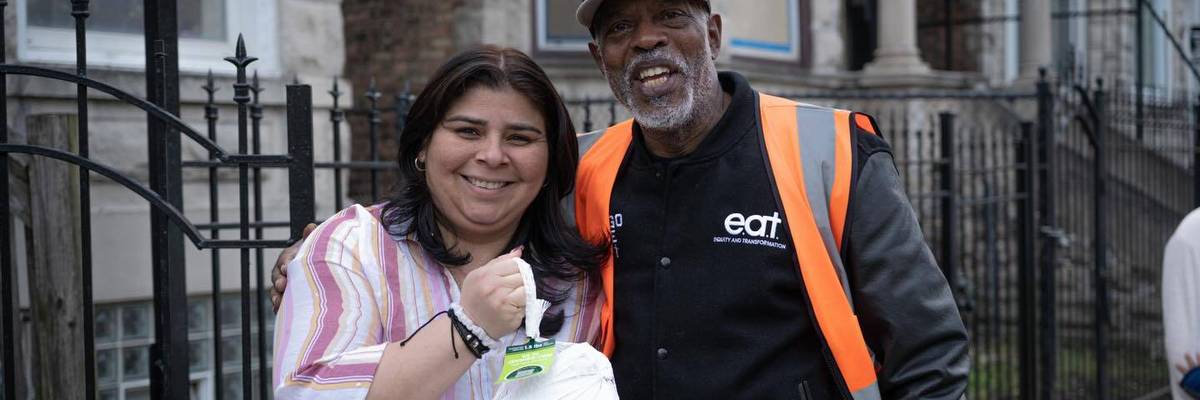
The Chicago-based Equity and Transformation engages in mutual aid on Thanksgiving, 2025.
In the shadow of federal failure, there’s a hopeful truth emerging in cities and states across our country: When communities act in solidarity, they can reclaim government and transform it to serve the people.
Our government should make life better for all people. Local and federal elected leaders should ensure we all have enough to eat, a roof over our heads, the opportunity to learn and grow, and access to care when needed.
Instead, Congress cut nearly $1 trillion from Medicaid and nearly $200 billion from food assistance programs like the Supplemental Nutrition Assistance Program (SNAP), while committing a staggering $85 billion to Immigration and Customs Enforcement (ICE). This administration has chosen to fund fear over food, detention over dignity, and the interests of billionaires over the well-being of working people.
In the shadow of this federal failure, there’s a hopeful truth emerging in cities and states across our country: When communities act in solidarity, they can reclaim government and transform it to serve the people.
This is evident in the work of countless community organizations, including Chicago-based Equity and Transformation (EAT). EAT creates space for working people across race and language to take action to advance collective worker safety and justice.
Housing, public transportation, public schools, healthcare, and food are the foundations of a dignified life, and must be guaranteed for all.
Thanks in large part to EAT’s community organizing, Cook County has established permanent funding for guaranteed income. This vital work can serve as a protective non-carceral form of community support that addresses some of the economic harm and exclusion EAT’s members face. Especially for communities disproportionately harmed by the violence of policing, a basic guaranteed income can provide material stability that helps ensure essential needs, healthcare, housing, and food are not trade-offs, and that acts as a buffer against criminalization and the trauma of overpolicing.
Now, EAT is scaling its Cook County win, leading a statewide campaign for a permanent guaranteed income program that would support all SNAP-eligible households. The Illinois Future Fund Act would direct 25% of cannabis tax revenue toward direct cash assistance of $500 per month to SNAP-eligible residents in communities disproportionately impacted by decades of drug war policing. If passed, this legislation would be a step toward progress and show Illinois's commitment to using public resources to make people’s lives better.
We are clear about what's at stake at this moment and what leaders are being asked to do. Leaders of community organizing groups are being asked to meet the pressing needs of their members as services and benefits are cut, fight government overreach as police and ICE target their neighbors, and continue demonstrating that solidarity is central to building the country we want.
Marguerite Casey Foundation is committed to staying in lockstep with grant recipients like EAT and remaining clear about the role of funders supporting grassroots leadership as their communities create a new blueprint for how the government should work.
So, how can we scale this solidarity through the work of community organizing groups and ensure policy choices improve the lives of residents?
1. Create a universe of public goods that belong to all of us. Housing, public transportation, public schools, healthcare, and food are the foundations of a dignified life, and must be guaranteed for all. We have seen global proof that access to public goods reduces poverty and precarity. It’s time our public dollars are used for the public good across our country.
2. Hold corporations and lawmakers that are exploiting our communities accountable. Those who make policies that starve our schools, close our hospitals, and detain our loved ones always find another billion dollars for corporate subsidies and surveillance giveaways. We must create penalties for those who are stealing from the poorest and whose fortunes are built on systems of harm.
3. Continuously practice a politics of solidarity. For Marguerite Casey Foundation, acting in solidarity means using our endowment to surge funds to frontline groups like EAT. Philanthropy’s resources are meant for moments like this. For EAT, it means organizing not just for services but for the power to define and deliver on solutions.
If you are a funder, building real solidarity means moving beyond transactional grantmaking. Funders must support bold and creative actions, not only by funding larger efforts but by standing with our partners when they take risks to protect their communities. Solidarity also requires us to bring more than money to the table. We should leverage all of our resources, from our extensive networks to our role as institutional investors, and be intentional about activating those assets in ways that generate momentum to meet the urgency of this moment.
If you are a nonprofit leader, ask for what you need and refuse to settle. Urge funders to meet this moment with courage and capital to fuel the bold experimentation needed. Can they give more, commit to multiyear grants, frontload payments, reduce reporting hurdles, provide no-interest loans, or organize pooled funds with their colleagues in philanthropy to raise the resources needed to fully fund your initiatives?
And if you’re not a funder or nonprofit leader, find an organization to support with your money, time, and talent.
Local organizations building community power are mapping a new way forward in these dark times. They are proving that the government can and must keep its promise to improve people’s lives—to be a means to collective thriving. Nonprofits, funders, and community members, acting in solidarity, can make this promise real.
Dear Common Dreams reader, It’s been nearly 30 years since I co-founded Common Dreams with my late wife, Lina Newhouser. We had the radical notion that journalism should serve the public good, not corporate profits. It was clear to us from the outset what it would take to build such a project. No paid advertisements. No corporate sponsors. No millionaire publisher telling us what to think or do. Many people said we wouldn't last a year, but we proved those doubters wrong. Together with a tremendous team of journalists and dedicated staff, we built an independent media outlet free from the constraints of profits and corporate control. Our mission has always been simple: To inform. To inspire. To ignite change for the common good. Building Common Dreams was not easy. Our survival was never guaranteed. When you take on the most powerful forces—Wall Street greed, fossil fuel industry destruction, Big Tech lobbyists, and uber-rich oligarchs who have spent billions upon billions rigging the economy and democracy in their favor—the only bulwark you have is supporters who believe in your work. But here’s the urgent message from me today. It's never been this bad out there. And it's never been this hard to keep us going. At the very moment Common Dreams is most needed, the threats we face are intensifying. We need your support now more than ever. We don't accept corporate advertising and never will. We don't have a paywall because we don't think people should be blocked from critical news based on their ability to pay. Everything we do is funded by the donations of readers like you. When everyone does the little they can afford, we are strong. But if that support retreats or dries up, so do we. Will you donate now to make sure Common Dreams not only survives but thrives? —Craig Brown, Co-founder |
Our government should make life better for all people. Local and federal elected leaders should ensure we all have enough to eat, a roof over our heads, the opportunity to learn and grow, and access to care when needed.
Instead, Congress cut nearly $1 trillion from Medicaid and nearly $200 billion from food assistance programs like the Supplemental Nutrition Assistance Program (SNAP), while committing a staggering $85 billion to Immigration and Customs Enforcement (ICE). This administration has chosen to fund fear over food, detention over dignity, and the interests of billionaires over the well-being of working people.
In the shadow of this federal failure, there’s a hopeful truth emerging in cities and states across our country: When communities act in solidarity, they can reclaim government and transform it to serve the people.
This is evident in the work of countless community organizations, including Chicago-based Equity and Transformation (EAT). EAT creates space for working people across race and language to take action to advance collective worker safety and justice.
Housing, public transportation, public schools, healthcare, and food are the foundations of a dignified life, and must be guaranteed for all.
Thanks in large part to EAT’s community organizing, Cook County has established permanent funding for guaranteed income. This vital work can serve as a protective non-carceral form of community support that addresses some of the economic harm and exclusion EAT’s members face. Especially for communities disproportionately harmed by the violence of policing, a basic guaranteed income can provide material stability that helps ensure essential needs, healthcare, housing, and food are not trade-offs, and that acts as a buffer against criminalization and the trauma of overpolicing.
Now, EAT is scaling its Cook County win, leading a statewide campaign for a permanent guaranteed income program that would support all SNAP-eligible households. The Illinois Future Fund Act would direct 25% of cannabis tax revenue toward direct cash assistance of $500 per month to SNAP-eligible residents in communities disproportionately impacted by decades of drug war policing. If passed, this legislation would be a step toward progress and show Illinois's commitment to using public resources to make people’s lives better.
We are clear about what's at stake at this moment and what leaders are being asked to do. Leaders of community organizing groups are being asked to meet the pressing needs of their members as services and benefits are cut, fight government overreach as police and ICE target their neighbors, and continue demonstrating that solidarity is central to building the country we want.
Marguerite Casey Foundation is committed to staying in lockstep with grant recipients like EAT and remaining clear about the role of funders supporting grassroots leadership as their communities create a new blueprint for how the government should work.
So, how can we scale this solidarity through the work of community organizing groups and ensure policy choices improve the lives of residents?
1. Create a universe of public goods that belong to all of us. Housing, public transportation, public schools, healthcare, and food are the foundations of a dignified life, and must be guaranteed for all. We have seen global proof that access to public goods reduces poverty and precarity. It’s time our public dollars are used for the public good across our country.
2. Hold corporations and lawmakers that are exploiting our communities accountable. Those who make policies that starve our schools, close our hospitals, and detain our loved ones always find another billion dollars for corporate subsidies and surveillance giveaways. We must create penalties for those who are stealing from the poorest and whose fortunes are built on systems of harm.
3. Continuously practice a politics of solidarity. For Marguerite Casey Foundation, acting in solidarity means using our endowment to surge funds to frontline groups like EAT. Philanthropy’s resources are meant for moments like this. For EAT, it means organizing not just for services but for the power to define and deliver on solutions.
If you are a funder, building real solidarity means moving beyond transactional grantmaking. Funders must support bold and creative actions, not only by funding larger efforts but by standing with our partners when they take risks to protect their communities. Solidarity also requires us to bring more than money to the table. We should leverage all of our resources, from our extensive networks to our role as institutional investors, and be intentional about activating those assets in ways that generate momentum to meet the urgency of this moment.
If you are a nonprofit leader, ask for what you need and refuse to settle. Urge funders to meet this moment with courage and capital to fuel the bold experimentation needed. Can they give more, commit to multiyear grants, frontload payments, reduce reporting hurdles, provide no-interest loans, or organize pooled funds with their colleagues in philanthropy to raise the resources needed to fully fund your initiatives?
And if you’re not a funder or nonprofit leader, find an organization to support with your money, time, and talent.
Local organizations building community power are mapping a new way forward in these dark times. They are proving that the government can and must keep its promise to improve people’s lives—to be a means to collective thriving. Nonprofits, funders, and community members, acting in solidarity, can make this promise real.
Our government should make life better for all people. Local and federal elected leaders should ensure we all have enough to eat, a roof over our heads, the opportunity to learn and grow, and access to care when needed.
Instead, Congress cut nearly $1 trillion from Medicaid and nearly $200 billion from food assistance programs like the Supplemental Nutrition Assistance Program (SNAP), while committing a staggering $85 billion to Immigration and Customs Enforcement (ICE). This administration has chosen to fund fear over food, detention over dignity, and the interests of billionaires over the well-being of working people.
In the shadow of this federal failure, there’s a hopeful truth emerging in cities and states across our country: When communities act in solidarity, they can reclaim government and transform it to serve the people.
This is evident in the work of countless community organizations, including Chicago-based Equity and Transformation (EAT). EAT creates space for working people across race and language to take action to advance collective worker safety and justice.
Housing, public transportation, public schools, healthcare, and food are the foundations of a dignified life, and must be guaranteed for all.
Thanks in large part to EAT’s community organizing, Cook County has established permanent funding for guaranteed income. This vital work can serve as a protective non-carceral form of community support that addresses some of the economic harm and exclusion EAT’s members face. Especially for communities disproportionately harmed by the violence of policing, a basic guaranteed income can provide material stability that helps ensure essential needs, healthcare, housing, and food are not trade-offs, and that acts as a buffer against criminalization and the trauma of overpolicing.
Now, EAT is scaling its Cook County win, leading a statewide campaign for a permanent guaranteed income program that would support all SNAP-eligible households. The Illinois Future Fund Act would direct 25% of cannabis tax revenue toward direct cash assistance of $500 per month to SNAP-eligible residents in communities disproportionately impacted by decades of drug war policing. If passed, this legislation would be a step toward progress and show Illinois's commitment to using public resources to make people’s lives better.
We are clear about what's at stake at this moment and what leaders are being asked to do. Leaders of community organizing groups are being asked to meet the pressing needs of their members as services and benefits are cut, fight government overreach as police and ICE target their neighbors, and continue demonstrating that solidarity is central to building the country we want.
Marguerite Casey Foundation is committed to staying in lockstep with grant recipients like EAT and remaining clear about the role of funders supporting grassroots leadership as their communities create a new blueprint for how the government should work.
So, how can we scale this solidarity through the work of community organizing groups and ensure policy choices improve the lives of residents?
1. Create a universe of public goods that belong to all of us. Housing, public transportation, public schools, healthcare, and food are the foundations of a dignified life, and must be guaranteed for all. We have seen global proof that access to public goods reduces poverty and precarity. It’s time our public dollars are used for the public good across our country.
2. Hold corporations and lawmakers that are exploiting our communities accountable. Those who make policies that starve our schools, close our hospitals, and detain our loved ones always find another billion dollars for corporate subsidies and surveillance giveaways. We must create penalties for those who are stealing from the poorest and whose fortunes are built on systems of harm.
3. Continuously practice a politics of solidarity. For Marguerite Casey Foundation, acting in solidarity means using our endowment to surge funds to frontline groups like EAT. Philanthropy’s resources are meant for moments like this. For EAT, it means organizing not just for services but for the power to define and deliver on solutions.
If you are a funder, building real solidarity means moving beyond transactional grantmaking. Funders must support bold and creative actions, not only by funding larger efforts but by standing with our partners when they take risks to protect their communities. Solidarity also requires us to bring more than money to the table. We should leverage all of our resources, from our extensive networks to our role as institutional investors, and be intentional about activating those assets in ways that generate momentum to meet the urgency of this moment.
If you are a nonprofit leader, ask for what you need and refuse to settle. Urge funders to meet this moment with courage and capital to fuel the bold experimentation needed. Can they give more, commit to multiyear grants, frontload payments, reduce reporting hurdles, provide no-interest loans, or organize pooled funds with their colleagues in philanthropy to raise the resources needed to fully fund your initiatives?
And if you’re not a funder or nonprofit leader, find an organization to support with your money, time, and talent.
Local organizations building community power are mapping a new way forward in these dark times. They are proving that the government can and must keep its promise to improve people’s lives—to be a means to collective thriving. Nonprofits, funders, and community members, acting in solidarity, can make this promise real.