SUBSCRIBE TO OUR FREE NEWSLETTER
Daily news & progressive opinion—funded by the people, not the corporations—delivered straight to your inbox.
5
#000000
#FFFFFF
To donate by check, phone, or other method, see our More Ways to Give page.
Daily news & progressive opinion—funded by the people, not the corporations—delivered straight to your inbox.
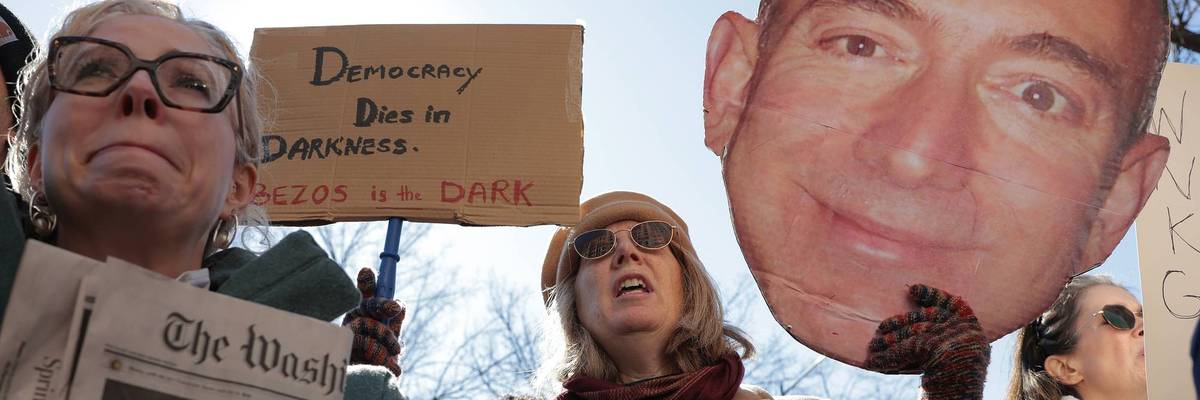
Local DDresidents who read the Washington Post joined members of the guild to protest during a rally outside the Washington Post office building on February 05, 2026 in Washington, DC. The Washington Post, owned by billionaire Amazon founder Jeff Bezos, announced major job cuts on February 4, laying off more than 300 journalists.
When it comes to media, journalism, and the broader information landscape, there’s a strong practical need to be utopian right now—to give us hope but to also provide clarity as to what we should be fighting for.
The Trump 2.0 era has intensified a deeply entrenched pathology in the American media system: concentrated corporate ownership. During less perilous times, legitimate concerns about a few corporations capturing so much of our news and information have often been dismissed as conspiracy theories and paranoia. But Donald Trump and his coterie of plutocrats have made our media oligarchy problem acutely evident and impossible to ignore.
Constant controversies—from government and corporate censorship of television comedians like Jimmy Kimmel and Stephen Colbert to the algorithmic and editorial abuses of Elon Musk’s X and Jeff Bezos’s Washington Post—remind us why media ownership holds such high stakes for any semblance of democracy. Meanwhile, rightwing nepotistic dynasties like the Murdochs and the Ellisons hold inordinate influence over what millions of people can see, hear, and read in their daily media.
Our current media system is simply incompatible with democracy, making structural media reform an urgent priority. This includes unwinding previously approved and pending mergers—exhibit A being Paramount Skydance’s potential acquisition of Warner Bros. Discovery (which owns CNN and HBO, among other key holdings)—as well as trust-busting corporate media behemoths by forcing them to divest major components of their sprawling conglomerates.
Undoing the wreckage will take time, but we must lay the groundwork now to launch necessary structural reforms the moment we dethrone Trump and his ilk. This project requires a clear analytical framework for understanding exactly why such run-amok media concentration is bad for democracy, and why breaking up media conglomerates is both necessary and insufficient for reconstructing the media we need from the ground up.
Big corporate media mergers are bad for everyone other than those few who stand to profit. They’re harmful for media workers, consumers, local communities, First Amendment freedoms, and democracy writ large. Over the years, the dangers for democracy posed by media concentration have been borne out by empirical evidence. Research shows that media conglomeration can lead to less local news, more advertising, and shifts toward conservative political commentary, especially under the ownership of rightwing companies such as Sinclair.
According to basic democratic theory, ensuring diverse voices, viewpoints, and stories in our media requires a pluralistic range of media owners. However, the hypercommercialized, corporate-dominated US media system wasn’t devised to privilege democracy. In fact, given its weak public media system, oligopolistic media markets, and light public interest regulations—many of which eroded over time or simply were ignored (or weaponized under Trump)—the US media system is almost perfectly designed to not serve democracy.
Within this hypercommercialized media structure, despite many individual journalists’ courageous work to the contrary, profit imperatives too often trump democracy (bad pun intended). Capitalist logics undercut and skew democratic discourse by encouraging clickbait, excluding low-income communities, and degrading the quality of journalism. Capitalist incentive structures also lead to pronounced deficits through sheer cost cutting, and by treating news and information as commodities, not public services, and audiences as passive consumers, not engaged citizens.
Even during the best of times, media corporations often maximize profits by ruthlessly cutting corners and forcing their media workers to do more for less. Too often, costly services like high-quality journalism are dismantled while content that’s cheaply produced and easily replicated—like shouting heads across ubiquitous screens, endlessly capturing our attention for advertisers—gets amplified.
Media conglomeration only intensifies these commercial logics. For example, cost cutting typically accelerates immediately following big mergers when companies take on tremendous debt. New corporate ownership has subjected CBS to such restructuring and would likely do the same to CNN if the pending merger goes through, for which Paramount Skydance is reportedly incurring $79 billion in debt. To compensate, media corporations often combine newsrooms and lay off reporters—or eliminate journalism altogether in favor of opinion and commentary.
In addition to decimating jobs, managing such debt tends to result in outsourcing costs to audiences by raising prices, offering lower-quality programming, and providing less creative cultural fare. This outcome is especially detrimental given a media landscape already riddled with news deserts, in which scarce original journalism and local media content are being produced.
The debasement of our news and entertainment media is bad enough. But media conglomeration also creates private tyrannies wherein oligarchs command broad swaths of our media. Driven by perverse incentives, these media barons wield dangerous control over public discourse, warping how important issues get framed and what stories get told.
Conferring such political economic power onto a small elite is itself a severe democratic threat. Whether through lobbying, campaign contributions, or preferential press coverage of politicians in exchange for regulatory favors, these media oligarchs almost always develop corrupt relationships with those in government, undercutting the press’s much-vaunted “watchdog function” of holding the powerful to account.
Moreover, media consolidation is a structural precondition for authoritarianism. We saw such patterns play out under Hungary’s former Prime Minister Viktor Orbán, who demonstrated how authoritarians needn’t control newsrooms by gunpoint. Rather, they can rely on chummy oligarchs to discipline the media for them, resulting in news feeds and media channels saturated with government-approved talking points and propagandistic narratives that brook little dissent toward those in power.
It shouldn’t surprise us that billionaires are likely to deploy their media assets to advance their class interests. This is especially prevalent in the United States, given devalued media properties and extreme concentrations of wealth. To provide one stark example: Jeff Bezos bought The Washington Post in 2013 for less than half of what he would later pay for his super yacht.
In the final analysis, such concentrated corporate ownership—whereby a tiny elite commands so much power over our media—is antithetical to democratic society. Even if today’s villainous oligarchs had the hearts of angels, it’s far too much power for any individual to wield over our news media. Just as every billionaire is a policy failure, every billionaire-owned media outlet is a profound threat to our democracy.
How did the United States fall under this media oligarchy? Many of our contemporary media failures trace back to specific policies and political decisions. One such inflection point occurred during the 1930s and 1940s, when policymakers established a privatized and highly commercialized broadcast media system tempered by relatively weak public interest protections. The latter included what became known as the Fairness Doctrine, which President Ronald Reagan’s Federal Communications Commission (FCC) jettisoned in 1987.
The United States belatedly established a chronically underfunded public broadcasting system in the late 1960s. But after a period of modest progressive policymaking, we began rolling back media ownership restrictions and “deregulating” our media in the 1980s, leading up to the infamous Telecommunications Act of 1996, when media consolidation began to escalate. In many ways, our oligopolistic media landscape has only worsened since the merger mania of the Clinton-Bush neoliberal heyday.
Particularly alarming is the utter collapse of local journalism, in which more than 40 percent of our newspapers and three-quarters of our local journalists have vanished since the early 2000s. Meanwhile, FCC Chair Brendan Carr is a loyal apparatchik for bullying what’s left of our independent media into capitulation to Trump.
Combined with the federal defunding of our public media, few structural alternatives and countervailing forces can withstand a blasted media landscape dominated by profit imperatives and a handful of media moguls. What’s to be done?
Today we face a dangerous new terrain upon which an authoritarian government weaponizes a hypercommercialized corporate media system against democracy. Yet, the market libertarianism and policy failures over the decades that enabled media oligarchy weren’t inevitable or natural, nor must they be permanent. These were political choices, and politics are subject to human agency and change. But first we must denaturalize this hypercapitalistic system that turns our media against democracy.
To begin, we must recognize that our media pathologies run even deeper than bad billionaire media owners doing bad things. Ownership structures are only part of the problem—a key part, to be sure—downstream from the core root of our media polycrisis: capitalism. Confronting media monopolies requires us to reckon with the underlying conditions that made such concentration possible, specifically the hypercapitalist logics capturing our information and communication infrastructures from root to branch.
Indeed, our media’s systemic problems predate the recent spate of mergers under Trump. While today we must stop mega media mergers, tomorrow we must create an entirely new public media ecosystem in service to local communities. To combat the capitalist capture of the entire American media apparatus that produces various kinds of “market censorship” that would-be autocrats like Trump can exploit, we must create a non-capitalistic system—a truly public and independent media system—that’s owned and controlled by us all.
Fortunately, recent positive signs have already emerged at the state and local levels, ranging from contesting media mergers by state attorneys general to making public investments toward local journalism. Yet we must broaden our political imagination and plan for bold national policy interventions for the post-Trump moment. There’s a strong practical need to be utopian right now—to give us hope but to also provide clarity as to what we should be fighting for. We need a long-term vision firmly planted on our political horizons—we can dare to imagine a media system that privileges democracy over power and profit.
Dear Common Dreams reader, It’s been nearly 30 years since I co-founded Common Dreams with my late wife, Lina Newhouser. We had the radical notion that journalism should serve the public good, not corporate profits. It was clear to us from the outset what it would take to build such a project. No paid advertisements. No corporate sponsors. No millionaire publisher telling us what to think or do. Many people said we wouldn't last a year, but we proved those doubters wrong. Together with a tremendous team of journalists and dedicated staff, we built an independent media outlet free from the constraints of profits and corporate control. Our mission has always been simple: To inform. To inspire. To ignite change for the common good. Building Common Dreams was not easy. Our survival was never guaranteed. When you take on the most powerful forces—Wall Street greed, fossil fuel industry destruction, Big Tech lobbyists, and uber-rich oligarchs who have spent billions upon billions rigging the economy and democracy in their favor—the only bulwark you have is supporters who believe in your work. But here’s the urgent message from me today. It's never been this bad out there. And it's never been this hard to keep us going. At the very moment Common Dreams is most needed, the threats we face are intensifying. We need your support now more than ever. We don't accept corporate advertising and never will. We don't have a paywall because we don't think people should be blocked from critical news based on their ability to pay. Everything we do is funded by the donations of readers like you. When everyone does the little they can afford, we are strong. But if that support retreats or dries up, so do we. Will you donate now to make sure Common Dreams not only survives but thrives? —Craig Brown, Co-founder |
The Trump 2.0 era has intensified a deeply entrenched pathology in the American media system: concentrated corporate ownership. During less perilous times, legitimate concerns about a few corporations capturing so much of our news and information have often been dismissed as conspiracy theories and paranoia. But Donald Trump and his coterie of plutocrats have made our media oligarchy problem acutely evident and impossible to ignore.
Constant controversies—from government and corporate censorship of television comedians like Jimmy Kimmel and Stephen Colbert to the algorithmic and editorial abuses of Elon Musk’s X and Jeff Bezos’s Washington Post—remind us why media ownership holds such high stakes for any semblance of democracy. Meanwhile, rightwing nepotistic dynasties like the Murdochs and the Ellisons hold inordinate influence over what millions of people can see, hear, and read in their daily media.
Our current media system is simply incompatible with democracy, making structural media reform an urgent priority. This includes unwinding previously approved and pending mergers—exhibit A being Paramount Skydance’s potential acquisition of Warner Bros. Discovery (which owns CNN and HBO, among other key holdings)—as well as trust-busting corporate media behemoths by forcing them to divest major components of their sprawling conglomerates.
Undoing the wreckage will take time, but we must lay the groundwork now to launch necessary structural reforms the moment we dethrone Trump and his ilk. This project requires a clear analytical framework for understanding exactly why such run-amok media concentration is bad for democracy, and why breaking up media conglomerates is both necessary and insufficient for reconstructing the media we need from the ground up.
Big corporate media mergers are bad for everyone other than those few who stand to profit. They’re harmful for media workers, consumers, local communities, First Amendment freedoms, and democracy writ large. Over the years, the dangers for democracy posed by media concentration have been borne out by empirical evidence. Research shows that media conglomeration can lead to less local news, more advertising, and shifts toward conservative political commentary, especially under the ownership of rightwing companies such as Sinclair.
According to basic democratic theory, ensuring diverse voices, viewpoints, and stories in our media requires a pluralistic range of media owners. However, the hypercommercialized, corporate-dominated US media system wasn’t devised to privilege democracy. In fact, given its weak public media system, oligopolistic media markets, and light public interest regulations—many of which eroded over time or simply were ignored (or weaponized under Trump)—the US media system is almost perfectly designed to not serve democracy.
Within this hypercommercialized media structure, despite many individual journalists’ courageous work to the contrary, profit imperatives too often trump democracy (bad pun intended). Capitalist logics undercut and skew democratic discourse by encouraging clickbait, excluding low-income communities, and degrading the quality of journalism. Capitalist incentive structures also lead to pronounced deficits through sheer cost cutting, and by treating news and information as commodities, not public services, and audiences as passive consumers, not engaged citizens.
Even during the best of times, media corporations often maximize profits by ruthlessly cutting corners and forcing their media workers to do more for less. Too often, costly services like high-quality journalism are dismantled while content that’s cheaply produced and easily replicated—like shouting heads across ubiquitous screens, endlessly capturing our attention for advertisers—gets amplified.
Media conglomeration only intensifies these commercial logics. For example, cost cutting typically accelerates immediately following big mergers when companies take on tremendous debt. New corporate ownership has subjected CBS to such restructuring and would likely do the same to CNN if the pending merger goes through, for which Paramount Skydance is reportedly incurring $79 billion in debt. To compensate, media corporations often combine newsrooms and lay off reporters—or eliminate journalism altogether in favor of opinion and commentary.
In addition to decimating jobs, managing such debt tends to result in outsourcing costs to audiences by raising prices, offering lower-quality programming, and providing less creative cultural fare. This outcome is especially detrimental given a media landscape already riddled with news deserts, in which scarce original journalism and local media content are being produced.
The debasement of our news and entertainment media is bad enough. But media conglomeration also creates private tyrannies wherein oligarchs command broad swaths of our media. Driven by perverse incentives, these media barons wield dangerous control over public discourse, warping how important issues get framed and what stories get told.
Conferring such political economic power onto a small elite is itself a severe democratic threat. Whether through lobbying, campaign contributions, or preferential press coverage of politicians in exchange for regulatory favors, these media oligarchs almost always develop corrupt relationships with those in government, undercutting the press’s much-vaunted “watchdog function” of holding the powerful to account.
Moreover, media consolidation is a structural precondition for authoritarianism. We saw such patterns play out under Hungary’s former Prime Minister Viktor Orbán, who demonstrated how authoritarians needn’t control newsrooms by gunpoint. Rather, they can rely on chummy oligarchs to discipline the media for them, resulting in news feeds and media channels saturated with government-approved talking points and propagandistic narratives that brook little dissent toward those in power.
It shouldn’t surprise us that billionaires are likely to deploy their media assets to advance their class interests. This is especially prevalent in the United States, given devalued media properties and extreme concentrations of wealth. To provide one stark example: Jeff Bezos bought The Washington Post in 2013 for less than half of what he would later pay for his super yacht.
In the final analysis, such concentrated corporate ownership—whereby a tiny elite commands so much power over our media—is antithetical to democratic society. Even if today’s villainous oligarchs had the hearts of angels, it’s far too much power for any individual to wield over our news media. Just as every billionaire is a policy failure, every billionaire-owned media outlet is a profound threat to our democracy.
How did the United States fall under this media oligarchy? Many of our contemporary media failures trace back to specific policies and political decisions. One such inflection point occurred during the 1930s and 1940s, when policymakers established a privatized and highly commercialized broadcast media system tempered by relatively weak public interest protections. The latter included what became known as the Fairness Doctrine, which President Ronald Reagan’s Federal Communications Commission (FCC) jettisoned in 1987.
The United States belatedly established a chronically underfunded public broadcasting system in the late 1960s. But after a period of modest progressive policymaking, we began rolling back media ownership restrictions and “deregulating” our media in the 1980s, leading up to the infamous Telecommunications Act of 1996, when media consolidation began to escalate. In many ways, our oligopolistic media landscape has only worsened since the merger mania of the Clinton-Bush neoliberal heyday.
Particularly alarming is the utter collapse of local journalism, in which more than 40 percent of our newspapers and three-quarters of our local journalists have vanished since the early 2000s. Meanwhile, FCC Chair Brendan Carr is a loyal apparatchik for bullying what’s left of our independent media into capitulation to Trump.
Combined with the federal defunding of our public media, few structural alternatives and countervailing forces can withstand a blasted media landscape dominated by profit imperatives and a handful of media moguls. What’s to be done?
Today we face a dangerous new terrain upon which an authoritarian government weaponizes a hypercommercialized corporate media system against democracy. Yet, the market libertarianism and policy failures over the decades that enabled media oligarchy weren’t inevitable or natural, nor must they be permanent. These were political choices, and politics are subject to human agency and change. But first we must denaturalize this hypercapitalistic system that turns our media against democracy.
To begin, we must recognize that our media pathologies run even deeper than bad billionaire media owners doing bad things. Ownership structures are only part of the problem—a key part, to be sure—downstream from the core root of our media polycrisis: capitalism. Confronting media monopolies requires us to reckon with the underlying conditions that made such concentration possible, specifically the hypercapitalist logics capturing our information and communication infrastructures from root to branch.
Indeed, our media’s systemic problems predate the recent spate of mergers under Trump. While today we must stop mega media mergers, tomorrow we must create an entirely new public media ecosystem in service to local communities. To combat the capitalist capture of the entire American media apparatus that produces various kinds of “market censorship” that would-be autocrats like Trump can exploit, we must create a non-capitalistic system—a truly public and independent media system—that’s owned and controlled by us all.
Fortunately, recent positive signs have already emerged at the state and local levels, ranging from contesting media mergers by state attorneys general to making public investments toward local journalism. Yet we must broaden our political imagination and plan for bold national policy interventions for the post-Trump moment. There’s a strong practical need to be utopian right now—to give us hope but to also provide clarity as to what we should be fighting for. We need a long-term vision firmly planted on our political horizons—we can dare to imagine a media system that privileges democracy over power and profit.
The Trump 2.0 era has intensified a deeply entrenched pathology in the American media system: concentrated corporate ownership. During less perilous times, legitimate concerns about a few corporations capturing so much of our news and information have often been dismissed as conspiracy theories and paranoia. But Donald Trump and his coterie of plutocrats have made our media oligarchy problem acutely evident and impossible to ignore.
Constant controversies—from government and corporate censorship of television comedians like Jimmy Kimmel and Stephen Colbert to the algorithmic and editorial abuses of Elon Musk’s X and Jeff Bezos’s Washington Post—remind us why media ownership holds such high stakes for any semblance of democracy. Meanwhile, rightwing nepotistic dynasties like the Murdochs and the Ellisons hold inordinate influence over what millions of people can see, hear, and read in their daily media.
Our current media system is simply incompatible with democracy, making structural media reform an urgent priority. This includes unwinding previously approved and pending mergers—exhibit A being Paramount Skydance’s potential acquisition of Warner Bros. Discovery (which owns CNN and HBO, among other key holdings)—as well as trust-busting corporate media behemoths by forcing them to divest major components of their sprawling conglomerates.
Undoing the wreckage will take time, but we must lay the groundwork now to launch necessary structural reforms the moment we dethrone Trump and his ilk. This project requires a clear analytical framework for understanding exactly why such run-amok media concentration is bad for democracy, and why breaking up media conglomerates is both necessary and insufficient for reconstructing the media we need from the ground up.
Big corporate media mergers are bad for everyone other than those few who stand to profit. They’re harmful for media workers, consumers, local communities, First Amendment freedoms, and democracy writ large. Over the years, the dangers for democracy posed by media concentration have been borne out by empirical evidence. Research shows that media conglomeration can lead to less local news, more advertising, and shifts toward conservative political commentary, especially under the ownership of rightwing companies such as Sinclair.
According to basic democratic theory, ensuring diverse voices, viewpoints, and stories in our media requires a pluralistic range of media owners. However, the hypercommercialized, corporate-dominated US media system wasn’t devised to privilege democracy. In fact, given its weak public media system, oligopolistic media markets, and light public interest regulations—many of which eroded over time or simply were ignored (or weaponized under Trump)—the US media system is almost perfectly designed to not serve democracy.
Within this hypercommercialized media structure, despite many individual journalists’ courageous work to the contrary, profit imperatives too often trump democracy (bad pun intended). Capitalist logics undercut and skew democratic discourse by encouraging clickbait, excluding low-income communities, and degrading the quality of journalism. Capitalist incentive structures also lead to pronounced deficits through sheer cost cutting, and by treating news and information as commodities, not public services, and audiences as passive consumers, not engaged citizens.
Even during the best of times, media corporations often maximize profits by ruthlessly cutting corners and forcing their media workers to do more for less. Too often, costly services like high-quality journalism are dismantled while content that’s cheaply produced and easily replicated—like shouting heads across ubiquitous screens, endlessly capturing our attention for advertisers—gets amplified.
Media conglomeration only intensifies these commercial logics. For example, cost cutting typically accelerates immediately following big mergers when companies take on tremendous debt. New corporate ownership has subjected CBS to such restructuring and would likely do the same to CNN if the pending merger goes through, for which Paramount Skydance is reportedly incurring $79 billion in debt. To compensate, media corporations often combine newsrooms and lay off reporters—or eliminate journalism altogether in favor of opinion and commentary.
In addition to decimating jobs, managing such debt tends to result in outsourcing costs to audiences by raising prices, offering lower-quality programming, and providing less creative cultural fare. This outcome is especially detrimental given a media landscape already riddled with news deserts, in which scarce original journalism and local media content are being produced.
The debasement of our news and entertainment media is bad enough. But media conglomeration also creates private tyrannies wherein oligarchs command broad swaths of our media. Driven by perverse incentives, these media barons wield dangerous control over public discourse, warping how important issues get framed and what stories get told.
Conferring such political economic power onto a small elite is itself a severe democratic threat. Whether through lobbying, campaign contributions, or preferential press coverage of politicians in exchange for regulatory favors, these media oligarchs almost always develop corrupt relationships with those in government, undercutting the press’s much-vaunted “watchdog function” of holding the powerful to account.
Moreover, media consolidation is a structural precondition for authoritarianism. We saw such patterns play out under Hungary’s former Prime Minister Viktor Orbán, who demonstrated how authoritarians needn’t control newsrooms by gunpoint. Rather, they can rely on chummy oligarchs to discipline the media for them, resulting in news feeds and media channels saturated with government-approved talking points and propagandistic narratives that brook little dissent toward those in power.
It shouldn’t surprise us that billionaires are likely to deploy their media assets to advance their class interests. This is especially prevalent in the United States, given devalued media properties and extreme concentrations of wealth. To provide one stark example: Jeff Bezos bought The Washington Post in 2013 for less than half of what he would later pay for his super yacht.
In the final analysis, such concentrated corporate ownership—whereby a tiny elite commands so much power over our media—is antithetical to democratic society. Even if today’s villainous oligarchs had the hearts of angels, it’s far too much power for any individual to wield over our news media. Just as every billionaire is a policy failure, every billionaire-owned media outlet is a profound threat to our democracy.
How did the United States fall under this media oligarchy? Many of our contemporary media failures trace back to specific policies and political decisions. One such inflection point occurred during the 1930s and 1940s, when policymakers established a privatized and highly commercialized broadcast media system tempered by relatively weak public interest protections. The latter included what became known as the Fairness Doctrine, which President Ronald Reagan’s Federal Communications Commission (FCC) jettisoned in 1987.
The United States belatedly established a chronically underfunded public broadcasting system in the late 1960s. But after a period of modest progressive policymaking, we began rolling back media ownership restrictions and “deregulating” our media in the 1980s, leading up to the infamous Telecommunications Act of 1996, when media consolidation began to escalate. In many ways, our oligopolistic media landscape has only worsened since the merger mania of the Clinton-Bush neoliberal heyday.
Particularly alarming is the utter collapse of local journalism, in which more than 40 percent of our newspapers and three-quarters of our local journalists have vanished since the early 2000s. Meanwhile, FCC Chair Brendan Carr is a loyal apparatchik for bullying what’s left of our independent media into capitulation to Trump.
Combined with the federal defunding of our public media, few structural alternatives and countervailing forces can withstand a blasted media landscape dominated by profit imperatives and a handful of media moguls. What’s to be done?
Today we face a dangerous new terrain upon which an authoritarian government weaponizes a hypercommercialized corporate media system against democracy. Yet, the market libertarianism and policy failures over the decades that enabled media oligarchy weren’t inevitable or natural, nor must they be permanent. These were political choices, and politics are subject to human agency and change. But first we must denaturalize this hypercapitalistic system that turns our media against democracy.
To begin, we must recognize that our media pathologies run even deeper than bad billionaire media owners doing bad things. Ownership structures are only part of the problem—a key part, to be sure—downstream from the core root of our media polycrisis: capitalism. Confronting media monopolies requires us to reckon with the underlying conditions that made such concentration possible, specifically the hypercapitalist logics capturing our information and communication infrastructures from root to branch.
Indeed, our media’s systemic problems predate the recent spate of mergers under Trump. While today we must stop mega media mergers, tomorrow we must create an entirely new public media ecosystem in service to local communities. To combat the capitalist capture of the entire American media apparatus that produces various kinds of “market censorship” that would-be autocrats like Trump can exploit, we must create a non-capitalistic system—a truly public and independent media system—that’s owned and controlled by us all.
Fortunately, recent positive signs have already emerged at the state and local levels, ranging from contesting media mergers by state attorneys general to making public investments toward local journalism. Yet we must broaden our political imagination and plan for bold national policy interventions for the post-Trump moment. There’s a strong practical need to be utopian right now—to give us hope but to also provide clarity as to what we should be fighting for. We need a long-term vision firmly planted on our political horizons—we can dare to imagine a media system that privileges democracy over power and profit.