SUBSCRIBE TO OUR FREE NEWSLETTER
Daily news & progressive opinion—funded by the people, not the corporations—delivered straight to your inbox.
5
#000000
#FFFFFF
To donate by check, phone, or other method, see our More Ways to Give page.
Daily news & progressive opinion—funded by the people, not the corporations—delivered straight to your inbox.
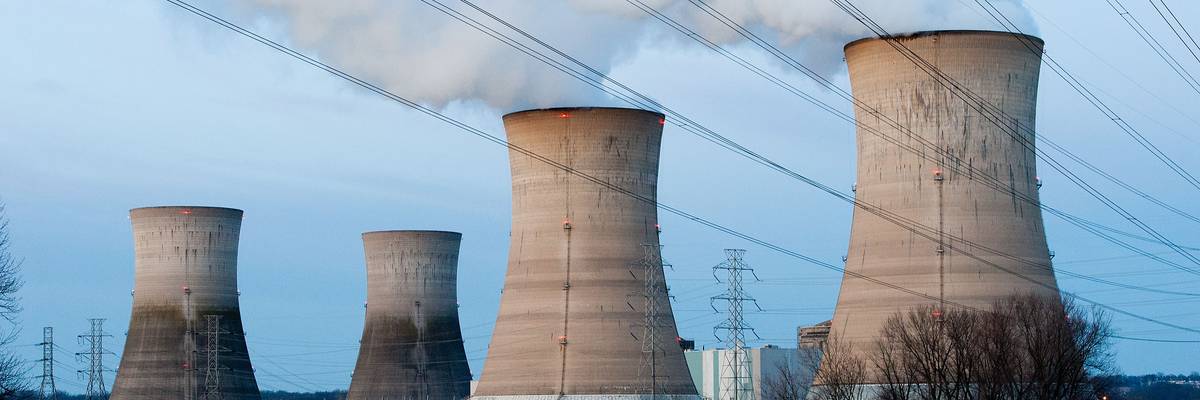
The Three Mile Island Nuclear Plant is seen in the early morning hours March 28, 2011 in Middletown, Pennsylvania.
Under pressure to expand nuclear energy production, the commission has proposed weakening standards protecting workers and communities from radiation exposure.
The Nuclear Regulatory Commission, or NRC, whose mission is to protect public health and safety regarding nuclear energy, has now transformed into an agency, as so many have under the current administration, to support the nuclear industry and its billionaire backers. Following other captured federal agencies like the Department of Energy, which is variably led by individuals from the very industries it is intended to regulate, the NRC is under pressure from the president to facilitate the quadrupling of nuclear energy production by 2050. This is to be accomplished by fast-tracking the licensure and building of reactors while discarding the nuclear radiation exposure safety measures in place for decades as these are seen to be onerous and financially burdensome to the industry.
The current safety standard for nuclear exposure comes from the BEIR VII (Biologic Effects of Ionizing Radiation) study. This was produced by the National Academies of Sciences, Engineering, and Medicine and concluded that there is no safe level of ionizing radiation exposure above background, noting that any excess exposure above background increases the risk to human health of cancer, and other diseases associated with nuclear exposure. This is the so-called Linear No Threshold, LNT, theory. This theory is the basis for the core precautionary safety principle and risk management approach used in the fields of ionizing radiation exposure from medicine and dentistry to nuclear energy referred to as “ALARA,” or "As Low As Reasonably Achievable.”
The problem that exists, even with current standards of radiation exposure allowance, is that they are based on the “Reference Man,” which is a 25-to-30-year-old 70 kilogram man. This androcentric standard totally disregards the fact that the majority of humanity is not represented by this standard, and that children, females, pregnant women, and the elderly are more sensitive to radioactivity exposure. In addition workers involved throughout the entire nuclear cycle are at increased risk from exposure. Furthermore, a recent Harvard study demonstrated increased cancer rates in the communities surrounding nuclear power plants within ~18.5 miles.
The current NRC proposal plans to do away with ALARA while purportedly supporting the LNT. This flies in the face of reason and is duplicitous as LNT is the basis of ALARA. Their plan is to substitute an unproven “graded approach” allowing workers to be exposed to near the regulatory limits and then taking added measures so as not to exceed it. They propose allowing the exceeding of exposure limits under “certain circumstances” setting up a banking system from subsequent year allowances amortizing over five years. They have even invoked the controversial unproven hypothesis of “Radiation Hormesis,” which proposes that a small amount of radiation causing cellular damage will stimulate cellular repair, as though to say what does not kill you, is good for you. Remember LNT.
The current proposal does just the opposite unless we stop it from moving forward. The NRC is providing a limited public comment period on this proposal which ends at midnight on August 31.
Furthermore, when implemented, these new regulations will most likely be used to reduce the already weak cleanup standards, further increasing the health risks to impacted communities contaminated from our nuclear legacy and history. These include communities such as the South Carolina Savannah River Site and New Mexico Los Alamos Nuclear Lab and Trinity Test Site to the Navajo Nation mining sites, Hanford Washington site, Nevada Test Site, St Louis Cold Water Creek, Parks Township (Pennsylvani), Rocky Flats Site near Denver, and the Santa Susana Field Lab near Los Angeles, among others.
The rationale for this current proposal is to facilitate the fast-tracking of nuclear power for the uncontrolled growth of data centers (with 1,500 new data centers currently in development), artificial intelligence, additional large commercial nuclear power plants, and new plutonium pits that are the nuclear trigger of nuclear weapons, reminding us that nuclear power remains the cover story for nuclear weapons.
The potential health risks of cancer, heart disease, birth defects, cognitive defects, thyroid and endocrine disorders, genetic mutations, and infertility are all related to ionizing radiation exposure. These are risks lasting for generations, passed on from one generation to the next. Yet, these health effects do not have to be and can be prevented if we demand the strengthening of current radiation exposure guidelines. The current proposal does just the opposite unless we stop it from moving forward. The NRC is providing a limited public comment period on this proposal which ends at midnight on August 31. Your comment is critical and can be submitted at federalregister.gov. More information can be found at www.protectbetter.org.
Dear Common Dreams reader, It’s been nearly 30 years since I co-founded Common Dreams with my late wife, Lina Newhouser. We had the radical notion that journalism should serve the public good, not corporate profits. It was clear to us from the outset what it would take to build such a project. No paid advertisements. No corporate sponsors. No millionaire publisher telling us what to think or do. Many people said we wouldn't last a year, but we proved those doubters wrong. Together with a tremendous team of journalists and dedicated staff, we built an independent media outlet free from the constraints of profits and corporate control. Our mission has always been simple: To inform. To inspire. To ignite change for the common good. Building Common Dreams was not easy. Our survival was never guaranteed. When you take on the most powerful forces—Wall Street greed, fossil fuel industry destruction, Big Tech lobbyists, and uber-rich oligarchs who have spent billions upon billions rigging the economy and democracy in their favor—the only bulwark you have is supporters who believe in your work. But here’s the urgent message from me today. It's never been this bad out there. And it's never been this hard to keep us going. At the very moment Common Dreams is most needed, the threats we face are intensifying. We need your support now more than ever. We don't accept corporate advertising and never will. We don't have a paywall because we don't think people should be blocked from critical news based on their ability to pay. Everything we do is funded by the donations of readers like you. When everyone does the little they can afford, we are strong. But if that support retreats or dries up, so do we. Will you donate now to make sure Common Dreams not only survives but thrives? —Craig Brown, Co-founder |
The Nuclear Regulatory Commission, or NRC, whose mission is to protect public health and safety regarding nuclear energy, has now transformed into an agency, as so many have under the current administration, to support the nuclear industry and its billionaire backers. Following other captured federal agencies like the Department of Energy, which is variably led by individuals from the very industries it is intended to regulate, the NRC is under pressure from the president to facilitate the quadrupling of nuclear energy production by 2050. This is to be accomplished by fast-tracking the licensure and building of reactors while discarding the nuclear radiation exposure safety measures in place for decades as these are seen to be onerous and financially burdensome to the industry.
The current safety standard for nuclear exposure comes from the BEIR VII (Biologic Effects of Ionizing Radiation) study. This was produced by the National Academies of Sciences, Engineering, and Medicine and concluded that there is no safe level of ionizing radiation exposure above background, noting that any excess exposure above background increases the risk to human health of cancer, and other diseases associated with nuclear exposure. This is the so-called Linear No Threshold, LNT, theory. This theory is the basis for the core precautionary safety principle and risk management approach used in the fields of ionizing radiation exposure from medicine and dentistry to nuclear energy referred to as “ALARA,” or "As Low As Reasonably Achievable.”
The problem that exists, even with current standards of radiation exposure allowance, is that they are based on the “Reference Man,” which is a 25-to-30-year-old 70 kilogram man. This androcentric standard totally disregards the fact that the majority of humanity is not represented by this standard, and that children, females, pregnant women, and the elderly are more sensitive to radioactivity exposure. In addition workers involved throughout the entire nuclear cycle are at increased risk from exposure. Furthermore, a recent Harvard study demonstrated increased cancer rates in the communities surrounding nuclear power plants within ~18.5 miles.
The current NRC proposal plans to do away with ALARA while purportedly supporting the LNT. This flies in the face of reason and is duplicitous as LNT is the basis of ALARA. Their plan is to substitute an unproven “graded approach” allowing workers to be exposed to near the regulatory limits and then taking added measures so as not to exceed it. They propose allowing the exceeding of exposure limits under “certain circumstances” setting up a banking system from subsequent year allowances amortizing over five years. They have even invoked the controversial unproven hypothesis of “Radiation Hormesis,” which proposes that a small amount of radiation causing cellular damage will stimulate cellular repair, as though to say what does not kill you, is good for you. Remember LNT.
The current proposal does just the opposite unless we stop it from moving forward. The NRC is providing a limited public comment period on this proposal which ends at midnight on August 31.
Furthermore, when implemented, these new regulations will most likely be used to reduce the already weak cleanup standards, further increasing the health risks to impacted communities contaminated from our nuclear legacy and history. These include communities such as the South Carolina Savannah River Site and New Mexico Los Alamos Nuclear Lab and Trinity Test Site to the Navajo Nation mining sites, Hanford Washington site, Nevada Test Site, St Louis Cold Water Creek, Parks Township (Pennsylvani), Rocky Flats Site near Denver, and the Santa Susana Field Lab near Los Angeles, among others.
The rationale for this current proposal is to facilitate the fast-tracking of nuclear power for the uncontrolled growth of data centers (with 1,500 new data centers currently in development), artificial intelligence, additional large commercial nuclear power plants, and new plutonium pits that are the nuclear trigger of nuclear weapons, reminding us that nuclear power remains the cover story for nuclear weapons.
The potential health risks of cancer, heart disease, birth defects, cognitive defects, thyroid and endocrine disorders, genetic mutations, and infertility are all related to ionizing radiation exposure. These are risks lasting for generations, passed on from one generation to the next. Yet, these health effects do not have to be and can be prevented if we demand the strengthening of current radiation exposure guidelines. The current proposal does just the opposite unless we stop it from moving forward. The NRC is providing a limited public comment period on this proposal which ends at midnight on August 31. Your comment is critical and can be submitted at federalregister.gov. More information can be found at www.protectbetter.org.
The Nuclear Regulatory Commission, or NRC, whose mission is to protect public health and safety regarding nuclear energy, has now transformed into an agency, as so many have under the current administration, to support the nuclear industry and its billionaire backers. Following other captured federal agencies like the Department of Energy, which is variably led by individuals from the very industries it is intended to regulate, the NRC is under pressure from the president to facilitate the quadrupling of nuclear energy production by 2050. This is to be accomplished by fast-tracking the licensure and building of reactors while discarding the nuclear radiation exposure safety measures in place for decades as these are seen to be onerous and financially burdensome to the industry.
The current safety standard for nuclear exposure comes from the BEIR VII (Biologic Effects of Ionizing Radiation) study. This was produced by the National Academies of Sciences, Engineering, and Medicine and concluded that there is no safe level of ionizing radiation exposure above background, noting that any excess exposure above background increases the risk to human health of cancer, and other diseases associated with nuclear exposure. This is the so-called Linear No Threshold, LNT, theory. This theory is the basis for the core precautionary safety principle and risk management approach used in the fields of ionizing radiation exposure from medicine and dentistry to nuclear energy referred to as “ALARA,” or "As Low As Reasonably Achievable.”
The problem that exists, even with current standards of radiation exposure allowance, is that they are based on the “Reference Man,” which is a 25-to-30-year-old 70 kilogram man. This androcentric standard totally disregards the fact that the majority of humanity is not represented by this standard, and that children, females, pregnant women, and the elderly are more sensitive to radioactivity exposure. In addition workers involved throughout the entire nuclear cycle are at increased risk from exposure. Furthermore, a recent Harvard study demonstrated increased cancer rates in the communities surrounding nuclear power plants within ~18.5 miles.
The current NRC proposal plans to do away with ALARA while purportedly supporting the LNT. This flies in the face of reason and is duplicitous as LNT is the basis of ALARA. Their plan is to substitute an unproven “graded approach” allowing workers to be exposed to near the regulatory limits and then taking added measures so as not to exceed it. They propose allowing the exceeding of exposure limits under “certain circumstances” setting up a banking system from subsequent year allowances amortizing over five years. They have even invoked the controversial unproven hypothesis of “Radiation Hormesis,” which proposes that a small amount of radiation causing cellular damage will stimulate cellular repair, as though to say what does not kill you, is good for you. Remember LNT.
The current proposal does just the opposite unless we stop it from moving forward. The NRC is providing a limited public comment period on this proposal which ends at midnight on August 31.
Furthermore, when implemented, these new regulations will most likely be used to reduce the already weak cleanup standards, further increasing the health risks to impacted communities contaminated from our nuclear legacy and history. These include communities such as the South Carolina Savannah River Site and New Mexico Los Alamos Nuclear Lab and Trinity Test Site to the Navajo Nation mining sites, Hanford Washington site, Nevada Test Site, St Louis Cold Water Creek, Parks Township (Pennsylvani), Rocky Flats Site near Denver, and the Santa Susana Field Lab near Los Angeles, among others.
The rationale for this current proposal is to facilitate the fast-tracking of nuclear power for the uncontrolled growth of data centers (with 1,500 new data centers currently in development), artificial intelligence, additional large commercial nuclear power plants, and new plutonium pits that are the nuclear trigger of nuclear weapons, reminding us that nuclear power remains the cover story for nuclear weapons.
The potential health risks of cancer, heart disease, birth defects, cognitive defects, thyroid and endocrine disorders, genetic mutations, and infertility are all related to ionizing radiation exposure. These are risks lasting for generations, passed on from one generation to the next. Yet, these health effects do not have to be and can be prevented if we demand the strengthening of current radiation exposure guidelines. The current proposal does just the opposite unless we stop it from moving forward. The NRC is providing a limited public comment period on this proposal which ends at midnight on August 31. Your comment is critical and can be submitted at federalregister.gov. More information can be found at www.protectbetter.org.