SUBSCRIBE TO OUR FREE NEWSLETTER
Daily news & progressive opinion—funded by the people, not the corporations—delivered straight to your inbox.
5
#000000
#FFFFFF
To donate by check, phone, or other method, see our More Ways to Give page.
Daily news & progressive opinion—funded by the people, not the corporations—delivered straight to your inbox.
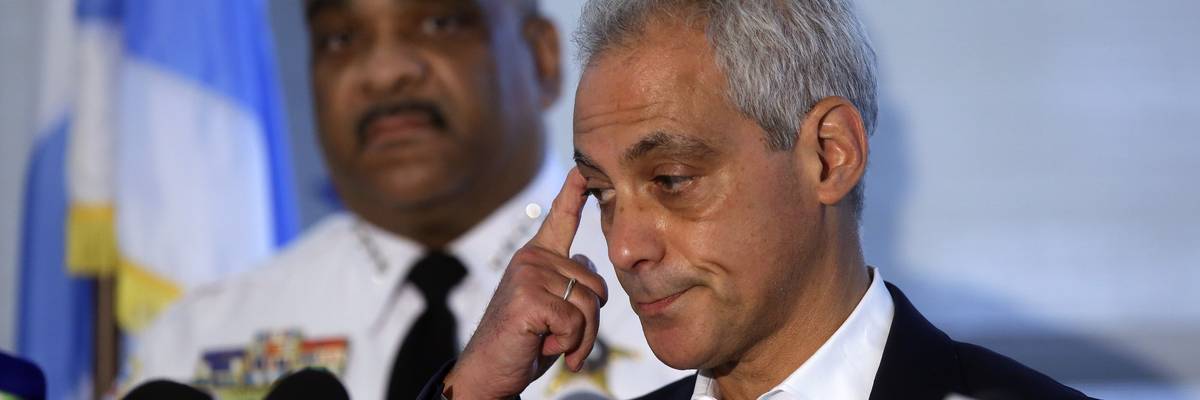
Former Chicago Police Superintendent Eddie Johnson listens as former Chicago Mayor Rahm Emanuel speaks about Chicago's weekend of gun violence during a news conference at the Chicago Police Department 6th District station August 6, 2018 in Chicago, Illinois.
The Democratic base is fed up with a system that gives inordinate power to the wealthy and to large corporations.
We’ve been hearing a lot of panicky warnings lately after Democratic primary voters chose socialists and other leftists instead of “moderates” in several major elections. The alarm bells got louder this month after Michigan’s progressive Senate candidate Abdul El-Sayed defeated Rep. Haley Stevens—who was, the New York Times reported, “the moderate establishment-backed candidate.”
The soothing “moderate” label routinely goes to candidates like Stevens who’ve supported continual arming of Israel. She “benefited from about $62 million in advertising spending from half a dozen outside groups,” the Times noted. “Over half of that sum came from the super PAC arm of the American Israel Public Affairs Committee, the country’s most influential pro-Israel group.”
What’s so “moderate” about supporting genocide?
Politicians are also routinely dubbed “moderate” when they’re running interference for extreme income inequality and deadly healthcare inequities – helping to block popular policy options like tax hikes on the rich and Medicare for All, which is supported by three-quarters of Democrats.
The Democratic base is fed up with a system that gives inordinate power to the wealthy and to large corporations. In the real world, the so-called “moderates” are aligned with a status quo that continues to inflict widespread suffering and preventable death at home and abroad.
To hear timeworn party strategists like James Carville and Paul Begala tell it, leftwing candidates are duping the Democratic electorate. As this month began, Carville threatened to leave the party. Begala made headlines by declaring, “I don’t like the socialists. I can’t stand them.”
But last month, a CNN poll found that “about a third of Democrats and Democratic-leaning adults identify as democratic socialists.” At a time when defeating the fascistic Republican Party is imperative, any strategist’s prescription that would denigrate or seek to exclude them amounts to political malpractice.
Treating so many Democratic voters like interlopers to be scolded might play well with corporate donors. But it’s a feeble swim against the political current. Polling shows that the younger Democratic voters are, the more favorable they’re apt to be toward socialism. “Younger adults are more likely to be in groups on the left, while older adults tend to cluster in more conservative groups,” the Pew Research Center noted.
Drawing on the results of its new public opinion survey, Global Strategy Group just reported that “socialist Democrats skew younger, with 57 percent of them being between the ages of 18 and 44.” Another poll, released a month ago by Tufts University’s Center for Information and Research, found that two-thirds of young people “said that their political views have changed in some way in recent years”—and “youth whose views did shift were almost twice as likely to become more liberal/progressive instead of more conservative.”
As socialists and others on the left prevail in many high-profile races, the refrains of condemnation coming from some of the Democratic Party establishment are potshots in a losing battle. By definition, young voters are the future of the party. Its prospects for winning elections are diminished to the extent that younger voters are made to feel unwelcome, or even vilified.
To the ears of many young Democratic voters, derision about how they cast their ballots is coming from out-of-touch party elders who treat crucial problems as abstractions or matters worthy only of lip service. Millions of Americans in early adulthood are facing financial stress with bleak outlooks for jobs and careers. College tuitions are often prohibitive, and college debt can be debilitating. Rents and mortgages are high. Everyday expenses are worse than a challenge. The climate crisis is real.
Such realities cast a shadow over the future. The last thing those voters want is arrogant leadership that refuses to grasp the urgency of this political moment.
Dear Common Dreams reader, It’s been nearly 30 years since I co-founded Common Dreams with my late wife, Lina Newhouser. We had the radical notion that journalism should serve the public good, not corporate profits. It was clear to us from the outset what it would take to build such a project. No paid advertisements. No corporate sponsors. No millionaire publisher telling us what to think or do. Many people said we wouldn't last a year, but we proved those doubters wrong. Together with a tremendous team of journalists and dedicated staff, we built an independent media outlet free from the constraints of profits and corporate control. Our mission has always been simple: To inform. To inspire. To ignite change for the common good. Building Common Dreams was not easy. Our survival was never guaranteed. When you take on the most powerful forces—Wall Street greed, fossil fuel industry destruction, Big Tech lobbyists, and uber-rich oligarchs who have spent billions upon billions rigging the economy and democracy in their favor—the only bulwark you have is supporters who believe in your work. But here’s the urgent message from me today. It's never been this bad out there. And it's never been this hard to keep us going. At the very moment Common Dreams is most needed, the threats we face are intensifying. We need your support now more than ever. We don't accept corporate advertising and never will. We don't have a paywall because we don't think people should be blocked from critical news based on their ability to pay. Everything we do is funded by the donations of readers like you. When everyone does the little they can afford, we are strong. But if that support retreats or dries up, so do we. Will you donate now to make sure Common Dreams not only survives but thrives? —Craig Brown, Co-founder |
Norman Solomon is the national director of RootsAction.org and executive director of the Institute for Public Accuracy. The paperback edition of his latest book, War Made Invisible: How America Hides the Human Toll of Its Military Machine, includes an afterword about the Gaza war.
We’ve been hearing a lot of panicky warnings lately after Democratic primary voters chose socialists and other leftists instead of “moderates” in several major elections. The alarm bells got louder this month after Michigan’s progressive Senate candidate Abdul El-Sayed defeated Rep. Haley Stevens—who was, the New York Times reported, “the moderate establishment-backed candidate.”
The soothing “moderate” label routinely goes to candidates like Stevens who’ve supported continual arming of Israel. She “benefited from about $62 million in advertising spending from half a dozen outside groups,” the Times noted. “Over half of that sum came from the super PAC arm of the American Israel Public Affairs Committee, the country’s most influential pro-Israel group.”
What’s so “moderate” about supporting genocide?
Politicians are also routinely dubbed “moderate” when they’re running interference for extreme income inequality and deadly healthcare inequities – helping to block popular policy options like tax hikes on the rich and Medicare for All, which is supported by three-quarters of Democrats.
The Democratic base is fed up with a system that gives inordinate power to the wealthy and to large corporations. In the real world, the so-called “moderates” are aligned with a status quo that continues to inflict widespread suffering and preventable death at home and abroad.
To hear timeworn party strategists like James Carville and Paul Begala tell it, leftwing candidates are duping the Democratic electorate. As this month began, Carville threatened to leave the party. Begala made headlines by declaring, “I don’t like the socialists. I can’t stand them.”
But last month, a CNN poll found that “about a third of Democrats and Democratic-leaning adults identify as democratic socialists.” At a time when defeating the fascistic Republican Party is imperative, any strategist’s prescription that would denigrate or seek to exclude them amounts to political malpractice.
Treating so many Democratic voters like interlopers to be scolded might play well with corporate donors. But it’s a feeble swim against the political current. Polling shows that the younger Democratic voters are, the more favorable they’re apt to be toward socialism. “Younger adults are more likely to be in groups on the left, while older adults tend to cluster in more conservative groups,” the Pew Research Center noted.
Drawing on the results of its new public opinion survey, Global Strategy Group just reported that “socialist Democrats skew younger, with 57 percent of them being between the ages of 18 and 44.” Another poll, released a month ago by Tufts University’s Center for Information and Research, found that two-thirds of young people “said that their political views have changed in some way in recent years”—and “youth whose views did shift were almost twice as likely to become more liberal/progressive instead of more conservative.”
As socialists and others on the left prevail in many high-profile races, the refrains of condemnation coming from some of the Democratic Party establishment are potshots in a losing battle. By definition, young voters are the future of the party. Its prospects for winning elections are diminished to the extent that younger voters are made to feel unwelcome, or even vilified.
To the ears of many young Democratic voters, derision about how they cast their ballots is coming from out-of-touch party elders who treat crucial problems as abstractions or matters worthy only of lip service. Millions of Americans in early adulthood are facing financial stress with bleak outlooks for jobs and careers. College tuitions are often prohibitive, and college debt can be debilitating. Rents and mortgages are high. Everyday expenses are worse than a challenge. The climate crisis is real.
Such realities cast a shadow over the future. The last thing those voters want is arrogant leadership that refuses to grasp the urgency of this political moment.
Norman Solomon is the national director of RootsAction.org and executive director of the Institute for Public Accuracy. The paperback edition of his latest book, War Made Invisible: How America Hides the Human Toll of Its Military Machine, includes an afterword about the Gaza war.
We’ve been hearing a lot of panicky warnings lately after Democratic primary voters chose socialists and other leftists instead of “moderates” in several major elections. The alarm bells got louder this month after Michigan’s progressive Senate candidate Abdul El-Sayed defeated Rep. Haley Stevens—who was, the New York Times reported, “the moderate establishment-backed candidate.”
The soothing “moderate” label routinely goes to candidates like Stevens who’ve supported continual arming of Israel. She “benefited from about $62 million in advertising spending from half a dozen outside groups,” the Times noted. “Over half of that sum came from the super PAC arm of the American Israel Public Affairs Committee, the country’s most influential pro-Israel group.”
What’s so “moderate” about supporting genocide?
Politicians are also routinely dubbed “moderate” when they’re running interference for extreme income inequality and deadly healthcare inequities – helping to block popular policy options like tax hikes on the rich and Medicare for All, which is supported by three-quarters of Democrats.
The Democratic base is fed up with a system that gives inordinate power to the wealthy and to large corporations. In the real world, the so-called “moderates” are aligned with a status quo that continues to inflict widespread suffering and preventable death at home and abroad.
To hear timeworn party strategists like James Carville and Paul Begala tell it, leftwing candidates are duping the Democratic electorate. As this month began, Carville threatened to leave the party. Begala made headlines by declaring, “I don’t like the socialists. I can’t stand them.”
But last month, a CNN poll found that “about a third of Democrats and Democratic-leaning adults identify as democratic socialists.” At a time when defeating the fascistic Republican Party is imperative, any strategist’s prescription that would denigrate or seek to exclude them amounts to political malpractice.
Treating so many Democratic voters like interlopers to be scolded might play well with corporate donors. But it’s a feeble swim against the political current. Polling shows that the younger Democratic voters are, the more favorable they’re apt to be toward socialism. “Younger adults are more likely to be in groups on the left, while older adults tend to cluster in more conservative groups,” the Pew Research Center noted.
Drawing on the results of its new public opinion survey, Global Strategy Group just reported that “socialist Democrats skew younger, with 57 percent of them being between the ages of 18 and 44.” Another poll, released a month ago by Tufts University’s Center for Information and Research, found that two-thirds of young people “said that their political views have changed in some way in recent years”—and “youth whose views did shift were almost twice as likely to become more liberal/progressive instead of more conservative.”
As socialists and others on the left prevail in many high-profile races, the refrains of condemnation coming from some of the Democratic Party establishment are potshots in a losing battle. By definition, young voters are the future of the party. Its prospects for winning elections are diminished to the extent that younger voters are made to feel unwelcome, or even vilified.
To the ears of many young Democratic voters, derision about how they cast their ballots is coming from out-of-touch party elders who treat crucial problems as abstractions or matters worthy only of lip service. Millions of Americans in early adulthood are facing financial stress with bleak outlooks for jobs and careers. College tuitions are often prohibitive, and college debt can be debilitating. Rents and mortgages are high. Everyday expenses are worse than a challenge. The climate crisis is real.
Such realities cast a shadow over the future. The last thing those voters want is arrogant leadership that refuses to grasp the urgency of this political moment.