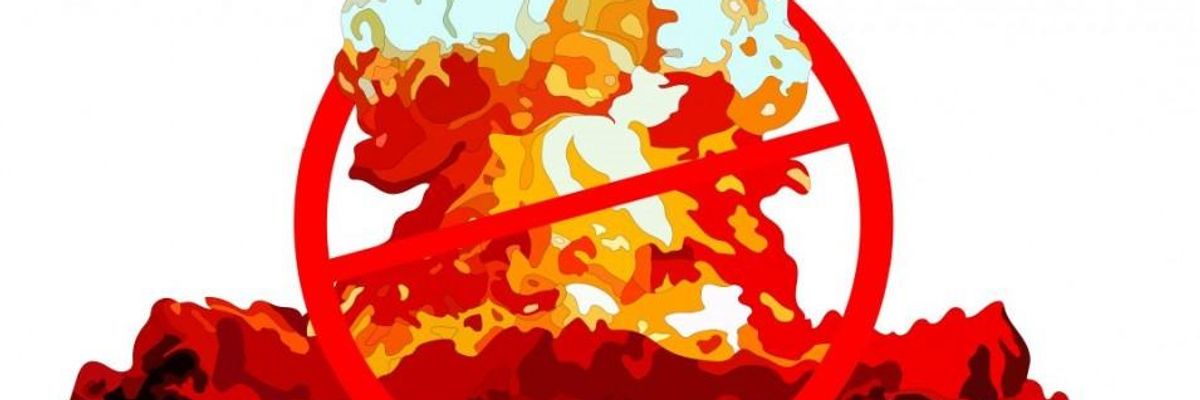
Why does it take a pandemic to get the world to stop fighting? Are we being led by 3-year-olds? (Photo: Shutterstock)
Can We Achieve Nuclear Adulthood?
Half the money the world spends on militarism—including nukes —every year is hemorrhaged by the United States of America.
"I'll never tire of repeating: We need to demilitarize world affairs, international politics and political thinking."
What if a world leader -- someone with extraordinary power, even, my God, control over nuclear weapons -- were to talk this way? Well, this is as close as we can get for now. The words are those of Mikhail Gorbachev, writing recently in Time magazine about the pandemic and its revelation of "how fragile" our planet is.
"What we urgently need now is a rethinking of the entire concept of security. Even after the end of the Cold War, it has been envisioned mostly in military terms. Over the past few years, all we've been hearing is talk about weapons, missiles and airstrikes. . . .
"Is it not clear by now that wars and the arms race cannot solve today's global problems? War is a sign of defeat, a failure of politics."
If only such words had resonance in the linear world of geopolitics, where militarism and mysteriously determined "national interest" rule and security means -- though it is never put this way -- playing games with Armageddon. This is called realism. And those who claim to be realists never -- ever, ever -- allow a word like "disarmament" into the conversation, much less into the realm of political choice.
Sorry, Mikhail. You're old and out of it. When national security is discussed in military terms, it is discussed only in military terms.
Thus, a recent issue of Popular Mechanics investigated whether the nation was still safe from, you know, its enemies during the pandemic. Typically, any complex scrutiny of militarized security was avoided and the article limited itself to the mechanics of nuclear deterrence, which, we are informed, "requires extreme levels of readiness among pilots, maintenance crews, and security teams."
Yes, that makes sense, but then, in the same paragraph, the article quietly transitions from mechanics to ideology: "Adversaries that don't think the U.S. can respond with conventional bombing strikes or nukes could be emboldened to act aggressively."
Nuclear war has no borders and, if unleashed, would destroy the whole planet.
Pandemic or no pandemic, our enemies are still focused on any opening in our nuclear defense system and -- who can prove otherwise? -- might well jump at the opportunity to send us to Kingdom Come if the opportunity arises. When it comes to geopolitics, fear is all you need to understand. Therefore, as Gen. Timothy M. Ray, commander of Air Force Global Strike Command, explained:
"Our long-range strike capability from bombers, both conventional and nuclear, and our ICBMs have to continue to operate in the background and to do what's needed, when it's needed."
He added that the American nuclear arsenal, just in case there were any doubts, is "the foundation of the security structure of the free world. We know that and we've got to make sure that it's viable."
My point here isn't that militarized security is wrong (necessarily), but that when it's discussed, the maintenance of such security is presented with only a single potential downside: The shape-shifting enemy that has hated our values for, lo, the last three-quarters of a century, that wants our wealth, that can't tolerate the idea of democracy, that manifests evil itself, could grab our power and take over the world if we let up in our nuclear and conventional readiness even for a moment, or fail to continue developing the next generation of weaponry.
Here are some things that generally do not get to be part of the discussion -- because, if they were, they would make the military-industrial reasoning collapse in half a second: 1. Nuclear war has no borders and, if unleashed, would destroy the whole planet. 2. Even if we "won" a nuclear war, uh, did you ever hear of nuclear winter? 3. The nations of the world spend about $2 trillion a year on wars and weaponry, which of course is money that could be spent ending poverty, saving lives, providing educational opportunities and, generally, healing the wounds that keep promulgating wars in the first place. 4. Over the last ten or so millennia, no war has ever created peace. 5. Our real enemy is not some other country but climate collapse caused by endless human exploitation of the natural world -- much of it perpetuated by war--and absolutely the only way to deal with this looming disaster is via unprecedented geopolitical cooperation.
The Christian Science Monitor recently took a broader look at nukes and militarism in the time of COVID-19, quoting former NATO Deputy Secretary General Rose Gottemoeller: "I continue to believe that the coronavirus pandemic is providing an opportunity for leaders to come together around international institutions and agreements and to restate commitments to international cooperation."
This definitely seemed a little more hopeful, but as I read her words, I couldn't help wondering: Why does it take a pandemic to get the world to stop fighting? Are we being led by 3-year-olds? Fascinatingly, as the article continued, Gottemoeller herself addressed the matter as though it involved 3-year-olds, referring to several countries as "mischief-makers" in the nuclear arena.
Which countries? North Korea and Iran.
God help us if we're the nuclear adults--U.S.A.! U.S.A.! Half the money the world spends on militarism--including nukes --every year is hemorrhaged by the United States of America.
And, as Medea Benjamin and Nicolas J.S. Davies note: "Bipartisan hostility to Russia and China is only helping to justify the Pentagon's pivot from 'counterterrorism' to its New Cold War with our nuclear-armed neighbors and trillions of dollars in spending on new weapons that make the world more dangerous for all of us."
And then, of course, there's the nation's mischief-maker-in chief. I wonder if Gorbachev would be interested in running against him this fall?

Urgent. It's never been this bad.
Dear Common Dreams reader, It’s been nearly 30 years since I co-founded Common Dreams with my late wife, Lina Newhouser. We had the radical notion that journalism should serve the public good, not corporate profits. It was clear to us from the outset what it would take to build such a project. No paid advertisements. No corporate sponsors. No millionaire publisher telling us what to think or do. Many people said we wouldn't last a year, but we proved those doubters wrong. Together with a tremendous team of journalists and dedicated staff, we built an independent media outlet free from the constraints of profits and corporate control. Our mission from the outset was simple. To inform. To inspire. To ignite change for the common good. Building Common Dreams was not easy. Our survival was never guaranteed. When you take on the most powerful forces—Wall Street greed, fossil fuel industry destruction, Big Tech lobbyists, and uber-rich oligarchs who have spent billions upon billions rigging the economy and democracy in their favor—the only bulwark you have is supporters who believe in your work. But here’s the urgent message from me today. It’s never been this bad out there. And it’s never been this hard to keep us going. At the very moment Common Dreams is most needed and doing some of its best and most important work, the threats we face are intensifying. Right now, with just two days to go in our Spring Campaign, we're falling short of our make-or-break goal. When everyone does the little they can afford, we are strong. But if that support retreats or dries up, so do we. Can you make a gift right now to make sure Common Dreams not only survives but thrives? There is no backup plan or rainy day fund. There is only you. —Craig Brown, Co-founder |
"I'll never tire of repeating: We need to demilitarize world affairs, international politics and political thinking."
What if a world leader -- someone with extraordinary power, even, my God, control over nuclear weapons -- were to talk this way? Well, this is as close as we can get for now. The words are those of Mikhail Gorbachev, writing recently in Time magazine about the pandemic and its revelation of "how fragile" our planet is.
"What we urgently need now is a rethinking of the entire concept of security. Even after the end of the Cold War, it has been envisioned mostly in military terms. Over the past few years, all we've been hearing is talk about weapons, missiles and airstrikes. . . .
"Is it not clear by now that wars and the arms race cannot solve today's global problems? War is a sign of defeat, a failure of politics."
If only such words had resonance in the linear world of geopolitics, where militarism and mysteriously determined "national interest" rule and security means -- though it is never put this way -- playing games with Armageddon. This is called realism. And those who claim to be realists never -- ever, ever -- allow a word like "disarmament" into the conversation, much less into the realm of political choice.
Sorry, Mikhail. You're old and out of it. When national security is discussed in military terms, it is discussed only in military terms.
Thus, a recent issue of Popular Mechanics investigated whether the nation was still safe from, you know, its enemies during the pandemic. Typically, any complex scrutiny of militarized security was avoided and the article limited itself to the mechanics of nuclear deterrence, which, we are informed, "requires extreme levels of readiness among pilots, maintenance crews, and security teams."
Yes, that makes sense, but then, in the same paragraph, the article quietly transitions from mechanics to ideology: "Adversaries that don't think the U.S. can respond with conventional bombing strikes or nukes could be emboldened to act aggressively."
Nuclear war has no borders and, if unleashed, would destroy the whole planet.
Pandemic or no pandemic, our enemies are still focused on any opening in our nuclear defense system and -- who can prove otherwise? -- might well jump at the opportunity to send us to Kingdom Come if the opportunity arises. When it comes to geopolitics, fear is all you need to understand. Therefore, as Gen. Timothy M. Ray, commander of Air Force Global Strike Command, explained:
"Our long-range strike capability from bombers, both conventional and nuclear, and our ICBMs have to continue to operate in the background and to do what's needed, when it's needed."
He added that the American nuclear arsenal, just in case there were any doubts, is "the foundation of the security structure of the free world. We know that and we've got to make sure that it's viable."
My point here isn't that militarized security is wrong (necessarily), but that when it's discussed, the maintenance of such security is presented with only a single potential downside: The shape-shifting enemy that has hated our values for, lo, the last three-quarters of a century, that wants our wealth, that can't tolerate the idea of democracy, that manifests evil itself, could grab our power and take over the world if we let up in our nuclear and conventional readiness even for a moment, or fail to continue developing the next generation of weaponry.
Here are some things that generally do not get to be part of the discussion -- because, if they were, they would make the military-industrial reasoning collapse in half a second: 1. Nuclear war has no borders and, if unleashed, would destroy the whole planet. 2. Even if we "won" a nuclear war, uh, did you ever hear of nuclear winter? 3. The nations of the world spend about $2 trillion a year on wars and weaponry, which of course is money that could be spent ending poverty, saving lives, providing educational opportunities and, generally, healing the wounds that keep promulgating wars in the first place. 4. Over the last ten or so millennia, no war has ever created peace. 5. Our real enemy is not some other country but climate collapse caused by endless human exploitation of the natural world -- much of it perpetuated by war--and absolutely the only way to deal with this looming disaster is via unprecedented geopolitical cooperation.
The Christian Science Monitor recently took a broader look at nukes and militarism in the time of COVID-19, quoting former NATO Deputy Secretary General Rose Gottemoeller: "I continue to believe that the coronavirus pandemic is providing an opportunity for leaders to come together around international institutions and agreements and to restate commitments to international cooperation."
This definitely seemed a little more hopeful, but as I read her words, I couldn't help wondering: Why does it take a pandemic to get the world to stop fighting? Are we being led by 3-year-olds? Fascinatingly, as the article continued, Gottemoeller herself addressed the matter as though it involved 3-year-olds, referring to several countries as "mischief-makers" in the nuclear arena.
Which countries? North Korea and Iran.
God help us if we're the nuclear adults--U.S.A.! U.S.A.! Half the money the world spends on militarism--including nukes --every year is hemorrhaged by the United States of America.
And, as Medea Benjamin and Nicolas J.S. Davies note: "Bipartisan hostility to Russia and China is only helping to justify the Pentagon's pivot from 'counterterrorism' to its New Cold War with our nuclear-armed neighbors and trillions of dollars in spending on new weapons that make the world more dangerous for all of us."
And then, of course, there's the nation's mischief-maker-in chief. I wonder if Gorbachev would be interested in running against him this fall?
"I'll never tire of repeating: We need to demilitarize world affairs, international politics and political thinking."
What if a world leader -- someone with extraordinary power, even, my God, control over nuclear weapons -- were to talk this way? Well, this is as close as we can get for now. The words are those of Mikhail Gorbachev, writing recently in Time magazine about the pandemic and its revelation of "how fragile" our planet is.
"What we urgently need now is a rethinking of the entire concept of security. Even after the end of the Cold War, it has been envisioned mostly in military terms. Over the past few years, all we've been hearing is talk about weapons, missiles and airstrikes. . . .
"Is it not clear by now that wars and the arms race cannot solve today's global problems? War is a sign of defeat, a failure of politics."
If only such words had resonance in the linear world of geopolitics, where militarism and mysteriously determined "national interest" rule and security means -- though it is never put this way -- playing games with Armageddon. This is called realism. And those who claim to be realists never -- ever, ever -- allow a word like "disarmament" into the conversation, much less into the realm of political choice.
Sorry, Mikhail. You're old and out of it. When national security is discussed in military terms, it is discussed only in military terms.
Thus, a recent issue of Popular Mechanics investigated whether the nation was still safe from, you know, its enemies during the pandemic. Typically, any complex scrutiny of militarized security was avoided and the article limited itself to the mechanics of nuclear deterrence, which, we are informed, "requires extreme levels of readiness among pilots, maintenance crews, and security teams."
Yes, that makes sense, but then, in the same paragraph, the article quietly transitions from mechanics to ideology: "Adversaries that don't think the U.S. can respond with conventional bombing strikes or nukes could be emboldened to act aggressively."
Nuclear war has no borders and, if unleashed, would destroy the whole planet.
Pandemic or no pandemic, our enemies are still focused on any opening in our nuclear defense system and -- who can prove otherwise? -- might well jump at the opportunity to send us to Kingdom Come if the opportunity arises. When it comes to geopolitics, fear is all you need to understand. Therefore, as Gen. Timothy M. Ray, commander of Air Force Global Strike Command, explained:
"Our long-range strike capability from bombers, both conventional and nuclear, and our ICBMs have to continue to operate in the background and to do what's needed, when it's needed."
He added that the American nuclear arsenal, just in case there were any doubts, is "the foundation of the security structure of the free world. We know that and we've got to make sure that it's viable."
My point here isn't that militarized security is wrong (necessarily), but that when it's discussed, the maintenance of such security is presented with only a single potential downside: The shape-shifting enemy that has hated our values for, lo, the last three-quarters of a century, that wants our wealth, that can't tolerate the idea of democracy, that manifests evil itself, could grab our power and take over the world if we let up in our nuclear and conventional readiness even for a moment, or fail to continue developing the next generation of weaponry.
Here are some things that generally do not get to be part of the discussion -- because, if they were, they would make the military-industrial reasoning collapse in half a second: 1. Nuclear war has no borders and, if unleashed, would destroy the whole planet. 2. Even if we "won" a nuclear war, uh, did you ever hear of nuclear winter? 3. The nations of the world spend about $2 trillion a year on wars and weaponry, which of course is money that could be spent ending poverty, saving lives, providing educational opportunities and, generally, healing the wounds that keep promulgating wars in the first place. 4. Over the last ten or so millennia, no war has ever created peace. 5. Our real enemy is not some other country but climate collapse caused by endless human exploitation of the natural world -- much of it perpetuated by war--and absolutely the only way to deal with this looming disaster is via unprecedented geopolitical cooperation.
The Christian Science Monitor recently took a broader look at nukes and militarism in the time of COVID-19, quoting former NATO Deputy Secretary General Rose Gottemoeller: "I continue to believe that the coronavirus pandemic is providing an opportunity for leaders to come together around international institutions and agreements and to restate commitments to international cooperation."
This definitely seemed a little more hopeful, but as I read her words, I couldn't help wondering: Why does it take a pandemic to get the world to stop fighting? Are we being led by 3-year-olds? Fascinatingly, as the article continued, Gottemoeller herself addressed the matter as though it involved 3-year-olds, referring to several countries as "mischief-makers" in the nuclear arena.
Which countries? North Korea and Iran.
God help us if we're the nuclear adults--U.S.A.! U.S.A.! Half the money the world spends on militarism--including nukes --every year is hemorrhaged by the United States of America.
And, as Medea Benjamin and Nicolas J.S. Davies note: "Bipartisan hostility to Russia and China is only helping to justify the Pentagon's pivot from 'counterterrorism' to its New Cold War with our nuclear-armed neighbors and trillions of dollars in spending on new weapons that make the world more dangerous for all of us."
And then, of course, there's the nation's mischief-maker-in chief. I wonder if Gorbachev would be interested in running against him this fall?