SUBSCRIBE TO OUR FREE NEWSLETTER
Daily news & progressive opinion—funded by the people, not the corporations—delivered straight to your inbox.
5
#000000
#FFFFFF
To donate by check, phone, or other method, see our More Ways to Give page.
Daily news & progressive opinion—funded by the people, not the corporations—delivered straight to your inbox.
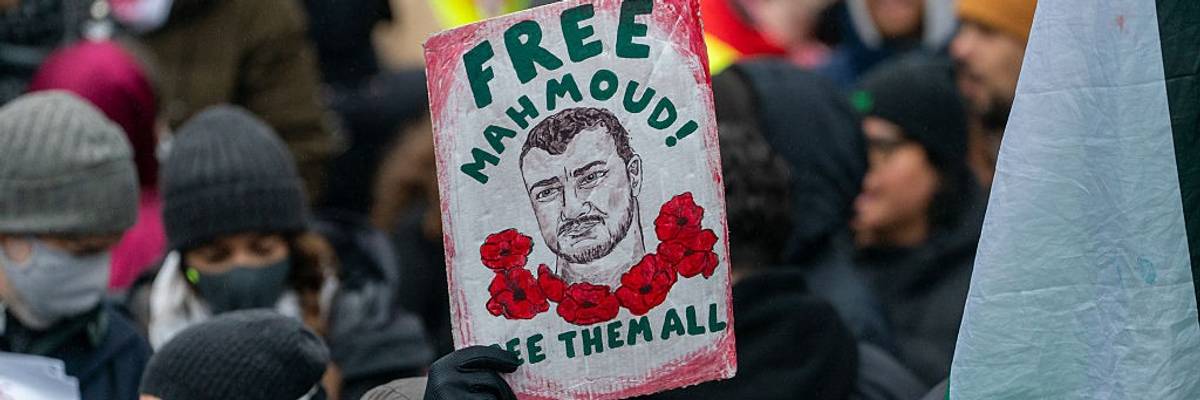
Demonstrators gather in Times Square in solidarity and to demand the release of detained Columbia University graduate student Mahmoud Khalil on April 12, 2025 in New York City.
In his new memoir, Mahmoud Khalil describes the moment he realized his detention was bigger than him.
I had the first call with my lawyers four days after my arrest. The guards escorted me to a room across the detention center, a multipurpose hall with scattered chairs and a small table and a phone next to the reinforced window overlooking the inner yard. Several people were already on the call, attorneys whose names and faces I would see on the screen over the next hundred days. They asked me to confirm that I was alone. I did. “Do a visual sweep,” one of them suggested. I scanned the room and checked the corners, beneath the air-conditioning vents, along the ceiling lights, searching for something I couldn’t name. It felt performative. If they wanted to listen, they would listen.
The lawyers filled me in on the court proceedings so far. I had so many questions. They tumbled out of me, one after another, the accumulation of four days of confusion and dread. How could they do this? What are the charges? How is any of this legal? When will I be out? When will I be returned to New York?
They had no conclusive answers, only mostly legal terminology that obscured as much as it revealed. The lawyers were careful with their words, precise in ways that frustrated me. I wanted certainty. They could only offer procedure.
The king wanted to send a message, and I was the messenger, sent to everyone who might consider speaking out.
They explained that they had filed something called a habeas corpus petition on my behalf. It sounded ancient, almost biblical. Baher, one of the lawyers, was generous enough to explain that the Latin phrase dated back to the Magna Carta, to the thirteenth century, when kings could make people disappear and the barons had to invent a mechanism to find them. Habeas corpus was a demand: Produce the body. Show us the prisoner. Justify his detention, or let him go.
I was the body in question, shipped over thirteen hundred miles from New York to Jena, Louisiana.
The habeas corpus petition had been filed in federal court in New York, along with two requests or motions, one for release on bail while the case continued and another to compel my return to New York. Federal court was different from immigration court, I learned. The separate immigration process would start in two weeks, which was indicated in the papers they had handed me in New York. I didn’t understand. It’s all the same country, the same system. What difference does it make which court hears my case, and where?
A huge difference, it turned out—one that would decide the fate of my case in the days to come. “Immigration court is not a real court,” one of the lawyers said. Immigration courts are the president’s courts, where arguments challenging presidential illegality are swallowed by the urgency of an executive campaign of mass deportation. Immigration judges are government employees, appointed by the attorney general, who is appointed by the president—the same president who had tweeted about me. In immigration court, there is no presumption of innocence, no jury or real independence. The process is designed for efficiency, not justice. Federal courts were different. The federal court is a constitutional court, which can hear constitutional claims against the executive branch. The judges are appointed for life. They don’t answer to the administration. They must follow the Constitution and case law. The government wanted my case in immigration court because the outcome was easier to control. In federal court, they would actually have to justify what they had done. In federal court, I might win.
The government had concealed my whereabouts in those first crucial hours, the lawyers said. They hadn’t known where I was. New York? Elsewhere? They had even tried tracking flights to Guantánamo. They had filed an emergency petition at 4:38 in the morning to prevent my deportation, but I had already been moved to New Jersey at that point. By the time everyone figured out I was in Louisiana, the government was arguing that any legal challenge should be heard there, not in New York.
Louisiana’s courts, heavily Republican, would be more favorable to the Trump administration. By moving me here, the government had shifted the fight to terrain they controlled, using geography as a weapon.
But there was another reason. They wanted to isolate me. In New York, I had my wife, friends, community, and the press. In Louisiana, I had nothing. I was alone in a facility in the middle of the woods, cut off from everyone who knew me.
The battle, then, was over two things: Which court system would hear my case, immigration or federal? And which venue, New York or Louisiana? Our argument was simple: I resided and was arrested in New York. This wasn’t really an immigration case. I wasn’t detained for violating immigration law. I was detained for what I said. For protesting and speaking out about Palestine. That made it a constitutional case, one where the First Amendment was crucial, and constitutional questions belong in federal court.
The government’s argument was equally simple: You’re an immigrant, now detained in Louisiana. This is an immigration matter. Stay in your lane.
It all sounded technical. Procedural. The kind of thing that puts people to sleep. But the venue and jurisdiction would determine everything. The government knew it. That’s why they had moved so fast to get me out of New York. That’s why they hid where they were taking me.
My case was the blueprint they wanted to set, and the one we had to tear up.
As the lawyers talked, I began to understand the scope of what I was facing. This was not a mistake. It was not overzealous enforcement. This was deliberate and planned at the highest levels of government. The president had tweeted my picture. The secretary of state had invoked obscure powers. Multiple agencies had worked together to snatch me from my home and transport me across the country in less than a day.
By the end of the call, one thing was clear: The lawyers were as shocked as I was. These were experienced attorneys: Some had worked on landmark Guantánamo cases. They had seen government abuse and overreach. But this was different: the speed, the secrecy, the coordination. The invocation of powers they had never seen used before. They compared it to the Red Scare.
“This provision the secretary of state used,” or the Rubio Determination, as it was called, “we’re not aware of it ever being applied in a case like this,” one of the lawyers said. “It’s unprecedented.” So I was not just a case; I was an experiment, I realized. The government was testing what it could get away with, using me as the test subject or “blueprint,” as the White House would boast. If they succeeded with me, a permanent resident with no criminal history, imagine what they could do to others. To the men sleeping in bunks around me, who had no lawyers, no press, no one watching. We would later learn, from the government’s own court filings, that this law had never before been used against anyone with my status.
My case was the blueprint they wanted to set, and the one we had to tear up.
This was the turning point, the moment when I grasped that this was bigger than me. It was bigger than my case, my green card, my deportation. I had not been detained for a crime I committed. They knew I never committed a crime. I was detained for what I represent, for saying something the king and his courtiers didn’t like.
The king wanted to send a message, and I was the messenger, sent to everyone who might consider speaking out. Every student who might join a protest would get the message, every person who might dare to criticize Israel or question American policy, domestic or foreign. The message was simple: This could be you. Your rights will not protect you. Your innocence will not protect you. We can take you in the night, and there is nothing you can do about it.
If I chose not to fight the case, I could “self-deport,” the lawyers explained, and leave “voluntarily.” But the Rubio Determination came with a lifetime ban against returning to the United States. We ended the call. I made no response to this offer. Maybe I should have.
Lying on my bunk that night, my eyes wrapped in a makeshift blindfold of socks, I knew I couldn’t walk away. If I left, they would call it a victory. They would say I must have been guilty of something. My departure would confirm their accusations without them having to prove anything. Every lie they told about me would be validated by my departure. The smear campaign would become the official record. And it wouldn’t end with me.
If I self-deported, I would be handing them the road map for silencing dissent. Immigrants joining a protest would remember that green cards offer no protection, that years of building a life in this country can be erased if the government doesn’t like their speech. Everyone would understand the new rules: Speak up, and we will find a way to make you disappear.
The Palestine solidarity movement in America was already under siege when I was abducted. Students had been doxxed, smeared, suspended, expelled. Others had lost their jobs for signing letters or joining a protest. During his presidential campaign, Trump vowed to donors who were furious at the student uprising that he would crush the pro-Palestine protests and “set that movement back twenty-five or thirty years.” My case was meant to be the capstone, proof that they could go further than suspensions and firings.
I thought about the students I had met at Columbia, the ones who had risked their careers to pitch tents on the lawn, to demand that the university divest from companies profiting from occupation. If I ran, what message would that send to them? That the fight wasn’t worth it? That when the pressure got real, even the people who told them to speak up would flee?
I thought about the Palestinians who had been waging this struggle for decades, long before it was fashionable, before celebrities posted about it on Instagram or walked red carpets with pins on their lapels. They had faced worse than arbitrary detention. They had faced ethnic cleansing, daily humiliation, dehumanization, imprisonment, the loss of everything. Who was I to give up at the first serious test? I thought of the people in Gaza buried beneath rubble while the world debated the justifications for their deaths. About farmers in the West Bank facing Israeli settlers burning their villages with impunity. About the millions of refugees, scattered across the world, still holding keys to the homes to which they could not return. They couldn’t self-deport out of their suffering. They couldn’t sign a paper to make it stop.
I was the test case. And I refused to comply.
Excerpted from NO LAND TO STAND ON: Notes from Detention by Mahmoud Khalil. Published by Metropolitan Books. Copyright © 2026 by Mahmoud Khalil. All rights reserved.
Dear Common Dreams reader, It’s been nearly 30 years since I co-founded Common Dreams with my late wife, Lina Newhouser. We had the radical notion that journalism should serve the public good, not corporate profits. It was clear to us from the outset what it would take to build such a project. No paid advertisements. No corporate sponsors. No millionaire publisher telling us what to think or do. Many people said we wouldn't last a year, but we proved those doubters wrong. Together with a tremendous team of journalists and dedicated staff, we built an independent media outlet free from the constraints of profits and corporate control. Our mission has always been simple: To inform. To inspire. To ignite change for the common good. Building Common Dreams was not easy. Our survival was never guaranteed. When you take on the most powerful forces—Wall Street greed, fossil fuel industry destruction, Big Tech lobbyists, and uber-rich oligarchs who have spent billions upon billions rigging the economy and democracy in their favor—the only bulwark you have is supporters who believe in your work. But here’s the urgent message from me today. It's never been this bad out there. And it's never been this hard to keep us going. At the very moment Common Dreams is most needed, the threats we face are intensifying. We need your support now more than ever. We don't accept corporate advertising and never will. We don't have a paywall because we don't think people should be blocked from critical news based on their ability to pay. Everything we do is funded by the donations of readers like you. When everyone does the little they can afford, we are strong. But if that support retreats or dries up, so do we. Will you donate now to make sure Common Dreams not only survives but thrives? —Craig Brown, Co-founder |
I had the first call with my lawyers four days after my arrest. The guards escorted me to a room across the detention center, a multipurpose hall with scattered chairs and a small table and a phone next to the reinforced window overlooking the inner yard. Several people were already on the call, attorneys whose names and faces I would see on the screen over the next hundred days. They asked me to confirm that I was alone. I did. “Do a visual sweep,” one of them suggested. I scanned the room and checked the corners, beneath the air-conditioning vents, along the ceiling lights, searching for something I couldn’t name. It felt performative. If they wanted to listen, they would listen.
The lawyers filled me in on the court proceedings so far. I had so many questions. They tumbled out of me, one after another, the accumulation of four days of confusion and dread. How could they do this? What are the charges? How is any of this legal? When will I be out? When will I be returned to New York?
They had no conclusive answers, only mostly legal terminology that obscured as much as it revealed. The lawyers were careful with their words, precise in ways that frustrated me. I wanted certainty. They could only offer procedure.
The king wanted to send a message, and I was the messenger, sent to everyone who might consider speaking out.
They explained that they had filed something called a habeas corpus petition on my behalf. It sounded ancient, almost biblical. Baher, one of the lawyers, was generous enough to explain that the Latin phrase dated back to the Magna Carta, to the thirteenth century, when kings could make people disappear and the barons had to invent a mechanism to find them. Habeas corpus was a demand: Produce the body. Show us the prisoner. Justify his detention, or let him go.
I was the body in question, shipped over thirteen hundred miles from New York to Jena, Louisiana.
The habeas corpus petition had been filed in federal court in New York, along with two requests or motions, one for release on bail while the case continued and another to compel my return to New York. Federal court was different from immigration court, I learned. The separate immigration process would start in two weeks, which was indicated in the papers they had handed me in New York. I didn’t understand. It’s all the same country, the same system. What difference does it make which court hears my case, and where?
A huge difference, it turned out—one that would decide the fate of my case in the days to come. “Immigration court is not a real court,” one of the lawyers said. Immigration courts are the president’s courts, where arguments challenging presidential illegality are swallowed by the urgency of an executive campaign of mass deportation. Immigration judges are government employees, appointed by the attorney general, who is appointed by the president—the same president who had tweeted about me. In immigration court, there is no presumption of innocence, no jury or real independence. The process is designed for efficiency, not justice. Federal courts were different. The federal court is a constitutional court, which can hear constitutional claims against the executive branch. The judges are appointed for life. They don’t answer to the administration. They must follow the Constitution and case law. The government wanted my case in immigration court because the outcome was easier to control. In federal court, they would actually have to justify what they had done. In federal court, I might win.
The government had concealed my whereabouts in those first crucial hours, the lawyers said. They hadn’t known where I was. New York? Elsewhere? They had even tried tracking flights to Guantánamo. They had filed an emergency petition at 4:38 in the morning to prevent my deportation, but I had already been moved to New Jersey at that point. By the time everyone figured out I was in Louisiana, the government was arguing that any legal challenge should be heard there, not in New York.
Louisiana’s courts, heavily Republican, would be more favorable to the Trump administration. By moving me here, the government had shifted the fight to terrain they controlled, using geography as a weapon.
But there was another reason. They wanted to isolate me. In New York, I had my wife, friends, community, and the press. In Louisiana, I had nothing. I was alone in a facility in the middle of the woods, cut off from everyone who knew me.
The battle, then, was over two things: Which court system would hear my case, immigration or federal? And which venue, New York or Louisiana? Our argument was simple: I resided and was arrested in New York. This wasn’t really an immigration case. I wasn’t detained for violating immigration law. I was detained for what I said. For protesting and speaking out about Palestine. That made it a constitutional case, one where the First Amendment was crucial, and constitutional questions belong in federal court.
The government’s argument was equally simple: You’re an immigrant, now detained in Louisiana. This is an immigration matter. Stay in your lane.
It all sounded technical. Procedural. The kind of thing that puts people to sleep. But the venue and jurisdiction would determine everything. The government knew it. That’s why they had moved so fast to get me out of New York. That’s why they hid where they were taking me.
My case was the blueprint they wanted to set, and the one we had to tear up.
As the lawyers talked, I began to understand the scope of what I was facing. This was not a mistake. It was not overzealous enforcement. This was deliberate and planned at the highest levels of government. The president had tweeted my picture. The secretary of state had invoked obscure powers. Multiple agencies had worked together to snatch me from my home and transport me across the country in less than a day.
By the end of the call, one thing was clear: The lawyers were as shocked as I was. These were experienced attorneys: Some had worked on landmark Guantánamo cases. They had seen government abuse and overreach. But this was different: the speed, the secrecy, the coordination. The invocation of powers they had never seen used before. They compared it to the Red Scare.
“This provision the secretary of state used,” or the Rubio Determination, as it was called, “we’re not aware of it ever being applied in a case like this,” one of the lawyers said. “It’s unprecedented.” So I was not just a case; I was an experiment, I realized. The government was testing what it could get away with, using me as the test subject or “blueprint,” as the White House would boast. If they succeeded with me, a permanent resident with no criminal history, imagine what they could do to others. To the men sleeping in bunks around me, who had no lawyers, no press, no one watching. We would later learn, from the government’s own court filings, that this law had never before been used against anyone with my status.
My case was the blueprint they wanted to set, and the one we had to tear up.
This was the turning point, the moment when I grasped that this was bigger than me. It was bigger than my case, my green card, my deportation. I had not been detained for a crime I committed. They knew I never committed a crime. I was detained for what I represent, for saying something the king and his courtiers didn’t like.
The king wanted to send a message, and I was the messenger, sent to everyone who might consider speaking out. Every student who might join a protest would get the message, every person who might dare to criticize Israel or question American policy, domestic or foreign. The message was simple: This could be you. Your rights will not protect you. Your innocence will not protect you. We can take you in the night, and there is nothing you can do about it.
If I chose not to fight the case, I could “self-deport,” the lawyers explained, and leave “voluntarily.” But the Rubio Determination came with a lifetime ban against returning to the United States. We ended the call. I made no response to this offer. Maybe I should have.
Lying on my bunk that night, my eyes wrapped in a makeshift blindfold of socks, I knew I couldn’t walk away. If I left, they would call it a victory. They would say I must have been guilty of something. My departure would confirm their accusations without them having to prove anything. Every lie they told about me would be validated by my departure. The smear campaign would become the official record. And it wouldn’t end with me.
If I self-deported, I would be handing them the road map for silencing dissent. Immigrants joining a protest would remember that green cards offer no protection, that years of building a life in this country can be erased if the government doesn’t like their speech. Everyone would understand the new rules: Speak up, and we will find a way to make you disappear.
The Palestine solidarity movement in America was already under siege when I was abducted. Students had been doxxed, smeared, suspended, expelled. Others had lost their jobs for signing letters or joining a protest. During his presidential campaign, Trump vowed to donors who were furious at the student uprising that he would crush the pro-Palestine protests and “set that movement back twenty-five or thirty years.” My case was meant to be the capstone, proof that they could go further than suspensions and firings.
I thought about the students I had met at Columbia, the ones who had risked their careers to pitch tents on the lawn, to demand that the university divest from companies profiting from occupation. If I ran, what message would that send to them? That the fight wasn’t worth it? That when the pressure got real, even the people who told them to speak up would flee?
I thought about the Palestinians who had been waging this struggle for decades, long before it was fashionable, before celebrities posted about it on Instagram or walked red carpets with pins on their lapels. They had faced worse than arbitrary detention. They had faced ethnic cleansing, daily humiliation, dehumanization, imprisonment, the loss of everything. Who was I to give up at the first serious test? I thought of the people in Gaza buried beneath rubble while the world debated the justifications for their deaths. About farmers in the West Bank facing Israeli settlers burning their villages with impunity. About the millions of refugees, scattered across the world, still holding keys to the homes to which they could not return. They couldn’t self-deport out of their suffering. They couldn’t sign a paper to make it stop.
I was the test case. And I refused to comply.
Excerpted from NO LAND TO STAND ON: Notes from Detention by Mahmoud Khalil. Published by Metropolitan Books. Copyright © 2026 by Mahmoud Khalil. All rights reserved.
I had the first call with my lawyers four days after my arrest. The guards escorted me to a room across the detention center, a multipurpose hall with scattered chairs and a small table and a phone next to the reinforced window overlooking the inner yard. Several people were already on the call, attorneys whose names and faces I would see on the screen over the next hundred days. They asked me to confirm that I was alone. I did. “Do a visual sweep,” one of them suggested. I scanned the room and checked the corners, beneath the air-conditioning vents, along the ceiling lights, searching for something I couldn’t name. It felt performative. If they wanted to listen, they would listen.
The lawyers filled me in on the court proceedings so far. I had so many questions. They tumbled out of me, one after another, the accumulation of four days of confusion and dread. How could they do this? What are the charges? How is any of this legal? When will I be out? When will I be returned to New York?
They had no conclusive answers, only mostly legal terminology that obscured as much as it revealed. The lawyers were careful with their words, precise in ways that frustrated me. I wanted certainty. They could only offer procedure.
The king wanted to send a message, and I was the messenger, sent to everyone who might consider speaking out.
They explained that they had filed something called a habeas corpus petition on my behalf. It sounded ancient, almost biblical. Baher, one of the lawyers, was generous enough to explain that the Latin phrase dated back to the Magna Carta, to the thirteenth century, when kings could make people disappear and the barons had to invent a mechanism to find them. Habeas corpus was a demand: Produce the body. Show us the prisoner. Justify his detention, or let him go.
I was the body in question, shipped over thirteen hundred miles from New York to Jena, Louisiana.
The habeas corpus petition had been filed in federal court in New York, along with two requests or motions, one for release on bail while the case continued and another to compel my return to New York. Federal court was different from immigration court, I learned. The separate immigration process would start in two weeks, which was indicated in the papers they had handed me in New York. I didn’t understand. It’s all the same country, the same system. What difference does it make which court hears my case, and where?
A huge difference, it turned out—one that would decide the fate of my case in the days to come. “Immigration court is not a real court,” one of the lawyers said. Immigration courts are the president’s courts, where arguments challenging presidential illegality are swallowed by the urgency of an executive campaign of mass deportation. Immigration judges are government employees, appointed by the attorney general, who is appointed by the president—the same president who had tweeted about me. In immigration court, there is no presumption of innocence, no jury or real independence. The process is designed for efficiency, not justice. Federal courts were different. The federal court is a constitutional court, which can hear constitutional claims against the executive branch. The judges are appointed for life. They don’t answer to the administration. They must follow the Constitution and case law. The government wanted my case in immigration court because the outcome was easier to control. In federal court, they would actually have to justify what they had done. In federal court, I might win.
The government had concealed my whereabouts in those first crucial hours, the lawyers said. They hadn’t known where I was. New York? Elsewhere? They had even tried tracking flights to Guantánamo. They had filed an emergency petition at 4:38 in the morning to prevent my deportation, but I had already been moved to New Jersey at that point. By the time everyone figured out I was in Louisiana, the government was arguing that any legal challenge should be heard there, not in New York.
Louisiana’s courts, heavily Republican, would be more favorable to the Trump administration. By moving me here, the government had shifted the fight to terrain they controlled, using geography as a weapon.
But there was another reason. They wanted to isolate me. In New York, I had my wife, friends, community, and the press. In Louisiana, I had nothing. I was alone in a facility in the middle of the woods, cut off from everyone who knew me.
The battle, then, was over two things: Which court system would hear my case, immigration or federal? And which venue, New York or Louisiana? Our argument was simple: I resided and was arrested in New York. This wasn’t really an immigration case. I wasn’t detained for violating immigration law. I was detained for what I said. For protesting and speaking out about Palestine. That made it a constitutional case, one where the First Amendment was crucial, and constitutional questions belong in federal court.
The government’s argument was equally simple: You’re an immigrant, now detained in Louisiana. This is an immigration matter. Stay in your lane.
It all sounded technical. Procedural. The kind of thing that puts people to sleep. But the venue and jurisdiction would determine everything. The government knew it. That’s why they had moved so fast to get me out of New York. That’s why they hid where they were taking me.
My case was the blueprint they wanted to set, and the one we had to tear up.
As the lawyers talked, I began to understand the scope of what I was facing. This was not a mistake. It was not overzealous enforcement. This was deliberate and planned at the highest levels of government. The president had tweeted my picture. The secretary of state had invoked obscure powers. Multiple agencies had worked together to snatch me from my home and transport me across the country in less than a day.
By the end of the call, one thing was clear: The lawyers were as shocked as I was. These were experienced attorneys: Some had worked on landmark Guantánamo cases. They had seen government abuse and overreach. But this was different: the speed, the secrecy, the coordination. The invocation of powers they had never seen used before. They compared it to the Red Scare.
“This provision the secretary of state used,” or the Rubio Determination, as it was called, “we’re not aware of it ever being applied in a case like this,” one of the lawyers said. “It’s unprecedented.” So I was not just a case; I was an experiment, I realized. The government was testing what it could get away with, using me as the test subject or “blueprint,” as the White House would boast. If they succeeded with me, a permanent resident with no criminal history, imagine what they could do to others. To the men sleeping in bunks around me, who had no lawyers, no press, no one watching. We would later learn, from the government’s own court filings, that this law had never before been used against anyone with my status.
My case was the blueprint they wanted to set, and the one we had to tear up.
This was the turning point, the moment when I grasped that this was bigger than me. It was bigger than my case, my green card, my deportation. I had not been detained for a crime I committed. They knew I never committed a crime. I was detained for what I represent, for saying something the king and his courtiers didn’t like.
The king wanted to send a message, and I was the messenger, sent to everyone who might consider speaking out. Every student who might join a protest would get the message, every person who might dare to criticize Israel or question American policy, domestic or foreign. The message was simple: This could be you. Your rights will not protect you. Your innocence will not protect you. We can take you in the night, and there is nothing you can do about it.
If I chose not to fight the case, I could “self-deport,” the lawyers explained, and leave “voluntarily.” But the Rubio Determination came with a lifetime ban against returning to the United States. We ended the call. I made no response to this offer. Maybe I should have.
Lying on my bunk that night, my eyes wrapped in a makeshift blindfold of socks, I knew I couldn’t walk away. If I left, they would call it a victory. They would say I must have been guilty of something. My departure would confirm their accusations without them having to prove anything. Every lie they told about me would be validated by my departure. The smear campaign would become the official record. And it wouldn’t end with me.
If I self-deported, I would be handing them the road map for silencing dissent. Immigrants joining a protest would remember that green cards offer no protection, that years of building a life in this country can be erased if the government doesn’t like their speech. Everyone would understand the new rules: Speak up, and we will find a way to make you disappear.
The Palestine solidarity movement in America was already under siege when I was abducted. Students had been doxxed, smeared, suspended, expelled. Others had lost their jobs for signing letters or joining a protest. During his presidential campaign, Trump vowed to donors who were furious at the student uprising that he would crush the pro-Palestine protests and “set that movement back twenty-five or thirty years.” My case was meant to be the capstone, proof that they could go further than suspensions and firings.
I thought about the students I had met at Columbia, the ones who had risked their careers to pitch tents on the lawn, to demand that the university divest from companies profiting from occupation. If I ran, what message would that send to them? That the fight wasn’t worth it? That when the pressure got real, even the people who told them to speak up would flee?
I thought about the Palestinians who had been waging this struggle for decades, long before it was fashionable, before celebrities posted about it on Instagram or walked red carpets with pins on their lapels. They had faced worse than arbitrary detention. They had faced ethnic cleansing, daily humiliation, dehumanization, imprisonment, the loss of everything. Who was I to give up at the first serious test? I thought of the people in Gaza buried beneath rubble while the world debated the justifications for their deaths. About farmers in the West Bank facing Israeli settlers burning their villages with impunity. About the millions of refugees, scattered across the world, still holding keys to the homes to which they could not return. They couldn’t self-deport out of their suffering. They couldn’t sign a paper to make it stop.
I was the test case. And I refused to comply.
Excerpted from NO LAND TO STAND ON: Notes from Detention by Mahmoud Khalil. Published by Metropolitan Books. Copyright © 2026 by Mahmoud Khalil. All rights reserved.