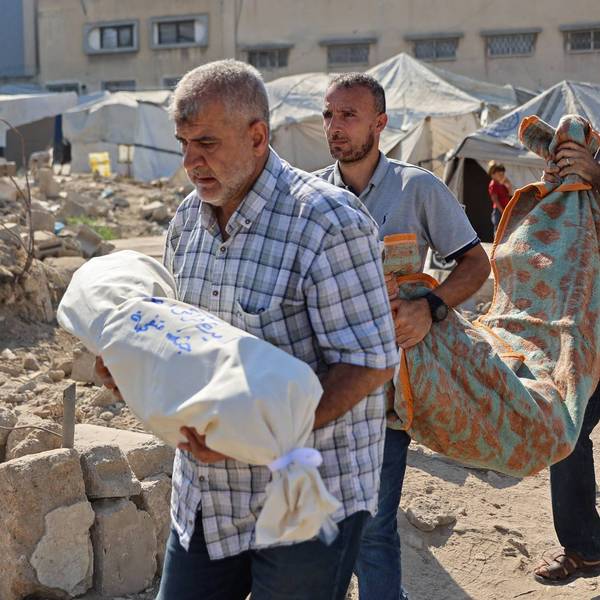
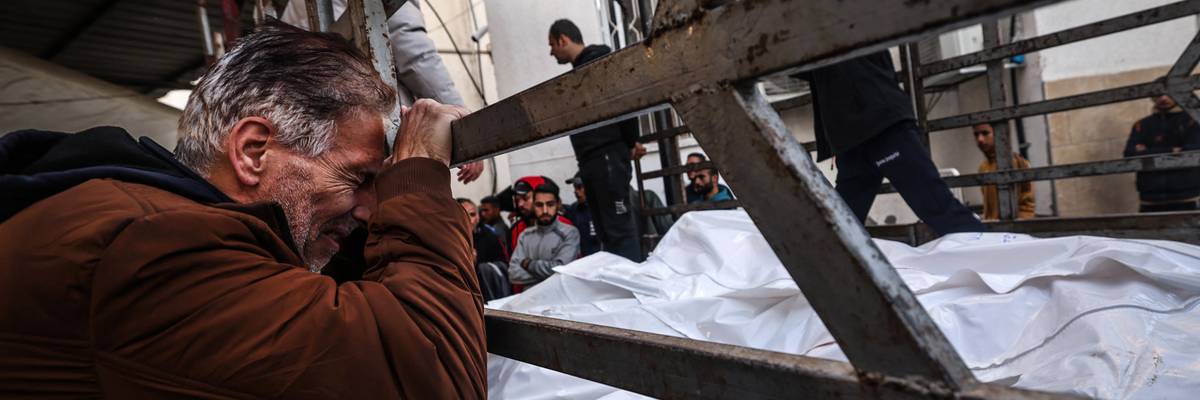
A man mourns as the shrouded bodies of loved ones killed during Israeli bombardment arrive at a Rafah hospital in the southern Gaza Strip on December 29, 2023.
The Erasure of Palestinians
“The Arab’s” range of emotion is limited to frothing, fanatical rage. We refuse to see his grief.
At the trial of God, we will ask: Why did you allow all this?
And the answer will be an echo: Why did you allow all this?
-Ilya Kaminsky, Deaf Republic
It’s jarring to see someone you’ve broken bread with—a former colleague, an acquaintance, a friend—suddenly become a cheerleader for ethnic cleansing. It’s an experience I have had repeatedly since October 7. People who I had believed were thoughtful and kind were now sharing social media posts calling for Israel to bomb mosques, schools, and hospitals in Gaza. They responded to any whisper of a cease-fire with wrath. And their zeal for collective punishment of Palestinians has not abated over time.
The moral certainty of these people, completely ahistorical, is crazy-making. As I try to make sense of the madness, I keep returning to one word: erasure. How else to explain a roomful of people hissing at and shouting down a rabbi who did nothing more than call for a cease-fire? If the Palestinians—the humans with full lives who love and are loved and feel pain—don’t exist (or are synonymous with Hamas), we don’t have to complicate our care for the lives of Israeli civilians with care for the lives of Palestinians. Erasure quiets cognitive dissonance, and anyone who calls for a cease-fire can then be demonized as someone who doesn’t care about the only lives that are seemingly at stake: Israeli lives.
The erasure of Palestinians isn’t new, whether viewed in the context of their own history or as one example among many of the erasure of Indigenous peoples in various settler-colonial projects.* But there’s not just erasure. There is also a construction (or perhaps you could call it a form of erasure), the accretion of images, stories, and insinuations that create the Frankenstein’s monster living in our heads as “the Arab” (especially, but not exclusively, the Arab man). “The Arab” is the terrorist, not a brother or a friend or a nurse or a tween or a poet or a grocery store worker who feels terror when deafening explosions reduce his apartment building to a pile of rubble in the middle of the night. “The Arab” is never the kindergartener with the Spider-Man backpack. “The Arab” is unworthy of our empathy no matter how young, because—we’re told—he’s taught to hate from the moment he leaves the womb, taught to cheer the killing of Jews.** “The Arab’s” range of emotion is limited to frothing, fanatical rage. We refuse to see his grief.
The powers-that-be... want history to begin on October 7, 2023, to sever the event from all that came before.
The New York Times has published numerous stories about October 7. Reading them, one learns the names and ages of those killed or taken hostage in the October 7 attacks. You learn the names of their family members, what their lives were like before the attacks, and the details of what they endured during the attacks. You come face-to-face with their fear and their trauma. But there are hardly any such stories about the over 21,000 Gazans who have been killed since October 7. For more than a month after October 7, nearly every NPR story I heard about the October 7 attack began with the words “Hamas’s brutal attack.” I searched in vain for instances of the word “brutal” being used to describe what Israel is doing to Gaza’s civilians. Instead, I found an article entitled “The Brutal Calculus of War: Is the Killing of Civilians Ever Justified?” It does not characterize the massacre of Gazans as “brutal” (or as a “massacre”). Instead, it says this:
Targeting civilians is a war crime. But what if there are civilians in or near a legitimate military target? This is where something in the laws of war called “proportionality” comes into play. As in, the military advantage must be proportionate to the loss of civilian life.
This just about sums up the discourse. Wholesale killing of Israelis: brutal. Wholesale killing of Palestinians: well, sometimes these things are inevitable, aren’t they, so the correct question to ask is about proportionality. The reaction to the killing of Israelis: visceral. The reaction to the killing of Palestinians: wrapped carefully in euphemism, almost mathematical. The “disregarding, essentializing, denuding the humanity” of a people that Edward Said described 45 years ago, continues.
Erasing a people also requires erasing history and memory. When you’re effectively banned from chanting “From the river to the sea, Palestine will be free,” what you’re being told is this: Don’t bring up anything pre-1948, or pre-1967, for that matter. Because if you start talking about history, you might start to see (among other things) the parallels between how Haifa was forcibly depopulated in 1948 and how Gaza is being forcibly depopulated in 2023: the warnings to leave, backed by the threat (soon carried out) of imminent indiscriminate bombing. Which is why, to borrow Arundhati Roy’s phrase, the powers-that-be always want to be the ones to “decide the most convenient place on which to airdrop history’s markers.” In this instance, they want history to begin on October 7, 2023, to sever the event from all that came before.
What do you do, then, faced with all of this? Do you close your eyes to the death and destruction being rained down on 2 million people? Do you quibble over whether activists should continue using a slogan that has become “controversial”? Do you accept as unremarkable the near-total absence of the Palestinian from the dominant narrative of what we’re witnessing? Or, do you use what you have—your voice, your body, money, access—to refuse to participate in the collective amnesia and erasure?
*For a history of Israel’s manifest-destinying itself into Palestine, facilitated by a consistent denial of the peoplehood of Palestine’s Indigenous population, see Rashid Khalidi’s The Hundred Years’ War on Palestine: A History of Settler Colonialism and Resistance, 1917-2017.
**What you won’t hear from those who dehumanize even Palestinian children this way, is that no group of people has a monopoly on tribal hate and indoctrination. See, for example, Nathan Thrall’s A Day in the Life of Abed Salama, which chronicles a horrific school bus accident outside Jerusalem in 2012 and the apartheid that bred conditions ripe for such an accident and the resulting deaths. Thrall writes about Israeli middle school and high school students who openly expressed glee on social media when they heard that the accident had burned several small Palestinian children to death.
We are at a crossroads
This country and this world are at a monumental crossroads. In a few short weeks, US voters will have an opportunity to beat back the forces of fascism and confront the billionaires who are rigging the economy, our media system, and our democracy, making it increasingly impossible for ordinary people to get by. We’re not just talking about the election. We’re talking about what must be done once these fascist elements are vanquished from power. We need a bolder set of solutions than what either major party has so far been willing to offer and a working-class movement ready to fight like hell for it. Trump didn't emerge from nowhere. The conditions that fueled MAGA authoritarianism were created by decades of radical neoliberal economic policies and a corrupt political system dominated by corporate interests. They slashed taxes on the super-rich, promising that the benefits would trickle down. They said giveaways to the corporate titans would make life more affordable for the rest of us. It was all bullshit. And when a bitter, betrayed populace searches for someone to blame, right-wing demagogues have little trouble finding scapegoats. People know when they're being lied to, but you won't hear any of this from the corporate media. Only independent journalism—powered and funded by people who believe in building a better world—can deliver truly trustworthy daily news. Our Fall Campaign is underway, and we need your help. To power our newsroom through the rest of the year, we need to raise $125,000 by midnight on October 31. So if you share our vision, please contribute whatever you can to sustain our work. |
At the trial of God, we will ask: Why did you allow all this?
And the answer will be an echo: Why did you allow all this?
-Ilya Kaminsky, Deaf Republic
It’s jarring to see someone you’ve broken bread with—a former colleague, an acquaintance, a friend—suddenly become a cheerleader for ethnic cleansing. It’s an experience I have had repeatedly since October 7. People who I had believed were thoughtful and kind were now sharing social media posts calling for Israel to bomb mosques, schools, and hospitals in Gaza. They responded to any whisper of a cease-fire with wrath. And their zeal for collective punishment of Palestinians has not abated over time.
The moral certainty of these people, completely ahistorical, is crazy-making. As I try to make sense of the madness, I keep returning to one word: erasure. How else to explain a roomful of people hissing at and shouting down a rabbi who did nothing more than call for a cease-fire? If the Palestinians—the humans with full lives who love and are loved and feel pain—don’t exist (or are synonymous with Hamas), we don’t have to complicate our care for the lives of Israeli civilians with care for the lives of Palestinians. Erasure quiets cognitive dissonance, and anyone who calls for a cease-fire can then be demonized as someone who doesn’t care about the only lives that are seemingly at stake: Israeli lives.
The erasure of Palestinians isn’t new, whether viewed in the context of their own history or as one example among many of the erasure of Indigenous peoples in various settler-colonial projects.* But there’s not just erasure. There is also a construction (or perhaps you could call it a form of erasure), the accretion of images, stories, and insinuations that create the Frankenstein’s monster living in our heads as “the Arab” (especially, but not exclusively, the Arab man). “The Arab” is the terrorist, not a brother or a friend or a nurse or a tween or a poet or a grocery store worker who feels terror when deafening explosions reduce his apartment building to a pile of rubble in the middle of the night. “The Arab” is never the kindergartener with the Spider-Man backpack. “The Arab” is unworthy of our empathy no matter how young, because—we’re told—he’s taught to hate from the moment he leaves the womb, taught to cheer the killing of Jews.** “The Arab’s” range of emotion is limited to frothing, fanatical rage. We refuse to see his grief.
The powers-that-be... want history to begin on October 7, 2023, to sever the event from all that came before.
The New York Times has published numerous stories about October 7. Reading them, one learns the names and ages of those killed or taken hostage in the October 7 attacks. You learn the names of their family members, what their lives were like before the attacks, and the details of what they endured during the attacks. You come face-to-face with their fear and their trauma. But there are hardly any such stories about the over 21,000 Gazans who have been killed since October 7. For more than a month after October 7, nearly every NPR story I heard about the October 7 attack began with the words “Hamas’s brutal attack.” I searched in vain for instances of the word “brutal” being used to describe what Israel is doing to Gaza’s civilians. Instead, I found an article entitled “The Brutal Calculus of War: Is the Killing of Civilians Ever Justified?” It does not characterize the massacre of Gazans as “brutal” (or as a “massacre”). Instead, it says this:
Targeting civilians is a war crime. But what if there are civilians in or near a legitimate military target? This is where something in the laws of war called “proportionality” comes into play. As in, the military advantage must be proportionate to the loss of civilian life.
This just about sums up the discourse. Wholesale killing of Israelis: brutal. Wholesale killing of Palestinians: well, sometimes these things are inevitable, aren’t they, so the correct question to ask is about proportionality. The reaction to the killing of Israelis: visceral. The reaction to the killing of Palestinians: wrapped carefully in euphemism, almost mathematical. The “disregarding, essentializing, denuding the humanity” of a people that Edward Said described 45 years ago, continues.
Erasing a people also requires erasing history and memory. When you’re effectively banned from chanting “From the river to the sea, Palestine will be free,” what you’re being told is this: Don’t bring up anything pre-1948, or pre-1967, for that matter. Because if you start talking about history, you might start to see (among other things) the parallels between how Haifa was forcibly depopulated in 1948 and how Gaza is being forcibly depopulated in 2023: the warnings to leave, backed by the threat (soon carried out) of imminent indiscriminate bombing. Which is why, to borrow Arundhati Roy’s phrase, the powers-that-be always want to be the ones to “decide the most convenient place on which to airdrop history’s markers.” In this instance, they want history to begin on October 7, 2023, to sever the event from all that came before.
What do you do, then, faced with all of this? Do you close your eyes to the death and destruction being rained down on 2 million people? Do you quibble over whether activists should continue using a slogan that has become “controversial”? Do you accept as unremarkable the near-total absence of the Palestinian from the dominant narrative of what we’re witnessing? Or, do you use what you have—your voice, your body, money, access—to refuse to participate in the collective amnesia and erasure?
*For a history of Israel’s manifest-destinying itself into Palestine, facilitated by a consistent denial of the peoplehood of Palestine’s Indigenous population, see Rashid Khalidi’s The Hundred Years’ War on Palestine: A History of Settler Colonialism and Resistance, 1917-2017.
**What you won’t hear from those who dehumanize even Palestinian children this way, is that no group of people has a monopoly on tribal hate and indoctrination. See, for example, Nathan Thrall’s A Day in the Life of Abed Salama, which chronicles a horrific school bus accident outside Jerusalem in 2012 and the apartheid that bred conditions ripe for such an accident and the resulting deaths. Thrall writes about Israeli middle school and high school students who openly expressed glee on social media when they heard that the accident had burned several small Palestinian children to death.
At the trial of God, we will ask: Why did you allow all this?
And the answer will be an echo: Why did you allow all this?
-Ilya Kaminsky, Deaf Republic
It’s jarring to see someone you’ve broken bread with—a former colleague, an acquaintance, a friend—suddenly become a cheerleader for ethnic cleansing. It’s an experience I have had repeatedly since October 7. People who I had believed were thoughtful and kind were now sharing social media posts calling for Israel to bomb mosques, schools, and hospitals in Gaza. They responded to any whisper of a cease-fire with wrath. And their zeal for collective punishment of Palestinians has not abated over time.
The moral certainty of these people, completely ahistorical, is crazy-making. As I try to make sense of the madness, I keep returning to one word: erasure. How else to explain a roomful of people hissing at and shouting down a rabbi who did nothing more than call for a cease-fire? If the Palestinians—the humans with full lives who love and are loved and feel pain—don’t exist (or are synonymous with Hamas), we don’t have to complicate our care for the lives of Israeli civilians with care for the lives of Palestinians. Erasure quiets cognitive dissonance, and anyone who calls for a cease-fire can then be demonized as someone who doesn’t care about the only lives that are seemingly at stake: Israeli lives.
The erasure of Palestinians isn’t new, whether viewed in the context of their own history or as one example among many of the erasure of Indigenous peoples in various settler-colonial projects.* But there’s not just erasure. There is also a construction (or perhaps you could call it a form of erasure), the accretion of images, stories, and insinuations that create the Frankenstein’s monster living in our heads as “the Arab” (especially, but not exclusively, the Arab man). “The Arab” is the terrorist, not a brother or a friend or a nurse or a tween or a poet or a grocery store worker who feels terror when deafening explosions reduce his apartment building to a pile of rubble in the middle of the night. “The Arab” is never the kindergartener with the Spider-Man backpack. “The Arab” is unworthy of our empathy no matter how young, because—we’re told—he’s taught to hate from the moment he leaves the womb, taught to cheer the killing of Jews.** “The Arab’s” range of emotion is limited to frothing, fanatical rage. We refuse to see his grief.
The powers-that-be... want history to begin on October 7, 2023, to sever the event from all that came before.
The New York Times has published numerous stories about October 7. Reading them, one learns the names and ages of those killed or taken hostage in the October 7 attacks. You learn the names of their family members, what their lives were like before the attacks, and the details of what they endured during the attacks. You come face-to-face with their fear and their trauma. But there are hardly any such stories about the over 21,000 Gazans who have been killed since October 7. For more than a month after October 7, nearly every NPR story I heard about the October 7 attack began with the words “Hamas’s brutal attack.” I searched in vain for instances of the word “brutal” being used to describe what Israel is doing to Gaza’s civilians. Instead, I found an article entitled “The Brutal Calculus of War: Is the Killing of Civilians Ever Justified?” It does not characterize the massacre of Gazans as “brutal” (or as a “massacre”). Instead, it says this:
Targeting civilians is a war crime. But what if there are civilians in or near a legitimate military target? This is where something in the laws of war called “proportionality” comes into play. As in, the military advantage must be proportionate to the loss of civilian life.
This just about sums up the discourse. Wholesale killing of Israelis: brutal. Wholesale killing of Palestinians: well, sometimes these things are inevitable, aren’t they, so the correct question to ask is about proportionality. The reaction to the killing of Israelis: visceral. The reaction to the killing of Palestinians: wrapped carefully in euphemism, almost mathematical. The “disregarding, essentializing, denuding the humanity” of a people that Edward Said described 45 years ago, continues.
Erasing a people also requires erasing history and memory. When you’re effectively banned from chanting “From the river to the sea, Palestine will be free,” what you’re being told is this: Don’t bring up anything pre-1948, or pre-1967, for that matter. Because if you start talking about history, you might start to see (among other things) the parallels between how Haifa was forcibly depopulated in 1948 and how Gaza is being forcibly depopulated in 2023: the warnings to leave, backed by the threat (soon carried out) of imminent indiscriminate bombing. Which is why, to borrow Arundhati Roy’s phrase, the powers-that-be always want to be the ones to “decide the most convenient place on which to airdrop history’s markers.” In this instance, they want history to begin on October 7, 2023, to sever the event from all that came before.
What do you do, then, faced with all of this? Do you close your eyes to the death and destruction being rained down on 2 million people? Do you quibble over whether activists should continue using a slogan that has become “controversial”? Do you accept as unremarkable the near-total absence of the Palestinian from the dominant narrative of what we’re witnessing? Or, do you use what you have—your voice, your body, money, access—to refuse to participate in the collective amnesia and erasure?
*For a history of Israel’s manifest-destinying itself into Palestine, facilitated by a consistent denial of the peoplehood of Palestine’s Indigenous population, see Rashid Khalidi’s The Hundred Years’ War on Palestine: A History of Settler Colonialism and Resistance, 1917-2017.
**What you won’t hear from those who dehumanize even Palestinian children this way, is that no group of people has a monopoly on tribal hate and indoctrination. See, for example, Nathan Thrall’s A Day in the Life of Abed Salama, which chronicles a horrific school bus accident outside Jerusalem in 2012 and the apartheid that bred conditions ripe for such an accident and the resulting deaths. Thrall writes about Israeli middle school and high school students who openly expressed glee on social media when they heard that the accident had burned several small Palestinian children to death.