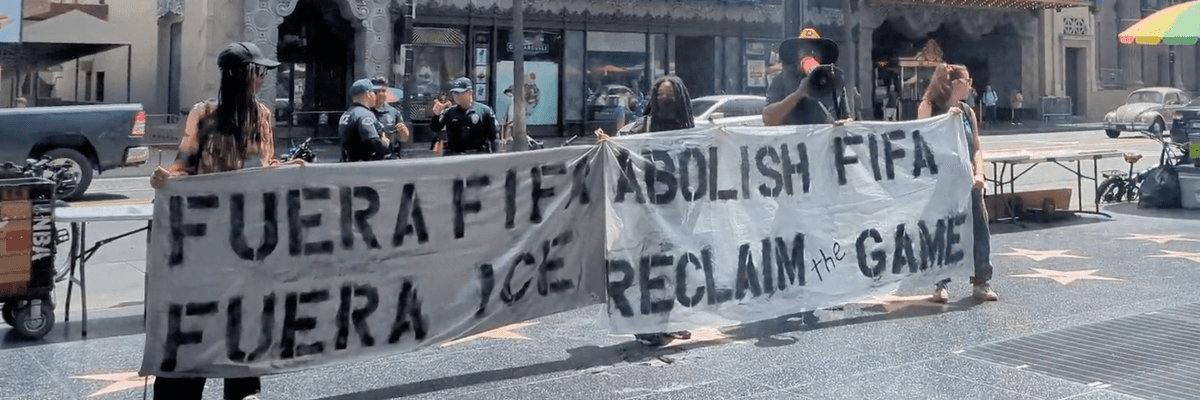
NOlympics LA and Black Alliance for Peace SoCal protest outside a Hollywood FIFA store.
LA Must Stop Bidding for Mega Sports Events
The city’s FIFA World Cup experience raises questions about the costs and benefits of hosting.
The FIFA World Cup is over, but with the 2027 Super Bowl and 2028 Olympics on the horizon, Los Angeles’ mega-event spree is just beginning. Paul Krekorian, a former LA City councilmember and now head of the mayor’s Office of Major Events, has declared the World Cup a triumph for the city.
“Even some of the naysayers about the ’28 [Olympic] games,” he told The New York Times, “will have to look at the unmitigated success of the World Cup here in Los Angeles and say, 'OK, now I understand what you’ve been talking about, when you talk about the benefit of major events. Now I get how this is beneficial to Angelenos.'”
As one of those so-called “naysayers,” I disagree. LA’s World Cup experience reinforces concerns about the city’s ongoing efforts to bring one sports mega event after another to the region. Hosting major events always gobbles up public resources that could otherwise be directed toward pressing needs, while host cities under pressure to sparkle on camera often violate residents’ rights.
The people paid to organize these big events, like Krekorian, love to repeat myths about mega-event benefits while pooh-poohing questions about the costs. But saying, "No" to more mega events is saying, "Yes’ to a city that puts residents ahead of corporate sponsors. It’s saying, "Yes" to a city that puts long-term planning ahead of last-minute scrambling.
The host committee’s human rights listicle fails to acknowledge that mega events’ own massive security apparatuses often threaten residents’ rights and safety.
Bidding to host one major sports event after another is the explicit goal of the LA Sports and Entertainment Commission (LASEC), a little-known but influential organization that acts as the local host committee for both the FIFA World Cup and the Super Bowl.
As LA’s World Cup host committee, LASEC has refused to publish the host city contract with FIFA. That means Angelenos do not know who exactly is paying—and how much they’re paying—for the significant additional city and county-run security, transportation, and sanitation services that come with hosting. Refusing to disclose that information is shady business. What is LASEC hiding? (Probably at least the fact that taxpayers are footing a large bill.) If LASEC leaders show such little regard for basic transparency, why should residents allow them to continue shaping the region’s commitments?
Because World Cup hosts have a record of violating human rights as they prepare for and host the mega event, each 2026 host committee was supposed to develop a plan to proactively protect human rights. LA’s long-overdue “plan” turned out to be a list of existing laws and hotlines. Several local advocacy groups have concluded that human rights were an afterthought for LASEC.
The host committee’s human rights listicle fails to acknowledge that mega events’ own massive security apparatuses often threaten residents’ rights and safety. On the day of the first game in the US, for example, snipers in military fatigues sat on rooftops about a mile from the temporarily renamed “Los Angeles Stadium,” pointing rifles down in the direction of Black and Latino kids playing soccer at a street festival. Over LA’s eight game days, the area around the stadium was teeming with local, state, and federal police. Some prevented local residents from accessing their own homes; some hassled and ticketed street vendors; and others monitored the area’s extensive (and expanding) AI-powered surveillance systems, technology that has been denounced by privacy and human rights organizations. Before and during the World Cup, federal agents conducted multiple raids on a LA city park, one where homelessness and drug use are visible. The raids allegedly targeted drug trafficking networks but have had the effects of displacing vulnerable individuals and disrupting essential harm reduction services. It seems likely these spectacular policing operations were timed with the park’s World Cup watch parties in mind.
The militarization of relatively small urban areas for the World Cup offers us just a taste of the much larger, more invasive operations Angelenos can expect to see with the 2028 Olympics, as police forces try to “secure” more of the region. Unfortunately, like LASEC, LA28 is showing little appetite to take human rights seriously. Its own months-late “human rights strategy” suggests unsheltered Angelenos will be displaced from event areas, a recipe for trampling on human rights. The strategy does not mention Immigration and Customs Enforcement once, even though ICE will be a core part of Olympic security operations. While there were few reports of ICE around the Los Angeles Stadium for the World Cup, ICE arrests surged across LA and the nation while we consumed the beautiful game. ICE’s efforts will be more concentrated on LA for the Olympics.
Krekorian talks up the benefits of hosting major events. The meager “legacy” projects promoted by LA’s World Cup Host Committee—26 community grants, two volunteer days, and one soccer clinic—reflects a paradigm shift from past World Cup and Olympic host cities that promised large-scale urban transformation as legacy projects. While it’s good that LA leaders aren’t overpromising at the same scale and public expense, we’re now left with a new question: Without marquee legacy investments, what justifies the financial and social costs of hosting?
LASEC argues that mega events bring lasting economic benefits, but these claims have been consistently debunked by economists. The assertion that events generate a long-term tourism boost? There’s little evidence of that for already popular destinations like LA. The promise of a short-term bump in tourist spending? Mega events attract sports-loving tourists but actually deter other potential visitors. So while attendees spend a lot of money at stadiums and multinational hotels, other cultural attractions and businesses struggle during big events. Just ask the Louvre about the Paris 2024 Olympics. During this World Cup, much like for the 2022 Super Bowl, the owners and staff of several local businesses near the Los Angeles Stadium told me game days were bad for business, as their regular customers stayed away to avoid chaotic traffic.
Beyond one-off grants and volunteer days, LA’s World Cup “legacy” boils down to intangibles, like the moments of collective effervescence and the sense of witnessing history. These intangibles are why I love watching the World Cup. But they do not justify the costs of hosting.
LASEC is unwilling to be transparent with the public and uninterested in grappling seriously with human rights concerns. This World Cup has not demonstrated that mega events generate substantive benefits that warrant the immense expenditure of city and county resources. LA must put a stop to LASEC’s plans to continue diverting public resources to one mega event after another.
We are at a crossroads
This country and this world are at a monumental crossroads. In a few short weeks, US voters will have an opportunity to beat back the forces of fascism and confront the billionaires who are rigging the economy, our media system, and our democracy, making it increasingly impossible for ordinary people to get by. We’re not just talking about the election. We’re talking about what must be done once these fascist elements are vanquished from power. We need a bolder set of solutions than what either major party has so far been willing to offer and a working-class movement ready to fight like hell for it. Trump didn't emerge from nowhere. The conditions that fueled MAGA authoritarianism were created by decades of radical neoliberal economic policies and a corrupt political system dominated by corporate interests. They slashed taxes on the super-rich, promising that the benefits would trickle down. They said giveaways to the corporate titans would make life more affordable for the rest of us. It was all bullshit. And when a bitter, betrayed populace searches for someone to blame, right-wing demagogues have little trouble finding scapegoats. People know when they're being lied to, but you won't hear any of this from the corporate media. Only independent journalism—powered and funded by people who believe in building a better world—can deliver truly trustworthy daily news. Our Fall Campaign is underway, and we need your help. To power our newsroom through the rest of the year, we need to raise $125,000 by midnight on October 31. So if you share our vision, please contribute whatever you can to sustain our work. |
The FIFA World Cup is over, but with the 2027 Super Bowl and 2028 Olympics on the horizon, Los Angeles’ mega-event spree is just beginning. Paul Krekorian, a former LA City councilmember and now head of the mayor’s Office of Major Events, has declared the World Cup a triumph for the city.
“Even some of the naysayers about the ’28 [Olympic] games,” he told The New York Times, “will have to look at the unmitigated success of the World Cup here in Los Angeles and say, 'OK, now I understand what you’ve been talking about, when you talk about the benefit of major events. Now I get how this is beneficial to Angelenos.'”
As one of those so-called “naysayers,” I disagree. LA’s World Cup experience reinforces concerns about the city’s ongoing efforts to bring one sports mega event after another to the region. Hosting major events always gobbles up public resources that could otherwise be directed toward pressing needs, while host cities under pressure to sparkle on camera often violate residents’ rights.
The people paid to organize these big events, like Krekorian, love to repeat myths about mega-event benefits while pooh-poohing questions about the costs. But saying, "No" to more mega events is saying, "Yes’ to a city that puts residents ahead of corporate sponsors. It’s saying, "Yes" to a city that puts long-term planning ahead of last-minute scrambling.
The host committee’s human rights listicle fails to acknowledge that mega events’ own massive security apparatuses often threaten residents’ rights and safety.
Bidding to host one major sports event after another is the explicit goal of the LA Sports and Entertainment Commission (LASEC), a little-known but influential organization that acts as the local host committee for both the FIFA World Cup and the Super Bowl.
As LA’s World Cup host committee, LASEC has refused to publish the host city contract with FIFA. That means Angelenos do not know who exactly is paying—and how much they’re paying—for the significant additional city and county-run security, transportation, and sanitation services that come with hosting. Refusing to disclose that information is shady business. What is LASEC hiding? (Probably at least the fact that taxpayers are footing a large bill.) If LASEC leaders show such little regard for basic transparency, why should residents allow them to continue shaping the region’s commitments?
Because World Cup hosts have a record of violating human rights as they prepare for and host the mega event, each 2026 host committee was supposed to develop a plan to proactively protect human rights. LA’s long-overdue “plan” turned out to be a list of existing laws and hotlines. Several local advocacy groups have concluded that human rights were an afterthought for LASEC.
The host committee’s human rights listicle fails to acknowledge that mega events’ own massive security apparatuses often threaten residents’ rights and safety. On the day of the first game in the US, for example, snipers in military fatigues sat on rooftops about a mile from the temporarily renamed “Los Angeles Stadium,” pointing rifles down in the direction of Black and Latino kids playing soccer at a street festival. Over LA’s eight game days, the area around the stadium was teeming with local, state, and federal police. Some prevented local residents from accessing their own homes; some hassled and ticketed street vendors; and others monitored the area’s extensive (and expanding) AI-powered surveillance systems, technology that has been denounced by privacy and human rights organizations. Before and during the World Cup, federal agents conducted multiple raids on a LA city park, one where homelessness and drug use are visible. The raids allegedly targeted drug trafficking networks but have had the effects of displacing vulnerable individuals and disrupting essential harm reduction services. It seems likely these spectacular policing operations were timed with the park’s World Cup watch parties in mind.
The militarization of relatively small urban areas for the World Cup offers us just a taste of the much larger, more invasive operations Angelenos can expect to see with the 2028 Olympics, as police forces try to “secure” more of the region. Unfortunately, like LASEC, LA28 is showing little appetite to take human rights seriously. Its own months-late “human rights strategy” suggests unsheltered Angelenos will be displaced from event areas, a recipe for trampling on human rights. The strategy does not mention Immigration and Customs Enforcement once, even though ICE will be a core part of Olympic security operations. While there were few reports of ICE around the Los Angeles Stadium for the World Cup, ICE arrests surged across LA and the nation while we consumed the beautiful game. ICE’s efforts will be more concentrated on LA for the Olympics.
Krekorian talks up the benefits of hosting major events. The meager “legacy” projects promoted by LA’s World Cup Host Committee—26 community grants, two volunteer days, and one soccer clinic—reflects a paradigm shift from past World Cup and Olympic host cities that promised large-scale urban transformation as legacy projects. While it’s good that LA leaders aren’t overpromising at the same scale and public expense, we’re now left with a new question: Without marquee legacy investments, what justifies the financial and social costs of hosting?
LASEC argues that mega events bring lasting economic benefits, but these claims have been consistently debunked by economists. The assertion that events generate a long-term tourism boost? There’s little evidence of that for already popular destinations like LA. The promise of a short-term bump in tourist spending? Mega events attract sports-loving tourists but actually deter other potential visitors. So while attendees spend a lot of money at stadiums and multinational hotels, other cultural attractions and businesses struggle during big events. Just ask the Louvre about the Paris 2024 Olympics. During this World Cup, much like for the 2022 Super Bowl, the owners and staff of several local businesses near the Los Angeles Stadium told me game days were bad for business, as their regular customers stayed away to avoid chaotic traffic.
Beyond one-off grants and volunteer days, LA’s World Cup “legacy” boils down to intangibles, like the moments of collective effervescence and the sense of witnessing history. These intangibles are why I love watching the World Cup. But they do not justify the costs of hosting.
LASEC is unwilling to be transparent with the public and uninterested in grappling seriously with human rights concerns. This World Cup has not demonstrated that mega events generate substantive benefits that warrant the immense expenditure of city and county resources. LA must put a stop to LASEC’s plans to continue diverting public resources to one mega event after another.
The FIFA World Cup is over, but with the 2027 Super Bowl and 2028 Olympics on the horizon, Los Angeles’ mega-event spree is just beginning. Paul Krekorian, a former LA City councilmember and now head of the mayor’s Office of Major Events, has declared the World Cup a triumph for the city.
“Even some of the naysayers about the ’28 [Olympic] games,” he told The New York Times, “will have to look at the unmitigated success of the World Cup here in Los Angeles and say, 'OK, now I understand what you’ve been talking about, when you talk about the benefit of major events. Now I get how this is beneficial to Angelenos.'”
As one of those so-called “naysayers,” I disagree. LA’s World Cup experience reinforces concerns about the city’s ongoing efforts to bring one sports mega event after another to the region. Hosting major events always gobbles up public resources that could otherwise be directed toward pressing needs, while host cities under pressure to sparkle on camera often violate residents’ rights.
The people paid to organize these big events, like Krekorian, love to repeat myths about mega-event benefits while pooh-poohing questions about the costs. But saying, "No" to more mega events is saying, "Yes’ to a city that puts residents ahead of corporate sponsors. It’s saying, "Yes" to a city that puts long-term planning ahead of last-minute scrambling.
The host committee’s human rights listicle fails to acknowledge that mega events’ own massive security apparatuses often threaten residents’ rights and safety.
Bidding to host one major sports event after another is the explicit goal of the LA Sports and Entertainment Commission (LASEC), a little-known but influential organization that acts as the local host committee for both the FIFA World Cup and the Super Bowl.
As LA’s World Cup host committee, LASEC has refused to publish the host city contract with FIFA. That means Angelenos do not know who exactly is paying—and how much they’re paying—for the significant additional city and county-run security, transportation, and sanitation services that come with hosting. Refusing to disclose that information is shady business. What is LASEC hiding? (Probably at least the fact that taxpayers are footing a large bill.) If LASEC leaders show such little regard for basic transparency, why should residents allow them to continue shaping the region’s commitments?
Because World Cup hosts have a record of violating human rights as they prepare for and host the mega event, each 2026 host committee was supposed to develop a plan to proactively protect human rights. LA’s long-overdue “plan” turned out to be a list of existing laws and hotlines. Several local advocacy groups have concluded that human rights were an afterthought for LASEC.
The host committee’s human rights listicle fails to acknowledge that mega events’ own massive security apparatuses often threaten residents’ rights and safety. On the day of the first game in the US, for example, snipers in military fatigues sat on rooftops about a mile from the temporarily renamed “Los Angeles Stadium,” pointing rifles down in the direction of Black and Latino kids playing soccer at a street festival. Over LA’s eight game days, the area around the stadium was teeming with local, state, and federal police. Some prevented local residents from accessing their own homes; some hassled and ticketed street vendors; and others monitored the area’s extensive (and expanding) AI-powered surveillance systems, technology that has been denounced by privacy and human rights organizations. Before and during the World Cup, federal agents conducted multiple raids on a LA city park, one where homelessness and drug use are visible. The raids allegedly targeted drug trafficking networks but have had the effects of displacing vulnerable individuals and disrupting essential harm reduction services. It seems likely these spectacular policing operations were timed with the park’s World Cup watch parties in mind.
The militarization of relatively small urban areas for the World Cup offers us just a taste of the much larger, more invasive operations Angelenos can expect to see with the 2028 Olympics, as police forces try to “secure” more of the region. Unfortunately, like LASEC, LA28 is showing little appetite to take human rights seriously. Its own months-late “human rights strategy” suggests unsheltered Angelenos will be displaced from event areas, a recipe for trampling on human rights. The strategy does not mention Immigration and Customs Enforcement once, even though ICE will be a core part of Olympic security operations. While there were few reports of ICE around the Los Angeles Stadium for the World Cup, ICE arrests surged across LA and the nation while we consumed the beautiful game. ICE’s efforts will be more concentrated on LA for the Olympics.
Krekorian talks up the benefits of hosting major events. The meager “legacy” projects promoted by LA’s World Cup Host Committee—26 community grants, two volunteer days, and one soccer clinic—reflects a paradigm shift from past World Cup and Olympic host cities that promised large-scale urban transformation as legacy projects. While it’s good that LA leaders aren’t overpromising at the same scale and public expense, we’re now left with a new question: Without marquee legacy investments, what justifies the financial and social costs of hosting?
LASEC argues that mega events bring lasting economic benefits, but these claims have been consistently debunked by economists. The assertion that events generate a long-term tourism boost? There’s little evidence of that for already popular destinations like LA. The promise of a short-term bump in tourist spending? Mega events attract sports-loving tourists but actually deter other potential visitors. So while attendees spend a lot of money at stadiums and multinational hotels, other cultural attractions and businesses struggle during big events. Just ask the Louvre about the Paris 2024 Olympics. During this World Cup, much like for the 2022 Super Bowl, the owners and staff of several local businesses near the Los Angeles Stadium told me game days were bad for business, as their regular customers stayed away to avoid chaotic traffic.
Beyond one-off grants and volunteer days, LA’s World Cup “legacy” boils down to intangibles, like the moments of collective effervescence and the sense of witnessing history. These intangibles are why I love watching the World Cup. But they do not justify the costs of hosting.
LASEC is unwilling to be transparent with the public and uninterested in grappling seriously with human rights concerns. This World Cup has not demonstrated that mega events generate substantive benefits that warrant the immense expenditure of city and county resources. LA must put a stop to LASEC’s plans to continue diverting public resources to one mega event after another.