

SUBSCRIBE TO OUR FREE NEWSLETTER
Daily news & progressive opinion—funded by the people, not the corporations—delivered straight to your inbox.
5
#000000
#FFFFFF
To donate by check, phone, or other method, see our More Ways to Give page.
Daily news & progressive opinion—funded by the people, not the corporations—delivered straight to your inbox.
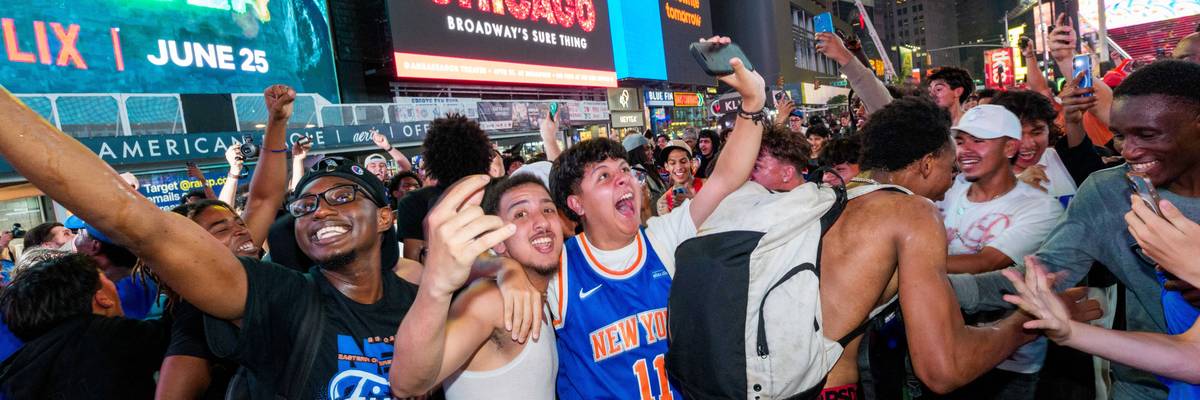
New York Knicks fans celebrate in Times Square as they win Game 4 of the NBA Finals between New York Knicks and San Antonio Spurs, on June 10, 2026 in New York City.
On Wednesday night, the Knicks embodied hope as remaining present. Hope as remaining committed. Hope as continuing to work when you are 29 points down and the other side is telling you they're in your head.
I was one of millions of people who died multiple times during Wednesday night's NBA Finals game. And I was among the millions who were reborn, multiple times, during that same game.
Much has been written about the power of sports, and I may not be adding anything new to the conversation. That's all right. Sometimes it is enough to join the chorus in effervescent awe. But like millions of others, I cannot help finding deep metaphor in being part of the Knicks family during these times of horror.
Wednesday's game broke records, first in the wrong direction. Shockingly early in the night, the Knicks fell behind by 29 points, on their way to the largest deficit ever overcome in NBA Finals history. They were down 27 at halftime; until this series, no team had rallied from more than 24 points in a Finals game, a mark set by the 2008 Celtics against the Lakers. The Spurs were shooting the lights out of Madison Square Garden, and their superstar seemed unstoppable. At one point, after absorbing a hard foul, he rose from the floor, pointed to his temple, and taunted: I'm in your head.
In my head, I felt nothing but devastation.
Fromm was right that art captures human experience better than abstraction ever could, and the art of basketball, through the brilliance of these Knicks, captures hope better than any essay I could write, including this one.
There is so much to be devastated about in this world. President Donald Trump is making a mockery of our dream of a democracy and of our collective efforts to build a more just world, taking our taxpayer money to wage a war (which he calls flippantly an excursion) on Iran that includes attacks on civilian infrastructure. He has torn into the White House itself, a building whose restrained architecture once symbolized a leadership that refused the grandiosity of false emperors. And this Sunday, on his 80th birthday, he is converting its South Lawn into a $60 million carnival of toxic masculinity: a cage-fighting spectacle staged to soothe an unbelievably fragile ego, men bashing into one another beneath the windows of the people's house.
This is only scratching the surface. If the Spurs were truly in our heads, the heads of so many of us in the United States and around the world, they would find us grappling to locate our way back to hope during this time of polycrises.
And yet, somehow, that is exactly what is happening. It has nothing to do with chest-thumping enactments of domination. Nor does it have anything to do with positive thinking, manifestation, or any other individualizing nonsense. The Knicks, friends, are showing us something about how communities find their way out of despair, and maybe even out of fascism.
The long arc toward justice is indeed long. It can look devastating. Unprecedented. It can break new records in how low it sinks. There might be a step toward the championship, and then suddenly the gap grows wider than it has ever been.
But Jalen Brunson and his teammates did not simply believe. They did not repeat mantras. They did not lash out with aggression because they were threatened and humiliated. They kept working. Possession by possession. A 13-0 run to claw the lead under 20. Brunson answering basket after basket, he would finish with 36 points, while OG Anunoby added 33 of his own.
Mariame Kaba, the brilliant abolitionist organizer and author, teaches us that hope is a discipline. Not a feeling that visits us when conditions improve, but a practice we commit to precisely when they don't. Half a century earlier, the critical psychologist Erich Fromm arrived at the same insight in The Revolution of Hope, distinguishing real hope from both passive optimism and desperate waiting. For Fromm, hope is active or it is nothing, a readiness to move toward what does not yet exist. He also warned that our language for experiences like hope has been flattened into "worn-out coins," and that art often captures what essays cannot.
On Wednesday night, the Knicks embodied what Kaba and Fromm theorized. Hope as remaining present. Hope as remaining committed. Hope as continuing to work when you are 29 points down and the other side is telling you they're in your head. That is hope. That is also how change happens.
Some fans at Madison Square Garden walked out early during those moments of deep devastation. I don't judge them, they weren't wrong about how bad it looked. They were only wrong about what it meant to stay. They read the score as the ending rather than the middle, and walking to the subway they missed witnessing one of the greatest moments in NBA history. So many around us conclude that the score of our democracy is final. Despair is a premature exit from a game that is still being played.
And, the lessons do not stop here. That winning basket, with 1.2 seconds left, was not a triumphant swish. Brunson's three-pointer missed. The game was won because Anunoby crashed the boards anyway and, unthinkably, miraculously, gloriously, tipped the miss in with one hand. The decisive act of the greatest comeback in Finals history was someone showing up for a shot that failed. If you want a single image of disciplined hope, there it is: The work continues even when the shot doesn't make it, especially when the shot doesn't make it.
I would be remiss as a critical psychologist if I did not name a very important irony playing out before us as well. The Spurs' young superstar is a French immigrant, beloved and celebrated by a state whose government has made the persecution of immigrants and white supremacy its signature project. None of this is his fault, he is 22 years old and magnificent at his craft, and he deserves none of our resentment. The contradiction belongs to Texas, and to a country that cheers immigrant excellence in its arenas while caging immigrant families at its borders.
So this is my invitation. This Saturday night, while the machinery of spectacle prepares the White House lawn for Sunday's celebration of brute force, watch the Knicks instead. Watch a group of people who were further down than anyone has ever been, who did not posture and did not quit, attempt to finish what they started, one win from the franchise's first championship since 1973. Fromm was right that art captures human experience better than abstraction ever could, and the art of basketball, through the brilliance of these Knicks, captures hope better than any essay I could write, including this one.
We need to understand how change happens in devastating times. We need to understand how we, too, can participate in revolutionary care. Not by thumping our chests when we are up. Not by throwing in the towel when we break records in our losses. But by continuing to show up. By the discipline of persisting, not out of naïve faith, but out of practice.
The game isn't over. Find your team, and keep making your way toward the basket. And, when it is time to celebrate, get in community and dance under those famous orange and blue skies!
Dear Common Dreams reader, It’s been nearly 30 years since I co-founded Common Dreams with my late wife, Lina Newhouser. We had the radical notion that journalism should serve the public good, not corporate profits. It was clear to us from the outset what it would take to build such a project. No paid advertisements. No corporate sponsors. No millionaire publisher telling us what to think or do. Many people said we wouldn't last a year, but we proved those doubters wrong. Together with a tremendous team of journalists and dedicated staff, we built an independent media outlet free from the constraints of profits and corporate control. Our mission has always been simple: To inform. To inspire. To ignite change for the common good. Building Common Dreams was not easy. Our survival was never guaranteed. When you take on the most powerful forces—Wall Street greed, fossil fuel industry destruction, Big Tech lobbyists, and uber-rich oligarchs who have spent billions upon billions rigging the economy and democracy in their favor—the only bulwark you have is supporters who believe in your work. But here’s the urgent message from me today. It's never been this bad out there. And it's never been this hard to keep us going. At the very moment Common Dreams is most needed, the threats we face are intensifying. We need your support now more than ever. We don't accept corporate advertising and never will. We don't have a paywall because we don't think people should be blocked from critical news based on their ability to pay. Everything we do is funded by the donations of readers like you. When everyone does the little they can afford, we are strong. But if that support retreats or dries up, so do we. Will you donate now to make sure Common Dreams not only survives but thrives? —Craig Brown, Co-founder |
I was one of millions of people who died multiple times during Wednesday night's NBA Finals game. And I was among the millions who were reborn, multiple times, during that same game.
Much has been written about the power of sports, and I may not be adding anything new to the conversation. That's all right. Sometimes it is enough to join the chorus in effervescent awe. But like millions of others, I cannot help finding deep metaphor in being part of the Knicks family during these times of horror.
Wednesday's game broke records, first in the wrong direction. Shockingly early in the night, the Knicks fell behind by 29 points, on their way to the largest deficit ever overcome in NBA Finals history. They were down 27 at halftime; until this series, no team had rallied from more than 24 points in a Finals game, a mark set by the 2008 Celtics against the Lakers. The Spurs were shooting the lights out of Madison Square Garden, and their superstar seemed unstoppable. At one point, after absorbing a hard foul, he rose from the floor, pointed to his temple, and taunted: I'm in your head.
In my head, I felt nothing but devastation.
Fromm was right that art captures human experience better than abstraction ever could, and the art of basketball, through the brilliance of these Knicks, captures hope better than any essay I could write, including this one.
There is so much to be devastated about in this world. President Donald Trump is making a mockery of our dream of a democracy and of our collective efforts to build a more just world, taking our taxpayer money to wage a war (which he calls flippantly an excursion) on Iran that includes attacks on civilian infrastructure. He has torn into the White House itself, a building whose restrained architecture once symbolized a leadership that refused the grandiosity of false emperors. And this Sunday, on his 80th birthday, he is converting its South Lawn into a $60 million carnival of toxic masculinity: a cage-fighting spectacle staged to soothe an unbelievably fragile ego, men bashing into one another beneath the windows of the people's house.
This is only scratching the surface. If the Spurs were truly in our heads, the heads of so many of us in the United States and around the world, they would find us grappling to locate our way back to hope during this time of polycrises.
And yet, somehow, that is exactly what is happening. It has nothing to do with chest-thumping enactments of domination. Nor does it have anything to do with positive thinking, manifestation, or any other individualizing nonsense. The Knicks, friends, are showing us something about how communities find their way out of despair, and maybe even out of fascism.
The long arc toward justice is indeed long. It can look devastating. Unprecedented. It can break new records in how low it sinks. There might be a step toward the championship, and then suddenly the gap grows wider than it has ever been.
But Jalen Brunson and his teammates did not simply believe. They did not repeat mantras. They did not lash out with aggression because they were threatened and humiliated. They kept working. Possession by possession. A 13-0 run to claw the lead under 20. Brunson answering basket after basket, he would finish with 36 points, while OG Anunoby added 33 of his own.
Mariame Kaba, the brilliant abolitionist organizer and author, teaches us that hope is a discipline. Not a feeling that visits us when conditions improve, but a practice we commit to precisely when they don't. Half a century earlier, the critical psychologist Erich Fromm arrived at the same insight in The Revolution of Hope, distinguishing real hope from both passive optimism and desperate waiting. For Fromm, hope is active or it is nothing, a readiness to move toward what does not yet exist. He also warned that our language for experiences like hope has been flattened into "worn-out coins," and that art often captures what essays cannot.
On Wednesday night, the Knicks embodied what Kaba and Fromm theorized. Hope as remaining present. Hope as remaining committed. Hope as continuing to work when you are 29 points down and the other side is telling you they're in your head. That is hope. That is also how change happens.
Some fans at Madison Square Garden walked out early during those moments of deep devastation. I don't judge them, they weren't wrong about how bad it looked. They were only wrong about what it meant to stay. They read the score as the ending rather than the middle, and walking to the subway they missed witnessing one of the greatest moments in NBA history. So many around us conclude that the score of our democracy is final. Despair is a premature exit from a game that is still being played.
And, the lessons do not stop here. That winning basket, with 1.2 seconds left, was not a triumphant swish. Brunson's three-pointer missed. The game was won because Anunoby crashed the boards anyway and, unthinkably, miraculously, gloriously, tipped the miss in with one hand. The decisive act of the greatest comeback in Finals history was someone showing up for a shot that failed. If you want a single image of disciplined hope, there it is: The work continues even when the shot doesn't make it, especially when the shot doesn't make it.
I would be remiss as a critical psychologist if I did not name a very important irony playing out before us as well. The Spurs' young superstar is a French immigrant, beloved and celebrated by a state whose government has made the persecution of immigrants and white supremacy its signature project. None of this is his fault, he is 22 years old and magnificent at his craft, and he deserves none of our resentment. The contradiction belongs to Texas, and to a country that cheers immigrant excellence in its arenas while caging immigrant families at its borders.
So this is my invitation. This Saturday night, while the machinery of spectacle prepares the White House lawn for Sunday's celebration of brute force, watch the Knicks instead. Watch a group of people who were further down than anyone has ever been, who did not posture and did not quit, attempt to finish what they started, one win from the franchise's first championship since 1973. Fromm was right that art captures human experience better than abstraction ever could, and the art of basketball, through the brilliance of these Knicks, captures hope better than any essay I could write, including this one.
We need to understand how change happens in devastating times. We need to understand how we, too, can participate in revolutionary care. Not by thumping our chests when we are up. Not by throwing in the towel when we break records in our losses. But by continuing to show up. By the discipline of persisting, not out of naïve faith, but out of practice.
The game isn't over. Find your team, and keep making your way toward the basket. And, when it is time to celebrate, get in community and dance under those famous orange and blue skies!
I was one of millions of people who died multiple times during Wednesday night's NBA Finals game. And I was among the millions who were reborn, multiple times, during that same game.
Much has been written about the power of sports, and I may not be adding anything new to the conversation. That's all right. Sometimes it is enough to join the chorus in effervescent awe. But like millions of others, I cannot help finding deep metaphor in being part of the Knicks family during these times of horror.
Wednesday's game broke records, first in the wrong direction. Shockingly early in the night, the Knicks fell behind by 29 points, on their way to the largest deficit ever overcome in NBA Finals history. They were down 27 at halftime; until this series, no team had rallied from more than 24 points in a Finals game, a mark set by the 2008 Celtics against the Lakers. The Spurs were shooting the lights out of Madison Square Garden, and their superstar seemed unstoppable. At one point, after absorbing a hard foul, he rose from the floor, pointed to his temple, and taunted: I'm in your head.
In my head, I felt nothing but devastation.
Fromm was right that art captures human experience better than abstraction ever could, and the art of basketball, through the brilliance of these Knicks, captures hope better than any essay I could write, including this one.
There is so much to be devastated about in this world. President Donald Trump is making a mockery of our dream of a democracy and of our collective efforts to build a more just world, taking our taxpayer money to wage a war (which he calls flippantly an excursion) on Iran that includes attacks on civilian infrastructure. He has torn into the White House itself, a building whose restrained architecture once symbolized a leadership that refused the grandiosity of false emperors. And this Sunday, on his 80th birthday, he is converting its South Lawn into a $60 million carnival of toxic masculinity: a cage-fighting spectacle staged to soothe an unbelievably fragile ego, men bashing into one another beneath the windows of the people's house.
This is only scratching the surface. If the Spurs were truly in our heads, the heads of so many of us in the United States and around the world, they would find us grappling to locate our way back to hope during this time of polycrises.
And yet, somehow, that is exactly what is happening. It has nothing to do with chest-thumping enactments of domination. Nor does it have anything to do with positive thinking, manifestation, or any other individualizing nonsense. The Knicks, friends, are showing us something about how communities find their way out of despair, and maybe even out of fascism.
The long arc toward justice is indeed long. It can look devastating. Unprecedented. It can break new records in how low it sinks. There might be a step toward the championship, and then suddenly the gap grows wider than it has ever been.
But Jalen Brunson and his teammates did not simply believe. They did not repeat mantras. They did not lash out with aggression because they were threatened and humiliated. They kept working. Possession by possession. A 13-0 run to claw the lead under 20. Brunson answering basket after basket, he would finish with 36 points, while OG Anunoby added 33 of his own.
Mariame Kaba, the brilliant abolitionist organizer and author, teaches us that hope is a discipline. Not a feeling that visits us when conditions improve, but a practice we commit to precisely when they don't. Half a century earlier, the critical psychologist Erich Fromm arrived at the same insight in The Revolution of Hope, distinguishing real hope from both passive optimism and desperate waiting. For Fromm, hope is active or it is nothing, a readiness to move toward what does not yet exist. He also warned that our language for experiences like hope has been flattened into "worn-out coins," and that art often captures what essays cannot.
On Wednesday night, the Knicks embodied what Kaba and Fromm theorized. Hope as remaining present. Hope as remaining committed. Hope as continuing to work when you are 29 points down and the other side is telling you they're in your head. That is hope. That is also how change happens.
Some fans at Madison Square Garden walked out early during those moments of deep devastation. I don't judge them, they weren't wrong about how bad it looked. They were only wrong about what it meant to stay. They read the score as the ending rather than the middle, and walking to the subway they missed witnessing one of the greatest moments in NBA history. So many around us conclude that the score of our democracy is final. Despair is a premature exit from a game that is still being played.
And, the lessons do not stop here. That winning basket, with 1.2 seconds left, was not a triumphant swish. Brunson's three-pointer missed. The game was won because Anunoby crashed the boards anyway and, unthinkably, miraculously, gloriously, tipped the miss in with one hand. The decisive act of the greatest comeback in Finals history was someone showing up for a shot that failed. If you want a single image of disciplined hope, there it is: The work continues even when the shot doesn't make it, especially when the shot doesn't make it.
I would be remiss as a critical psychologist if I did not name a very important irony playing out before us as well. The Spurs' young superstar is a French immigrant, beloved and celebrated by a state whose government has made the persecution of immigrants and white supremacy its signature project. None of this is his fault, he is 22 years old and magnificent at his craft, and he deserves none of our resentment. The contradiction belongs to Texas, and to a country that cheers immigrant excellence in its arenas while caging immigrant families at its borders.
So this is my invitation. This Saturday night, while the machinery of spectacle prepares the White House lawn for Sunday's celebration of brute force, watch the Knicks instead. Watch a group of people who were further down than anyone has ever been, who did not posture and did not quit, attempt to finish what they started, one win from the franchise's first championship since 1973. Fromm was right that art captures human experience better than abstraction ever could, and the art of basketball, through the brilliance of these Knicks, captures hope better than any essay I could write, including this one.
We need to understand how change happens in devastating times. We need to understand how we, too, can participate in revolutionary care. Not by thumping our chests when we are up. Not by throwing in the towel when we break records in our losses. But by continuing to show up. By the discipline of persisting, not out of naïve faith, but out of practice.
The game isn't over. Find your team, and keep making your way toward the basket. And, when it is time to celebrate, get in community and dance under those famous orange and blue skies!

