SUBSCRIBE TO OUR FREE NEWSLETTER
Daily news & progressive opinion—funded by the people, not the corporations—delivered straight to your inbox.
5
#000000
#FFFFFF
To donate by check, phone, or other method, see our More Ways to Give page.
Daily news & progressive opinion—funded by the people, not the corporations—delivered straight to your inbox.
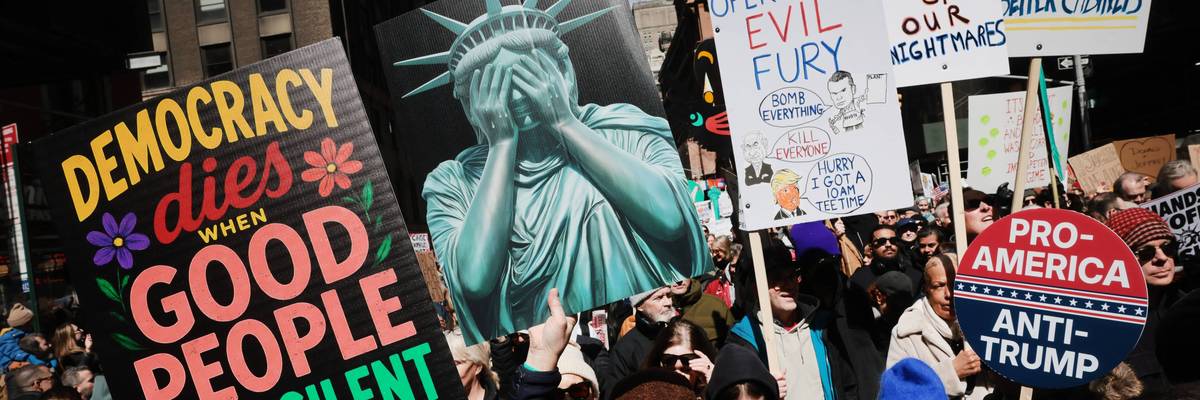
Protesters hold signs as they participate in a "No Kings" protest in Manhattan on March 28, 2026 in New York City.
Two major reports released this year tell a grim story: Global freedom continues to decline and the US has lost its longstanding classification a liberal democracy. But hope lies in the data.
The US score on the University of Gothenburg’s V-Dem Liberal Democracy Index declined by 24% in only one year, while its world rank dropped from 20th to 51st place out of 179 nations.” The US joins nearly a quarter of the world’s nations undergoing democratic backsliding, and is on its way to joining the three-quarters of the world population, some 6 billion people, who live in autocracies. If President Donald Trump’s first term “laid the foundation”, according to the report, the second term has seen the backslide quicken.
The bad news is now measurable. V-dem rates the US as an elected democracy, losing its higher position as a liberal democracy. V-dem points to a breakdown of liberal characteristics including freedom of expression, respect for civil liberties, and well-functioning checks and balances, especially those between the executive branch and the judiciary. Freedom House reports a similar dramatic decline. As does the Democracy Meter.
Such a democratic crash is typically associated with coup d’etats. According to V-Dem we are back to the lowest level of democracy since 1965, when President Lyndon B. Johnson signed the Voting Rights Act, establishing the US as a democracy that enfranchised, at least in law, all citizens.
Trump did not create our democratic weaknesses, but he is exploiting them. Power has been unevenly coalescing in the presidency since at least Andrew Jackson’s administration. Democrats have done little to roll back the executive overreach that marked George W. Bush’s post 9/11 War on Terror or Barack Obama’s drone strikes. Even former President Joe Biden could not help but overuse executive orders to overcome congressional gridlock. These precedents emboldened Trump. If the imperial presidency has previously been restricted to despotic rule abroad, it is now directed to the US' own citizens and subjects. Trump is the domestic return of the imperial boomerang, establishing what political theorist Nikhil Pal Singh calls a “Homeland Empire.”
The 2026 midterm elections are more than a referendum on Trump. They are a test of whether American democracy can repair itself.
We were warned. This most recent executive power grab was foreshadowed by the Project 2025 Heritage Foundation plan to enact “unitary executive theory.” By 2026, according to Project 2025 Tracker, half of the 320 objectives have been met. We have entered what former Republican adviser Gregg Nunziata calls “the age of American Caesarism.”
Still, buried within V-dem’s report are two important lessons of hope. The first lesson is that demand for democracy, as both a norm and practice, remains strong. Democracy remains powerful as an ideal, which is why even autocrats rarely reject elections outright and often rely on the appearance of democratic forms to confer legitimacy. Trump may troll liberals by cosplaying a king, selling 2028 merch, or even quipping in relation to the midterms that “when you think of it, we shouldn’t even have an election.” But Trump still requires elections to be viewed as legitimate—even within the Republican Party. Uncertainty in elections can never fully be removed while democracy remains the norm.
The second lesson is that the first election after a democratic slide is a pivotal moment to reverse the trend. This means the 2026 midterm elections are more than a referendum on Trump. They are a test of whether American democracy can repair itself. Elections remain dangerous to autocrats precisely because they cannot fully control what voters will do.
Nevertheless, autocrats still attempt to tilt the playing field in their favor. To consolidate their grip on power, autocrats engage in what Stephen Levitsky and Lucan Way call “competitive authoritarianism.” Opposition remains legal and elections are still contested. But authoritarians weaponize the executive and judicial machinery of the state to make opposition costly.
Taking a page out of the authoritarian playbook, Trump has worked to discipline institutions that might constrain him. He has filled the administrative state with party sycophants, hollowed out government agencies, and targeted media and universities. He wields violent rhetoric to delegitimize opposition, both antifa bogymen and centrist liberals, and pardons those who illegally act in the administration’s interests, encouraging others to act with impunity. The list goes on. The point is to intimidate civil society and silence dissent. Historian Timothy Snyder calls this “anticipatory obedience.”
The danger, however, is that Trump is not alone. His impulses have become intertwined with party strategy. Voting rights are the clearest example of this unified threat. Trump’s SAVE Act has stalled in the Senate, but the Roberts Court has arrived with the cavalry to fulfill the Republican party’s long-awaited agenda. The recent Callais v Louisiana has already revealed itself to be a cudgel in Black voting districts. In a perverse acceptance that racism no longer exists, the ruling has green-lit a gerrymander race to the bottom.
Trump is a political bully. He seeks to whittle us down with near constant reminders that he has the power and we do not. Broadly, this thumb-on-his nose strategy underpins his social media message. This is its only message: Power begets power. Trump is relying on us to accept defeat that has not yet occurred. But power is not the same as inevitability. Despite the increasingly stacked odds, the upcoming midterm elections are a pivotal moment to repudiate autocracy.
Justice Elena Kagan, in her stinging dissent in the Callais v Louisiana decision, reminds us that the Voting Rights Act “was born of the literal blood of Union soldiers and civil rights marchers” and “[brought] this Nation closer to fulfilling the ideals of democracy and racial equality.” Rights were born in struggle. They can be lost in despondency. We must remind ourselves that democratic institutions are not self-executing: We are the guardrails.
What I call a “living democracy” builds on the uncertainty and hope that lies within the heart of the democratic project. The late political theorist Sheldin Wolin named this hopefulness “fugitive democracy,” something fleeting that must be continually renewed. As Wolin writes, “The possibility of renewal draws on a simple fact: that ordinary individuals are capable of creating new cultural patterns of commonality at any moment.” It is up to us to rebuild hope in our political communities and in such numbers that we can defeat the electoral odds stacked against us.
Dear Common Dreams reader, It’s been nearly 30 years since I co-founded Common Dreams with my late wife, Lina Newhouser. We had the radical notion that journalism should serve the public good, not corporate profits. It was clear to us from the outset what it would take to build such a project. No paid advertisements. No corporate sponsors. No millionaire publisher telling us what to think or do. Many people said we wouldn't last a year, but we proved those doubters wrong. Together with a tremendous team of journalists and dedicated staff, we built an independent media outlet free from the constraints of profits and corporate control. Our mission has always been simple: To inform. To inspire. To ignite change for the common good. Building Common Dreams was not easy. Our survival was never guaranteed. When you take on the most powerful forces—Wall Street greed, fossil fuel industry destruction, Big Tech lobbyists, and uber-rich oligarchs who have spent billions upon billions rigging the economy and democracy in their favor—the only bulwark you have is supporters who believe in your work. But here’s the urgent message from me today. It's never been this bad out there. And it's never been this hard to keep us going. At the very moment Common Dreams is most needed, the threats we face are intensifying. We need your support now more than ever. We don't accept corporate advertising and never will. We don't have a paywall because we don't think people should be blocked from critical news based on their ability to pay. Everything we do is funded by the donations of readers like you. When everyone does the little they can afford, we are strong. But if that support retreats or dries up, so do we. Will you donate now to make sure Common Dreams not only survives but thrives? —Craig Brown, Co-founder |
The US score on the University of Gothenburg’s V-Dem Liberal Democracy Index declined by 24% in only one year, while its world rank dropped from 20th to 51st place out of 179 nations.” The US joins nearly a quarter of the world’s nations undergoing democratic backsliding, and is on its way to joining the three-quarters of the world population, some 6 billion people, who live in autocracies. If President Donald Trump’s first term “laid the foundation”, according to the report, the second term has seen the backslide quicken.
The bad news is now measurable. V-dem rates the US as an elected democracy, losing its higher position as a liberal democracy. V-dem points to a breakdown of liberal characteristics including freedom of expression, respect for civil liberties, and well-functioning checks and balances, especially those between the executive branch and the judiciary. Freedom House reports a similar dramatic decline. As does the Democracy Meter.
Such a democratic crash is typically associated with coup d’etats. According to V-Dem we are back to the lowest level of democracy since 1965, when President Lyndon B. Johnson signed the Voting Rights Act, establishing the US as a democracy that enfranchised, at least in law, all citizens.
Trump did not create our democratic weaknesses, but he is exploiting them. Power has been unevenly coalescing in the presidency since at least Andrew Jackson’s administration. Democrats have done little to roll back the executive overreach that marked George W. Bush’s post 9/11 War on Terror or Barack Obama’s drone strikes. Even former President Joe Biden could not help but overuse executive orders to overcome congressional gridlock. These precedents emboldened Trump. If the imperial presidency has previously been restricted to despotic rule abroad, it is now directed to the US' own citizens and subjects. Trump is the domestic return of the imperial boomerang, establishing what political theorist Nikhil Pal Singh calls a “Homeland Empire.”
The 2026 midterm elections are more than a referendum on Trump. They are a test of whether American democracy can repair itself.
We were warned. This most recent executive power grab was foreshadowed by the Project 2025 Heritage Foundation plan to enact “unitary executive theory.” By 2026, according to Project 2025 Tracker, half of the 320 objectives have been met. We have entered what former Republican adviser Gregg Nunziata calls “the age of American Caesarism.”
Still, buried within V-dem’s report are two important lessons of hope. The first lesson is that demand for democracy, as both a norm and practice, remains strong. Democracy remains powerful as an ideal, which is why even autocrats rarely reject elections outright and often rely on the appearance of democratic forms to confer legitimacy. Trump may troll liberals by cosplaying a king, selling 2028 merch, or even quipping in relation to the midterms that “when you think of it, we shouldn’t even have an election.” But Trump still requires elections to be viewed as legitimate—even within the Republican Party. Uncertainty in elections can never fully be removed while democracy remains the norm.
The second lesson is that the first election after a democratic slide is a pivotal moment to reverse the trend. This means the 2026 midterm elections are more than a referendum on Trump. They are a test of whether American democracy can repair itself. Elections remain dangerous to autocrats precisely because they cannot fully control what voters will do.
Nevertheless, autocrats still attempt to tilt the playing field in their favor. To consolidate their grip on power, autocrats engage in what Stephen Levitsky and Lucan Way call “competitive authoritarianism.” Opposition remains legal and elections are still contested. But authoritarians weaponize the executive and judicial machinery of the state to make opposition costly.
Taking a page out of the authoritarian playbook, Trump has worked to discipline institutions that might constrain him. He has filled the administrative state with party sycophants, hollowed out government agencies, and targeted media and universities. He wields violent rhetoric to delegitimize opposition, both antifa bogymen and centrist liberals, and pardons those who illegally act in the administration’s interests, encouraging others to act with impunity. The list goes on. The point is to intimidate civil society and silence dissent. Historian Timothy Snyder calls this “anticipatory obedience.”
The danger, however, is that Trump is not alone. His impulses have become intertwined with party strategy. Voting rights are the clearest example of this unified threat. Trump’s SAVE Act has stalled in the Senate, but the Roberts Court has arrived with the cavalry to fulfill the Republican party’s long-awaited agenda. The recent Callais v Louisiana has already revealed itself to be a cudgel in Black voting districts. In a perverse acceptance that racism no longer exists, the ruling has green-lit a gerrymander race to the bottom.
Trump is a political bully. He seeks to whittle us down with near constant reminders that he has the power and we do not. Broadly, this thumb-on-his nose strategy underpins his social media message. This is its only message: Power begets power. Trump is relying on us to accept defeat that has not yet occurred. But power is not the same as inevitability. Despite the increasingly stacked odds, the upcoming midterm elections are a pivotal moment to repudiate autocracy.
Justice Elena Kagan, in her stinging dissent in the Callais v Louisiana decision, reminds us that the Voting Rights Act “was born of the literal blood of Union soldiers and civil rights marchers” and “[brought] this Nation closer to fulfilling the ideals of democracy and racial equality.” Rights were born in struggle. They can be lost in despondency. We must remind ourselves that democratic institutions are not self-executing: We are the guardrails.
What I call a “living democracy” builds on the uncertainty and hope that lies within the heart of the democratic project. The late political theorist Sheldin Wolin named this hopefulness “fugitive democracy,” something fleeting that must be continually renewed. As Wolin writes, “The possibility of renewal draws on a simple fact: that ordinary individuals are capable of creating new cultural patterns of commonality at any moment.” It is up to us to rebuild hope in our political communities and in such numbers that we can defeat the electoral odds stacked against us.
The US score on the University of Gothenburg’s V-Dem Liberal Democracy Index declined by 24% in only one year, while its world rank dropped from 20th to 51st place out of 179 nations.” The US joins nearly a quarter of the world’s nations undergoing democratic backsliding, and is on its way to joining the three-quarters of the world population, some 6 billion people, who live in autocracies. If President Donald Trump’s first term “laid the foundation”, according to the report, the second term has seen the backslide quicken.
The bad news is now measurable. V-dem rates the US as an elected democracy, losing its higher position as a liberal democracy. V-dem points to a breakdown of liberal characteristics including freedom of expression, respect for civil liberties, and well-functioning checks and balances, especially those between the executive branch and the judiciary. Freedom House reports a similar dramatic decline. As does the Democracy Meter.
Such a democratic crash is typically associated with coup d’etats. According to V-Dem we are back to the lowest level of democracy since 1965, when President Lyndon B. Johnson signed the Voting Rights Act, establishing the US as a democracy that enfranchised, at least in law, all citizens.
Trump did not create our democratic weaknesses, but he is exploiting them. Power has been unevenly coalescing in the presidency since at least Andrew Jackson’s administration. Democrats have done little to roll back the executive overreach that marked George W. Bush’s post 9/11 War on Terror or Barack Obama’s drone strikes. Even former President Joe Biden could not help but overuse executive orders to overcome congressional gridlock. These precedents emboldened Trump. If the imperial presidency has previously been restricted to despotic rule abroad, it is now directed to the US' own citizens and subjects. Trump is the domestic return of the imperial boomerang, establishing what political theorist Nikhil Pal Singh calls a “Homeland Empire.”
The 2026 midterm elections are more than a referendum on Trump. They are a test of whether American democracy can repair itself.
We were warned. This most recent executive power grab was foreshadowed by the Project 2025 Heritage Foundation plan to enact “unitary executive theory.” By 2026, according to Project 2025 Tracker, half of the 320 objectives have been met. We have entered what former Republican adviser Gregg Nunziata calls “the age of American Caesarism.”
Still, buried within V-dem’s report are two important lessons of hope. The first lesson is that demand for democracy, as both a norm and practice, remains strong. Democracy remains powerful as an ideal, which is why even autocrats rarely reject elections outright and often rely on the appearance of democratic forms to confer legitimacy. Trump may troll liberals by cosplaying a king, selling 2028 merch, or even quipping in relation to the midterms that “when you think of it, we shouldn’t even have an election.” But Trump still requires elections to be viewed as legitimate—even within the Republican Party. Uncertainty in elections can never fully be removed while democracy remains the norm.
The second lesson is that the first election after a democratic slide is a pivotal moment to reverse the trend. This means the 2026 midterm elections are more than a referendum on Trump. They are a test of whether American democracy can repair itself. Elections remain dangerous to autocrats precisely because they cannot fully control what voters will do.
Nevertheless, autocrats still attempt to tilt the playing field in their favor. To consolidate their grip on power, autocrats engage in what Stephen Levitsky and Lucan Way call “competitive authoritarianism.” Opposition remains legal and elections are still contested. But authoritarians weaponize the executive and judicial machinery of the state to make opposition costly.
Taking a page out of the authoritarian playbook, Trump has worked to discipline institutions that might constrain him. He has filled the administrative state with party sycophants, hollowed out government agencies, and targeted media and universities. He wields violent rhetoric to delegitimize opposition, both antifa bogymen and centrist liberals, and pardons those who illegally act in the administration’s interests, encouraging others to act with impunity. The list goes on. The point is to intimidate civil society and silence dissent. Historian Timothy Snyder calls this “anticipatory obedience.”
The danger, however, is that Trump is not alone. His impulses have become intertwined with party strategy. Voting rights are the clearest example of this unified threat. Trump’s SAVE Act has stalled in the Senate, but the Roberts Court has arrived with the cavalry to fulfill the Republican party’s long-awaited agenda. The recent Callais v Louisiana has already revealed itself to be a cudgel in Black voting districts. In a perverse acceptance that racism no longer exists, the ruling has green-lit a gerrymander race to the bottom.
Trump is a political bully. He seeks to whittle us down with near constant reminders that he has the power and we do not. Broadly, this thumb-on-his nose strategy underpins his social media message. This is its only message: Power begets power. Trump is relying on us to accept defeat that has not yet occurred. But power is not the same as inevitability. Despite the increasingly stacked odds, the upcoming midterm elections are a pivotal moment to repudiate autocracy.
Justice Elena Kagan, in her stinging dissent in the Callais v Louisiana decision, reminds us that the Voting Rights Act “was born of the literal blood of Union soldiers and civil rights marchers” and “[brought] this Nation closer to fulfilling the ideals of democracy and racial equality.” Rights were born in struggle. They can be lost in despondency. We must remind ourselves that democratic institutions are not self-executing: We are the guardrails.
What I call a “living democracy” builds on the uncertainty and hope that lies within the heart of the democratic project. The late political theorist Sheldin Wolin named this hopefulness “fugitive democracy,” something fleeting that must be continually renewed. As Wolin writes, “The possibility of renewal draws on a simple fact: that ordinary individuals are capable of creating new cultural patterns of commonality at any moment.” It is up to us to rebuild hope in our political communities and in such numbers that we can defeat the electoral odds stacked against us.