SUBSCRIBE TO OUR FREE NEWSLETTER
Daily news & progressive opinion—funded by the people, not the corporations—delivered straight to your inbox.
5
#000000
#FFFFFF
To donate by check, phone, or other method, see our More Ways to Give page.
Daily news & progressive opinion—funded by the people, not the corporations—delivered straight to your inbox.
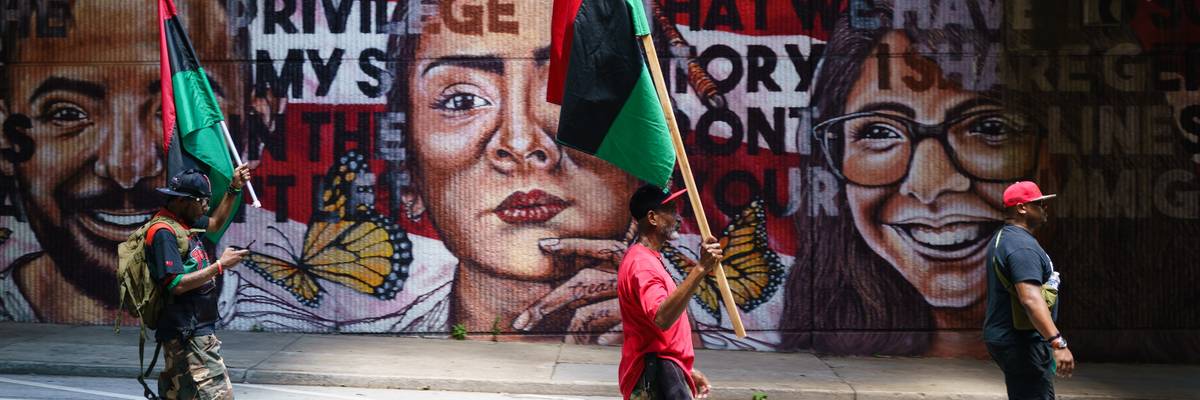
People hold up Pan-African flags while marching in the Juneteenth Atlanta Black History parade on June 18, 2022 in Atlanta, Georgia.
Freedom does not become real simply because it is declared. It becomes real because someone carries it into the world. Someone teaches it. Someone protects it. Someone organizes around it. Someone refuses to let it disappear.
As Juneteenth approaches, I find myself thinking about anniversaries.
Not because I am particularly sentimental about dates, but because anniversaries reveal something about how societies remember. They tell us which stories we choose to elevate, which contradictions we learn to live with, and which truths we have become comfortable leaving unresolved.
This year, those questions feel particularly urgent.
Communities across the country will gather to celebrate Juneteenth, commemorating the moment enslaved Black people in Galveston, Texas learned they were free more than two years after the Emancipation Proclamation had been signed. At the same time, the nation is preparing to commemorate its 250th anniversary, renewing familiar conversations about liberty, democracy, independence, and freedom. There is something meaningful about those two anniversaries sitting so close together. One asks us to remember the promise of freedom. The other asks us to remember the distance between a promise and its fulfillment.
Every democratic gain we now celebrate exists because ordinary people organized, challenged existing systems, imagined alternatives, and demanded that the nation become more than it was.
For many people, Juneteenth is understood as a story about delayed freedom. That is certainly true. But the older I get, the more I think it is also a story about delayed meaning. The people in Galveston were legally free long before they knew they were free. The law had changed. Their status had changed. On paper, their relationship to the nation had changed.
Yet their lived reality had not. The declaration existed, but the meaning had not yet reached them. That distinction matters because we often talk about freedom as though it becomes real the moment it is declared. We assume that once a law is passed, a court issues a ruling, or a right is recognized, the work is complete. History tells a different story.
Again and again, America has demonstrated that there is often a gap between what institutions proclaim and what people experience. The abolition of slavery did not end racial hierarchy. The passage of the Voting Rights Act did not end voter suppression. Legal victories did not eliminate the need for organizing, education, resistance, or vigilance. Rights may be secured in law, but they must still be carried into communities, institutions, and everyday life. Juneteenth reminds us of that reality. It reminds us that freedom is not simply a legal condition. It is also a social condition, a cultural condition, and a lived condition. It becomes meaningful only when people can actually experience it.
That lesson feels particularly relevant today.
Across the country, we are witnessing renewed debates about democracy, citizenship, rights, belonging, and power. We are watching efforts to restrict voting access, weaken public institutions, narrow how history is taught, and redefine who gets to participate fully in public life. At the same time, many Americans are being encouraged to believe that these concerns are exaggerated, that racism and inequality belong primarily to the past, and that the nation's democratic project is largely complete. What concerns me is not simply the political debate itself. It is the historical amnesia that often accompanies it. Too often, we remember progress while forgetting the struggle that produced it. We celebrate outcomes while ignoring the generations of people who fought to make those outcomes possible. We remember milestones but forget movements. We remember victories but forget the conditions that made those victories necessary in the first place.
In doing so, we begin to mistake progress for permanence. Juneteenth offers a corrective.
It reminds us that democracy has never been self-executing. Freedom has never expanded automatically. Rights have never sustained themselves. Every democratic gain we now celebrate exists because ordinary people organized, challenged existing systems, imagined alternatives, and demanded that the nation become more than it was. That is why I find myself thinking differently about the conversations surrounding America's 250th anniversary. I am less interested in celebrating a polished national mythology than I am in wrestling honestly with the tension at the center of the American story. The United States was founded on extraordinary democratic ideals while simultaneously denying many people access to them. Those contradictions are not incidental to our history. They are central to understanding it.
Yet Juneteenth is not ultimately a story about contradiction. It is a story about persistence. It is a story about Black people who continued reaching for freedom even when freedom arrived late. It is a story about Black people who expanded democracy even when democracy excluded them. It is a story about generations of Black Americans who carried hope, memory, responsibility, and struggle across time so that future generations might inherit possibilities they themselves were denied. That is what I find myself celebrating this year.
Not a perfect nation, completed democracy, or a tidy story of inevitable progress.
I am celebrating the people who carried the work forward anyway. The people who understood that freedom does not become real simply because it is declared. It becomes real because someone carries it into the world. Someone teaches it. Someone protects it. Someone organizes around it. Someone refuses to let it disappear.
The lesson of Juneteenth is not that freedom finally arrived. The lesson is that even after freedom was declared, someone still had to carry the news.
And generations later, someone still has to carry the meaning.
Dear Common Dreams reader, It’s been nearly 30 years since I co-founded Common Dreams with my late wife, Lina Newhouser. We had the radical notion that journalism should serve the public good, not corporate profits. It was clear to us from the outset what it would take to build such a project. No paid advertisements. No corporate sponsors. No millionaire publisher telling us what to think or do. Many people said we wouldn't last a year, but we proved those doubters wrong. Together with a tremendous team of journalists and dedicated staff, we built an independent media outlet free from the constraints of profits and corporate control. Our mission has always been simple: To inform. To inspire. To ignite change for the common good. Building Common Dreams was not easy. Our survival was never guaranteed. When you take on the most powerful forces—Wall Street greed, fossil fuel industry destruction, Big Tech lobbyists, and uber-rich oligarchs who have spent billions upon billions rigging the economy and democracy in their favor—the only bulwark you have is supporters who believe in your work. But here’s the urgent message from me today. It's never been this bad out there. And it's never been this hard to keep us going. At the very moment Common Dreams is most needed, the threats we face are intensifying. We need your support now more than ever. We don't accept corporate advertising and never will. We don't have a paywall because we don't think people should be blocked from critical news based on their ability to pay. Everything we do is funded by the donations of readers like you. When everyone does the little they can afford, we are strong. But if that support retreats or dries up, so do we. Will you donate now to make sure Common Dreams not only survives but thrives? —Craig Brown, Co-founder |
As Juneteenth approaches, I find myself thinking about anniversaries.
Not because I am particularly sentimental about dates, but because anniversaries reveal something about how societies remember. They tell us which stories we choose to elevate, which contradictions we learn to live with, and which truths we have become comfortable leaving unresolved.
This year, those questions feel particularly urgent.
Communities across the country will gather to celebrate Juneteenth, commemorating the moment enslaved Black people in Galveston, Texas learned they were free more than two years after the Emancipation Proclamation had been signed. At the same time, the nation is preparing to commemorate its 250th anniversary, renewing familiar conversations about liberty, democracy, independence, and freedom. There is something meaningful about those two anniversaries sitting so close together. One asks us to remember the promise of freedom. The other asks us to remember the distance between a promise and its fulfillment.
Every democratic gain we now celebrate exists because ordinary people organized, challenged existing systems, imagined alternatives, and demanded that the nation become more than it was.
For many people, Juneteenth is understood as a story about delayed freedom. That is certainly true. But the older I get, the more I think it is also a story about delayed meaning. The people in Galveston were legally free long before they knew they were free. The law had changed. Their status had changed. On paper, their relationship to the nation had changed.
Yet their lived reality had not. The declaration existed, but the meaning had not yet reached them. That distinction matters because we often talk about freedom as though it becomes real the moment it is declared. We assume that once a law is passed, a court issues a ruling, or a right is recognized, the work is complete. History tells a different story.
Again and again, America has demonstrated that there is often a gap between what institutions proclaim and what people experience. The abolition of slavery did not end racial hierarchy. The passage of the Voting Rights Act did not end voter suppression. Legal victories did not eliminate the need for organizing, education, resistance, or vigilance. Rights may be secured in law, but they must still be carried into communities, institutions, and everyday life. Juneteenth reminds us of that reality. It reminds us that freedom is not simply a legal condition. It is also a social condition, a cultural condition, and a lived condition. It becomes meaningful only when people can actually experience it.
That lesson feels particularly relevant today.
Across the country, we are witnessing renewed debates about democracy, citizenship, rights, belonging, and power. We are watching efforts to restrict voting access, weaken public institutions, narrow how history is taught, and redefine who gets to participate fully in public life. At the same time, many Americans are being encouraged to believe that these concerns are exaggerated, that racism and inequality belong primarily to the past, and that the nation's democratic project is largely complete. What concerns me is not simply the political debate itself. It is the historical amnesia that often accompanies it. Too often, we remember progress while forgetting the struggle that produced it. We celebrate outcomes while ignoring the generations of people who fought to make those outcomes possible. We remember milestones but forget movements. We remember victories but forget the conditions that made those victories necessary in the first place.
In doing so, we begin to mistake progress for permanence. Juneteenth offers a corrective.
It reminds us that democracy has never been self-executing. Freedom has never expanded automatically. Rights have never sustained themselves. Every democratic gain we now celebrate exists because ordinary people organized, challenged existing systems, imagined alternatives, and demanded that the nation become more than it was. That is why I find myself thinking differently about the conversations surrounding America's 250th anniversary. I am less interested in celebrating a polished national mythology than I am in wrestling honestly with the tension at the center of the American story. The United States was founded on extraordinary democratic ideals while simultaneously denying many people access to them. Those contradictions are not incidental to our history. They are central to understanding it.
Yet Juneteenth is not ultimately a story about contradiction. It is a story about persistence. It is a story about Black people who continued reaching for freedom even when freedom arrived late. It is a story about Black people who expanded democracy even when democracy excluded them. It is a story about generations of Black Americans who carried hope, memory, responsibility, and struggle across time so that future generations might inherit possibilities they themselves were denied. That is what I find myself celebrating this year.
Not a perfect nation, completed democracy, or a tidy story of inevitable progress.
I am celebrating the people who carried the work forward anyway. The people who understood that freedom does not become real simply because it is declared. It becomes real because someone carries it into the world. Someone teaches it. Someone protects it. Someone organizes around it. Someone refuses to let it disappear.
The lesson of Juneteenth is not that freedom finally arrived. The lesson is that even after freedom was declared, someone still had to carry the news.
And generations later, someone still has to carry the meaning.
As Juneteenth approaches, I find myself thinking about anniversaries.
Not because I am particularly sentimental about dates, but because anniversaries reveal something about how societies remember. They tell us which stories we choose to elevate, which contradictions we learn to live with, and which truths we have become comfortable leaving unresolved.
This year, those questions feel particularly urgent.
Communities across the country will gather to celebrate Juneteenth, commemorating the moment enslaved Black people in Galveston, Texas learned they were free more than two years after the Emancipation Proclamation had been signed. At the same time, the nation is preparing to commemorate its 250th anniversary, renewing familiar conversations about liberty, democracy, independence, and freedom. There is something meaningful about those two anniversaries sitting so close together. One asks us to remember the promise of freedom. The other asks us to remember the distance between a promise and its fulfillment.
Every democratic gain we now celebrate exists because ordinary people organized, challenged existing systems, imagined alternatives, and demanded that the nation become more than it was.
For many people, Juneteenth is understood as a story about delayed freedom. That is certainly true. But the older I get, the more I think it is also a story about delayed meaning. The people in Galveston were legally free long before they knew they were free. The law had changed. Their status had changed. On paper, their relationship to the nation had changed.
Yet their lived reality had not. The declaration existed, but the meaning had not yet reached them. That distinction matters because we often talk about freedom as though it becomes real the moment it is declared. We assume that once a law is passed, a court issues a ruling, or a right is recognized, the work is complete. History tells a different story.
Again and again, America has demonstrated that there is often a gap between what institutions proclaim and what people experience. The abolition of slavery did not end racial hierarchy. The passage of the Voting Rights Act did not end voter suppression. Legal victories did not eliminate the need for organizing, education, resistance, or vigilance. Rights may be secured in law, but they must still be carried into communities, institutions, and everyday life. Juneteenth reminds us of that reality. It reminds us that freedom is not simply a legal condition. It is also a social condition, a cultural condition, and a lived condition. It becomes meaningful only when people can actually experience it.
That lesson feels particularly relevant today.
Across the country, we are witnessing renewed debates about democracy, citizenship, rights, belonging, and power. We are watching efforts to restrict voting access, weaken public institutions, narrow how history is taught, and redefine who gets to participate fully in public life. At the same time, many Americans are being encouraged to believe that these concerns are exaggerated, that racism and inequality belong primarily to the past, and that the nation's democratic project is largely complete. What concerns me is not simply the political debate itself. It is the historical amnesia that often accompanies it. Too often, we remember progress while forgetting the struggle that produced it. We celebrate outcomes while ignoring the generations of people who fought to make those outcomes possible. We remember milestones but forget movements. We remember victories but forget the conditions that made those victories necessary in the first place.
In doing so, we begin to mistake progress for permanence. Juneteenth offers a corrective.
It reminds us that democracy has never been self-executing. Freedom has never expanded automatically. Rights have never sustained themselves. Every democratic gain we now celebrate exists because ordinary people organized, challenged existing systems, imagined alternatives, and demanded that the nation become more than it was. That is why I find myself thinking differently about the conversations surrounding America's 250th anniversary. I am less interested in celebrating a polished national mythology than I am in wrestling honestly with the tension at the center of the American story. The United States was founded on extraordinary democratic ideals while simultaneously denying many people access to them. Those contradictions are not incidental to our history. They are central to understanding it.
Yet Juneteenth is not ultimately a story about contradiction. It is a story about persistence. It is a story about Black people who continued reaching for freedom even when freedom arrived late. It is a story about Black people who expanded democracy even when democracy excluded them. It is a story about generations of Black Americans who carried hope, memory, responsibility, and struggle across time so that future generations might inherit possibilities they themselves were denied. That is what I find myself celebrating this year.
Not a perfect nation, completed democracy, or a tidy story of inevitable progress.
I am celebrating the people who carried the work forward anyway. The people who understood that freedom does not become real simply because it is declared. It becomes real because someone carries it into the world. Someone teaches it. Someone protects it. Someone organizes around it. Someone refuses to let it disappear.
The lesson of Juneteenth is not that freedom finally arrived. The lesson is that even after freedom was declared, someone still had to carry the news.
And generations later, someone still has to carry the meaning.