SUBSCRIBE TO OUR FREE NEWSLETTER
Daily news & progressive opinion—funded by the people, not the corporations—delivered straight to your inbox.
5
#000000
#FFFFFF
To donate by check, phone, or other method, see our More Ways to Give page.
Daily news & progressive opinion—funded by the people, not the corporations—delivered straight to your inbox.
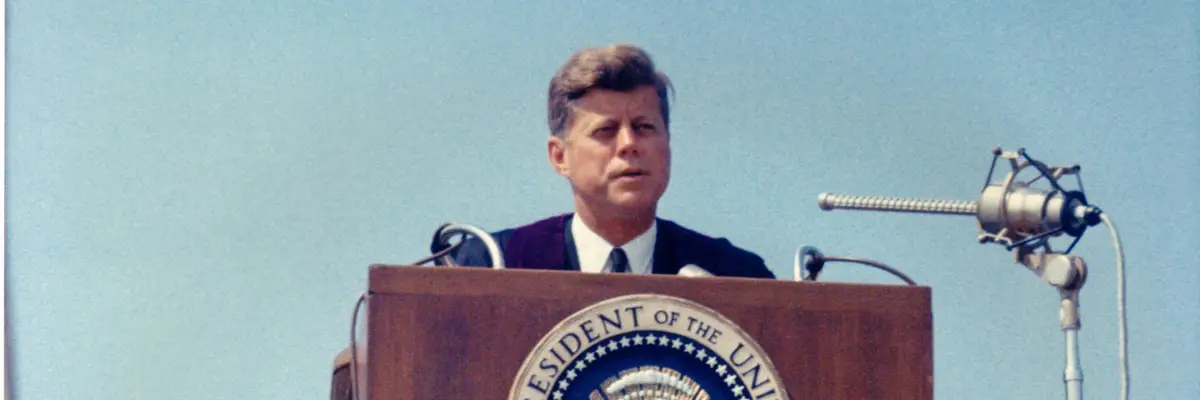
U.S. President John F Kennedy (1917 - 1963) speaks at the American University's commencement ceremony in Washington D.C. on June 10, 1963. Known as the 'Pax Americana' speech, Kennedy outlined his vision for world peace.
Sixty years after Kennedy's commencement address at American University, crucial lessons must still be learned about how to end dangerous conflicts in a nuclear world.
President John F. Kennedy was one of the world’s great peacemakers. He led a peaceful solution to the Cuban Missile Crisis and then successfully negotiated the Partial Nuclear Test Ban Treaty with the Soviet Union at the very height of the Cold War. At the time of his assassination, he was taking steps to end US involvement in Vietnam.
In his dazzling and unsurpassed Peace Speech, delivered exactly sixty years ago on June 10, 1963, Kennedy laid out his formula for peace with the Soviet Union. Kennedy’s Peace Speech highlights how Joe Biden’s approach to Russia and the Ukraine War needs a dramatic reorientation. Until now, Biden has not followed the precepts that Kennedy recommended to find peace. By heeding Kennedy’s advice, Biden too could become a peacemaker.
A mathematician would call JFK’s speech a “constructive proof” of how to make peace, since the speech itself contributed directly to the Partial Nuclear Test Ban Treaty signed by the US and Soviet Union in July 1963. Upon receipt of the speech, Soviet leader Nikita Khrushchev told Kennedy’s envoy to Russia, Averell Harriman, that the speech was the greatest by an American president since Franklin D. Roosevelt, and that he wanted to pursue peace with Kennedy.
The deepest key to peace, in Kennedy’s view, is the fact that both sides want peace.
In the speech, Kennedy describes peace “as the necessary rational end [goal] of rational men.” Yet he acknowledges that peacemaking is not easy: “I realize that the pursuit of peace is not as dramatic as the pursuit of war—and frequently the words of the pursuer fall on deaf ears. But we have no more urgent task.”
President John F. Kennedy's "Peace Speech"youtu.be
The deepest key to peace, in Kennedy’s view, is the fact that both sides want peace. It is easy to fall into the trap, warns Kennedy, of blaming a conflict only on the other side. It is easy to fall into the trap of insisting that only the adversary should change their attitudes and behavior. Kennedy is very clear: “We must reexamine our own attitude—as individuals and as a Nation—for our attitude is as essential as theirs.”
Kennedy attacked the prevailing pessimism at the height of the Cold War that peace with the Soviet Union was impossible, “that war is inevitable—that mankind is doomed—that we are gripped by forces we cannot control. We need not accept that view. Our problems are man-made—therefore, they can be solved by man.”
Crucially, said Kennedy, we must not “see only a distorted and desperate view of the other side.” We must not “see conflict as inevitable, accommodation as impossible, and communication as nothing more than an exchange of threats.” Indeed, said Kennedy, we should “hail the Russian people for their many achievements—in science and space, in economic and industrial growth, in culture and in acts of courage.”
Kennedy knew that since peace was in the mutual interest of the US and the Soviet Union, a peace treaty could be reached.
Kennedy warned against putting a nuclear adversary into a corner that could lead the adversary to desperate actions. “Above all, while defending our own vital interests, nuclear powers must avert those confrontations which bring an adversary to a choice of either a humiliating retreat or a nuclear war. To adopt that kind of course in the nuclear age would be evidence only of the bankruptcy of our policy—or of a collective death wish for the world.”
Kennedy knew that since peace was in the mutual interest of the US and the Soviet Union, a peace treaty could be reached. To those who said that the Soviet Union would not abide by a peace treaty, Kennedy responded that “both the United States and its allies, and the Soviet Union and its allies, have a mutually deep interest in a just and genuine peace and in halting the arms race. Agreements to this end are in the interests of the Soviet Union as well as ours—and even the most hostile nations can be relied upon to accept and keep those treaty obligations, and only those treaty obligations, which are in their own interest.”
Kennedy emphasized the importance of direct communication between the two adversaries. Peace, he said, “will require increased understanding between the Soviets and ourselves. And increased understanding will require increased contact and communication. One step in this direction is the proposed arrangement for a direct line between Moscow and Washington, to avoid on each side the dangerous delays, misunderstandings, and misreadings of the other’s actions which might occur at a time of crisis.”
“Let us never negotiate out of fear. But let us never fear to negotiate.”
In the context of the Ukraine War, Biden has behaved almost the opposite of JFK. He has personally and repeatedly denigrated Russian President Vladimir Putin. His administration has defined the US war aim as the weakening of Russia. Biden has avoided all communications with Putin. They have apparently not spoken once since February 2022, and Biden rebuffed a bilateral meeting with Putin at last year’s G20 Summit in Bali, Indonesia.
Biden has refused to even acknowledge, much less to address, Russia’s deep security concerns. Putin repeatedly expressed Russia’s ardent opposition to NATO enlargement to Ukraine, a country with a 2,000-kilometer border with Russia. The US would never tolerate a Mexican-Russian or Mexican-Chinese military alliance in view of the 2000-mile Mexico-US border. It is time for Biden to negotiate with Russia on NATO enlargement, as part of broader negotiations to end the Ukraine war.
When Kennedy came into office in January 1961, he stated clearly his position on negotiations: “Let us never negotiate out of fear. But let us never fear to negotiate. Let both sides explore what problems unite us instead of belaboring those problems which divide us.”
In his Peace Speech, JFK reminded us that what unites the US and Russia is that “we all inhabit this small planet. We all breathe the same air. We all cherish our children’s future. And we are all mortal.”
Note: Jeffrey D. Sachs is author of "To Move the World: JFK’s Quest for Peace, Random House: 2013."
Dear Common Dreams reader, It’s been nearly 30 years since I co-founded Common Dreams with my late wife, Lina Newhouser. We had the radical notion that journalism should serve the public good, not corporate profits. It was clear to us from the outset what it would take to build such a project. No paid advertisements. No corporate sponsors. No millionaire publisher telling us what to think or do. Many people said we wouldn't last a year, but we proved those doubters wrong. Together with a tremendous team of journalists and dedicated staff, we built an independent media outlet free from the constraints of profits and corporate control. Our mission has always been simple: To inform. To inspire. To ignite change for the common good. Building Common Dreams was not easy. Our survival was never guaranteed. When you take on the most powerful forces—Wall Street greed, fossil fuel industry destruction, Big Tech lobbyists, and uber-rich oligarchs who have spent billions upon billions rigging the economy and democracy in their favor—the only bulwark you have is supporters who believe in your work. But here’s the urgent message from me today. It's never been this bad out there. And it's never been this hard to keep us going. At the very moment Common Dreams is most needed, the threats we face are intensifying. We need your support now more than ever. We don't accept corporate advertising and never will. We don't have a paywall because we don't think people should be blocked from critical news based on their ability to pay. Everything we do is funded by the donations of readers like you. When everyone does the little they can afford, we are strong. But if that support retreats or dries up, so do we. Will you donate now to make sure Common Dreams not only survives but thrives? —Craig Brown, Co-founder |
President John F. Kennedy was one of the world’s great peacemakers. He led a peaceful solution to the Cuban Missile Crisis and then successfully negotiated the Partial Nuclear Test Ban Treaty with the Soviet Union at the very height of the Cold War. At the time of his assassination, he was taking steps to end US involvement in Vietnam.
In his dazzling and unsurpassed Peace Speech, delivered exactly sixty years ago on June 10, 1963, Kennedy laid out his formula for peace with the Soviet Union. Kennedy’s Peace Speech highlights how Joe Biden’s approach to Russia and the Ukraine War needs a dramatic reorientation. Until now, Biden has not followed the precepts that Kennedy recommended to find peace. By heeding Kennedy’s advice, Biden too could become a peacemaker.
A mathematician would call JFK’s speech a “constructive proof” of how to make peace, since the speech itself contributed directly to the Partial Nuclear Test Ban Treaty signed by the US and Soviet Union in July 1963. Upon receipt of the speech, Soviet leader Nikita Khrushchev told Kennedy’s envoy to Russia, Averell Harriman, that the speech was the greatest by an American president since Franklin D. Roosevelt, and that he wanted to pursue peace with Kennedy.
The deepest key to peace, in Kennedy’s view, is the fact that both sides want peace.
In the speech, Kennedy describes peace “as the necessary rational end [goal] of rational men.” Yet he acknowledges that peacemaking is not easy: “I realize that the pursuit of peace is not as dramatic as the pursuit of war—and frequently the words of the pursuer fall on deaf ears. But we have no more urgent task.”
President John F. Kennedy's "Peace Speech"youtu.be
The deepest key to peace, in Kennedy’s view, is the fact that both sides want peace. It is easy to fall into the trap, warns Kennedy, of blaming a conflict only on the other side. It is easy to fall into the trap of insisting that only the adversary should change their attitudes and behavior. Kennedy is very clear: “We must reexamine our own attitude—as individuals and as a Nation—for our attitude is as essential as theirs.”
Kennedy attacked the prevailing pessimism at the height of the Cold War that peace with the Soviet Union was impossible, “that war is inevitable—that mankind is doomed—that we are gripped by forces we cannot control. We need not accept that view. Our problems are man-made—therefore, they can be solved by man.”
Crucially, said Kennedy, we must not “see only a distorted and desperate view of the other side.” We must not “see conflict as inevitable, accommodation as impossible, and communication as nothing more than an exchange of threats.” Indeed, said Kennedy, we should “hail the Russian people for their many achievements—in science and space, in economic and industrial growth, in culture and in acts of courage.”
Kennedy knew that since peace was in the mutual interest of the US and the Soviet Union, a peace treaty could be reached.
Kennedy warned against putting a nuclear adversary into a corner that could lead the adversary to desperate actions. “Above all, while defending our own vital interests, nuclear powers must avert those confrontations which bring an adversary to a choice of either a humiliating retreat or a nuclear war. To adopt that kind of course in the nuclear age would be evidence only of the bankruptcy of our policy—or of a collective death wish for the world.”
Kennedy knew that since peace was in the mutual interest of the US and the Soviet Union, a peace treaty could be reached. To those who said that the Soviet Union would not abide by a peace treaty, Kennedy responded that “both the United States and its allies, and the Soviet Union and its allies, have a mutually deep interest in a just and genuine peace and in halting the arms race. Agreements to this end are in the interests of the Soviet Union as well as ours—and even the most hostile nations can be relied upon to accept and keep those treaty obligations, and only those treaty obligations, which are in their own interest.”
Kennedy emphasized the importance of direct communication between the two adversaries. Peace, he said, “will require increased understanding between the Soviets and ourselves. And increased understanding will require increased contact and communication. One step in this direction is the proposed arrangement for a direct line between Moscow and Washington, to avoid on each side the dangerous delays, misunderstandings, and misreadings of the other’s actions which might occur at a time of crisis.”
“Let us never negotiate out of fear. But let us never fear to negotiate.”
In the context of the Ukraine War, Biden has behaved almost the opposite of JFK. He has personally and repeatedly denigrated Russian President Vladimir Putin. His administration has defined the US war aim as the weakening of Russia. Biden has avoided all communications with Putin. They have apparently not spoken once since February 2022, and Biden rebuffed a bilateral meeting with Putin at last year’s G20 Summit in Bali, Indonesia.
Biden has refused to even acknowledge, much less to address, Russia’s deep security concerns. Putin repeatedly expressed Russia’s ardent opposition to NATO enlargement to Ukraine, a country with a 2,000-kilometer border with Russia. The US would never tolerate a Mexican-Russian or Mexican-Chinese military alliance in view of the 2000-mile Mexico-US border. It is time for Biden to negotiate with Russia on NATO enlargement, as part of broader negotiations to end the Ukraine war.
When Kennedy came into office in January 1961, he stated clearly his position on negotiations: “Let us never negotiate out of fear. But let us never fear to negotiate. Let both sides explore what problems unite us instead of belaboring those problems which divide us.”
In his Peace Speech, JFK reminded us that what unites the US and Russia is that “we all inhabit this small planet. We all breathe the same air. We all cherish our children’s future. And we are all mortal.”
Note: Jeffrey D. Sachs is author of "To Move the World: JFK’s Quest for Peace, Random House: 2013."
President John F. Kennedy was one of the world’s great peacemakers. He led a peaceful solution to the Cuban Missile Crisis and then successfully negotiated the Partial Nuclear Test Ban Treaty with the Soviet Union at the very height of the Cold War. At the time of his assassination, he was taking steps to end US involvement in Vietnam.
In his dazzling and unsurpassed Peace Speech, delivered exactly sixty years ago on June 10, 1963, Kennedy laid out his formula for peace with the Soviet Union. Kennedy’s Peace Speech highlights how Joe Biden’s approach to Russia and the Ukraine War needs a dramatic reorientation. Until now, Biden has not followed the precepts that Kennedy recommended to find peace. By heeding Kennedy’s advice, Biden too could become a peacemaker.
A mathematician would call JFK’s speech a “constructive proof” of how to make peace, since the speech itself contributed directly to the Partial Nuclear Test Ban Treaty signed by the US and Soviet Union in July 1963. Upon receipt of the speech, Soviet leader Nikita Khrushchev told Kennedy’s envoy to Russia, Averell Harriman, that the speech was the greatest by an American president since Franklin D. Roosevelt, and that he wanted to pursue peace with Kennedy.
The deepest key to peace, in Kennedy’s view, is the fact that both sides want peace.
In the speech, Kennedy describes peace “as the necessary rational end [goal] of rational men.” Yet he acknowledges that peacemaking is not easy: “I realize that the pursuit of peace is not as dramatic as the pursuit of war—and frequently the words of the pursuer fall on deaf ears. But we have no more urgent task.”
President John F. Kennedy's "Peace Speech"youtu.be
The deepest key to peace, in Kennedy’s view, is the fact that both sides want peace. It is easy to fall into the trap, warns Kennedy, of blaming a conflict only on the other side. It is easy to fall into the trap of insisting that only the adversary should change their attitudes and behavior. Kennedy is very clear: “We must reexamine our own attitude—as individuals and as a Nation—for our attitude is as essential as theirs.”
Kennedy attacked the prevailing pessimism at the height of the Cold War that peace with the Soviet Union was impossible, “that war is inevitable—that mankind is doomed—that we are gripped by forces we cannot control. We need not accept that view. Our problems are man-made—therefore, they can be solved by man.”
Crucially, said Kennedy, we must not “see only a distorted and desperate view of the other side.” We must not “see conflict as inevitable, accommodation as impossible, and communication as nothing more than an exchange of threats.” Indeed, said Kennedy, we should “hail the Russian people for their many achievements—in science and space, in economic and industrial growth, in culture and in acts of courage.”
Kennedy knew that since peace was in the mutual interest of the US and the Soviet Union, a peace treaty could be reached.
Kennedy warned against putting a nuclear adversary into a corner that could lead the adversary to desperate actions. “Above all, while defending our own vital interests, nuclear powers must avert those confrontations which bring an adversary to a choice of either a humiliating retreat or a nuclear war. To adopt that kind of course in the nuclear age would be evidence only of the bankruptcy of our policy—or of a collective death wish for the world.”
Kennedy knew that since peace was in the mutual interest of the US and the Soviet Union, a peace treaty could be reached. To those who said that the Soviet Union would not abide by a peace treaty, Kennedy responded that “both the United States and its allies, and the Soviet Union and its allies, have a mutually deep interest in a just and genuine peace and in halting the arms race. Agreements to this end are in the interests of the Soviet Union as well as ours—and even the most hostile nations can be relied upon to accept and keep those treaty obligations, and only those treaty obligations, which are in their own interest.”
Kennedy emphasized the importance of direct communication between the two adversaries. Peace, he said, “will require increased understanding between the Soviets and ourselves. And increased understanding will require increased contact and communication. One step in this direction is the proposed arrangement for a direct line between Moscow and Washington, to avoid on each side the dangerous delays, misunderstandings, and misreadings of the other’s actions which might occur at a time of crisis.”
“Let us never negotiate out of fear. But let us never fear to negotiate.”
In the context of the Ukraine War, Biden has behaved almost the opposite of JFK. He has personally and repeatedly denigrated Russian President Vladimir Putin. His administration has defined the US war aim as the weakening of Russia. Biden has avoided all communications with Putin. They have apparently not spoken once since February 2022, and Biden rebuffed a bilateral meeting with Putin at last year’s G20 Summit in Bali, Indonesia.
Biden has refused to even acknowledge, much less to address, Russia’s deep security concerns. Putin repeatedly expressed Russia’s ardent opposition to NATO enlargement to Ukraine, a country with a 2,000-kilometer border with Russia. The US would never tolerate a Mexican-Russian or Mexican-Chinese military alliance in view of the 2000-mile Mexico-US border. It is time for Biden to negotiate with Russia on NATO enlargement, as part of broader negotiations to end the Ukraine war.
When Kennedy came into office in January 1961, he stated clearly his position on negotiations: “Let us never negotiate out of fear. But let us never fear to negotiate. Let both sides explore what problems unite us instead of belaboring those problems which divide us.”
In his Peace Speech, JFK reminded us that what unites the US and Russia is that “we all inhabit this small planet. We all breathe the same air. We all cherish our children’s future. And we are all mortal.”
Note: Jeffrey D. Sachs is author of "To Move the World: JFK’s Quest for Peace, Random House: 2013."