SUBSCRIBE TO OUR FREE NEWSLETTER
Daily news & progressive opinion—funded by the people, not the corporations—delivered straight to your inbox.
5
#000000
#FFFFFF
To donate by check, phone, or other method, see our More Ways to Give page.
Daily news & progressive opinion—funded by the people, not the corporations—delivered straight to your inbox.
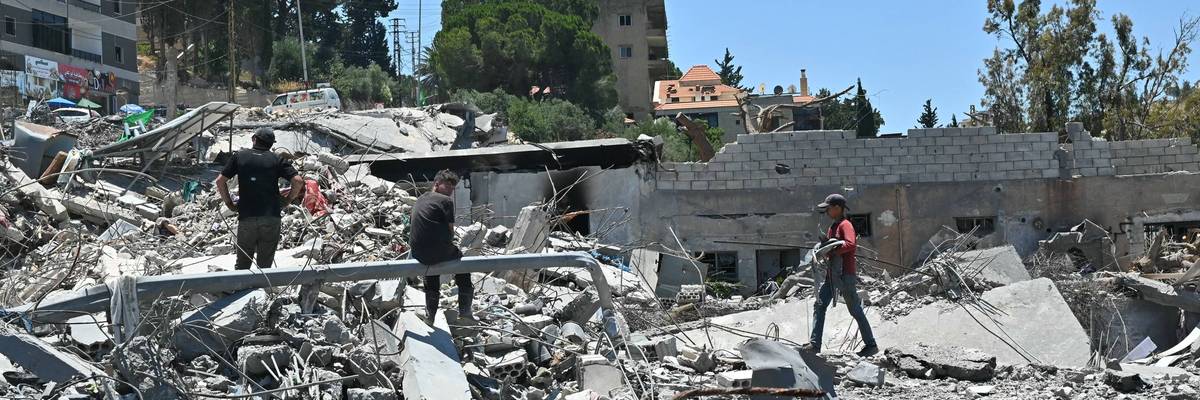
Residents arrive to inspect what is left of their homes and businesses, destroyed in Israeli military strikes, in the southern Lebanese village of Bir Al-Salasil on June 24, 2026.
Washington says it wants the Lebanese state to reclaim authority, but Beirut is still being asked to move first while Israeli withdrawal remains conditional.
This week, the argument over Lebanese sovereignty became concrete on a ridge overlooking Nabatieh. The New Arab reported on August 24 that Washington is pressing for the strategic Ali al-Taher ridge, where Hezbollah fighters are present, to be transferred to the Lebanese Army in exchange for Israeli withdrawal. The same area has been subjected to repeated Israeli shelling. In one small patch of southern Lebanon, the larger problem is suddenly hard to hide: Beirut is being asked to move first, while the withdrawal of foreign forces from Lebanese territory remains the inducement offered in return.
That pressure did not begin this week. Reuters reported in July 2025 that Washington was pressing Lebanon to make a formal cabinet commitment to disarm Hezbollah before talks could continue on halting Israeli military operations. Lebanese officials were told that without such a commitment, the United States would stop sending its envoy and would no longer press Israel to halt airstrikes or withdraw troops. Even the Washington Institute for Near East Policy, which strongly favors disarmament, later described Lebanon's policy shift as having been adopted “under duress.”
Call it diplomacy if you like. It is still leverage. And it is being applied unevenly. Lebanon is expected to reduce its own side's military leverage first, while Israeli withdrawal is treated as something Lebanon must earn through compliance. If sovereignty means anything, it should not mean that a weaker country first dismantles its deterrent while a stronger military power keeps troops on its land.
None of this requires pretending Hezbollah has made no miscalculations. In March, after Hezbollah fired on Israel during the US-Israeli war with Iran, Lebanon's cabinet prohibited Hezbollah's military and security activities and ordered it to surrender its weapons to the state. The principle behind that decision is legitimate. A political movement, however rooted or powerful, should not be able to decide by itself when an entire country goes to war.
That is what real sovereignty would look like: not simply fewer Hezbollah weapons, but a Lebanese state strong enough that people no longer feel they need Hezbollah for protection, reconstruction, or basic support.
But sovereignty cannot stop at Hezbollah's weapons. It also has to mean that Israeli troops leave Lebanese territory and that Israeli strikes do not become a permanent feature of Lebanese life. Washington itself warned Israel this month that a permanent military presence in southern Lebanon would conflict with the US-backed framework. Yet the practical sequence still asks Beirut to show progress first. For many Lebanese in the south, that does not feel like state building. It feels like being told to surrender under fire.
There is another reality that is often flattened out of the American debate: Hezbollah is more than an arsenal. Its institutions became deeply rooted because they stepped into places where the Lebanese state was weak, slow, or absent. CNN reported as far back as 2006 that Hezbollah was providing water, helping pay medical costs, running schools, and collecting garbage in communities where government capacity was thin. The Council on Foreign Relations still describes a broad network of Hezbollah-linked healthcare, schools, infrastructure, and youth programs.
Calling that a “state within a state” is not far-fetched. But the phrase contains an uncomfortable admission: There was space for a parallel state because the official one repeatedly left a vacuum.
After the 2006 war, NPR found Hezbollah moving into reconstruction within hours of the ceasefire, assessing damage and distributing assistance while the government struggled to respond. For families standing in front of rubble, that was not an abstract debate about militias. It was help arriving when they needed it. People remember that.
The pattern returned after the 2024 war. The World Bank estimated Lebanon's reconstruction and recovery needs at $11 billion. While Lebanon searched for financing, Hezbollah's Jihad al-Bina network was already surveying damaged communities and paying compensation. Le Monde reported in early 2025 that Hezbollah had paid about $400 million to roughly 140,000 people. The effort was imperfect, and residents complained about delays. But it was there, visible on the ground, while the state had nothing comparable at that scale.
The same failure of formal institutions helped the Hezbollah-linked Al-Qard al-Hassan network grow during Lebanon's banking collapse. Families turned to it because ordinary depositors had been locked out of their savings. The United States has sanctioned Al-Qard al-Hassan officials and says the institution helps Hezbollah evade sanctions and move money. That allegation belongs in the picture. So does the reason such an institution became useful to ordinary people: The formal banking system had failed them.
This is the part a disarmament order cannot solve. Remove the weapons, and then what? Who fills the security gap along the border? Who rebuilds the next damaged neighborhood? Who replaces the clinics, schools, relief networks, and financial lifelines people have relied on for years? Lebanon's army can and should become the country's sole military authority. But it cannot also become a nationwide welfare system and reconstruction agency overnight.
There is a path out, but the order matters. Hezbollah should ultimately give up its military role and function as a political and social organization. Israel should withdraw fully from Lebanese territory, with an enforceable mechanism to stop renewed attacks and violations. At the same time, Lebanon and its international partners need to build institutions strong enough to replace the civilian functions that helped Hezbollah become indispensable to many communities.
That is what real sovereignty would look like: not simply fewer Hezbollah weapons, but a Lebanese state strong enough that people no longer feel they need Hezbollah for protection, reconstruction, or basic support.
The Ali al-Taher dispute shows why sequencing is not an academic concern. When Washington asks Beirut to take control of a strategic position in exchange for Israeli withdrawal, it reinforces the very perception that has sustained Hezbollah's argument for decades: that Lebanon is expected to prove its sovereignty by satisfying conditions imposed from outside. You cannot build a sovereign state by removing structures people rely on and promising that the state will catch up later. Build the security, capacity, and trust first. Then disarmament becomes a transfer of responsibility to a functioning state rather than an act of surrender to someone else's timetable.
Dear Common Dreams reader, It’s been nearly 30 years since I co-founded Common Dreams with my late wife, Lina Newhouser. We had the radical notion that journalism should serve the public good, not corporate profits. It was clear to us from the outset what it would take to build such a project. No paid advertisements. No corporate sponsors. No millionaire publisher telling us what to think or do. Many people said we wouldn't last a year, but we proved those doubters wrong. Together with a tremendous team of journalists and dedicated staff, we built an independent media outlet free from the constraints of profits and corporate control. Our mission has always been simple: To inform. To inspire. To ignite change for the common good. Building Common Dreams was not easy. Our survival was never guaranteed. When you take on the most powerful forces—Wall Street greed, fossil fuel industry destruction, Big Tech lobbyists, and uber-rich oligarchs who have spent billions upon billions rigging the economy and democracy in their favor—the only bulwark you have is supporters who believe in your work. But here’s the urgent message from me today. It's never been this bad out there. And it's never been this hard to keep us going. At the very moment Common Dreams is most needed, the threats we face are intensifying. We need your support now more than ever. We don't accept corporate advertising and never will. We don't have a paywall because we don't think people should be blocked from critical news based on their ability to pay. Everything we do is funded by the donations of readers like you. When everyone does the little they can afford, we are strong. But if that support retreats or dries up, so do we. Will you donate now to make sure Common Dreams not only survives but thrives? —Craig Brown, Co-founder |
This week, the argument over Lebanese sovereignty became concrete on a ridge overlooking Nabatieh. The New Arab reported on August 24 that Washington is pressing for the strategic Ali al-Taher ridge, where Hezbollah fighters are present, to be transferred to the Lebanese Army in exchange for Israeli withdrawal. The same area has been subjected to repeated Israeli shelling. In one small patch of southern Lebanon, the larger problem is suddenly hard to hide: Beirut is being asked to move first, while the withdrawal of foreign forces from Lebanese territory remains the inducement offered in return.
That pressure did not begin this week. Reuters reported in July 2025 that Washington was pressing Lebanon to make a formal cabinet commitment to disarm Hezbollah before talks could continue on halting Israeli military operations. Lebanese officials were told that without such a commitment, the United States would stop sending its envoy and would no longer press Israel to halt airstrikes or withdraw troops. Even the Washington Institute for Near East Policy, which strongly favors disarmament, later described Lebanon's policy shift as having been adopted “under duress.”
Call it diplomacy if you like. It is still leverage. And it is being applied unevenly. Lebanon is expected to reduce its own side's military leverage first, while Israeli withdrawal is treated as something Lebanon must earn through compliance. If sovereignty means anything, it should not mean that a weaker country first dismantles its deterrent while a stronger military power keeps troops on its land.
None of this requires pretending Hezbollah has made no miscalculations. In March, after Hezbollah fired on Israel during the US-Israeli war with Iran, Lebanon's cabinet prohibited Hezbollah's military and security activities and ordered it to surrender its weapons to the state. The principle behind that decision is legitimate. A political movement, however rooted or powerful, should not be able to decide by itself when an entire country goes to war.
That is what real sovereignty would look like: not simply fewer Hezbollah weapons, but a Lebanese state strong enough that people no longer feel they need Hezbollah for protection, reconstruction, or basic support.
But sovereignty cannot stop at Hezbollah's weapons. It also has to mean that Israeli troops leave Lebanese territory and that Israeli strikes do not become a permanent feature of Lebanese life. Washington itself warned Israel this month that a permanent military presence in southern Lebanon would conflict with the US-backed framework. Yet the practical sequence still asks Beirut to show progress first. For many Lebanese in the south, that does not feel like state building. It feels like being told to surrender under fire.
There is another reality that is often flattened out of the American debate: Hezbollah is more than an arsenal. Its institutions became deeply rooted because they stepped into places where the Lebanese state was weak, slow, or absent. CNN reported as far back as 2006 that Hezbollah was providing water, helping pay medical costs, running schools, and collecting garbage in communities where government capacity was thin. The Council on Foreign Relations still describes a broad network of Hezbollah-linked healthcare, schools, infrastructure, and youth programs.
Calling that a “state within a state” is not far-fetched. But the phrase contains an uncomfortable admission: There was space for a parallel state because the official one repeatedly left a vacuum.
After the 2006 war, NPR found Hezbollah moving into reconstruction within hours of the ceasefire, assessing damage and distributing assistance while the government struggled to respond. For families standing in front of rubble, that was not an abstract debate about militias. It was help arriving when they needed it. People remember that.
The pattern returned after the 2024 war. The World Bank estimated Lebanon's reconstruction and recovery needs at $11 billion. While Lebanon searched for financing, Hezbollah's Jihad al-Bina network was already surveying damaged communities and paying compensation. Le Monde reported in early 2025 that Hezbollah had paid about $400 million to roughly 140,000 people. The effort was imperfect, and residents complained about delays. But it was there, visible on the ground, while the state had nothing comparable at that scale.
The same failure of formal institutions helped the Hezbollah-linked Al-Qard al-Hassan network grow during Lebanon's banking collapse. Families turned to it because ordinary depositors had been locked out of their savings. The United States has sanctioned Al-Qard al-Hassan officials and says the institution helps Hezbollah evade sanctions and move money. That allegation belongs in the picture. So does the reason such an institution became useful to ordinary people: The formal banking system had failed them.
This is the part a disarmament order cannot solve. Remove the weapons, and then what? Who fills the security gap along the border? Who rebuilds the next damaged neighborhood? Who replaces the clinics, schools, relief networks, and financial lifelines people have relied on for years? Lebanon's army can and should become the country's sole military authority. But it cannot also become a nationwide welfare system and reconstruction agency overnight.
There is a path out, but the order matters. Hezbollah should ultimately give up its military role and function as a political and social organization. Israel should withdraw fully from Lebanese territory, with an enforceable mechanism to stop renewed attacks and violations. At the same time, Lebanon and its international partners need to build institutions strong enough to replace the civilian functions that helped Hezbollah become indispensable to many communities.
That is what real sovereignty would look like: not simply fewer Hezbollah weapons, but a Lebanese state strong enough that people no longer feel they need Hezbollah for protection, reconstruction, or basic support.
The Ali al-Taher dispute shows why sequencing is not an academic concern. When Washington asks Beirut to take control of a strategic position in exchange for Israeli withdrawal, it reinforces the very perception that has sustained Hezbollah's argument for decades: that Lebanon is expected to prove its sovereignty by satisfying conditions imposed from outside. You cannot build a sovereign state by removing structures people rely on and promising that the state will catch up later. Build the security, capacity, and trust first. Then disarmament becomes a transfer of responsibility to a functioning state rather than an act of surrender to someone else's timetable.
This week, the argument over Lebanese sovereignty became concrete on a ridge overlooking Nabatieh. The New Arab reported on August 24 that Washington is pressing for the strategic Ali al-Taher ridge, where Hezbollah fighters are present, to be transferred to the Lebanese Army in exchange for Israeli withdrawal. The same area has been subjected to repeated Israeli shelling. In one small patch of southern Lebanon, the larger problem is suddenly hard to hide: Beirut is being asked to move first, while the withdrawal of foreign forces from Lebanese territory remains the inducement offered in return.
That pressure did not begin this week. Reuters reported in July 2025 that Washington was pressing Lebanon to make a formal cabinet commitment to disarm Hezbollah before talks could continue on halting Israeli military operations. Lebanese officials were told that without such a commitment, the United States would stop sending its envoy and would no longer press Israel to halt airstrikes or withdraw troops. Even the Washington Institute for Near East Policy, which strongly favors disarmament, later described Lebanon's policy shift as having been adopted “under duress.”
Call it diplomacy if you like. It is still leverage. And it is being applied unevenly. Lebanon is expected to reduce its own side's military leverage first, while Israeli withdrawal is treated as something Lebanon must earn through compliance. If sovereignty means anything, it should not mean that a weaker country first dismantles its deterrent while a stronger military power keeps troops on its land.
None of this requires pretending Hezbollah has made no miscalculations. In March, after Hezbollah fired on Israel during the US-Israeli war with Iran, Lebanon's cabinet prohibited Hezbollah's military and security activities and ordered it to surrender its weapons to the state. The principle behind that decision is legitimate. A political movement, however rooted or powerful, should not be able to decide by itself when an entire country goes to war.
That is what real sovereignty would look like: not simply fewer Hezbollah weapons, but a Lebanese state strong enough that people no longer feel they need Hezbollah for protection, reconstruction, or basic support.
But sovereignty cannot stop at Hezbollah's weapons. It also has to mean that Israeli troops leave Lebanese territory and that Israeli strikes do not become a permanent feature of Lebanese life. Washington itself warned Israel this month that a permanent military presence in southern Lebanon would conflict with the US-backed framework. Yet the practical sequence still asks Beirut to show progress first. For many Lebanese in the south, that does not feel like state building. It feels like being told to surrender under fire.
There is another reality that is often flattened out of the American debate: Hezbollah is more than an arsenal. Its institutions became deeply rooted because they stepped into places where the Lebanese state was weak, slow, or absent. CNN reported as far back as 2006 that Hezbollah was providing water, helping pay medical costs, running schools, and collecting garbage in communities where government capacity was thin. The Council on Foreign Relations still describes a broad network of Hezbollah-linked healthcare, schools, infrastructure, and youth programs.
Calling that a “state within a state” is not far-fetched. But the phrase contains an uncomfortable admission: There was space for a parallel state because the official one repeatedly left a vacuum.
After the 2006 war, NPR found Hezbollah moving into reconstruction within hours of the ceasefire, assessing damage and distributing assistance while the government struggled to respond. For families standing in front of rubble, that was not an abstract debate about militias. It was help arriving when they needed it. People remember that.
The pattern returned after the 2024 war. The World Bank estimated Lebanon's reconstruction and recovery needs at $11 billion. While Lebanon searched for financing, Hezbollah's Jihad al-Bina network was already surveying damaged communities and paying compensation. Le Monde reported in early 2025 that Hezbollah had paid about $400 million to roughly 140,000 people. The effort was imperfect, and residents complained about delays. But it was there, visible on the ground, while the state had nothing comparable at that scale.
The same failure of formal institutions helped the Hezbollah-linked Al-Qard al-Hassan network grow during Lebanon's banking collapse. Families turned to it because ordinary depositors had been locked out of their savings. The United States has sanctioned Al-Qard al-Hassan officials and says the institution helps Hezbollah evade sanctions and move money. That allegation belongs in the picture. So does the reason such an institution became useful to ordinary people: The formal banking system had failed them.
This is the part a disarmament order cannot solve. Remove the weapons, and then what? Who fills the security gap along the border? Who rebuilds the next damaged neighborhood? Who replaces the clinics, schools, relief networks, and financial lifelines people have relied on for years? Lebanon's army can and should become the country's sole military authority. But it cannot also become a nationwide welfare system and reconstruction agency overnight.
There is a path out, but the order matters. Hezbollah should ultimately give up its military role and function as a political and social organization. Israel should withdraw fully from Lebanese territory, with an enforceable mechanism to stop renewed attacks and violations. At the same time, Lebanon and its international partners need to build institutions strong enough to replace the civilian functions that helped Hezbollah become indispensable to many communities.
That is what real sovereignty would look like: not simply fewer Hezbollah weapons, but a Lebanese state strong enough that people no longer feel they need Hezbollah for protection, reconstruction, or basic support.
The Ali al-Taher dispute shows why sequencing is not an academic concern. When Washington asks Beirut to take control of a strategic position in exchange for Israeli withdrawal, it reinforces the very perception that has sustained Hezbollah's argument for decades: that Lebanon is expected to prove its sovereignty by satisfying conditions imposed from outside. You cannot build a sovereign state by removing structures people rely on and promising that the state will catch up later. Build the security, capacity, and trust first. Then disarmament becomes a transfer of responsibility to a functioning state rather than an act of surrender to someone else's timetable.