SUBSCRIBE TO OUR FREE NEWSLETTER
Daily news & progressive opinion—funded by the people, not the corporations—delivered straight to your inbox.
5
#000000
#FFFFFF
To donate by check, phone, or other method, see our More Ways to Give page.
Daily news & progressive opinion—funded by the people, not the corporations—delivered straight to your inbox.
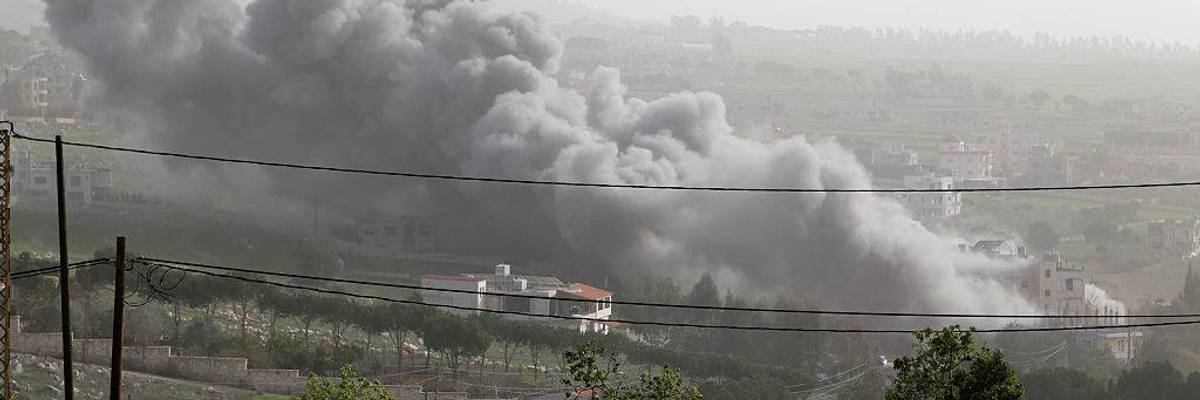
Smoke rises as civil defense and firefighting teams arrive in the area to conduct emergency response operations after Israeli army carried out an airstrike in southern Lebanon on February 2, 2026.
"This incident cannot be viewed in isolation from the scorched-earth policy pursued by the Israeli army," said watchdog Euro-Med Human Rights Monitor.
The Lebanese president has accused the Israeli government of committing "a crime against the environment and health" for allegedly spraying the herbicide glyphosate on agricultural lands in Lebanon and Syria.
As reported by Naharnet on Wednesday, Lebanon's agriculture and environmental ministries recently conducted analysis of soil near the site where Israel had sprayed a chemical substance and found glyphosate "20 to 30 times higher than the average" in the area.
The ministries said that this level of glyphosate in the soil could cause "damage to agricultural production," while also harming soil fertility.
Lebanese President Joseph Aoun denounced the spraying as a "flagrant violation of Lebanese sovereignty," and called on the United Nations (UN) and the international community at large to take action to stop future attacks.
Al-Jazeera reported on Tuesday that the UN Interim Force in Lebanon (UNIFIL) was warned by the Israel military on Monday to stay away from the border area because it planned to deploy a "nontoxic chemical substance" there, forcing the peacekeeping forces to cancel over a dozen planned activities.
Stephane Dujarric, a spokesperson for UN Secretary-General António Guterres, condemned Israel for preventing UNIFIL from conducting operations, emphasizing that "any activity that may put peacekeepers and civilians at risk is of serious concern."
Euro-Med Human Rights Monitor said on Wednesday that it has detected "Israeli aircraft spraying pesticides of unknown composition over farmland in the countryside of Quneitra in southern Syria" on January 26 and 27.
"This incident cannot be viewed in isolation from the scorched-earth policy pursued by the Israeli army," the human rights watchdog said. "It forms part of a pattern of systematic destruction of agricultural land, including the burning of approximately 9,000 hectares during recent military operations using white phosphorus and incendiary munitions."
Dear Common Dreams reader, It’s been nearly 30 years since I co-founded Common Dreams with my late wife, Lina Newhouser. We had the radical notion that journalism should serve the public good, not corporate profits. It was clear to us from the outset what it would take to build such a project. No paid advertisements. No corporate sponsors. No millionaire publisher telling us what to think or do. Many people said we wouldn't last a year, but we proved those doubters wrong. Together with a tremendous team of journalists and dedicated staff, we built an independent media outlet free from the constraints of profits and corporate control. Our mission has always been simple: To inform. To inspire. To ignite change for the common good. Building Common Dreams was not easy. Our survival was never guaranteed. When you take on the most powerful forces—Wall Street greed, fossil fuel industry destruction, Big Tech lobbyists, and uber-rich oligarchs who have spent billions upon billions rigging the economy and democracy in their favor—the only bulwark you have is supporters who believe in your work. But here’s the urgent message from me today. It's never been this bad out there. And it's never been this hard to keep us going. At the very moment Common Dreams is most needed, the threats we face are intensifying. We need your support now more than ever. We don't accept corporate advertising and never will. We don't have a paywall because we don't think people should be blocked from critical news based on their ability to pay. Everything we do is funded by the donations of readers like you. When everyone does the little they can afford, we are strong. But if that support retreats or dries up, so do we. Will you donate now to make sure Common Dreams not only survives but thrives? —Craig Brown, Co-founder |
The Lebanese president has accused the Israeli government of committing "a crime against the environment and health" for allegedly spraying the herbicide glyphosate on agricultural lands in Lebanon and Syria.
As reported by Naharnet on Wednesday, Lebanon's agriculture and environmental ministries recently conducted analysis of soil near the site where Israel had sprayed a chemical substance and found glyphosate "20 to 30 times higher than the average" in the area.
The ministries said that this level of glyphosate in the soil could cause "damage to agricultural production," while also harming soil fertility.
Lebanese President Joseph Aoun denounced the spraying as a "flagrant violation of Lebanese sovereignty," and called on the United Nations (UN) and the international community at large to take action to stop future attacks.
Al-Jazeera reported on Tuesday that the UN Interim Force in Lebanon (UNIFIL) was warned by the Israel military on Monday to stay away from the border area because it planned to deploy a "nontoxic chemical substance" there, forcing the peacekeeping forces to cancel over a dozen planned activities.
Stephane Dujarric, a spokesperson for UN Secretary-General António Guterres, condemned Israel for preventing UNIFIL from conducting operations, emphasizing that "any activity that may put peacekeepers and civilians at risk is of serious concern."
Euro-Med Human Rights Monitor said on Wednesday that it has detected "Israeli aircraft spraying pesticides of unknown composition over farmland in the countryside of Quneitra in southern Syria" on January 26 and 27.
"This incident cannot be viewed in isolation from the scorched-earth policy pursued by the Israeli army," the human rights watchdog said. "It forms part of a pattern of systematic destruction of agricultural land, including the burning of approximately 9,000 hectares during recent military operations using white phosphorus and incendiary munitions."
The Lebanese president has accused the Israeli government of committing "a crime against the environment and health" for allegedly spraying the herbicide glyphosate on agricultural lands in Lebanon and Syria.
As reported by Naharnet on Wednesday, Lebanon's agriculture and environmental ministries recently conducted analysis of soil near the site where Israel had sprayed a chemical substance and found glyphosate "20 to 30 times higher than the average" in the area.
The ministries said that this level of glyphosate in the soil could cause "damage to agricultural production," while also harming soil fertility.
Lebanese President Joseph Aoun denounced the spraying as a "flagrant violation of Lebanese sovereignty," and called on the United Nations (UN) and the international community at large to take action to stop future attacks.
Al-Jazeera reported on Tuesday that the UN Interim Force in Lebanon (UNIFIL) was warned by the Israel military on Monday to stay away from the border area because it planned to deploy a "nontoxic chemical substance" there, forcing the peacekeeping forces to cancel over a dozen planned activities.
Stephane Dujarric, a spokesperson for UN Secretary-General António Guterres, condemned Israel for preventing UNIFIL from conducting operations, emphasizing that "any activity that may put peacekeepers and civilians at risk is of serious concern."
Euro-Med Human Rights Monitor said on Wednesday that it has detected "Israeli aircraft spraying pesticides of unknown composition over farmland in the countryside of Quneitra in southern Syria" on January 26 and 27.
"This incident cannot be viewed in isolation from the scorched-earth policy pursued by the Israeli army," the human rights watchdog said. "It forms part of a pattern of systematic destruction of agricultural land, including the burning of approximately 9,000 hectares during recent military operations using white phosphorus and incendiary munitions."