SUBSCRIBE TO OUR FREE NEWSLETTER
Daily news & progressive opinion—funded by the people, not the corporations—delivered straight to your inbox.
5
#000000
#FFFFFF
To donate by check, phone, or other method, see our More Ways to Give page.
Daily news & progressive opinion—funded by the people, not the corporations—delivered straight to your inbox.
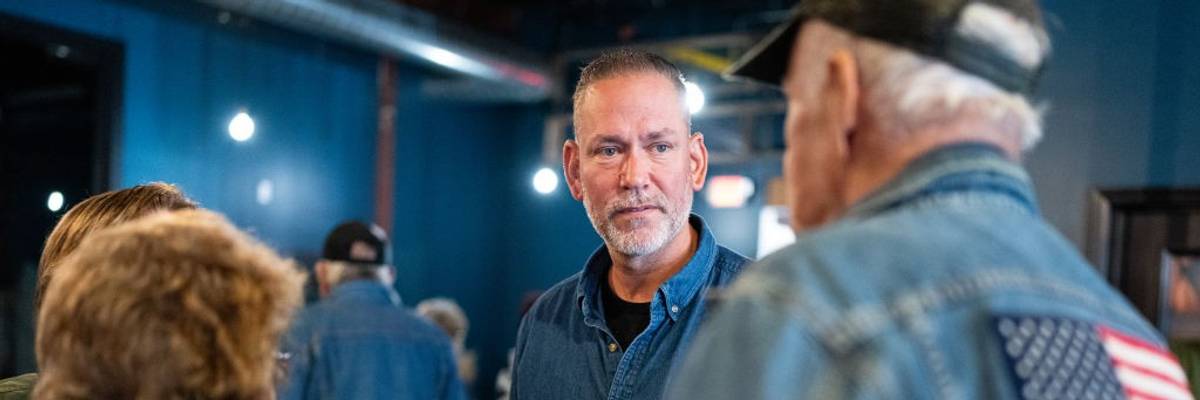
Independent Senate candidate Dan Osborn chats with attendees after speaking during his campaign stop at the Handlebend coffeshop in O'Neill, Neb., on Monday, October 14, 2024.
Asking if independent candidates will destroy the Democratic Party is asking the wrong question.
Independent candidates are popping up all over. We see them running for the U.S. Senate in South Dakota, Idaho, Montana, and Nebraska. In most of these races, Democratic candidates have stepped aside to avoid splitting the anti-Republican vote.
But what does this mean for the Democratic Party?
My friend Bob Kuttner, co-founder and co-editor of The American Prospect, takes up this question. Although he believes the damage to the Democratic brand is sometimes overstated, he recognizes that it is a severe problem in the Great Plains and Mountain West:
These are socially conservative states that used to send economically progressive Democrats to both houses of Congress. New Deal farm, public power, and economic development policies were good for the West. But the damage done to the Democratic brand by the combination of Democratic national leaders going left on cultural issues and right on corporate issues was especially potent in this part of the country.
Nevertheless, Kuttner worries that deference to independent candidates could further weaken the Democratic Party. But this argument rests on a questionable assumption—that Democrats remain a viable political force in most of these states.
They aren’t.
They abandoned ship years ago.
Of the roughly 719 state legislative seats in Oklahoma, Kansas, Nebraska, South Dakota, North Dakota, Montana, and Idaho, Democrats do not even field candidates in 255 (36%) of them in 2024.
Independent candidates are not pushing Democrats aside. They are filling a vast political vacuum—a one-party landscape that offers no meaningful political home for working people who once elected Democratic populists.
Kuttner much prefers the fusion strategy used by the Working Families Party:
Still, as a national strategy, substituting progressive independents for Democrats would be a recipe for killing the party. Fusion, the recipe of the Working Families Party, allows the best of both worlds: a party to the left of the Democrats that cross-endorses Democrats while pushing them to nominate more progressive candidates.
But there are several problems with applying the Working Families Party model to these abandoned states.
First, fusion voting is illegal in every one of the states listed above. Until those laws change, the Working Families Party offers no practical path forward in these Democratic political deserts.
Second, the Working Families Party is no longer a working-class party, as I document in my latest book.
Bob and I both attended a conference at Oberlin College—our alma mater—where I asked the students whether they had ever heard of the Working Families Party. Nearly every hand went up.
A few weeks later, I surveyed 120 union electrical apprentices attending Empire State University in New York City. Only eight had ever heard of the Working Families Party—and this is where the party was founded 27 years ago and where it remains strongest.
Suffice it to say, the Working Families Party is unlikely to break much political ground anytime soon in the Great Plains.
We should expect that independent candidates will continue to fill the vacuum created by decades of Democratic Party malpractice. Democrats will either rebuild their party or continue to fade in red America.
The issue is not how to protect the Democratic Party where it no longer exists in any meaningful sense. The issue is how to build a political movement by and for working people in those abandoned regions.
Independent candidates are a good place to start.
Better still would be for unions and state labor federations to build coherent independent political organizations through which working people could find a political home and develop their own collective voice.
That may further weaken the Democratic Party in those states.
But it would strengthen American democracy.
Dear Common Dreams reader, It’s been nearly 30 years since I co-founded Common Dreams with my late wife, Lina Newhouser. We had the radical notion that journalism should serve the public good, not corporate profits. It was clear to us from the outset what it would take to build such a project. No paid advertisements. No corporate sponsors. No millionaire publisher telling us what to think or do. Many people said we wouldn't last a year, but we proved those doubters wrong. Together with a tremendous team of journalists and dedicated staff, we built an independent media outlet free from the constraints of profits and corporate control. Our mission has always been simple: To inform. To inspire. To ignite change for the common good. Building Common Dreams was not easy. Our survival was never guaranteed. When you take on the most powerful forces—Wall Street greed, fossil fuel industry destruction, Big Tech lobbyists, and uber-rich oligarchs who have spent billions upon billions rigging the economy and democracy in their favor—the only bulwark you have is supporters who believe in your work. But here’s the urgent message from me today. It's never been this bad out there. And it's never been this hard to keep us going. At the very moment Common Dreams is most needed, the threats we face are intensifying. We need your support now more than ever. We don't accept corporate advertising and never will. We don't have a paywall because we don't think people should be blocked from critical news based on their ability to pay. Everything we do is funded by the donations of readers like you. When everyone does the little they can afford, we are strong. But if that support retreats or dries up, so do we. Will you donate now to make sure Common Dreams not only survives but thrives? —Craig Brown, Co-founder |
Les Leopold is the executive director of the Labor Institute and author of the new book, “The Billionaires Have Two Parties, We Need a Party of Our Own” (2026). His previous books include: “Wall Street’s War on Workers: How Mass Layoffs and Greed Are Destroying the Working Class and What to Do About It" (2024); "Runaway Inequality: An Activist's Guide to Economic Justice" (2015); and “The Man Who Hated Work and Loved Labor: The Life and Times of Tony Mazzocchi” (2007). Read more of his work on his substack here.
Independent candidates are popping up all over. We see them running for the U.S. Senate in South Dakota, Idaho, Montana, and Nebraska. In most of these races, Democratic candidates have stepped aside to avoid splitting the anti-Republican vote.
But what does this mean for the Democratic Party?
My friend Bob Kuttner, co-founder and co-editor of The American Prospect, takes up this question. Although he believes the damage to the Democratic brand is sometimes overstated, he recognizes that it is a severe problem in the Great Plains and Mountain West:
These are socially conservative states that used to send economically progressive Democrats to both houses of Congress. New Deal farm, public power, and economic development policies were good for the West. But the damage done to the Democratic brand by the combination of Democratic national leaders going left on cultural issues and right on corporate issues was especially potent in this part of the country.
Nevertheless, Kuttner worries that deference to independent candidates could further weaken the Democratic Party. But this argument rests on a questionable assumption—that Democrats remain a viable political force in most of these states.
They aren’t.
They abandoned ship years ago.
Of the roughly 719 state legislative seats in Oklahoma, Kansas, Nebraska, South Dakota, North Dakota, Montana, and Idaho, Democrats do not even field candidates in 255 (36%) of them in 2024.
Independent candidates are not pushing Democrats aside. They are filling a vast political vacuum—a one-party landscape that offers no meaningful political home for working people who once elected Democratic populists.
Kuttner much prefers the fusion strategy used by the Working Families Party:
Still, as a national strategy, substituting progressive independents for Democrats would be a recipe for killing the party. Fusion, the recipe of the Working Families Party, allows the best of both worlds: a party to the left of the Democrats that cross-endorses Democrats while pushing them to nominate more progressive candidates.
But there are several problems with applying the Working Families Party model to these abandoned states.
First, fusion voting is illegal in every one of the states listed above. Until those laws change, the Working Families Party offers no practical path forward in these Democratic political deserts.
Second, the Working Families Party is no longer a working-class party, as I document in my latest book.
Bob and I both attended a conference at Oberlin College—our alma mater—where I asked the students whether they had ever heard of the Working Families Party. Nearly every hand went up.
A few weeks later, I surveyed 120 union electrical apprentices attending Empire State University in New York City. Only eight had ever heard of the Working Families Party—and this is where the party was founded 27 years ago and where it remains strongest.
Suffice it to say, the Working Families Party is unlikely to break much political ground anytime soon in the Great Plains.
We should expect that independent candidates will continue to fill the vacuum created by decades of Democratic Party malpractice. Democrats will either rebuild their party or continue to fade in red America.
The issue is not how to protect the Democratic Party where it no longer exists in any meaningful sense. The issue is how to build a political movement by and for working people in those abandoned regions.
Independent candidates are a good place to start.
Better still would be for unions and state labor federations to build coherent independent political organizations through which working people could find a political home and develop their own collective voice.
That may further weaken the Democratic Party in those states.
But it would strengthen American democracy.
Les Leopold is the executive director of the Labor Institute and author of the new book, “The Billionaires Have Two Parties, We Need a Party of Our Own” (2026). His previous books include: “Wall Street’s War on Workers: How Mass Layoffs and Greed Are Destroying the Working Class and What to Do About It" (2024); "Runaway Inequality: An Activist's Guide to Economic Justice" (2015); and “The Man Who Hated Work and Loved Labor: The Life and Times of Tony Mazzocchi” (2007). Read more of his work on his substack here.
Independent candidates are popping up all over. We see them running for the U.S. Senate in South Dakota, Idaho, Montana, and Nebraska. In most of these races, Democratic candidates have stepped aside to avoid splitting the anti-Republican vote.
But what does this mean for the Democratic Party?
My friend Bob Kuttner, co-founder and co-editor of The American Prospect, takes up this question. Although he believes the damage to the Democratic brand is sometimes overstated, he recognizes that it is a severe problem in the Great Plains and Mountain West:
These are socially conservative states that used to send economically progressive Democrats to both houses of Congress. New Deal farm, public power, and economic development policies were good for the West. But the damage done to the Democratic brand by the combination of Democratic national leaders going left on cultural issues and right on corporate issues was especially potent in this part of the country.
Nevertheless, Kuttner worries that deference to independent candidates could further weaken the Democratic Party. But this argument rests on a questionable assumption—that Democrats remain a viable political force in most of these states.
They aren’t.
They abandoned ship years ago.
Of the roughly 719 state legislative seats in Oklahoma, Kansas, Nebraska, South Dakota, North Dakota, Montana, and Idaho, Democrats do not even field candidates in 255 (36%) of them in 2024.
Independent candidates are not pushing Democrats aside. They are filling a vast political vacuum—a one-party landscape that offers no meaningful political home for working people who once elected Democratic populists.
Kuttner much prefers the fusion strategy used by the Working Families Party:
Still, as a national strategy, substituting progressive independents for Democrats would be a recipe for killing the party. Fusion, the recipe of the Working Families Party, allows the best of both worlds: a party to the left of the Democrats that cross-endorses Democrats while pushing them to nominate more progressive candidates.
But there are several problems with applying the Working Families Party model to these abandoned states.
First, fusion voting is illegal in every one of the states listed above. Until those laws change, the Working Families Party offers no practical path forward in these Democratic political deserts.
Second, the Working Families Party is no longer a working-class party, as I document in my latest book.
Bob and I both attended a conference at Oberlin College—our alma mater—where I asked the students whether they had ever heard of the Working Families Party. Nearly every hand went up.
A few weeks later, I surveyed 120 union electrical apprentices attending Empire State University in New York City. Only eight had ever heard of the Working Families Party—and this is where the party was founded 27 years ago and where it remains strongest.
Suffice it to say, the Working Families Party is unlikely to break much political ground anytime soon in the Great Plains.
We should expect that independent candidates will continue to fill the vacuum created by decades of Democratic Party malpractice. Democrats will either rebuild their party or continue to fade in red America.
The issue is not how to protect the Democratic Party where it no longer exists in any meaningful sense. The issue is how to build a political movement by and for working people in those abandoned regions.
Independent candidates are a good place to start.
Better still would be for unions and state labor federations to build coherent independent political organizations through which working people could find a political home and develop their own collective voice.
That may further weaken the Democratic Party in those states.
But it would strengthen American democracy.