5
#000000
#FFFFFF
To donate by check, phone, or other method, see our More Ways to Give page.
Daily news & progressive opinion—funded by the people, not the corporations—delivered straight to your inbox.
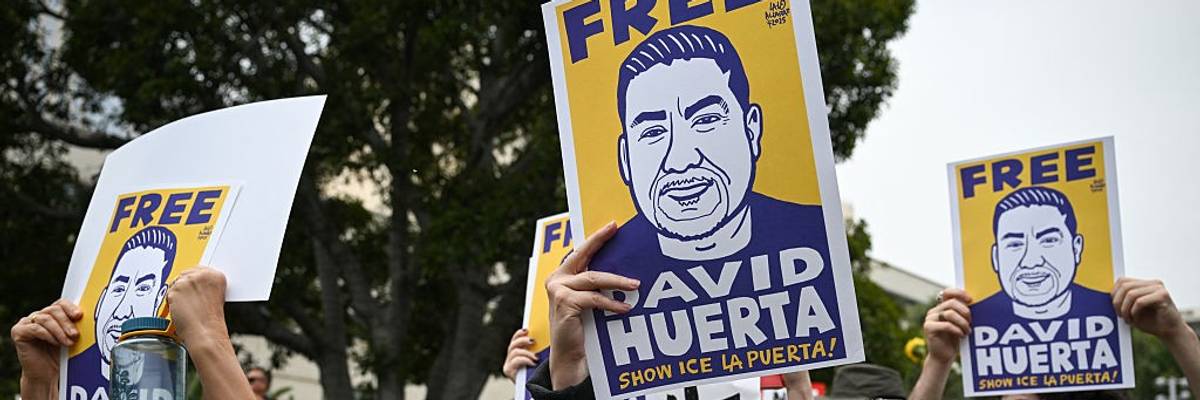
Demonstrators rally against US Immigration and Customs Enforcement (ICE) and call for the release of union leader David Huerta, President of SEIU California and SEIU-USWW, who was arrested on June 6 during federal immigration operations, at Gloria Molina Grand Park in Los Angeles, on June 9, 2025.
The Trump administration claims that its assault on immigrants will protect American workers. But its masked, armed federal agents are creating hostile environments for all workers, not just immigrants.
In late 2025, federal immigration authorities detained a non-union janitor who’d accused contractors for Minnesota’s Ramsey County of wage theft.
The worker is now in deportation proceedings. But his courage helped win policy changes in Ramsey County, and his fierce advocacy in a similar wage theft case in nearby Hennepin County also paid off: More than 70 subcontracted workers for Hennepin County received nearly $400,000 in back pay in December 2025.
When someone who fights for workers is detained, “it sends a chill,” Greg Nammacher, president of SEIU Local 26, told me. “When the workers who are stepping up to try and reveal violations are silenced, the standard comes down for the whole industry.”
The Trump administration claims that its assault on immigrants will protect American workers. But its masked, armed federal agents are creating hostile environments for all workers, not just immigrants.
“They treated us like animals. And it’s not some immigrants who are affected—it’s everybody.”
In Minneapolis, federal agents abducted an educator trying to ensure safe dismissal at a high school. In Southern California, they chased a day laborer at a Home Depot onto a freeway, where he was hit and killed by a vehicle. In Chicago, they detained a childcare worker as children watched.
Agents have even directly harassed striking workers.
On December 16, Juanita Robinson was out on the picket line in Chicago when armed federal agents—including border chief Gregory Bovino—approached and demanded identification. The group “interrogated and laughed at our members while they were on the picket line,” according to a press statement from Teamsters Local 705.
“It was scary when they pulled up on us,” said Robinson, who was born in Chicago but calls her immigrant coworkers family. “We’re out there trying to make ends meet, and y’all abusing us,” she said of the agents. “They treated us like animals. And it’s not some immigrants who are affected—it’s everybody.”
The scholarly research backs Robinson up.
By studying “Secure Communities,” a federal program that resulted in the deportation of nearly half a million people from 2008 to 2014, scholars found that upticks in immigration enforcement are associated with increased minimum wage violations and more dangerous workplaces for all workers.
“If I complain to the Wage and Hour Division that I’m not getting paid minimum wage, it might mean that my wages get restored,” said Matt Johnson, a professor at Duke’s Sanford School of Public Policy. “But it also might affect my coworkers, who were facing similar violations. So when one worker becomes more reluctant to complain,” he told me, it ultimately affects “the rest of the labor market.”
Research also shows that immigration crackdowns actually reduce jobs for US-born workers. Chloe East, an economics professor at the University of Colorado Boulder, says that’s because immigrants and US-born workers “complement” each other rather than compete directly.
For example, in order for a restaurant “to hire waiters, waitresses, hosts, and hostesses, which are jobs typically taken by US-born people, they also have to be able to hire cooks and dishwashers, jobs more often taken by immigrants,” she explained. When they “can’t find anybody to do the dishwashing, they may have to reduce their hiring overall.”
The effect ripples out. “When many people are all of a sudden removed from a local area because of detention or deportation, or afraid to leave their homes to get haircuts and eat at restaurants,” she explained, that hurts the economy “for everybody, including US-born workers.”
The GOP’s so-called ”Big Beautiful Bill” gave the Trump administration an unprecedented $170 billion over and above existing funding to carry out abuses like these. That enormous sum comes directly at the expense of programs that were cut, like Medicaid and SNAP, and could end up hurting all workers and their communities.
They’re trying to “break the unity that we have to have to be able to actually get raises and health insurance and retirement,” Nummacher told me. “Working people have never been able to win these things without being organized.”
This country and this world are at a monumental crossroads. US voters have an opportunity to beat back the forces of fascism and confront the billionaires who are rigging the economy, our media system, and our democracy, making it increasingly impossible for ordinary people to get by. We’re not just talking about the election. We’re talking about what must be done once these fascist elements are vanquished from power. We need a bolder set of solutions than what either major party has so far been willing to offer and a working-class movement ready to fight like hell for it. Trump didn't emerge from nowhere. The conditions that fueled MAGA authoritarianism were created by decades of radical neoliberal economic policies and a corrupt political system dominated by corporate interests. They slashed taxes on the super-rich, promising that the benefits would trickle down. They said giveaways to the corporate titans would make life more affordable for the rest of us. It was all bullshit. And when a bitter, betrayed populace searches for someone to blame, right-wing demagogues have little trouble finding scapegoats. People know when they're being lied to, but you won't hear any of this from the corporate media. Only independent journalism—powered and funded by people who believe in building a better world—can deliver truly trustworthy daily news. If you share our vision, please contribute whatever you can to sustain our work. |
In late 2025, federal immigration authorities detained a non-union janitor who’d accused contractors for Minnesota’s Ramsey County of wage theft.
The worker is now in deportation proceedings. But his courage helped win policy changes in Ramsey County, and his fierce advocacy in a similar wage theft case in nearby Hennepin County also paid off: More than 70 subcontracted workers for Hennepin County received nearly $400,000 in back pay in December 2025.
When someone who fights for workers is detained, “it sends a chill,” Greg Nammacher, president of SEIU Local 26, told me. “When the workers who are stepping up to try and reveal violations are silenced, the standard comes down for the whole industry.”
The Trump administration claims that its assault on immigrants will protect American workers. But its masked, armed federal agents are creating hostile environments for all workers, not just immigrants.
“They treated us like animals. And it’s not some immigrants who are affected—it’s everybody.”
In Minneapolis, federal agents abducted an educator trying to ensure safe dismissal at a high school. In Southern California, they chased a day laborer at a Home Depot onto a freeway, where he was hit and killed by a vehicle. In Chicago, they detained a childcare worker as children watched.
Agents have even directly harassed striking workers.
On December 16, Juanita Robinson was out on the picket line in Chicago when armed federal agents—including border chief Gregory Bovino—approached and demanded identification. The group “interrogated and laughed at our members while they were on the picket line,” according to a press statement from Teamsters Local 705.
“It was scary when they pulled up on us,” said Robinson, who was born in Chicago but calls her immigrant coworkers family. “We’re out there trying to make ends meet, and y’all abusing us,” she said of the agents. “They treated us like animals. And it’s not some immigrants who are affected—it’s everybody.”
The scholarly research backs Robinson up.
By studying “Secure Communities,” a federal program that resulted in the deportation of nearly half a million people from 2008 to 2014, scholars found that upticks in immigration enforcement are associated with increased minimum wage violations and more dangerous workplaces for all workers.
“If I complain to the Wage and Hour Division that I’m not getting paid minimum wage, it might mean that my wages get restored,” said Matt Johnson, a professor at Duke’s Sanford School of Public Policy. “But it also might affect my coworkers, who were facing similar violations. So when one worker becomes more reluctant to complain,” he told me, it ultimately affects “the rest of the labor market.”
Research also shows that immigration crackdowns actually reduce jobs for US-born workers. Chloe East, an economics professor at the University of Colorado Boulder, says that’s because immigrants and US-born workers “complement” each other rather than compete directly.
For example, in order for a restaurant “to hire waiters, waitresses, hosts, and hostesses, which are jobs typically taken by US-born people, they also have to be able to hire cooks and dishwashers, jobs more often taken by immigrants,” she explained. When they “can’t find anybody to do the dishwashing, they may have to reduce their hiring overall.”
The effect ripples out. “When many people are all of a sudden removed from a local area because of detention or deportation, or afraid to leave their homes to get haircuts and eat at restaurants,” she explained, that hurts the economy “for everybody, including US-born workers.”
The GOP’s so-called ”Big Beautiful Bill” gave the Trump administration an unprecedented $170 billion over and above existing funding to carry out abuses like these. That enormous sum comes directly at the expense of programs that were cut, like Medicaid and SNAP, and could end up hurting all workers and their communities.
They’re trying to “break the unity that we have to have to be able to actually get raises and health insurance and retirement,” Nummacher told me. “Working people have never been able to win these things without being organized.”