5
#000000
#FFFFFF
To donate by check, phone, or other method, see our More Ways to Give page.
Daily news & progressive opinion—funded by the people, not the corporations—delivered straight to your inbox.
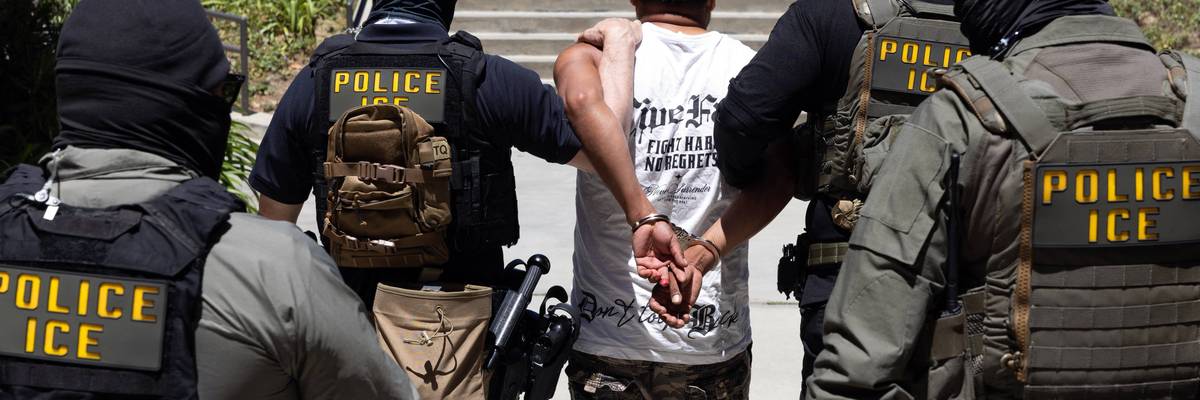
Immigration and Customs Enforcement (ICE) agents walk a detainee out of the Ventura County Government Center in Ventura, California, on July 27, 2026.
ICE rejected the recommendation to implement automated activation technology for use, making claims that are baseless and somewhat puzzling, especially since some federal law enforcement officers already use automated activation.
The Government Accountability Office, an independent non-partisan watchdog agency, released a report this month finding that the US Customs and Border Protection and US Immigration and Customs Enforcement have unsuccessfully implemented their body camera programs, with ICE failing to meet its own policy initiative of “accurately documenting events” to promote transparency and enhance public trust.
The GAO report noted, “ICE lacks a reasonable assurance of compliance with activation requirements in policy” and for this reason recommended that automated camera activation be used to ensure that body cameras are activated in accordance with its policy. ICE policy stipulates that agents activate their body cameras “as soon as practical at the beginning of an Enforcement Activity and deactivation when the activity is concluded.”
Automated activation technology guarantees that a body camera is automatically switched on the moment an officer draws their firearm or conducted energy device (commonly TASER) to capture as much as an enforcement activity (from start to finish) as possible.
Automated activation for body cameras is already used by federal law enforcement officers, so why not for ICE?
ICE however rejected the recommendation to implement automated activation technology for use with its body cameras citing “significant operational risks, including inadvertent or false activations during routine movement,” while suggesting that accidental activations of its body cameras could record sensitive information, violate privacy, and even contravene the First Amendment.
These claims are baseless and somewhat puzzling especially since some federal law enforcement officers already use automated activation, as do other police agencies across the country.
Consider the VA Police who are federal law enforcement officers of the US Department of Veterans Affairs. According to their policy, body cameras are automatically activated when an officer draws their firearm.
In the case of an accidental activation, VA Police policy classifies such footage under the category of “false activation” and when designated as such, denotes that the accidental footage can be stored for 30 days before deletion whereas the retention of footage categorized as “investigation” may be retained for as long as 25 years.
The VA Police use Axon body cameras, the same devices used by ICE and by many police departments in the US.
Axon body cameras have a “false activation cancellation” option as an additional feature of their body-cameras products, providing law enforcement officers with the ability to “stop accidental or undesired recordings” should they occur. The option is initiated with the simple press of a “cancel button” on the screen of the body camera.
There are obvious worries of the unauthorized deletion of recordings, but such concerns can be addressed with good policy. Consider Section 11 “Accidental Recordings” of the body camera policy of the San Jose Police Department (SJPD) as an example.
Section 11 outlines the process for the handling of body camera recordings that have no evidentiary or investigative value. In such circumstances, the “officer will submit a request for deletion via email” to their direct supervisor. The policy specifies that the request email is to be forwarded through the chain of command. The receiving commanding officer is then responsible for reviewing the accidental footage prior to approving (or denying) the request for deletion. The email chain provides a shared written record to deter any malfeasance and to ensure accountability.
As if all of this wasn’t enough to warrant automated body camera activation for use with its body cameras, ICE has maintained that it will only release footage that “is in the best interests of the agency.” Presumably then any “false activations” of ICE body cameras that capture sensitive information or violate privacy would not be released anyway.
Automated activation for body cameras is already used by federal law enforcement officers, so why not for ICE?
The logical conclusion is that ICE’s failure to adopt automated camera activation into its body camera program is merely a blatant attempt to evade any semblance of transparency and accountability.
This country and this world are at a monumental crossroads. US voters have an opportunity to beat back the forces of fascism and confront the billionaires who are rigging the economy, our media system, and our democracy, making it increasingly impossible for ordinary people to get by. We’re not just talking about the election. We’re talking about what must be done once these fascist elements are vanquished from power. We need a bolder set of solutions than what either major party has so far been willing to offer and a working-class movement ready to fight like hell for it. Trump didn't emerge from nowhere. The conditions that fueled MAGA authoritarianism were created by decades of radical neoliberal economic policies and a corrupt political system dominated by corporate interests. They slashed taxes on the super-rich, promising that the benefits would trickle down. They said giveaways to the corporate titans would make life more affordable for the rest of us. It was all bullshit. And when a bitter, betrayed populace searches for someone to blame, right-wing demagogues have little trouble finding scapegoats. People know when they're being lied to, but you won't hear any of this from the corporate media. Only independent journalism—powered and funded by people who believe in building a better world—can deliver truly trustworthy daily news. If you share our vision, please contribute whatever you can to sustain our work. |
The Government Accountability Office, an independent non-partisan watchdog agency, released a report this month finding that the US Customs and Border Protection and US Immigration and Customs Enforcement have unsuccessfully implemented their body camera programs, with ICE failing to meet its own policy initiative of “accurately documenting events” to promote transparency and enhance public trust.
The GAO report noted, “ICE lacks a reasonable assurance of compliance with activation requirements in policy” and for this reason recommended that automated camera activation be used to ensure that body cameras are activated in accordance with its policy. ICE policy stipulates that agents activate their body cameras “as soon as practical at the beginning of an Enforcement Activity and deactivation when the activity is concluded.”
Automated activation technology guarantees that a body camera is automatically switched on the moment an officer draws their firearm or conducted energy device (commonly TASER) to capture as much as an enforcement activity (from start to finish) as possible.
Automated activation for body cameras is already used by federal law enforcement officers, so why not for ICE?
ICE however rejected the recommendation to implement automated activation technology for use with its body cameras citing “significant operational risks, including inadvertent or false activations during routine movement,” while suggesting that accidental activations of its body cameras could record sensitive information, violate privacy, and even contravene the First Amendment.
These claims are baseless and somewhat puzzling especially since some federal law enforcement officers already use automated activation, as do other police agencies across the country.
Consider the VA Police who are federal law enforcement officers of the US Department of Veterans Affairs. According to their policy, body cameras are automatically activated when an officer draws their firearm.
In the case of an accidental activation, VA Police policy classifies such footage under the category of “false activation” and when designated as such, denotes that the accidental footage can be stored for 30 days before deletion whereas the retention of footage categorized as “investigation” may be retained for as long as 25 years.
The VA Police use Axon body cameras, the same devices used by ICE and by many police departments in the US.
Axon body cameras have a “false activation cancellation” option as an additional feature of their body-cameras products, providing law enforcement officers with the ability to “stop accidental or undesired recordings” should they occur. The option is initiated with the simple press of a “cancel button” on the screen of the body camera.
There are obvious worries of the unauthorized deletion of recordings, but such concerns can be addressed with good policy. Consider Section 11 “Accidental Recordings” of the body camera policy of the San Jose Police Department (SJPD) as an example.
Section 11 outlines the process for the handling of body camera recordings that have no evidentiary or investigative value. In such circumstances, the “officer will submit a request for deletion via email” to their direct supervisor. The policy specifies that the request email is to be forwarded through the chain of command. The receiving commanding officer is then responsible for reviewing the accidental footage prior to approving (or denying) the request for deletion. The email chain provides a shared written record to deter any malfeasance and to ensure accountability.
As if all of this wasn’t enough to warrant automated body camera activation for use with its body cameras, ICE has maintained that it will only release footage that “is in the best interests of the agency.” Presumably then any “false activations” of ICE body cameras that capture sensitive information or violate privacy would not be released anyway.
Automated activation for body cameras is already used by federal law enforcement officers, so why not for ICE?
The logical conclusion is that ICE’s failure to adopt automated camera activation into its body camera program is merely a blatant attempt to evade any semblance of transparency and accountability.