SUBSCRIBE TO OUR FREE NEWSLETTER
Daily news & progressive opinion—funded by the people, not the corporations—delivered straight to your inbox.
5
#000000
#FFFFFF
To donate by check, phone, or other method, see our More Ways to Give page.
Daily news & progressive opinion—funded by the people, not the corporations—delivered straight to your inbox.
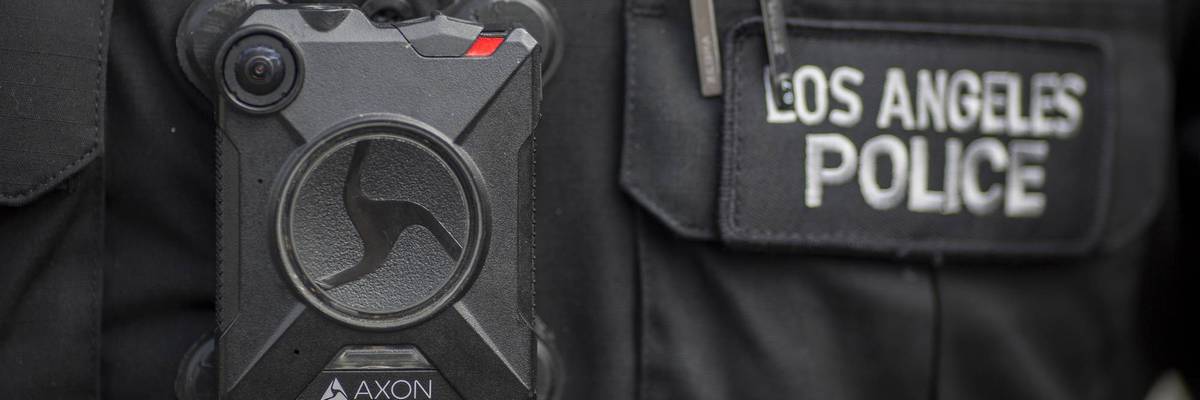
A Los Angeles police officer wear an AXON body camera during the Immigrants Make America Great March to protest actions being taken by the Trump administration on February 18, 2017 in Los Angeles, California.
Research suggests that the public should lower their expectations of body cameras, including assumptions that equipping federal officers with the devices will somehow effect change.
The US federal government has announced that it will “immediately” equip all its Homeland Security officers in Minneapolis with body-worn cameras, including Immigration and Customs Enforcement officers, with plans to outfit all federal officers nationwide.
The announcement follows criticisms in response to ICE and Customs and Border Protection (CBP) officers who killed two protesters last month in Minneapolis. The initiative to require federal law enforcement officers to wear body cameras has bipartisan support and is popular among the public.
But will body cameras effect change?
Research on the efficacy of body cameras is inconsistent. In 2018, a Bureau of Justice Statistics report outlined the primary reasons cited for law enforcement use of body cameras. These included increasing the quality of evidence, decreasing civilian complaints, reducing agency liability, and enhancing officer safety. However, according to a January 2022 National Institute of Justice report, the “research does not necessarily support the effectiveness of body-worn cameras in achieving those desired outcomes. A comprehensive review of 70 studies of body-worn cameras showed no consistent or no statistically significant effects.” Nevertheless, in May 2022 then-President Joe Biden signed an executive order expanding body cameras to federal law enforcement officers.
Will federal body camera footage be manipulated by AI for release? We can no longer be certain.
Why would President Biden sign an order to expand an otherwise inconsistent technology to law enforcement when acknowledged as such by his own government agency? The answer is because the promise of body cameras is based mostly on popular beliefs and assumptions even when the evidence does not support that the devices would deliver the results the public desired.
In our new book Police Body-Worn Cameras: Media and the New Discourse of Police Reform, we trace the broader shift in the rationale for body camera adoption to concerns over transparency and accountability. Indeed, “transparency” was cited as the primary reason in the Department of Homeland Security (DHS) announcement to equip its officers with body cameras.
Transparency is characterized by visibility. However, the release of body camera footage or agreement over what footage necessarily shows can never be assumed.
In October 2025, a judge in Chicago ordered all ICE agents in the city to wear body cameras after reviewing clips of submitted footage from officers who had already been equipped with the devices. In December, in response to a records request of immigration operations in Chicago, ICE reported that it had no body camera footage despite that it had earlier submitted footage. It remains uncertain if the footage will ever be released.
DHS has indicated it has body camera footage of CBP shooting and killing Alex Pretti last month in Minneapolis. There are widespread calls to release the footage including by politicians like the mayor of Kansas City who said, “Video is only great if we can see it.”
If seeing were only that simple.
Video footage, whether from body cameras or another source, is never some sort of objective arbiter of truth as it is routinely asserted. Instead, narratives are presented that explain footage to viewers, whether it be to the public or in a courtroom to a jury. Research has shown that narratives presented as textual descriptions have had an influence in how audiences judge what is depicted in video recordings, including body camera footage.
The 1991 bystander recording of police beating Black motorist Rodney King in Los Angeles is a standout example of narrative influence. At the time, the recording was considered the most extraordinary recording of police brutality to be shown on television. The footage, which many people believed very clearly showed police beating an unarmed man on the ground, was used as key evidence at the trial that resulted in the acquittal of four officers because of the ability of the defense to offer a counternarrative of the police beating.
The recent use of artificial intelligence has only further complicated such matters.
Last month, the White House released a digitally manipulated image of an ICE arrest. The image was different from other released AI materials in its presumably intended realism, which casts doubt on visual evidence released from the government moving forward. Will federal body camera footage be manipulated by AI for release? We can no longer be certain.
As if all of this wasn’t already enough, research examining online user assessments of video as possible evidence of a crime has found that people mostly interpret what they see as it best corresponds to their worldview. And alternative views are unlikely to sway them. The use of AI has only exacerbated this process, as online users across the political spectrum have manipulated images of bystander recordings of Alex Pretti’s killing to correspond to contradictory politically inspired narratives about his death. How then might body camera footage of Pretti’s killing fit into the discordant political discourse, assuming the video is released?
What this all suggests is that the public should lower their expectations of body cameras, including assumptions that equipping federal officers with the devices will somehow effect change. Moving forward clear policies governing the use of body cameras, like when cameras should be activated and a timeline for release, are important next steps. Policies prohibiting the official manipulation of any evidence including body camera footage should also be enacted.
Dear Common Dreams reader, It’s been nearly 30 years since I co-founded Common Dreams with my late wife, Lina Newhouser. We had the radical notion that journalism should serve the public good, not corporate profits. It was clear to us from the outset what it would take to build such a project. No paid advertisements. No corporate sponsors. No millionaire publisher telling us what to think or do. Many people said we wouldn't last a year, but we proved those doubters wrong. Together with a tremendous team of journalists and dedicated staff, we built an independent media outlet free from the constraints of profits and corporate control. Our mission has always been simple: To inform. To inspire. To ignite change for the common good. Building Common Dreams was not easy. Our survival was never guaranteed. When you take on the most powerful forces—Wall Street greed, fossil fuel industry destruction, Big Tech lobbyists, and uber-rich oligarchs who have spent billions upon billions rigging the economy and democracy in their favor—the only bulwark you have is supporters who believe in your work. But here’s the urgent message from me today. It's never been this bad out there. And it's never been this hard to keep us going. At the very moment Common Dreams is most needed, the threats we face are intensifying. We need your support now more than ever. We don't accept corporate advertising and never will. We don't have a paywall because we don't think people should be blocked from critical news based on their ability to pay. Everything we do is funded by the donations of readers like you. When everyone does the little they can afford, we are strong. But if that support retreats or dries up, so do we. Will you donate now to make sure Common Dreams not only survives but thrives? —Craig Brown, Co-founder |
The US federal government has announced that it will “immediately” equip all its Homeland Security officers in Minneapolis with body-worn cameras, including Immigration and Customs Enforcement officers, with plans to outfit all federal officers nationwide.
The announcement follows criticisms in response to ICE and Customs and Border Protection (CBP) officers who killed two protesters last month in Minneapolis. The initiative to require federal law enforcement officers to wear body cameras has bipartisan support and is popular among the public.
But will body cameras effect change?
Research on the efficacy of body cameras is inconsistent. In 2018, a Bureau of Justice Statistics report outlined the primary reasons cited for law enforcement use of body cameras. These included increasing the quality of evidence, decreasing civilian complaints, reducing agency liability, and enhancing officer safety. However, according to a January 2022 National Institute of Justice report, the “research does not necessarily support the effectiveness of body-worn cameras in achieving those desired outcomes. A comprehensive review of 70 studies of body-worn cameras showed no consistent or no statistically significant effects.” Nevertheless, in May 2022 then-President Joe Biden signed an executive order expanding body cameras to federal law enforcement officers.
Will federal body camera footage be manipulated by AI for release? We can no longer be certain.
Why would President Biden sign an order to expand an otherwise inconsistent technology to law enforcement when acknowledged as such by his own government agency? The answer is because the promise of body cameras is based mostly on popular beliefs and assumptions even when the evidence does not support that the devices would deliver the results the public desired.
In our new book Police Body-Worn Cameras: Media and the New Discourse of Police Reform, we trace the broader shift in the rationale for body camera adoption to concerns over transparency and accountability. Indeed, “transparency” was cited as the primary reason in the Department of Homeland Security (DHS) announcement to equip its officers with body cameras.
Transparency is characterized by visibility. However, the release of body camera footage or agreement over what footage necessarily shows can never be assumed.
In October 2025, a judge in Chicago ordered all ICE agents in the city to wear body cameras after reviewing clips of submitted footage from officers who had already been equipped with the devices. In December, in response to a records request of immigration operations in Chicago, ICE reported that it had no body camera footage despite that it had earlier submitted footage. It remains uncertain if the footage will ever be released.
DHS has indicated it has body camera footage of CBP shooting and killing Alex Pretti last month in Minneapolis. There are widespread calls to release the footage including by politicians like the mayor of Kansas City who said, “Video is only great if we can see it.”
If seeing were only that simple.
Video footage, whether from body cameras or another source, is never some sort of objective arbiter of truth as it is routinely asserted. Instead, narratives are presented that explain footage to viewers, whether it be to the public or in a courtroom to a jury. Research has shown that narratives presented as textual descriptions have had an influence in how audiences judge what is depicted in video recordings, including body camera footage.
The 1991 bystander recording of police beating Black motorist Rodney King in Los Angeles is a standout example of narrative influence. At the time, the recording was considered the most extraordinary recording of police brutality to be shown on television. The footage, which many people believed very clearly showed police beating an unarmed man on the ground, was used as key evidence at the trial that resulted in the acquittal of four officers because of the ability of the defense to offer a counternarrative of the police beating.
The recent use of artificial intelligence has only further complicated such matters.
Last month, the White House released a digitally manipulated image of an ICE arrest. The image was different from other released AI materials in its presumably intended realism, which casts doubt on visual evidence released from the government moving forward. Will federal body camera footage be manipulated by AI for release? We can no longer be certain.
As if all of this wasn’t already enough, research examining online user assessments of video as possible evidence of a crime has found that people mostly interpret what they see as it best corresponds to their worldview. And alternative views are unlikely to sway them. The use of AI has only exacerbated this process, as online users across the political spectrum have manipulated images of bystander recordings of Alex Pretti’s killing to correspond to contradictory politically inspired narratives about his death. How then might body camera footage of Pretti’s killing fit into the discordant political discourse, assuming the video is released?
What this all suggests is that the public should lower their expectations of body cameras, including assumptions that equipping federal officers with the devices will somehow effect change. Moving forward clear policies governing the use of body cameras, like when cameras should be activated and a timeline for release, are important next steps. Policies prohibiting the official manipulation of any evidence including body camera footage should also be enacted.
The US federal government has announced that it will “immediately” equip all its Homeland Security officers in Minneapolis with body-worn cameras, including Immigration and Customs Enforcement officers, with plans to outfit all federal officers nationwide.
The announcement follows criticisms in response to ICE and Customs and Border Protection (CBP) officers who killed two protesters last month in Minneapolis. The initiative to require federal law enforcement officers to wear body cameras has bipartisan support and is popular among the public.
But will body cameras effect change?
Research on the efficacy of body cameras is inconsistent. In 2018, a Bureau of Justice Statistics report outlined the primary reasons cited for law enforcement use of body cameras. These included increasing the quality of evidence, decreasing civilian complaints, reducing agency liability, and enhancing officer safety. However, according to a January 2022 National Institute of Justice report, the “research does not necessarily support the effectiveness of body-worn cameras in achieving those desired outcomes. A comprehensive review of 70 studies of body-worn cameras showed no consistent or no statistically significant effects.” Nevertheless, in May 2022 then-President Joe Biden signed an executive order expanding body cameras to federal law enforcement officers.
Will federal body camera footage be manipulated by AI for release? We can no longer be certain.
Why would President Biden sign an order to expand an otherwise inconsistent technology to law enforcement when acknowledged as such by his own government agency? The answer is because the promise of body cameras is based mostly on popular beliefs and assumptions even when the evidence does not support that the devices would deliver the results the public desired.
In our new book Police Body-Worn Cameras: Media and the New Discourse of Police Reform, we trace the broader shift in the rationale for body camera adoption to concerns over transparency and accountability. Indeed, “transparency” was cited as the primary reason in the Department of Homeland Security (DHS) announcement to equip its officers with body cameras.
Transparency is characterized by visibility. However, the release of body camera footage or agreement over what footage necessarily shows can never be assumed.
In October 2025, a judge in Chicago ordered all ICE agents in the city to wear body cameras after reviewing clips of submitted footage from officers who had already been equipped with the devices. In December, in response to a records request of immigration operations in Chicago, ICE reported that it had no body camera footage despite that it had earlier submitted footage. It remains uncertain if the footage will ever be released.
DHS has indicated it has body camera footage of CBP shooting and killing Alex Pretti last month in Minneapolis. There are widespread calls to release the footage including by politicians like the mayor of Kansas City who said, “Video is only great if we can see it.”
If seeing were only that simple.
Video footage, whether from body cameras or another source, is never some sort of objective arbiter of truth as it is routinely asserted. Instead, narratives are presented that explain footage to viewers, whether it be to the public or in a courtroom to a jury. Research has shown that narratives presented as textual descriptions have had an influence in how audiences judge what is depicted in video recordings, including body camera footage.
The 1991 bystander recording of police beating Black motorist Rodney King in Los Angeles is a standout example of narrative influence. At the time, the recording was considered the most extraordinary recording of police brutality to be shown on television. The footage, which many people believed very clearly showed police beating an unarmed man on the ground, was used as key evidence at the trial that resulted in the acquittal of four officers because of the ability of the defense to offer a counternarrative of the police beating.
The recent use of artificial intelligence has only further complicated such matters.
Last month, the White House released a digitally manipulated image of an ICE arrest. The image was different from other released AI materials in its presumably intended realism, which casts doubt on visual evidence released from the government moving forward. Will federal body camera footage be manipulated by AI for release? We can no longer be certain.
As if all of this wasn’t already enough, research examining online user assessments of video as possible evidence of a crime has found that people mostly interpret what they see as it best corresponds to their worldview. And alternative views are unlikely to sway them. The use of AI has only exacerbated this process, as online users across the political spectrum have manipulated images of bystander recordings of Alex Pretti’s killing to correspond to contradictory politically inspired narratives about his death. How then might body camera footage of Pretti’s killing fit into the discordant political discourse, assuming the video is released?
What this all suggests is that the public should lower their expectations of body cameras, including assumptions that equipping federal officers with the devices will somehow effect change. Moving forward clear policies governing the use of body cameras, like when cameras should be activated and a timeline for release, are important next steps. Policies prohibiting the official manipulation of any evidence including body camera footage should also be enacted.