5
#000000
#FFFFFF
To donate by check, phone, or other method, see our More Ways to Give page.
Daily news & progressive opinion—funded by the people, not the corporations—delivered straight to your inbox.

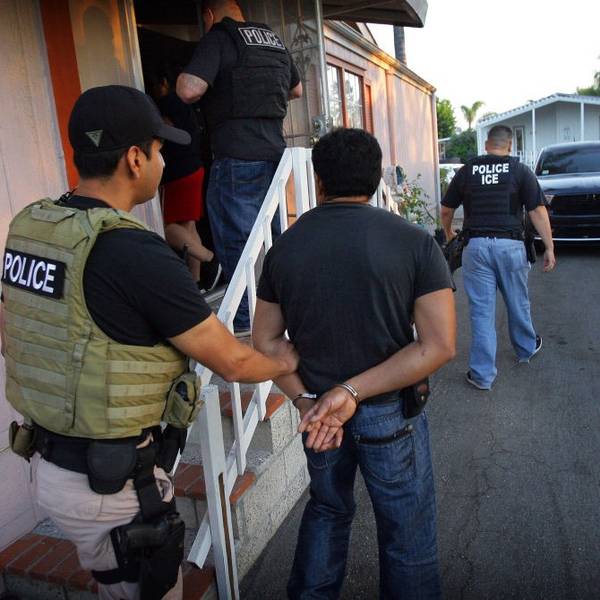
Immigration and Customs Enforcement (ICE) agents walk a detainee out of the Ventura County Government Center in Ventura, California, on July 27, 2026.
ICE rejected the recommendation to implement automated activation technology for use, making claims that are baseless and somewhat puzzling, especially since some federal law enforcement officers already use automated activation.
The Government Accountability Office, an independent non-partisan watchdog agency, released a report this month finding that the US Customs and Border Protection and US Immigration and Customs Enforcement have unsuccessfully implemented their body camera programs, with ICE failing to meet its own policy initiative of “accurately documenting events” to promote transparency and enhance public trust.
The GAO report noted, “ICE lacks a reasonable assurance of compliance with activation requirements in policy” and for this reason recommended that automated camera activation be used to ensure that body cameras are activated in accordance with its policy. ICE policy stipulates that agents activate their body cameras “as soon as practical at the beginning of an Enforcement Activity and deactivation when the activity is concluded.”
Automated activation technology guarantees that a body camera is automatically switched on the moment an officer draws their firearm or conducted energy device (commonly TASER) to capture as much as an enforcement activity (from start to finish) as possible.
Automated activation for body cameras is already used by federal law enforcement officers, so why not for ICE?
ICE however rejected the recommendation to implement automated activation technology for use with its body cameras citing “significant operational risks, including inadvertent or false activations during routine movement,” while suggesting that accidental activations of its body cameras could record sensitive information, violate privacy, and even contravene the First Amendment.
These claims are baseless and somewhat puzzling especially since some federal law enforcement officers already use automated activation, as do other police agencies across the country.
Consider the VA Police who are federal law enforcement officers of the US Department of Veterans Affairs. According to their policy, body cameras are automatically activated when an officer draws their firearm.
In the case of an accidental activation, VA Police policy classifies such footage under the category of “false activation” and when designated as such, denotes that the accidental footage can be stored for 30 days before deletion whereas the retention of footage categorized as “investigation” may be retained for as long as 25 years.
The VA Police use Axon body cameras, the same devices used by ICE and by many police departments in the US.
Axon body cameras have a “false activation cancellation” option as an additional feature of their body-cameras products, providing law enforcement officers with the ability to “stop accidental or undesired recordings” should they occur. The option is initiated with the simple press of a “cancel button” on the screen of the body camera.
There are obvious worries of the unauthorized deletion of recordings, but such concerns can be addressed with good policy. Consider Section 11 “Accidental Recordings” of the body camera policy of the San Jose Police Department (SJPD) as an example.
Section 11 outlines the process for the handling of body camera recordings that have no evidentiary or investigative value. In such circumstances, the “officer will submit a request for deletion via email” to their direct supervisor. The policy specifies that the request email is to be forwarded through the chain of command. The receiving commanding officer is then responsible for reviewing the accidental footage prior to approving (or denying) the request for deletion. The email chain provides a shared written record to deter any malfeasance and to ensure accountability.
As if all of this wasn’t enough to warrant automated body camera activation for use with its body cameras, ICE has maintained that it will only release footage that “is in the best interests of the agency.” Presumably then any “false activations” of ICE body cameras that capture sensitive information or violate privacy would not be released anyway.
Automated activation for body cameras is already used by federal law enforcement officers, so why not for ICE?
The logical conclusion is that ICE’s failure to adopt automated camera activation into its body camera program is merely a blatant attempt to evade any semblance of transparency and accountability.
Dear Common Dreams reader, It’s been nearly 30 years since I co-founded Common Dreams with my late wife, Lina Newhouser. We had the radical notion that journalism should serve the public good, not corporate profits. It was clear to us from the outset what it would take to build such a project. No paid advertisements. No corporate sponsors. No millionaire publisher telling us what to think or do. Many people said we wouldn't last a year, but we proved those doubters wrong. Together with a tremendous team of journalists and dedicated staff, we built an independent media outlet free from the constraints of profits and corporate control. Our mission has always been simple: To inform. To inspire. To ignite change for the common good. Building Common Dreams was not easy. Our survival was never guaranteed. When you take on the most powerful forces—Wall Street greed, fossil fuel industry destruction, Big Tech lobbyists, and uber-rich oligarchs who have spent billions upon billions rigging the economy and democracy in their favor—the only bulwark you have is supporters who believe in your work. But here’s the urgent message from me today. It's never been this bad out there. And it's never been this hard to keep us going. At the very moment Common Dreams is most needed, the threats we face are intensifying. We need your support now more than ever. We don't accept corporate advertising and never will. We don't have a paywall because we don't think people should be blocked from critical news based on their ability to pay. Everything we do is funded by the donations of readers like you. When everyone does the little they can afford, we are strong. But if that support retreats or dries up, so do we. Will you donate now to make sure Common Dreams not only survives but thrives? —Craig Brown, Co-founder |
The Government Accountability Office, an independent non-partisan watchdog agency, released a report this month finding that the US Customs and Border Protection and US Immigration and Customs Enforcement have unsuccessfully implemented their body camera programs, with ICE failing to meet its own policy initiative of “accurately documenting events” to promote transparency and enhance public trust.
The GAO report noted, “ICE lacks a reasonable assurance of compliance with activation requirements in policy” and for this reason recommended that automated camera activation be used to ensure that body cameras are activated in accordance with its policy. ICE policy stipulates that agents activate their body cameras “as soon as practical at the beginning of an Enforcement Activity and deactivation when the activity is concluded.”
Automated activation technology guarantees that a body camera is automatically switched on the moment an officer draws their firearm or conducted energy device (commonly TASER) to capture as much as an enforcement activity (from start to finish) as possible.
Automated activation for body cameras is already used by federal law enforcement officers, so why not for ICE?
ICE however rejected the recommendation to implement automated activation technology for use with its body cameras citing “significant operational risks, including inadvertent or false activations during routine movement,” while suggesting that accidental activations of its body cameras could record sensitive information, violate privacy, and even contravene the First Amendment.
These claims are baseless and somewhat puzzling especially since some federal law enforcement officers already use automated activation, as do other police agencies across the country.
Consider the VA Police who are federal law enforcement officers of the US Department of Veterans Affairs. According to their policy, body cameras are automatically activated when an officer draws their firearm.
In the case of an accidental activation, VA Police policy classifies such footage under the category of “false activation” and when designated as such, denotes that the accidental footage can be stored for 30 days before deletion whereas the retention of footage categorized as “investigation” may be retained for as long as 25 years.
The VA Police use Axon body cameras, the same devices used by ICE and by many police departments in the US.
Axon body cameras have a “false activation cancellation” option as an additional feature of their body-cameras products, providing law enforcement officers with the ability to “stop accidental or undesired recordings” should they occur. The option is initiated with the simple press of a “cancel button” on the screen of the body camera.
There are obvious worries of the unauthorized deletion of recordings, but such concerns can be addressed with good policy. Consider Section 11 “Accidental Recordings” of the body camera policy of the San Jose Police Department (SJPD) as an example.
Section 11 outlines the process for the handling of body camera recordings that have no evidentiary or investigative value. In such circumstances, the “officer will submit a request for deletion via email” to their direct supervisor. The policy specifies that the request email is to be forwarded through the chain of command. The receiving commanding officer is then responsible for reviewing the accidental footage prior to approving (or denying) the request for deletion. The email chain provides a shared written record to deter any malfeasance and to ensure accountability.
As if all of this wasn’t enough to warrant automated body camera activation for use with its body cameras, ICE has maintained that it will only release footage that “is in the best interests of the agency.” Presumably then any “false activations” of ICE body cameras that capture sensitive information or violate privacy would not be released anyway.
Automated activation for body cameras is already used by federal law enforcement officers, so why not for ICE?
The logical conclusion is that ICE’s failure to adopt automated camera activation into its body camera program is merely a blatant attempt to evade any semblance of transparency and accountability.
The Government Accountability Office, an independent non-partisan watchdog agency, released a report this month finding that the US Customs and Border Protection and US Immigration and Customs Enforcement have unsuccessfully implemented their body camera programs, with ICE failing to meet its own policy initiative of “accurately documenting events” to promote transparency and enhance public trust.
The GAO report noted, “ICE lacks a reasonable assurance of compliance with activation requirements in policy” and for this reason recommended that automated camera activation be used to ensure that body cameras are activated in accordance with its policy. ICE policy stipulates that agents activate their body cameras “as soon as practical at the beginning of an Enforcement Activity and deactivation when the activity is concluded.”
Automated activation technology guarantees that a body camera is automatically switched on the moment an officer draws their firearm or conducted energy device (commonly TASER) to capture as much as an enforcement activity (from start to finish) as possible.
Automated activation for body cameras is already used by federal law enforcement officers, so why not for ICE?
ICE however rejected the recommendation to implement automated activation technology for use with its body cameras citing “significant operational risks, including inadvertent or false activations during routine movement,” while suggesting that accidental activations of its body cameras could record sensitive information, violate privacy, and even contravene the First Amendment.
These claims are baseless and somewhat puzzling especially since some federal law enforcement officers already use automated activation, as do other police agencies across the country.
Consider the VA Police who are federal law enforcement officers of the US Department of Veterans Affairs. According to their policy, body cameras are automatically activated when an officer draws their firearm.
In the case of an accidental activation, VA Police policy classifies such footage under the category of “false activation” and when designated as such, denotes that the accidental footage can be stored for 30 days before deletion whereas the retention of footage categorized as “investigation” may be retained for as long as 25 years.
The VA Police use Axon body cameras, the same devices used by ICE and by many police departments in the US.
Axon body cameras have a “false activation cancellation” option as an additional feature of their body-cameras products, providing law enforcement officers with the ability to “stop accidental or undesired recordings” should they occur. The option is initiated with the simple press of a “cancel button” on the screen of the body camera.
There are obvious worries of the unauthorized deletion of recordings, but such concerns can be addressed with good policy. Consider Section 11 “Accidental Recordings” of the body camera policy of the San Jose Police Department (SJPD) as an example.
Section 11 outlines the process for the handling of body camera recordings that have no evidentiary or investigative value. In such circumstances, the “officer will submit a request for deletion via email” to their direct supervisor. The policy specifies that the request email is to be forwarded through the chain of command. The receiving commanding officer is then responsible for reviewing the accidental footage prior to approving (or denying) the request for deletion. The email chain provides a shared written record to deter any malfeasance and to ensure accountability.
As if all of this wasn’t enough to warrant automated body camera activation for use with its body cameras, ICE has maintained that it will only release footage that “is in the best interests of the agency.” Presumably then any “false activations” of ICE body cameras that capture sensitive information or violate privacy would not be released anyway.
Automated activation for body cameras is already used by federal law enforcement officers, so why not for ICE?
The logical conclusion is that ICE’s failure to adopt automated camera activation into its body camera program is merely a blatant attempt to evade any semblance of transparency and accountability.