SUBSCRIBE TO OUR FREE NEWSLETTER
Daily news & progressive opinion—funded by the people, not the corporations—delivered straight to your inbox.
5
#000000
#FFFFFF
To donate by check, phone, or other method, see our More Ways to Give page.
Daily news & progressive opinion—funded by the people, not the corporations—delivered straight to your inbox.
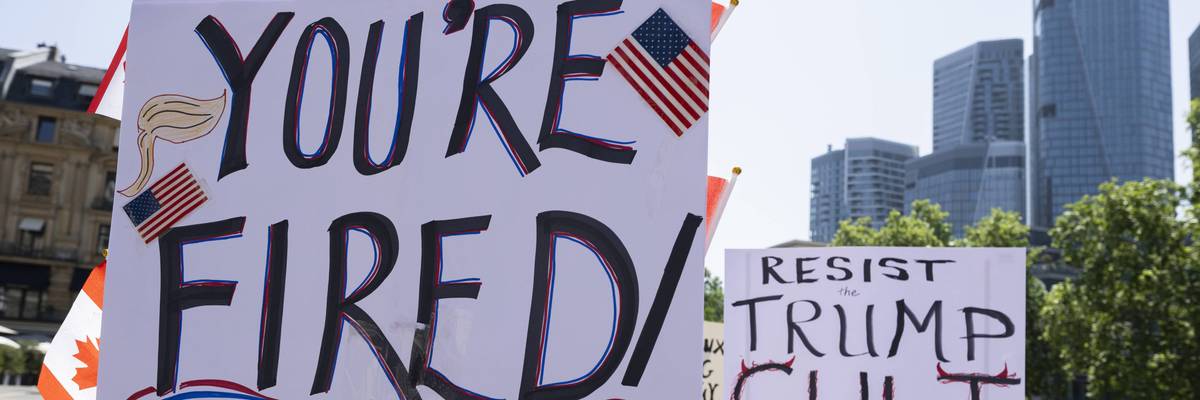
A woman holds a sign with the words "You're fired!" during a protest by demonstrators who have gathered in the center of Frankfurt under the slogan "No Kings," directed against US President Donald Trump and the policies of the US government on June 14, 2025.
We have built republics where the sword of Damocles hangs over the citizen’s head—not over that of the ruler. Giving people the ability to recall elected presidents could change this.
As Cicero wrote in The Tusculan Disputations (three centuries before Julius Caesar, the dictator who ruled Rome), the tyrant of Syracuse, Dionysius, tired of the flattery and envy of his courtier Damocles, invited him to sit on his throne. Damocles enjoyed the banquet for no more than a few minutes. When he looked up, he saw a sword hanging above his head, suspended by a horsehair. It was a warning: Those in power live under a constant threat. If they are aware of it, they will be alert to the consequences of their decisions.
At that time, the common people were more feared than the city’s wealthy. At that time, it was the wealthiest who had to foot the bill for most of the wars they dared to wage. But Julius Caesar was assassinated a year later, not by his own people, but by a group of senators representing the Roman oligarchy. It was an act of mutual betrayal, since these senators had been his main allies in government. Exactly 30 years later, Plutarch reported on the assassination of Quintus Sertorius in Hispania at the hands of mercenary officers, who did not receive the expected compensation—a classic reminder that “Rome does not pay traitors.”
Two thousand years later, we have achieved the opposite marvel: It is not the rich who pay for the wars they invent, but they are who profits from them. It is the people who provide all the money and all the blood that fuel a system administered by the sect of neo-feudal lords—a system infinitely more corrupt, more degenerate, and more brutal than the Roman Republic and the Roman Empire combined.
A business owner’s “sacred right” to fire someone who, in his judgment, is not meeting expectations does not apply to those at the top.
Systematically, and especially in so-called liberal democracies, the traitors are the Julius Caesars and their oligarchs; they are the Quintus Sertoriuses and his officers. They are the puppets that the puppeteer will make kill one another, to the people’s amusement. They are the Yamandú Orsis and the Delsy Rodríguezes on the left. They are the Javier Mileis, the José Antonio Kasts, the Alberto Fujimoris, the Jair Bolsonaros, and the Abelardo de la Espriellas on the right.
We have built republics where the sword of Damocles hangs over the citizen’s head—not over that of the ruler. Puppet presidents, after having betrayed their people and themselves, sleep soundly. They know—or believe—that for four or eight years, no matter what happens, no one can touch them. As history shows, this is an illusion; but history also shows that justice delayed is justice denied, because we humans cannot wait 100 years. We don’t even have a reserve supply of young people to make up for lost time.
Every four or five years, citizens of countries that perceive themselves as full-fledged democracies—such as Uruguay—sign a blank contract. They elect a president, and if they later discover that the promises were mere window dressing, all that remains for them is therapy, resignation, and republican patience until the circus returns to town.
Uruguay takes pride—with some justification—in its civic tradition, which includes plebiscites and referendums, such as the one in 1989 that confirmed impunity for human rights violators and, in the 1990s, halted privatizations despite the almost unanimous support of politicians in favor of the Washington Consensus. But neither Uruguay, nor Argentina, nor Brazil, nor Chile, nor Paraguay, nor Peru has a mechanism for citizens to recall their presidents. Impeachment proceedings are unreliable, because they are mediated by a representative body invented to ensure “responsible stability” for the major shareholders in each country.
In controlled democracies, laws are written by the powerful—the feudal lords of capital—who are almost always residents of the imperial capitals. When workers’ interests do not offend or inconvenience them due to their modesty, these laws are also passed off as achievements of the organized people. However, a law can be repealed; a term of office cannot—especially when the puppet plays along with those who hold the real power to promote, buy, extort, and remove.
Other societies have this instrument of removal, though it has rarely been used. In California, Gov. Gray Davis was recalled in 2003, while Gavin Newsom survived his recall in 2021. In Venezuela, Bolivia, Ecuador, and Mexico, the recall process has been included in those countries’ constitutions during the presidencies of Hugo Chávez, Evo Morales, Rafael Correa, and Manuel López Obrador. In Colombia (approved by César Gaviria), recall is available for mayors and governors, but the requirements are so high that there are almost no cases.
As is more than obvious, this mechanism is not enough to ensure a more just and direct democracy, but it remains a useful sword of Damocles; however, a democratic instrument is not measured by how often it is used, but by what it prevents. A fire extinguisher isn’t meant to put out fires every day either. Recall is not merely a punishment. It is, above all, a form of political education.
The objections are predictable: The instrument could become a weapon for sore losers; it could lead to a state of perpetual campaigning. Historical experience suggests otherwise, and, moreover, we must always begin a political reflection by asking ourselves whether these arguments serve those who hold the real power or the people. Even generous donations are used to do harm. That is why every reform bill must be carefully worded to guarantee this popular right and prevent good intentions from being hijacked once again.
To prevent abuse, the process might require that a high percentage of citizens sign the petition and that it cannot be initiated in the first or last year of the term. Designing the instrument correctly is the civilized way of ensuring it is not abandoned.
It will also be said that Uruguay already has impeachment and elections every five years. But impeachment is a matter for the elites—resolved among legislators who answer to the same parties that support the president or the opposition, both more or less anointed by the owners of capital. When the gap between campaign promises and government actions is displayed with brazen paternalism, citizens watch as spectators as they are humiliated. The school of resignation and futile complaining has been the mother of this political pornography.
A society that learns that voting is an irrevocable gamble ends up voting with distrust and, in the long run, ceases to participate. The old observation we wrote in 2013 for a legal journal: The worst thing that can happen to a democracy is for its citizens to leave politics in the hands of politicians (Revista Forumul Judecătorilor, No. 1/2014).
After all, in a world shaped by capitalist dogmas, it is always the heads of large corporations and their puppets in the political system who do not abide by their own laws. A business owner’s “sacred right” to fire someone who, in his judgment, is not meeting expectations does not apply to those at the top. The freedom of the powerful is protected by money and the law; the freedom of the powerless, by rights and legitimacy.
Neither can be achieved or defended without some form of radical struggle.
Dear Common Dreams reader, It’s been nearly 30 years since I co-founded Common Dreams with my late wife, Lina Newhouser. We had the radical notion that journalism should serve the public good, not corporate profits. It was clear to us from the outset what it would take to build such a project. No paid advertisements. No corporate sponsors. No millionaire publisher telling us what to think or do. Many people said we wouldn't last a year, but we proved those doubters wrong. Together with a tremendous team of journalists and dedicated staff, we built an independent media outlet free from the constraints of profits and corporate control. Our mission has always been simple: To inform. To inspire. To ignite change for the common good. Building Common Dreams was not easy. Our survival was never guaranteed. When you take on the most powerful forces—Wall Street greed, fossil fuel industry destruction, Big Tech lobbyists, and uber-rich oligarchs who have spent billions upon billions rigging the economy and democracy in their favor—the only bulwark you have is supporters who believe in your work. But here’s the urgent message from me today. It's never been this bad out there. And it's never been this hard to keep us going. At the very moment Common Dreams is most needed, the threats we face are intensifying. We need your support now more than ever. We don't accept corporate advertising and never will. We don't have a paywall because we don't think people should be blocked from critical news based on their ability to pay. Everything we do is funded by the donations of readers like you. When everyone does the little they can afford, we are strong. But if that support retreats or dries up, so do we. Will you donate now to make sure Common Dreams not only survives but thrives? —Craig Brown, Co-founder |
As Cicero wrote in The Tusculan Disputations (three centuries before Julius Caesar, the dictator who ruled Rome), the tyrant of Syracuse, Dionysius, tired of the flattery and envy of his courtier Damocles, invited him to sit on his throne. Damocles enjoyed the banquet for no more than a few minutes. When he looked up, he saw a sword hanging above his head, suspended by a horsehair. It was a warning: Those in power live under a constant threat. If they are aware of it, they will be alert to the consequences of their decisions.
At that time, the common people were more feared than the city’s wealthy. At that time, it was the wealthiest who had to foot the bill for most of the wars they dared to wage. But Julius Caesar was assassinated a year later, not by his own people, but by a group of senators representing the Roman oligarchy. It was an act of mutual betrayal, since these senators had been his main allies in government. Exactly 30 years later, Plutarch reported on the assassination of Quintus Sertorius in Hispania at the hands of mercenary officers, who did not receive the expected compensation—a classic reminder that “Rome does not pay traitors.”
Two thousand years later, we have achieved the opposite marvel: It is not the rich who pay for the wars they invent, but they are who profits from them. It is the people who provide all the money and all the blood that fuel a system administered by the sect of neo-feudal lords—a system infinitely more corrupt, more degenerate, and more brutal than the Roman Republic and the Roman Empire combined.
A business owner’s “sacred right” to fire someone who, in his judgment, is not meeting expectations does not apply to those at the top.
Systematically, and especially in so-called liberal democracies, the traitors are the Julius Caesars and their oligarchs; they are the Quintus Sertoriuses and his officers. They are the puppets that the puppeteer will make kill one another, to the people’s amusement. They are the Yamandú Orsis and the Delsy Rodríguezes on the left. They are the Javier Mileis, the José Antonio Kasts, the Alberto Fujimoris, the Jair Bolsonaros, and the Abelardo de la Espriellas on the right.
We have built republics where the sword of Damocles hangs over the citizen’s head—not over that of the ruler. Puppet presidents, after having betrayed their people and themselves, sleep soundly. They know—or believe—that for four or eight years, no matter what happens, no one can touch them. As history shows, this is an illusion; but history also shows that justice delayed is justice denied, because we humans cannot wait 100 years. We don’t even have a reserve supply of young people to make up for lost time.
Every four or five years, citizens of countries that perceive themselves as full-fledged democracies—such as Uruguay—sign a blank contract. They elect a president, and if they later discover that the promises were mere window dressing, all that remains for them is therapy, resignation, and republican patience until the circus returns to town.
Uruguay takes pride—with some justification—in its civic tradition, which includes plebiscites and referendums, such as the one in 1989 that confirmed impunity for human rights violators and, in the 1990s, halted privatizations despite the almost unanimous support of politicians in favor of the Washington Consensus. But neither Uruguay, nor Argentina, nor Brazil, nor Chile, nor Paraguay, nor Peru has a mechanism for citizens to recall their presidents. Impeachment proceedings are unreliable, because they are mediated by a representative body invented to ensure “responsible stability” for the major shareholders in each country.
In controlled democracies, laws are written by the powerful—the feudal lords of capital—who are almost always residents of the imperial capitals. When workers’ interests do not offend or inconvenience them due to their modesty, these laws are also passed off as achievements of the organized people. However, a law can be repealed; a term of office cannot—especially when the puppet plays along with those who hold the real power to promote, buy, extort, and remove.
Other societies have this instrument of removal, though it has rarely been used. In California, Gov. Gray Davis was recalled in 2003, while Gavin Newsom survived his recall in 2021. In Venezuela, Bolivia, Ecuador, and Mexico, the recall process has been included in those countries’ constitutions during the presidencies of Hugo Chávez, Evo Morales, Rafael Correa, and Manuel López Obrador. In Colombia (approved by César Gaviria), recall is available for mayors and governors, but the requirements are so high that there are almost no cases.
As is more than obvious, this mechanism is not enough to ensure a more just and direct democracy, but it remains a useful sword of Damocles; however, a democratic instrument is not measured by how often it is used, but by what it prevents. A fire extinguisher isn’t meant to put out fires every day either. Recall is not merely a punishment. It is, above all, a form of political education.
The objections are predictable: The instrument could become a weapon for sore losers; it could lead to a state of perpetual campaigning. Historical experience suggests otherwise, and, moreover, we must always begin a political reflection by asking ourselves whether these arguments serve those who hold the real power or the people. Even generous donations are used to do harm. That is why every reform bill must be carefully worded to guarantee this popular right and prevent good intentions from being hijacked once again.
To prevent abuse, the process might require that a high percentage of citizens sign the petition and that it cannot be initiated in the first or last year of the term. Designing the instrument correctly is the civilized way of ensuring it is not abandoned.
It will also be said that Uruguay already has impeachment and elections every five years. But impeachment is a matter for the elites—resolved among legislators who answer to the same parties that support the president or the opposition, both more or less anointed by the owners of capital. When the gap between campaign promises and government actions is displayed with brazen paternalism, citizens watch as spectators as they are humiliated. The school of resignation and futile complaining has been the mother of this political pornography.
A society that learns that voting is an irrevocable gamble ends up voting with distrust and, in the long run, ceases to participate. The old observation we wrote in 2013 for a legal journal: The worst thing that can happen to a democracy is for its citizens to leave politics in the hands of politicians (Revista Forumul Judecătorilor, No. 1/2014).
After all, in a world shaped by capitalist dogmas, it is always the heads of large corporations and their puppets in the political system who do not abide by their own laws. A business owner’s “sacred right” to fire someone who, in his judgment, is not meeting expectations does not apply to those at the top. The freedom of the powerful is protected by money and the law; the freedom of the powerless, by rights and legitimacy.
Neither can be achieved or defended without some form of radical struggle.
As Cicero wrote in The Tusculan Disputations (three centuries before Julius Caesar, the dictator who ruled Rome), the tyrant of Syracuse, Dionysius, tired of the flattery and envy of his courtier Damocles, invited him to sit on his throne. Damocles enjoyed the banquet for no more than a few minutes. When he looked up, he saw a sword hanging above his head, suspended by a horsehair. It was a warning: Those in power live under a constant threat. If they are aware of it, they will be alert to the consequences of their decisions.
At that time, the common people were more feared than the city’s wealthy. At that time, it was the wealthiest who had to foot the bill for most of the wars they dared to wage. But Julius Caesar was assassinated a year later, not by his own people, but by a group of senators representing the Roman oligarchy. It was an act of mutual betrayal, since these senators had been his main allies in government. Exactly 30 years later, Plutarch reported on the assassination of Quintus Sertorius in Hispania at the hands of mercenary officers, who did not receive the expected compensation—a classic reminder that “Rome does not pay traitors.”
Two thousand years later, we have achieved the opposite marvel: It is not the rich who pay for the wars they invent, but they are who profits from them. It is the people who provide all the money and all the blood that fuel a system administered by the sect of neo-feudal lords—a system infinitely more corrupt, more degenerate, and more brutal than the Roman Republic and the Roman Empire combined.
A business owner’s “sacred right” to fire someone who, in his judgment, is not meeting expectations does not apply to those at the top.
Systematically, and especially in so-called liberal democracies, the traitors are the Julius Caesars and their oligarchs; they are the Quintus Sertoriuses and his officers. They are the puppets that the puppeteer will make kill one another, to the people’s amusement. They are the Yamandú Orsis and the Delsy Rodríguezes on the left. They are the Javier Mileis, the José Antonio Kasts, the Alberto Fujimoris, the Jair Bolsonaros, and the Abelardo de la Espriellas on the right.
We have built republics where the sword of Damocles hangs over the citizen’s head—not over that of the ruler. Puppet presidents, after having betrayed their people and themselves, sleep soundly. They know—or believe—that for four or eight years, no matter what happens, no one can touch them. As history shows, this is an illusion; but history also shows that justice delayed is justice denied, because we humans cannot wait 100 years. We don’t even have a reserve supply of young people to make up for lost time.
Every four or five years, citizens of countries that perceive themselves as full-fledged democracies—such as Uruguay—sign a blank contract. They elect a president, and if they later discover that the promises were mere window dressing, all that remains for them is therapy, resignation, and republican patience until the circus returns to town.
Uruguay takes pride—with some justification—in its civic tradition, which includes plebiscites and referendums, such as the one in 1989 that confirmed impunity for human rights violators and, in the 1990s, halted privatizations despite the almost unanimous support of politicians in favor of the Washington Consensus. But neither Uruguay, nor Argentina, nor Brazil, nor Chile, nor Paraguay, nor Peru has a mechanism for citizens to recall their presidents. Impeachment proceedings are unreliable, because they are mediated by a representative body invented to ensure “responsible stability” for the major shareholders in each country.
In controlled democracies, laws are written by the powerful—the feudal lords of capital—who are almost always residents of the imperial capitals. When workers’ interests do not offend or inconvenience them due to their modesty, these laws are also passed off as achievements of the organized people. However, a law can be repealed; a term of office cannot—especially when the puppet plays along with those who hold the real power to promote, buy, extort, and remove.
Other societies have this instrument of removal, though it has rarely been used. In California, Gov. Gray Davis was recalled in 2003, while Gavin Newsom survived his recall in 2021. In Venezuela, Bolivia, Ecuador, and Mexico, the recall process has been included in those countries’ constitutions during the presidencies of Hugo Chávez, Evo Morales, Rafael Correa, and Manuel López Obrador. In Colombia (approved by César Gaviria), recall is available for mayors and governors, but the requirements are so high that there are almost no cases.
As is more than obvious, this mechanism is not enough to ensure a more just and direct democracy, but it remains a useful sword of Damocles; however, a democratic instrument is not measured by how often it is used, but by what it prevents. A fire extinguisher isn’t meant to put out fires every day either. Recall is not merely a punishment. It is, above all, a form of political education.
The objections are predictable: The instrument could become a weapon for sore losers; it could lead to a state of perpetual campaigning. Historical experience suggests otherwise, and, moreover, we must always begin a political reflection by asking ourselves whether these arguments serve those who hold the real power or the people. Even generous donations are used to do harm. That is why every reform bill must be carefully worded to guarantee this popular right and prevent good intentions from being hijacked once again.
To prevent abuse, the process might require that a high percentage of citizens sign the petition and that it cannot be initiated in the first or last year of the term. Designing the instrument correctly is the civilized way of ensuring it is not abandoned.
It will also be said that Uruguay already has impeachment and elections every five years. But impeachment is a matter for the elites—resolved among legislators who answer to the same parties that support the president or the opposition, both more or less anointed by the owners of capital. When the gap between campaign promises and government actions is displayed with brazen paternalism, citizens watch as spectators as they are humiliated. The school of resignation and futile complaining has been the mother of this political pornography.
A society that learns that voting is an irrevocable gamble ends up voting with distrust and, in the long run, ceases to participate. The old observation we wrote in 2013 for a legal journal: The worst thing that can happen to a democracy is for its citizens to leave politics in the hands of politicians (Revista Forumul Judecătorilor, No. 1/2014).
After all, in a world shaped by capitalist dogmas, it is always the heads of large corporations and their puppets in the political system who do not abide by their own laws. A business owner’s “sacred right” to fire someone who, in his judgment, is not meeting expectations does not apply to those at the top. The freedom of the powerful is protected by money and the law; the freedom of the powerless, by rights and legitimacy.
Neither can be achieved or defended without some form of radical struggle.