SUBSCRIBE TO OUR FREE NEWSLETTER
Daily news & progressive opinion—funded by the people, not the corporations—delivered straight to your inbox.
5
#000000
#FFFFFF
To donate by check, phone, or other method, see our More Ways to Give page.
Daily news & progressive opinion—funded by the people, not the corporations—delivered straight to your inbox.
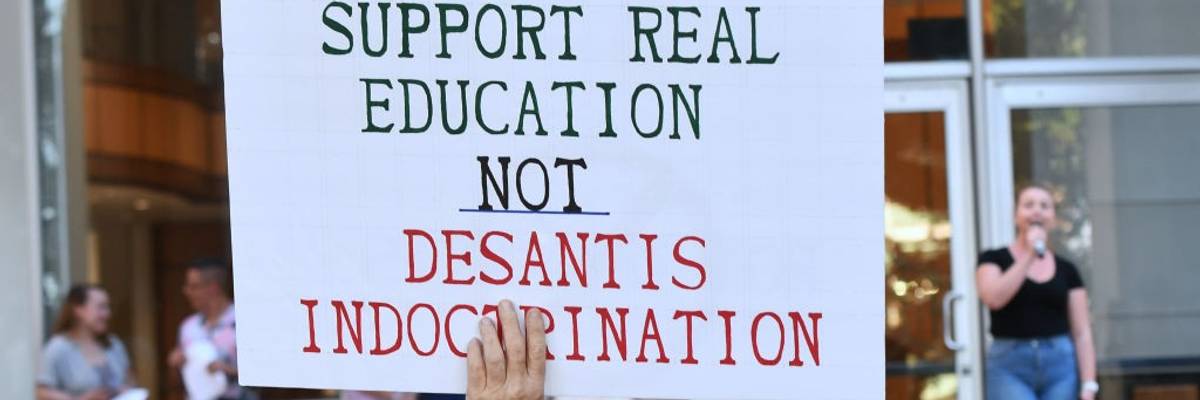
Students and others attend a walkout to protest Florida education policies outside Orlando City Hall on April 21, 2023 in Orlando, Florida.
Together, we have the power to stop the censors who want to whitewash our history and deprive kids of facts and stories that help them to understand our world.
A little over a year ago, the College Board unveiled its long-awaited draft AP African American Studies curriculum. What happened next was sad — and all too predictable.
Florida officials, led by Gov. Ron DeSantis, howled. They claimed the course “lacks educational value” and violated state laws against teaching about race and racism. The College Board initially caved to Florida’s demands and said the course would be heavily redacted, then said it wouldn’t.
At the end of 2023, it released the final version of the course, and it’s…better. But it’s still missing some important concepts. The new course omits any discussion of “structural racism” and makes studying the Black Lives Matter movement — modern Black history by any measure — optional.
That pretty much sums up the state of the fight against censorship and book-banning in this Black History Month: better, but still problematic.
On the plus side, the last few months have brought some very good news.
School board candidates endorsed by the pro-censorship group Moms for Liberty went down to resounding defeats last fall. After Illinois became the first state to prohibit book bans, several states — including Colorado, Kansas, Massachusetts, New Jersey, New Mexico, Washington, and Virginia — introduced their own anti-ban bills.
In December, two Black lawmakers, Reps. Ayanna Pressley (D-MA) and Maxwell Frost (D-FL), introduced bills in Congress aimed at fighting book bans. And a federal judge ruled that parts of an Iowa book ban were unenforceable.
But the censorship movement isn’t going away.
Moms for Liberty plans to start its own charter school in South Carolina. In other words, if you won’t let them ban books in your school, they’ll just start their own school. With your taxpayer money.
Meanwhile, librarians nationwide are being targeted by threats and harassment. And the propaganda outfit PragerU continues to pump out the offensive, woefully inaccurate junk it calls “edutainment” for public schools that will buy it.
So there’s still work to do.
Fortunately, the public is overwhelmingly on the right side of this issue. Poll after poll shows that Americans don’t support censorship and book bans in schools. Those of us who want children to have the freedom to learn are the majority.
We understand that kids are better prepared for life — and our country is better prepared to compete globally — when education is historically accurate and reflective of the diversity of our culture. We understand that book banning is un-American and censorship is a tool of dictators.
This majority needs to mobilize and be heard at the ballot box. The defeat of pro-censorship school board candidates in 2023 was a great start. Now we have to take that momentum into the local, state, and national elections this fall.
In the meantime, we also know that public pressure works. A public outcry got the College Board to change its plans for the African American Studies course. And when publisher Scholastic said it would segregate books about the Black and LGBTQ communities at its school book fairs, the public was outraged — and Scholastic reversed course.
Together, we have the power to stop the censors who want to whitewash our history and deprive kids of facts and stories that help them to understand our world. That applies to the Black experience in America, but also the experiences of LGBTQ people, Indigenous peoples, people of diverse faiths, immigrants, people with disabilities, and more.
Civil rights activists have pushed for decades for book publishers and educators to acknowledge and teach our full history, and to awaken our consciousness as a nation. We refuse to go backwards.
Black History Month is a great time for us to commit to using the power that we have to protect the freedom to learn. Our kids, and our country, will be better for it.
Dear Common Dreams reader, It’s been nearly 30 years since I co-founded Common Dreams with my late wife, Lina Newhouser. We had the radical notion that journalism should serve the public good, not corporate profits. It was clear to us from the outset what it would take to build such a project. No paid advertisements. No corporate sponsors. No millionaire publisher telling us what to think or do. Many people said we wouldn't last a year, but we proved those doubters wrong. Together with a tremendous team of journalists and dedicated staff, we built an independent media outlet free from the constraints of profits and corporate control. Our mission has always been simple: To inform. To inspire. To ignite change for the common good. Building Common Dreams was not easy. Our survival was never guaranteed. When you take on the most powerful forces—Wall Street greed, fossil fuel industry destruction, Big Tech lobbyists, and uber-rich oligarchs who have spent billions upon billions rigging the economy and democracy in their favor—the only bulwark you have is supporters who believe in your work. But here’s the urgent message from me today. It's never been this bad out there. And it's never been this hard to keep us going. At the very moment Common Dreams is most needed, the threats we face are intensifying. We need your support now more than ever. We don't accept corporate advertising and never will. We don't have a paywall because we don't think people should be blocked from critical news based on their ability to pay. Everything we do is funded by the donations of readers like you. When everyone does the little they can afford, we are strong. But if that support retreats or dries up, so do we. Will you donate now to make sure Common Dreams not only survives but thrives? —Craig Brown, Co-founder |
A little over a year ago, the College Board unveiled its long-awaited draft AP African American Studies curriculum. What happened next was sad — and all too predictable.
Florida officials, led by Gov. Ron DeSantis, howled. They claimed the course “lacks educational value” and violated state laws against teaching about race and racism. The College Board initially caved to Florida’s demands and said the course would be heavily redacted, then said it wouldn’t.
At the end of 2023, it released the final version of the course, and it’s…better. But it’s still missing some important concepts. The new course omits any discussion of “structural racism” and makes studying the Black Lives Matter movement — modern Black history by any measure — optional.
That pretty much sums up the state of the fight against censorship and book-banning in this Black History Month: better, but still problematic.
On the plus side, the last few months have brought some very good news.
School board candidates endorsed by the pro-censorship group Moms for Liberty went down to resounding defeats last fall. After Illinois became the first state to prohibit book bans, several states — including Colorado, Kansas, Massachusetts, New Jersey, New Mexico, Washington, and Virginia — introduced their own anti-ban bills.
In December, two Black lawmakers, Reps. Ayanna Pressley (D-MA) and Maxwell Frost (D-FL), introduced bills in Congress aimed at fighting book bans. And a federal judge ruled that parts of an Iowa book ban were unenforceable.
But the censorship movement isn’t going away.
Moms for Liberty plans to start its own charter school in South Carolina. In other words, if you won’t let them ban books in your school, they’ll just start their own school. With your taxpayer money.
Meanwhile, librarians nationwide are being targeted by threats and harassment. And the propaganda outfit PragerU continues to pump out the offensive, woefully inaccurate junk it calls “edutainment” for public schools that will buy it.
So there’s still work to do.
Fortunately, the public is overwhelmingly on the right side of this issue. Poll after poll shows that Americans don’t support censorship and book bans in schools. Those of us who want children to have the freedom to learn are the majority.
We understand that kids are better prepared for life — and our country is better prepared to compete globally — when education is historically accurate and reflective of the diversity of our culture. We understand that book banning is un-American and censorship is a tool of dictators.
This majority needs to mobilize and be heard at the ballot box. The defeat of pro-censorship school board candidates in 2023 was a great start. Now we have to take that momentum into the local, state, and national elections this fall.
In the meantime, we also know that public pressure works. A public outcry got the College Board to change its plans for the African American Studies course. And when publisher Scholastic said it would segregate books about the Black and LGBTQ communities at its school book fairs, the public was outraged — and Scholastic reversed course.
Together, we have the power to stop the censors who want to whitewash our history and deprive kids of facts and stories that help them to understand our world. That applies to the Black experience in America, but also the experiences of LGBTQ people, Indigenous peoples, people of diverse faiths, immigrants, people with disabilities, and more.
Civil rights activists have pushed for decades for book publishers and educators to acknowledge and teach our full history, and to awaken our consciousness as a nation. We refuse to go backwards.
Black History Month is a great time for us to commit to using the power that we have to protect the freedom to learn. Our kids, and our country, will be better for it.
A little over a year ago, the College Board unveiled its long-awaited draft AP African American Studies curriculum. What happened next was sad — and all too predictable.
Florida officials, led by Gov. Ron DeSantis, howled. They claimed the course “lacks educational value” and violated state laws against teaching about race and racism. The College Board initially caved to Florida’s demands and said the course would be heavily redacted, then said it wouldn’t.
At the end of 2023, it released the final version of the course, and it’s…better. But it’s still missing some important concepts. The new course omits any discussion of “structural racism” and makes studying the Black Lives Matter movement — modern Black history by any measure — optional.
That pretty much sums up the state of the fight against censorship and book-banning in this Black History Month: better, but still problematic.
On the plus side, the last few months have brought some very good news.
School board candidates endorsed by the pro-censorship group Moms for Liberty went down to resounding defeats last fall. After Illinois became the first state to prohibit book bans, several states — including Colorado, Kansas, Massachusetts, New Jersey, New Mexico, Washington, and Virginia — introduced their own anti-ban bills.
In December, two Black lawmakers, Reps. Ayanna Pressley (D-MA) and Maxwell Frost (D-FL), introduced bills in Congress aimed at fighting book bans. And a federal judge ruled that parts of an Iowa book ban were unenforceable.
But the censorship movement isn’t going away.
Moms for Liberty plans to start its own charter school in South Carolina. In other words, if you won’t let them ban books in your school, they’ll just start their own school. With your taxpayer money.
Meanwhile, librarians nationwide are being targeted by threats and harassment. And the propaganda outfit PragerU continues to pump out the offensive, woefully inaccurate junk it calls “edutainment” for public schools that will buy it.
So there’s still work to do.
Fortunately, the public is overwhelmingly on the right side of this issue. Poll after poll shows that Americans don’t support censorship and book bans in schools. Those of us who want children to have the freedom to learn are the majority.
We understand that kids are better prepared for life — and our country is better prepared to compete globally — when education is historically accurate and reflective of the diversity of our culture. We understand that book banning is un-American and censorship is a tool of dictators.
This majority needs to mobilize and be heard at the ballot box. The defeat of pro-censorship school board candidates in 2023 was a great start. Now we have to take that momentum into the local, state, and national elections this fall.
In the meantime, we also know that public pressure works. A public outcry got the College Board to change its plans for the African American Studies course. And when publisher Scholastic said it would segregate books about the Black and LGBTQ communities at its school book fairs, the public was outraged — and Scholastic reversed course.
Together, we have the power to stop the censors who want to whitewash our history and deprive kids of facts and stories that help them to understand our world. That applies to the Black experience in America, but also the experiences of LGBTQ people, Indigenous peoples, people of diverse faiths, immigrants, people with disabilities, and more.
Civil rights activists have pushed for decades for book publishers and educators to acknowledge and teach our full history, and to awaken our consciousness as a nation. We refuse to go backwards.
Black History Month is a great time for us to commit to using the power that we have to protect the freedom to learn. Our kids, and our country, will be better for it.