SUBSCRIBE TO OUR FREE NEWSLETTER
Daily news & progressive opinion—funded by the people, not the corporations—delivered straight to your inbox.
5
#000000
#FFFFFF
To donate by check, phone, or other method, see our More Ways to Give page.
Daily news & progressive opinion—funded by the people, not the corporations—delivered straight to your inbox.
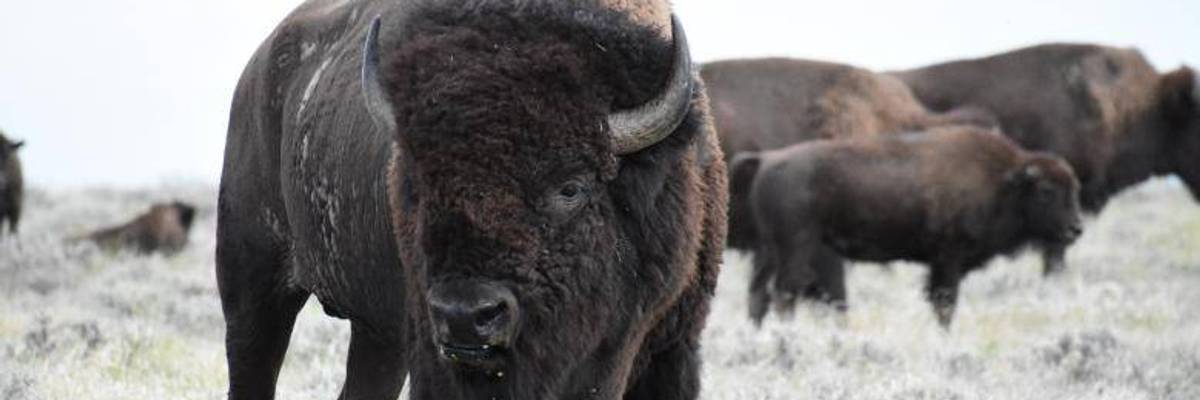
Bison graze on prairie land.
Last month the Interior Department approved new grazing rules that revoke tribal rights to graze bison on federal land in favor of cattle, all to benefit wealthy ranchers.
When the Senate Energy and Natural Resources Committee held confirmation hearings for current Department of Interior head Doug Burgum, he made it quite clear that he viewed public lands, lands belonging to the American public, as an asset on “America’s balance sheet.” His implication was pretty clear: These public lands should be used to turn a profit.
Public lands belong to all Americans and were set aside for their protection, not for profit. But, no surprise, Burgum fully supports exploitative industries like oil, gas, and mining on public lands, so who’s balance sheet will benefit? At an energy conference in Houston last year he noted, “If we’re going to drill, baby, drill, then we’ve got to be asked to also mine, baby, mine.”
So much for conservation and environmental protection of our public lands! But, like most members of the current administration, he acts like using your office to extract profit wherever possible is acceptable and “smart”—protecting the public trust takes a back seat. In 2024, President Donald Trump asked a gathering of oil and gas executives at his Florida estate hosted by Burgum to raise $1 billion for his campaign, for which in return he would roll back environmental protections requested by the oil industry. In his thinking, that’s smart, a win-win, personal profit for the president and windfall profits for energy companies.
But Burugm also knows there is profit to be made above ground on the public lands that cover large stretches of the Great Plains. Last month the Interior Department approved new grazing rules that revoke tribal rights to graze bison on federal land in favor of cattle, i.e. “production-oriented livestock.”
Aside from money made by extractive industries, administration officials, and ranchers—all at the expense of taxpayers and the environment—there are too few who question why the ongoing racism of the current administration is allowed to continue.
In the early 1800s, upward of 50 million bison roamed the Great Plains; by 1900, fewer than 1,000 were left. An organized campaign of commercial hunting, the government’s desire to subjugate the Native tribes by exterminating their food supply, and the perceived need to close the range for private cattle grazing nearly exterminated the American bison.
Déjà vu.
Tribal efforts to expand the herd, in cooperation with former Interior Secretary Deb Haaland during the Biden administration, prioritized efforts to manage the herd for traditional purposes of food, cultural heritage, and land conservation—and public land overseen by the Bureau of Land Management (BLM) was part of that partnership.
While fees charged for cattle grazing on BLM land are claimed to benefit the US Treasury, these fees do not help Secretary Burgum’s “balance sheet” either. Permitted grazing on BLM land actually costs taxpayers money, while it benefits a small number of mostly rich landowners. True, there are ranchers who use the privilege of grazing public lands responsibly, yet there are others who abuse the privilege, while the administration turns a blind eye and continues to roll back environmental enforcement. Nevada rancher Cliven Bundy continued to illegally graze BLM land in Nevada for years after piling up fees and fines of over $1 million.
Aside from money made by extractive industries, administration officials, and ranchers—all at the expense of taxpayers and the environment—there are too few who question why the ongoing racism of the current administration is allowed to continue. While the outright slaughter of Native tribes as seen in the 1800s is no longer occurring, the government is clearly denying the tribes the right to celebrate their culture, their heritage, and their right to a decent life on land that was once theirs, land where millions of bison grazed, animals that evolved with the native prairie and in effect managed it and put it to its highest use. Land that now, in addition to production-oriented livestock, is covered by millions of acres of corn and soy.
It is unlikely that cattle, corn, and soy will ever be replaced by bison herds on the Great Plains, because as the Coalition of Large Tribes (COLT), which represents more than 50 tribes managing 25,000 bison on land that accounts for about 95% of Indian Country noted, the new Interior Department rules are designed to protect cows and were published without prior consultation with tribes.
It is not nostalgia that bison should graze public lands, especially those adjacent to tribal reservations. Bison are far better environmental stewards than cattle and, for that matter, probably people as well. It is also, perhaps, a pipe dream that this administration would recognize the inherent cultural rights of Native Americans, or any minority for that matter. To them, the extraction of profit for themselves and their corporate cronies is all that matters. But this administration will someday end, and perhaps the next will be more enlightened and respectful of minority rights and common sense.
Dear Common Dreams reader, It’s been nearly 30 years since I co-founded Common Dreams with my late wife, Lina Newhouser. We had the radical notion that journalism should serve the public good, not corporate profits. It was clear to us from the outset what it would take to build such a project. No paid advertisements. No corporate sponsors. No millionaire publisher telling us what to think or do. Many people said we wouldn't last a year, but we proved those doubters wrong. Together with a tremendous team of journalists and dedicated staff, we built an independent media outlet free from the constraints of profits and corporate control. Our mission has always been simple: To inform. To inspire. To ignite change for the common good. Building Common Dreams was not easy. Our survival was never guaranteed. When you take on the most powerful forces—Wall Street greed, fossil fuel industry destruction, Big Tech lobbyists, and uber-rich oligarchs who have spent billions upon billions rigging the economy and democracy in their favor—the only bulwark you have is supporters who believe in your work. But here’s the urgent message from me today. It's never been this bad out there. And it's never been this hard to keep us going. At the very moment Common Dreams is most needed, the threats we face are intensifying. We need your support now more than ever. We don't accept corporate advertising and never will. We don't have a paywall because we don't think people should be blocked from critical news based on their ability to pay. Everything we do is funded by the donations of readers like you. When everyone does the little they can afford, we are strong. But if that support retreats or dries up, so do we. Will you donate now to make sure Common Dreams not only survives but thrives? —Craig Brown, Co-founder |
When the Senate Energy and Natural Resources Committee held confirmation hearings for current Department of Interior head Doug Burgum, he made it quite clear that he viewed public lands, lands belonging to the American public, as an asset on “America’s balance sheet.” His implication was pretty clear: These public lands should be used to turn a profit.
Public lands belong to all Americans and were set aside for their protection, not for profit. But, no surprise, Burgum fully supports exploitative industries like oil, gas, and mining on public lands, so who’s balance sheet will benefit? At an energy conference in Houston last year he noted, “If we’re going to drill, baby, drill, then we’ve got to be asked to also mine, baby, mine.”
So much for conservation and environmental protection of our public lands! But, like most members of the current administration, he acts like using your office to extract profit wherever possible is acceptable and “smart”—protecting the public trust takes a back seat. In 2024, President Donald Trump asked a gathering of oil and gas executives at his Florida estate hosted by Burgum to raise $1 billion for his campaign, for which in return he would roll back environmental protections requested by the oil industry. In his thinking, that’s smart, a win-win, personal profit for the president and windfall profits for energy companies.
But Burugm also knows there is profit to be made above ground on the public lands that cover large stretches of the Great Plains. Last month the Interior Department approved new grazing rules that revoke tribal rights to graze bison on federal land in favor of cattle, i.e. “production-oriented livestock.”
Aside from money made by extractive industries, administration officials, and ranchers—all at the expense of taxpayers and the environment—there are too few who question why the ongoing racism of the current administration is allowed to continue.
In the early 1800s, upward of 50 million bison roamed the Great Plains; by 1900, fewer than 1,000 were left. An organized campaign of commercial hunting, the government’s desire to subjugate the Native tribes by exterminating their food supply, and the perceived need to close the range for private cattle grazing nearly exterminated the American bison.
Déjà vu.
Tribal efforts to expand the herd, in cooperation with former Interior Secretary Deb Haaland during the Biden administration, prioritized efforts to manage the herd for traditional purposes of food, cultural heritage, and land conservation—and public land overseen by the Bureau of Land Management (BLM) was part of that partnership.
While fees charged for cattle grazing on BLM land are claimed to benefit the US Treasury, these fees do not help Secretary Burgum’s “balance sheet” either. Permitted grazing on BLM land actually costs taxpayers money, while it benefits a small number of mostly rich landowners. True, there are ranchers who use the privilege of grazing public lands responsibly, yet there are others who abuse the privilege, while the administration turns a blind eye and continues to roll back environmental enforcement. Nevada rancher Cliven Bundy continued to illegally graze BLM land in Nevada for years after piling up fees and fines of over $1 million.
Aside from money made by extractive industries, administration officials, and ranchers—all at the expense of taxpayers and the environment—there are too few who question why the ongoing racism of the current administration is allowed to continue. While the outright slaughter of Native tribes as seen in the 1800s is no longer occurring, the government is clearly denying the tribes the right to celebrate their culture, their heritage, and their right to a decent life on land that was once theirs, land where millions of bison grazed, animals that evolved with the native prairie and in effect managed it and put it to its highest use. Land that now, in addition to production-oriented livestock, is covered by millions of acres of corn and soy.
It is unlikely that cattle, corn, and soy will ever be replaced by bison herds on the Great Plains, because as the Coalition of Large Tribes (COLT), which represents more than 50 tribes managing 25,000 bison on land that accounts for about 95% of Indian Country noted, the new Interior Department rules are designed to protect cows and were published without prior consultation with tribes.
It is not nostalgia that bison should graze public lands, especially those adjacent to tribal reservations. Bison are far better environmental stewards than cattle and, for that matter, probably people as well. It is also, perhaps, a pipe dream that this administration would recognize the inherent cultural rights of Native Americans, or any minority for that matter. To them, the extraction of profit for themselves and their corporate cronies is all that matters. But this administration will someday end, and perhaps the next will be more enlightened and respectful of minority rights and common sense.
When the Senate Energy and Natural Resources Committee held confirmation hearings for current Department of Interior head Doug Burgum, he made it quite clear that he viewed public lands, lands belonging to the American public, as an asset on “America’s balance sheet.” His implication was pretty clear: These public lands should be used to turn a profit.
Public lands belong to all Americans and were set aside for their protection, not for profit. But, no surprise, Burgum fully supports exploitative industries like oil, gas, and mining on public lands, so who’s balance sheet will benefit? At an energy conference in Houston last year he noted, “If we’re going to drill, baby, drill, then we’ve got to be asked to also mine, baby, mine.”
So much for conservation and environmental protection of our public lands! But, like most members of the current administration, he acts like using your office to extract profit wherever possible is acceptable and “smart”—protecting the public trust takes a back seat. In 2024, President Donald Trump asked a gathering of oil and gas executives at his Florida estate hosted by Burgum to raise $1 billion for his campaign, for which in return he would roll back environmental protections requested by the oil industry. In his thinking, that’s smart, a win-win, personal profit for the president and windfall profits for energy companies.
But Burugm also knows there is profit to be made above ground on the public lands that cover large stretches of the Great Plains. Last month the Interior Department approved new grazing rules that revoke tribal rights to graze bison on federal land in favor of cattle, i.e. “production-oriented livestock.”
Aside from money made by extractive industries, administration officials, and ranchers—all at the expense of taxpayers and the environment—there are too few who question why the ongoing racism of the current administration is allowed to continue.
In the early 1800s, upward of 50 million bison roamed the Great Plains; by 1900, fewer than 1,000 were left. An organized campaign of commercial hunting, the government’s desire to subjugate the Native tribes by exterminating their food supply, and the perceived need to close the range for private cattle grazing nearly exterminated the American bison.
Déjà vu.
Tribal efforts to expand the herd, in cooperation with former Interior Secretary Deb Haaland during the Biden administration, prioritized efforts to manage the herd for traditional purposes of food, cultural heritage, and land conservation—and public land overseen by the Bureau of Land Management (BLM) was part of that partnership.
While fees charged for cattle grazing on BLM land are claimed to benefit the US Treasury, these fees do not help Secretary Burgum’s “balance sheet” either. Permitted grazing on BLM land actually costs taxpayers money, while it benefits a small number of mostly rich landowners. True, there are ranchers who use the privilege of grazing public lands responsibly, yet there are others who abuse the privilege, while the administration turns a blind eye and continues to roll back environmental enforcement. Nevada rancher Cliven Bundy continued to illegally graze BLM land in Nevada for years after piling up fees and fines of over $1 million.
Aside from money made by extractive industries, administration officials, and ranchers—all at the expense of taxpayers and the environment—there are too few who question why the ongoing racism of the current administration is allowed to continue. While the outright slaughter of Native tribes as seen in the 1800s is no longer occurring, the government is clearly denying the tribes the right to celebrate their culture, their heritage, and their right to a decent life on land that was once theirs, land where millions of bison grazed, animals that evolved with the native prairie and in effect managed it and put it to its highest use. Land that now, in addition to production-oriented livestock, is covered by millions of acres of corn and soy.
It is unlikely that cattle, corn, and soy will ever be replaced by bison herds on the Great Plains, because as the Coalition of Large Tribes (COLT), which represents more than 50 tribes managing 25,000 bison on land that accounts for about 95% of Indian Country noted, the new Interior Department rules are designed to protect cows and were published without prior consultation with tribes.
It is not nostalgia that bison should graze public lands, especially those adjacent to tribal reservations. Bison are far better environmental stewards than cattle and, for that matter, probably people as well. It is also, perhaps, a pipe dream that this administration would recognize the inherent cultural rights of Native Americans, or any minority for that matter. To them, the extraction of profit for themselves and their corporate cronies is all that matters. But this administration will someday end, and perhaps the next will be more enlightened and respectful of minority rights and common sense.