5
#000000
#FFFFFF
To donate by check, phone, or other method, see our More Ways to Give page.
Daily news & progressive opinion—funded by the people, not the corporations—delivered straight to your inbox.
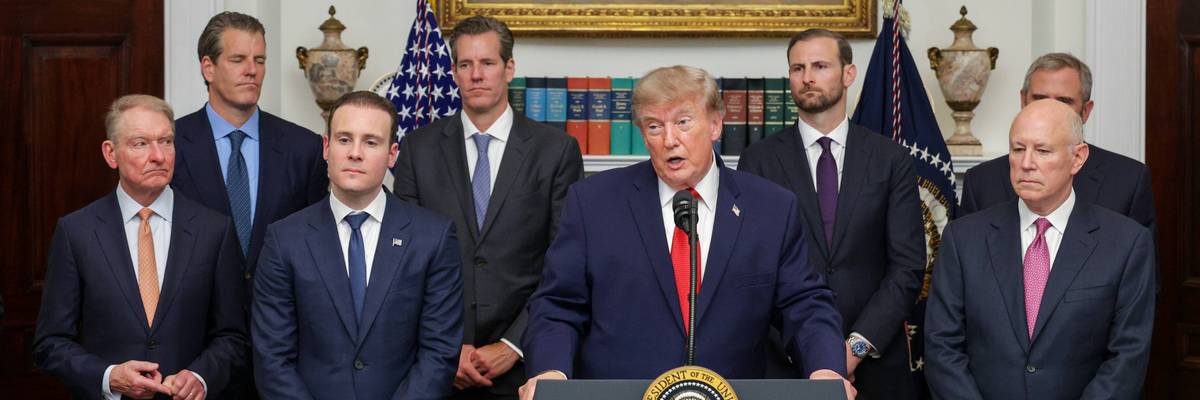
President Donald Trump delivers remarks as he is joined by (L-R, front) Chairman of the US Securities and Exchange Commission (SEC) Paul Atkins, Commodity Futures Trading Commission (CFTC) Chairman Michael Selig, and Chairman of the NYSE and CEO of Intercontinental Exchange Jeffrey Sprecher, during a summit of crypto and technology leaders in the Roosevelt Room of the White House on August 19, 2026 in Washington, DC.
Whatever level of outrage there is over this example of Trump's corruption and conflict of interests, it's likely not enough.
The Trump family has made a fortune from its crypto business. By granting his business a bank charter, the Office of the Comptroller of the Currency (OCC) in the Treasury Department has acted to help him, his family, and possibly one Middle Eastern spymaster make more money.
It is widely recognized that the OCC’s decision is laden with conflicts of interest. But there is more to it than self-dealing and self-enrichment. If implemented, the decision also corrupts the US economy by allowing criminals, terrorists and rogue states access to the payments system—the basic plumbing—used by regulated banks. It also creates conditions for crypto firms to maneuver for a federal bailout should their businesses start to fail.
The Trump family has a significant ownership interest in World Liberty Financial, a company that among other things issues the USD1 “stablecoin.” In 2025 Trump alone reported earning $536.4 million from WLF. Even this sum does not include income that may be going to Trumps’ family, or to the family of his emissary Steve Witkoff, which also have interests in WLF. Nor does it include income which may be going to Sheikh Tahnoon bin Zayed Al Nahyan, the United Arab Emirates spy chief, whose investment company owns a 49 percent equity share of WLF.
Not satisfied with that haul, WLF has obtained a trust bank charter from the OCC, which will be used to house its stablecoin business.
This will give WLF important new advantages.
First, a trust charter eases the way for the WLF stablecoin business to obtain a “master account” at the Federal Reserve, which are used by banks to hold and transfer dollars electronically. If a master account is granted, dollar payments into and out of USD1 can go through that system. This will lower USD1 costs, since it will not need to use a commercial bank to transfer funds.
Second, it will create a halo effect for USD1, enhancing its legitimacy and perceived safety. A “trust bank” sounds like something that comes with the regulations, supervision, and guarantees that make commercial banks a safe place for retail depositors. But that is not true. Trust banks do not take deposits or make loans, are not federally insured, and are not eligible for lending from the Federal Reserve.
The conflicts of interest in granting a bank charter to WLF are apparent. The OCC—which a Trump executive order claims is completely controlled by him—has granted a bank charter to a firm which makes him money and will act as the supposed supervisor of that bank.
Bad as this seems, there are harms beyond the self-dealing and self-enrichment involved in granting this charter. Giving any stablecoin or crypto currency firm access to a master account invites illicit use of the regulated financial system which we all depend on.
The Tether stablecoin, for example, has featured in international criminal cases, and has frequently been used by financial fraudsters laundering money, by countries such as Iran and Russia evading sanctions, and by terrorist networks. A record $158 billion of crypto tokens were sent to criminal wallets in 2025, a 145% increase from the previous years.
This risk has been recognized by the Federal Reserve in the past. According to guidance released by the Board of Governors in 2022, master accounts should not go to entities that create an undue risk to the economy by “facilitating activities such as money laundering, terrorism financing, fraud, cybercrimes, economic or trade sanctions violations, or other illicit activities”. It is not at all clear why any stablecoin or other crypto currency is not, on the face of it, ineligible under these and other parts of the BOG guidance. In fact, Federal Reserve Governor Michael Barr has objected to the creation of this class of account because it does not provide sufficiently specific and robust safeguards to protect against their being used for money laundering and terrorist financing by institutions the Fed does not supervise.
There is another alarming outcome that may result from giving bank charters to crypto firms. The halo effect—which may lead stablecoin users to believe they have federal protection—could be used by WLF and other crypto firms to provide political cover for a federal bail-out if their businesses were failing.
There would be no legal basis for such a bailout. But would this administration, and the OCC which it claims to control completely, look for a way to provide a bailout that protected their crypto firm wealth? That may seem unlikely, but so did a $1.8 billion fund to benefit January 6 rioters and other political favorites.
The OCC and the Federal Reserve are failing in their duty to protect the public and the economy from potential harm that can flow from crypto firms like WLF. A responsible Congress would intervene to stop it.
Marc Jarsulic and Gerald Epstein are economists and among dozens of expert contributors to Game Changers: Economic Policies for a Working America, a project of the Political Economy Research Institute, UMass Amherst. The ideas in this article are developed in their paper “No More Bailouts,” available on the Game Changers website.
Dear Common Dreams reader, It’s been nearly 30 years since I co-founded Common Dreams with my late wife, Lina Newhouser. We had the radical notion that journalism should serve the public good, not corporate profits. It was clear to us from the outset what it would take to build such a project. No paid advertisements. No corporate sponsors. No millionaire publisher telling us what to think or do. Many people said we wouldn't last a year, but we proved those doubters wrong. Together with a tremendous team of journalists and dedicated staff, we built an independent media outlet free from the constraints of profits and corporate control. Our mission has always been simple: To inform. To inspire. To ignite change for the common good. Building Common Dreams was not easy. Our survival was never guaranteed. When you take on the most powerful forces—Wall Street greed, fossil fuel industry destruction, Big Tech lobbyists, and uber-rich oligarchs who have spent billions upon billions rigging the economy and democracy in their favor—the only bulwark you have is supporters who believe in your work. But here’s the urgent message from me today. It's never been this bad out there. And it's never been this hard to keep us going. At the very moment Common Dreams is most needed, the threats we face are intensifying. We need your support now more than ever. We don't accept corporate advertising and never will. We don't have a paywall because we don't think people should be blocked from critical news based on their ability to pay. Everything we do is funded by the donations of readers like you. When everyone does the little they can afford, we are strong. But if that support retreats or dries up, so do we. Will you donate now to make sure Common Dreams not only survives but thrives? —Craig Brown, Co-founder |
The Trump family has made a fortune from its crypto business. By granting his business a bank charter, the Office of the Comptroller of the Currency (OCC) in the Treasury Department has acted to help him, his family, and possibly one Middle Eastern spymaster make more money.
It is widely recognized that the OCC’s decision is laden with conflicts of interest. But there is more to it than self-dealing and self-enrichment. If implemented, the decision also corrupts the US economy by allowing criminals, terrorists and rogue states access to the payments system—the basic plumbing—used by regulated banks. It also creates conditions for crypto firms to maneuver for a federal bailout should their businesses start to fail.
The Trump family has a significant ownership interest in World Liberty Financial, a company that among other things issues the USD1 “stablecoin.” In 2025 Trump alone reported earning $536.4 million from WLF. Even this sum does not include income that may be going to Trumps’ family, or to the family of his emissary Steve Witkoff, which also have interests in WLF. Nor does it include income which may be going to Sheikh Tahnoon bin Zayed Al Nahyan, the United Arab Emirates spy chief, whose investment company owns a 49 percent equity share of WLF.
Not satisfied with that haul, WLF has obtained a trust bank charter from the OCC, which will be used to house its stablecoin business.
This will give WLF important new advantages.
First, a trust charter eases the way for the WLF stablecoin business to obtain a “master account” at the Federal Reserve, which are used by banks to hold and transfer dollars electronically. If a master account is granted, dollar payments into and out of USD1 can go through that system. This will lower USD1 costs, since it will not need to use a commercial bank to transfer funds.
Second, it will create a halo effect for USD1, enhancing its legitimacy and perceived safety. A “trust bank” sounds like something that comes with the regulations, supervision, and guarantees that make commercial banks a safe place for retail depositors. But that is not true. Trust banks do not take deposits or make loans, are not federally insured, and are not eligible for lending from the Federal Reserve.
The conflicts of interest in granting a bank charter to WLF are apparent. The OCC—which a Trump executive order claims is completely controlled by him—has granted a bank charter to a firm which makes him money and will act as the supposed supervisor of that bank.
Bad as this seems, there are harms beyond the self-dealing and self-enrichment involved in granting this charter. Giving any stablecoin or crypto currency firm access to a master account invites illicit use of the regulated financial system which we all depend on.
The Tether stablecoin, for example, has featured in international criminal cases, and has frequently been used by financial fraudsters laundering money, by countries such as Iran and Russia evading sanctions, and by terrorist networks. A record $158 billion of crypto tokens were sent to criminal wallets in 2025, a 145% increase from the previous years.
This risk has been recognized by the Federal Reserve in the past. According to guidance released by the Board of Governors in 2022, master accounts should not go to entities that create an undue risk to the economy by “facilitating activities such as money laundering, terrorism financing, fraud, cybercrimes, economic or trade sanctions violations, or other illicit activities”. It is not at all clear why any stablecoin or other crypto currency is not, on the face of it, ineligible under these and other parts of the BOG guidance. In fact, Federal Reserve Governor Michael Barr has objected to the creation of this class of account because it does not provide sufficiently specific and robust safeguards to protect against their being used for money laundering and terrorist financing by institutions the Fed does not supervise.
There is another alarming outcome that may result from giving bank charters to crypto firms. The halo effect—which may lead stablecoin users to believe they have federal protection—could be used by WLF and other crypto firms to provide political cover for a federal bail-out if their businesses were failing.
There would be no legal basis for such a bailout. But would this administration, and the OCC which it claims to control completely, look for a way to provide a bailout that protected their crypto firm wealth? That may seem unlikely, but so did a $1.8 billion fund to benefit January 6 rioters and other political favorites.
The OCC and the Federal Reserve are failing in their duty to protect the public and the economy from potential harm that can flow from crypto firms like WLF. A responsible Congress would intervene to stop it.
Marc Jarsulic and Gerald Epstein are economists and among dozens of expert contributors to Game Changers: Economic Policies for a Working America, a project of the Political Economy Research Institute, UMass Amherst. The ideas in this article are developed in their paper “No More Bailouts,” available on the Game Changers website.
The Trump family has made a fortune from its crypto business. By granting his business a bank charter, the Office of the Comptroller of the Currency (OCC) in the Treasury Department has acted to help him, his family, and possibly one Middle Eastern spymaster make more money.
It is widely recognized that the OCC’s decision is laden with conflicts of interest. But there is more to it than self-dealing and self-enrichment. If implemented, the decision also corrupts the US economy by allowing criminals, terrorists and rogue states access to the payments system—the basic plumbing—used by regulated banks. It also creates conditions for crypto firms to maneuver for a federal bailout should their businesses start to fail.
The Trump family has a significant ownership interest in World Liberty Financial, a company that among other things issues the USD1 “stablecoin.” In 2025 Trump alone reported earning $536.4 million from WLF. Even this sum does not include income that may be going to Trumps’ family, or to the family of his emissary Steve Witkoff, which also have interests in WLF. Nor does it include income which may be going to Sheikh Tahnoon bin Zayed Al Nahyan, the United Arab Emirates spy chief, whose investment company owns a 49 percent equity share of WLF.
Not satisfied with that haul, WLF has obtained a trust bank charter from the OCC, which will be used to house its stablecoin business.
This will give WLF important new advantages.
First, a trust charter eases the way for the WLF stablecoin business to obtain a “master account” at the Federal Reserve, which are used by banks to hold and transfer dollars electronically. If a master account is granted, dollar payments into and out of USD1 can go through that system. This will lower USD1 costs, since it will not need to use a commercial bank to transfer funds.
Second, it will create a halo effect for USD1, enhancing its legitimacy and perceived safety. A “trust bank” sounds like something that comes with the regulations, supervision, and guarantees that make commercial banks a safe place for retail depositors. But that is not true. Trust banks do not take deposits or make loans, are not federally insured, and are not eligible for lending from the Federal Reserve.
The conflicts of interest in granting a bank charter to WLF are apparent. The OCC—which a Trump executive order claims is completely controlled by him—has granted a bank charter to a firm which makes him money and will act as the supposed supervisor of that bank.
Bad as this seems, there are harms beyond the self-dealing and self-enrichment involved in granting this charter. Giving any stablecoin or crypto currency firm access to a master account invites illicit use of the regulated financial system which we all depend on.
The Tether stablecoin, for example, has featured in international criminal cases, and has frequently been used by financial fraudsters laundering money, by countries such as Iran and Russia evading sanctions, and by terrorist networks. A record $158 billion of crypto tokens were sent to criminal wallets in 2025, a 145% increase from the previous years.
This risk has been recognized by the Federal Reserve in the past. According to guidance released by the Board of Governors in 2022, master accounts should not go to entities that create an undue risk to the economy by “facilitating activities such as money laundering, terrorism financing, fraud, cybercrimes, economic or trade sanctions violations, or other illicit activities”. It is not at all clear why any stablecoin or other crypto currency is not, on the face of it, ineligible under these and other parts of the BOG guidance. In fact, Federal Reserve Governor Michael Barr has objected to the creation of this class of account because it does not provide sufficiently specific and robust safeguards to protect against their being used for money laundering and terrorist financing by institutions the Fed does not supervise.
There is another alarming outcome that may result from giving bank charters to crypto firms. The halo effect—which may lead stablecoin users to believe they have federal protection—could be used by WLF and other crypto firms to provide political cover for a federal bail-out if their businesses were failing.
There would be no legal basis for such a bailout. But would this administration, and the OCC which it claims to control completely, look for a way to provide a bailout that protected their crypto firm wealth? That may seem unlikely, but so did a $1.8 billion fund to benefit January 6 rioters and other political favorites.
The OCC and the Federal Reserve are failing in their duty to protect the public and the economy from potential harm that can flow from crypto firms like WLF. A responsible Congress would intervene to stop it.
Marc Jarsulic and Gerald Epstein are economists and among dozens of expert contributors to Game Changers: Economic Policies for a Working America, a project of the Political Economy Research Institute, UMass Amherst. The ideas in this article are developed in their paper “No More Bailouts,” available on the Game Changers website.