SUBSCRIBE TO OUR FREE NEWSLETTER
Daily news & progressive opinion—funded by the people, not the corporations—delivered straight to your inbox.
5
#000000
#FFFFFF
To donate by check, phone, or other method, see our More Ways to Give page.
Daily news & progressive opinion—funded by the people, not the corporations—delivered straight to your inbox.
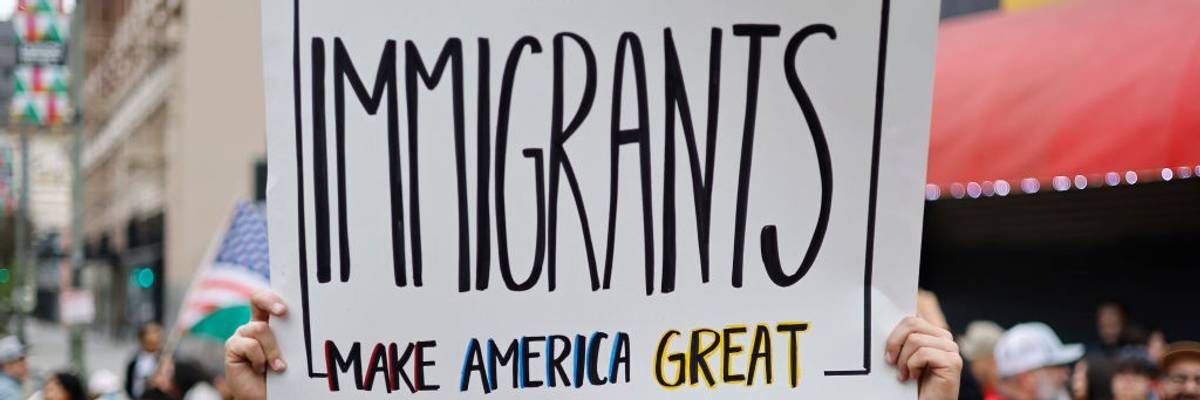
An immigrants rights supporter holds a sign reading, "Immigrants Make America Great" before marching downtown during a March for Dignity on March 1, 2025 in Los Angeles, California.
Amid Trumpian attacks on immigrants and erasure of history, it is more important than ever that we stop and examine the record of who we are and how we got to where we are as a country and an American people.
June is National Immigration Heritage Month, a time to celebrate the diverse peoples and cultures that have made America great.
This year–when not only immigration and cultural diversity are being challenged, but also the complex history of our country is being erased–it is more important than ever that we stop and examine the record of who we are and how we got to where we are as a country and an American people.
First, we should never forget that this country was born with two “original sins”: slavery and genocide. The current administration in Washington wants to rewrite our history by eliminating mention of negative events and practices that defined our past, focusing instead on the “greatness and industriousness” of our founders and their “glorious victories.” In reality, there would be no America if not for the surplus wealth created by the labor of enslaved people across the South and the riches accrued by those who benefited from the theft of Indigenous peoples’ lands.
Nor should it be forgotten (although it is) that the Declaration of Independence names one reason for the War of Independence against the British Empire as the American settlers’ grievance that King George would not defend them against “merciless Indian Savages,” who were resisting having their lands taken from them. And, of course, we fought a civil war not so much to end the deplorable practice of human slavery, but to rein in the power and independence of the Southern states.
What would be American food, fashion, music, art, humor, literature, diplomacy, and so much more be without the contributions of African Americans, the Chinese, Italian, Greek, Polish, Irish, Jewish, Latino, and Arab immigrants (and so many more)?
As the country grew and with the industrial age upon us, the need to build infrastructure to transport people and goods, mine coal for power; and operate factories opened the doors to new immigrants from countries far afield. Chinese built railroads; Irish dug canals; Irish and Eastern and Central Europeans worked in the mines, and they were joined in the mines and factories by Italians, Greeks, and Arabs.
As needed as these new immigrants were for America to grow and prosper, their very presence, growing numbers, and unique cultures provoked a backlash among the earlier northwest European settlers who had come to see themselves as the original and “real Americans.” The “new immigrants” were demeaned, discriminated against, and subjected to state and vigilante violence.
Tragically, we see the same pattern of behaviors playing out today as Americans are confronting our newest immigrants. In a brilliant paper written a decade and a half ago for the Immigration Policy Center, Jeffrey Kaye examines the immigration history of one town in Pennsylvania. He notes that when the Irish, Italian, and Eastern and Central Europeans were first moving into the community, newspaper articles and speeches by City Council members described the Irish as “drunkards,” the Slavs as “peculiar,” the Hungarians as “ignorant, immoral, and filthy,” and the Italians as “the most disreputable.” All were subjected to derision for their “queer languages” and not fitting in. The tragic irony is that one century later, the descendants of these same groups are now saying the very same things about the newest immigrants who were mostly from Latin American countries.
Forgotten in this history of miserable repetition are the lessons we should have learned and the benefits we accrued along the way. We now know that the early English settlers in New York and the eastern colonies learned lessons in governance and agriculture from the Native Americans, and yet they referred to them as “savages.” And we know that it was the hard work, for no wages, that brought wealth to white Southern landowners who nevertheless demeaned Blacks as lazy and shiftless. Much the same can be said about the immigrants of the industrial age. Despite the bigotry and violence they endured, we can ask, “Where would America be today if not for the hard work and inventiveness of these immigrant communities?” Further, what would be American food, fashion, music, art, humor, literature, diplomacy, and so much more be without the contributions of African Americans, the Chinese, Italian, Greek, Polish, Irish, Jewish, Latino, and Arab immigrants (and so many more)?
The lesson here is a simple one: We should never forget that what makes America great is its diversity and its capacity to absorb so many peoples and cultures. What threatens our greatness is when we forget this and stupidly attempt to fabricate our history and “whitewash” our culture.
Dear Common Dreams reader, It’s been nearly 30 years since I co-founded Common Dreams with my late wife, Lina Newhouser. We had the radical notion that journalism should serve the public good, not corporate profits. It was clear to us from the outset what it would take to build such a project. No paid advertisements. No corporate sponsors. No millionaire publisher telling us what to think or do. Many people said we wouldn't last a year, but we proved those doubters wrong. Together with a tremendous team of journalists and dedicated staff, we built an independent media outlet free from the constraints of profits and corporate control. Our mission has always been simple: To inform. To inspire. To ignite change for the common good. Building Common Dreams was not easy. Our survival was never guaranteed. When you take on the most powerful forces—Wall Street greed, fossil fuel industry destruction, Big Tech lobbyists, and uber-rich oligarchs who have spent billions upon billions rigging the economy and democracy in their favor—the only bulwark you have is supporters who believe in your work. But here’s the urgent message from me today. It's never been this bad out there. And it's never been this hard to keep us going. At the very moment Common Dreams is most needed, the threats we face are intensifying. We need your support now more than ever. We don't accept corporate advertising and never will. We don't have a paywall because we don't think people should be blocked from critical news based on their ability to pay. Everything we do is funded by the donations of readers like you. When everyone does the little they can afford, we are strong. But if that support retreats or dries up, so do we. Will you donate now to make sure Common Dreams not only survives but thrives? —Craig Brown, Co-founder |
June is National Immigration Heritage Month, a time to celebrate the diverse peoples and cultures that have made America great.
This year–when not only immigration and cultural diversity are being challenged, but also the complex history of our country is being erased–it is more important than ever that we stop and examine the record of who we are and how we got to where we are as a country and an American people.
First, we should never forget that this country was born with two “original sins”: slavery and genocide. The current administration in Washington wants to rewrite our history by eliminating mention of negative events and practices that defined our past, focusing instead on the “greatness and industriousness” of our founders and their “glorious victories.” In reality, there would be no America if not for the surplus wealth created by the labor of enslaved people across the South and the riches accrued by those who benefited from the theft of Indigenous peoples’ lands.
Nor should it be forgotten (although it is) that the Declaration of Independence names one reason for the War of Independence against the British Empire as the American settlers’ grievance that King George would not defend them against “merciless Indian Savages,” who were resisting having their lands taken from them. And, of course, we fought a civil war not so much to end the deplorable practice of human slavery, but to rein in the power and independence of the Southern states.
What would be American food, fashion, music, art, humor, literature, diplomacy, and so much more be without the contributions of African Americans, the Chinese, Italian, Greek, Polish, Irish, Jewish, Latino, and Arab immigrants (and so many more)?
As the country grew and with the industrial age upon us, the need to build infrastructure to transport people and goods, mine coal for power; and operate factories opened the doors to new immigrants from countries far afield. Chinese built railroads; Irish dug canals; Irish and Eastern and Central Europeans worked in the mines, and they were joined in the mines and factories by Italians, Greeks, and Arabs.
As needed as these new immigrants were for America to grow and prosper, their very presence, growing numbers, and unique cultures provoked a backlash among the earlier northwest European settlers who had come to see themselves as the original and “real Americans.” The “new immigrants” were demeaned, discriminated against, and subjected to state and vigilante violence.
Tragically, we see the same pattern of behaviors playing out today as Americans are confronting our newest immigrants. In a brilliant paper written a decade and a half ago for the Immigration Policy Center, Jeffrey Kaye examines the immigration history of one town in Pennsylvania. He notes that when the Irish, Italian, and Eastern and Central Europeans were first moving into the community, newspaper articles and speeches by City Council members described the Irish as “drunkards,” the Slavs as “peculiar,” the Hungarians as “ignorant, immoral, and filthy,” and the Italians as “the most disreputable.” All were subjected to derision for their “queer languages” and not fitting in. The tragic irony is that one century later, the descendants of these same groups are now saying the very same things about the newest immigrants who were mostly from Latin American countries.
Forgotten in this history of miserable repetition are the lessons we should have learned and the benefits we accrued along the way. We now know that the early English settlers in New York and the eastern colonies learned lessons in governance and agriculture from the Native Americans, and yet they referred to them as “savages.” And we know that it was the hard work, for no wages, that brought wealth to white Southern landowners who nevertheless demeaned Blacks as lazy and shiftless. Much the same can be said about the immigrants of the industrial age. Despite the bigotry and violence they endured, we can ask, “Where would America be today if not for the hard work and inventiveness of these immigrant communities?” Further, what would be American food, fashion, music, art, humor, literature, diplomacy, and so much more be without the contributions of African Americans, the Chinese, Italian, Greek, Polish, Irish, Jewish, Latino, and Arab immigrants (and so many more)?
The lesson here is a simple one: We should never forget that what makes America great is its diversity and its capacity to absorb so many peoples and cultures. What threatens our greatness is when we forget this and stupidly attempt to fabricate our history and “whitewash” our culture.
June is National Immigration Heritage Month, a time to celebrate the diverse peoples and cultures that have made America great.
This year–when not only immigration and cultural diversity are being challenged, but also the complex history of our country is being erased–it is more important than ever that we stop and examine the record of who we are and how we got to where we are as a country and an American people.
First, we should never forget that this country was born with two “original sins”: slavery and genocide. The current administration in Washington wants to rewrite our history by eliminating mention of negative events and practices that defined our past, focusing instead on the “greatness and industriousness” of our founders and their “glorious victories.” In reality, there would be no America if not for the surplus wealth created by the labor of enslaved people across the South and the riches accrued by those who benefited from the theft of Indigenous peoples’ lands.
Nor should it be forgotten (although it is) that the Declaration of Independence names one reason for the War of Independence against the British Empire as the American settlers’ grievance that King George would not defend them against “merciless Indian Savages,” who were resisting having their lands taken from them. And, of course, we fought a civil war not so much to end the deplorable practice of human slavery, but to rein in the power and independence of the Southern states.
What would be American food, fashion, music, art, humor, literature, diplomacy, and so much more be without the contributions of African Americans, the Chinese, Italian, Greek, Polish, Irish, Jewish, Latino, and Arab immigrants (and so many more)?
As the country grew and with the industrial age upon us, the need to build infrastructure to transport people and goods, mine coal for power; and operate factories opened the doors to new immigrants from countries far afield. Chinese built railroads; Irish dug canals; Irish and Eastern and Central Europeans worked in the mines, and they were joined in the mines and factories by Italians, Greeks, and Arabs.
As needed as these new immigrants were for America to grow and prosper, their very presence, growing numbers, and unique cultures provoked a backlash among the earlier northwest European settlers who had come to see themselves as the original and “real Americans.” The “new immigrants” were demeaned, discriminated against, and subjected to state and vigilante violence.
Tragically, we see the same pattern of behaviors playing out today as Americans are confronting our newest immigrants. In a brilliant paper written a decade and a half ago for the Immigration Policy Center, Jeffrey Kaye examines the immigration history of one town in Pennsylvania. He notes that when the Irish, Italian, and Eastern and Central Europeans were first moving into the community, newspaper articles and speeches by City Council members described the Irish as “drunkards,” the Slavs as “peculiar,” the Hungarians as “ignorant, immoral, and filthy,” and the Italians as “the most disreputable.” All were subjected to derision for their “queer languages” and not fitting in. The tragic irony is that one century later, the descendants of these same groups are now saying the very same things about the newest immigrants who were mostly from Latin American countries.
Forgotten in this history of miserable repetition are the lessons we should have learned and the benefits we accrued along the way. We now know that the early English settlers in New York and the eastern colonies learned lessons in governance and agriculture from the Native Americans, and yet they referred to them as “savages.” And we know that it was the hard work, for no wages, that brought wealth to white Southern landowners who nevertheless demeaned Blacks as lazy and shiftless. Much the same can be said about the immigrants of the industrial age. Despite the bigotry and violence they endured, we can ask, “Where would America be today if not for the hard work and inventiveness of these immigrant communities?” Further, what would be American food, fashion, music, art, humor, literature, diplomacy, and so much more be without the contributions of African Americans, the Chinese, Italian, Greek, Polish, Irish, Jewish, Latino, and Arab immigrants (and so many more)?
The lesson here is a simple one: We should never forget that what makes America great is its diversity and its capacity to absorb so many peoples and cultures. What threatens our greatness is when we forget this and stupidly attempt to fabricate our history and “whitewash” our culture.